 El PenecaDigital edition
Illustrated edition · English
El PenecaDigital edition
Illustrated edition · English
THE HISTORY OF EL PENECA
A Chilean Children's Weekly: 1908-1960 and 1971-1972.
1. INTRODUCTION.
2. EL PENECA: A CHILEAN CHILDREN'S WEEKLY.
2.1. First Period: 1908-1921. Enrique Blanchard-Chessi and Emilio Vaisse.
2.1.1. Covers, Illustrators, and Photographers.
2.1.2. Contributions: The Magazine Answered Letters.
2.1.3. Social Life.
2.1.4. Comics and Illustrated Stories.
2.1.5. Children's Literature.
2.2. Second Period: 1921-1951. Elvira Santa Cruz
2.2.1. Elvira Santa Cruz Ossa ("Roxane"): Her Life and Her Team.
2.2.2. Her Editorial Direction (1921-1951).
2.2.3. Covers, Illustrators, and Photographers. Interview with Gabriela Silva Ossa.
2.2.4. Contributions and Interaction with Readers.
2.2.5. Children's Literature: A New Style.
2.3. Third Period: 1951-1960 / 1971-1972.
Editors, Covers, and Illustrators.
2.4. What Did El Peneca Teach Without Saying So?
2.4.1. Patriotic Values and National Heroes.
2.4.2. Images of Women and Men.
2.4.3. The "Roto": A Chilean Figure That Later Disappeared.
3. CHILEAN PUBLIC FIGURES REMEMBER EL PENECA.
4. EL PENECA AND OTHER CHILEAN CHILDREN'S MAGAZINES.
5. WHY DID EL PENECA DISAPPEAR? (AND WHY DOES IT REMAIN IN MEMORY?)
ACKNOWLEDGMENTS.
This is a book of memory. I write it so that the young people of today may know that Chile was capable of dreaming with its children. Not so that they may look at the past with naive nostalgia, but so that they may verify that hope is not an invention. It is a decision. And it is worth fighting for.
INTRODUCTION.
El Peneca was the most successful children's weekly in Chilean history up to the time it closed in 1960. It was published continuously for 52 years, from 1908 to 1960. Entire generations of Chilean children—and children in other Latin American countries as well—grew up reading its pages.
In this work, I tell the story of the founders and the golden age of El Peneca: Enrique Blanchard-Chessi, Emilio Vaisse, and Elvira Santa Cruz (remembered as “Roxane”). I also write about its illustrators, writers, photographers, and comic-strip scriptwriters. Because El Peneca was a factory of talent.
It did more than entertain: it also taught habits, skills, and values, while reflecting Chile's changes, joys, and problems.
That is why studying El Peneca also means understanding the history of the country.
How This Research Began.
It all began in 1987. There was no internet. The only copies of El Peneca were kept in the underground archives of the National Library in Santiago. I spent months going through every bound volume by hand, with painstaking patience. The librarians helped me, especially Don Fernando Castro, who was in charge of the periodicals collection and became a pillar of this research.
At the same time, I began searching for old issues on my own: at street markets, through collectors—wherever I could find them.
El Peneca in the World.
To understand El Peneca properly, it must be placed in the broader context of children's literature around the world. Three major currents shaped that history:
Religious moralism (17th and 18th centuries): children were seen as pure beings who needed to be protected ad guided, drawing on mediaval legends and the fables of Aesop, the celebrated writer of Ancient Greece who lived in the sixth century B.C. and is considered the father os the Western fable as a vehicle for moral teachings.
Pedagogical Romanticism (mid-19th century): knights, fables, myths, and legends entered children's reading.
Commercial modernism (the turn from the 19th to the 20th century): comics, illustrated serials, and stories published in installments emerged.
The goal was to reach large numbers of children. El Peneca brought all of these currents together: a little religious moralism, some pedagogical Romanticism, and a great deal of commercial modernism—but with an unmistakably Chilean stamp.
Chapter 2 – The History of El Peneca.
Founding phase (1908–1921): Blanchard-Chessi and Vaisse. They created a publication built on trust, joy, and learning. Alongside entertainment, they wanted to help shape future citizens. Golden age (1921–1951): this is where Santa Cruz shines. She completely transformed the very idea of a children's magazine in Chile. Final stage (1951–1960), followed by a brief return (1971–1972). Other editors came afterward. The weekly changed, and eventually its light went out.
From the outset, the founders incorporated a project of national identity that linked military honor with patriotism. Although this underlying current was not expressed explicitly during Santa Cruz's tenure, it never fully disappeared. The message took shape in three areas: the role of the Armed Forces; gender models (developed in subsection 2.4.2); and the figure of the “roto” as a symbol of national identity—a figure that would later disappear.
Chapter 3 – CHILEAN PUBLIC FIGURES REMEMBER EL PENECA. What People Who Read El Peneca as Children Have to Say.
For this research, I interviewed well-known Chileans—writers, artists, politicians, and academics. They told me how El Peneca influenced their education, their way of thinking, and their memories. You will find points of agreement and also differences. But they all agree on one thing: El Peneca left a lasting mark on them.
Chapter 4 – El Peneca and Other Chilean children's Magazines.
El Peneca became a training ground for illustrators, scriptwriters, and advertising artists who worked there and later went on to found magazines of their own. This helped create what became known as the golden age of Chilean magazines.
Chapter 5 – Why did El Peneca disappear? And does it remain in memory?)
The secret of its success lay in a twofold strategy: visionary editors who knew how to weave a bridge between two worlds. They knew how to take the best of European fairy tales and Eastern fables and combine them with foreign comics, while giving many of them a Chilean soul: a landscape, an idiom, a conflict recognizable to the children of this land. They also knew how to reserve a place of honor for local creators, giving them space for their stories to find a home in its pages. But if El Peneca was so successful and so beloved, why did it disappear? The answer is complex, as is often the case with the endings of great stories.
A Few Key Facts.
First issue: November 23, 1908. Only five more issues appeared that year. After that, it was published weekly (four issues per month, 48 per year). Over 52 years—through December 15, 1960—2,705 issues were published. Some years included special issues, and months do not all have the same number of weeks, so the figure is not exact. But between December 1971 and April 1972, El Peneca returned: another 26 issues were published. Then came the final silence:
“EXTRAORDINARY ISSUE
As we have said, the next issue will be extraordinary, double, with a profusion of engravings and colors. It will be dedicated to commemorating the epic of Iquique. We wish to repay the favor bestowed upon us by our countless readers.
It will cost, moreover, only the usual price: TEN CENTS.
EL PENECA, No. 25, May 10, 1909."
This research is an initial contribution, not a complete one. It would be impossible to show the thousands of stories, drawings, letters, poems, games, and contributions that appeared during the magazine's 52 years.
What you will find here are representative texts and drawings, credited to their authors, pseudonyms, or left anonymous where appropriate. Dates may occasionally appear out of sequence, because the purpose is to convey what El Peneca was like—not to produce a flawless dissertation.
My purpose is twofold. First, to explain how this project was born, what its founders hoped to achieve, and how Elvira Santa Cruz, through her many-sided journalism, turned the magazine into mass reading with sales that reached close to 240,000 copies a week. But beyond the chronicle itself, this essay seeks to recover a vital cultural legacy whose presence can still be felt today. It is about telling the story of a magazine while also understanding how, for more than five decades, a communications medium helped shape citizens, build a national identity, and create a community of readers in a country divided by geography and inequality. El Peneca was a laboratory of modernity, experimenting with forms of participation, education, and artistic creation. Its disappearance marked the end of an artisanal era of publishing in the face of television's rise and changes in the book market.
Author's Note: This essay grew out of research begun in 1987 at the National Library in Santiago, while I was pursuing postgraduate studies in Literature at Johann Wolfgang Goethe University in Frankfurt am Main. Although I did not complete the doctoral dissertation, the material was preserved for almost four decades. Now transformed into a freely accessible essay, each section will be accompanied by illustrations that visually support the text. I welcome in advance any corrections or comments from readers.
2. EL PENECA: A Chilean Children's Weekly.
EL PENECA was first published in 1908 by the Zig-Zag publishing house, owned by Agustín Edwards Mac-Clure. The Edwards family had a major economic presence in Chilean agriculture, mining, and banking. His business partner was Gustavo Helfmann, whose family had been involved in publishing and newspapers since the mid-19th century, including the Chilian Times. In 1902, Helfmann purchased the Universo printing and lithography works in Valparaíso.
Agustín Edwards Mac-Clure was heir to one of Chile's most influential fortunes from the mid-19th into the 20th century. His grandfather, Agustín Edwards Ossandón, laid the foundations of the family legacy by acquiring and consolidating the newspaper El Mercurio in Valparaíso. In 1880, his son Agustín Edwards Ross inherited the newspaper and continued expanding the family's holdings.
Agustín Edwards Mac-Clure, son of Agustín Edwards Ross, became director of El Mercurio in 1900. Under his leadership, the newspaper made a strategic leap by publishing a Santiago edition for the first time, thereby becoming a publication with national reach. A lawyer, writer, intellectual, philanthropist, and moderate politician of the National Party, Edwards Mac-Clure also maintained close ties to banking and publishing. He was a cofounder of Federico Santa María Technical University in Valparaíso.
In 1905 he acquired the Zig-Zag publishing house and, together with the Universo printing and lithography works, created a magazine bearing the same name: Zig-Zag. Through the magazine Zig-Zag, the enterprise became one of the most modern publishing companies in South America at the time and consolidated the Edwards clan's influence over the continent's media and cultural life.
Agustín Edwards Mac-Clure and Gustavo Helfmann established a business relationship linking the publishing house and the printing works. On November 23, 1908, they published the first issue of the children's magazine under the title:
EL PENECA. In the masthead, to the left of the words El Peneca, two cheerful children were drawn in black-and-white pen and ink: one holding a drum and the other a spinning top; to the right, a little girl played with a skipping rope. The subtitle read:
ILLUSTRATED WEEKLY FOR CHILDREN. No. 1.
Year 1, Office: Teatinos 666. P.O. Box 2017, English Telephone 780.
Below it was a full-page portrait of a little boy's face wearing spectacles, a symbol of wisdom. Beneath this two-color drawing, the following verse appeared:
I am, gentlemen, the editor I have the tools to fight
A very singular character In this life full of thorns,
Who has many things to tell you Much experience, much joy,
Who has many things to recount to you Forty pens and a pair of spectacles."
At the lower right appeared the words: PRICE 10 CTS. The first cover was created by the Italian artist José Foradori (“Pepin”). Born in Bologna, Italy (according to estimates based on an early-20th-century portrait, 1900-1905), and trained at the prestigious School of Graphic Arts in Milan, Foradori came to South America, first settling in Argentina before establishing himself in Chile in the late 19th century. Despite the importance of his work, no clear information is available about the year of his death—a striking contrast with the enduring graphic legacy he left on the weekly. His professional career was closely tied to Editorial Zig-Zag and, especially, to El Peneca. His work there revealed both technical mastery and a creativity that allowed him to play with form and scale, producing an immediate visual impact on readers.
In this first issue, the editorial staff—and the first editor—addressed readers in a warm, intimate voice: “a word of sympathy and affection for you, boys and girls, who will be the true supporters of this publication. ‘El Peneca’ is for you.” The tone sought to build an emotional bond with its young audience, presenting the magazine not only as entertainment but as a companion in growing up. The use of vosotros, a form associated with Peninsular Spanish and common in formal writing of the period, reinforced the publication's solemn, institutional character.
The opening paragraph explained its mission in two words: “to entertain and instruct you.” That dual purpose reflected the educational thinking of the era, in which entertainment was understood as a vehicle for moral, civic, and cultural education. The aim was to shape good citizens from childhood onward:
" INFORMACION from 'El Peneca'. To Our Readers
Before anything else, a word of sympathy and affection for you, boys and girls, who will be the true supporters of this publication.
El Peneca is for you, to entertain and instruct you. We will give you very beautiful stories, with interesting engravings that will greatly please you; precious poems, which you will be able to recite to your dear parents, or, if you are already a little older, at gatherings and academies; plays that you can use to perform at school or at home; scientific recreations and puzzles of all kinds with which you can pleasantly spend your recesses and vacations, and which will serve to astonish many people; entertaining and instructive pictures, illustrations of world history that give an exact idea of great events and that make it easier to remember what is being studied or has been studied, and as much news of interest as may be necessary or at least useful to you. For the little girls, we will especially dedicate a page concerning sewing, embroidery, or other tasks proper to their calling. Manuals on carpentry, printing, tinwork, bookbinding, etc., will be especially dedicated to the boys. Music will deserve our attention. Moreover, since we wish to please you, we will spare no effort to bring about every kind of improvement in the publication.
The children themselves will be able to tell us everything they wish for.
Children's portraits, Christmas and New Year Raffles, Improvements in El Peneca, Contributions, School Parties, Conditions, Prizes, Questions and Answers, Postage Stamps."
EL PENECA, No. 1, November 23, 1908.
By declaring that “grown-ups, too, will find much to learn,” the magazine broke with the idea that children's material belonged only to children. Adults were invited to participate, to read alongside the young, and to act as a bridge. The phrase “everything depends on their goodwill” amounted to a statement of principle. The weekly presented itself as something alive, sustained by the community and, above all, by the advice of older readers:
“INFORMATION ABOUT 'EL PENECA'
For whom will 'El Peneca' be intended?
Undoubtedly it is destined for the entertainment of boys and girls, which is why we will express ourselves in the simplest language possible; but we are certain that adults too will find much in it to learn and, above all, more with which to amuse themselves. Adults, moreover, will be the ones who can advise us: everything depends on their good will."
EL PENECA, no. 1, November 23, 1908.
The idea of publishing children's books and magazines in a weekly format came from Europe. Edwards Mac-Clure and Gustavo Helfmann almost certainly saw an editorial opportunity in it, taking advantage of the popularity such publications had already achieved in Europe and the United States. Indeed, it was in those markets that this kind of reading had first gained wide circulation in the early and mid-19th century.
By declaring practical education, morality, and hygiene to be its “primary aims,” the publication aligned itself with the hygienist and educational currents that prevailed in Chile during the first decades of the 20th century. Its call for the “cooperation of all” revealed an understanding of reading as a communal and participatory act, in which children and families were active partners in building the weekly.
The word objeto here meant purpose or aim. This was not simply a matter of saying, “Here is our magazine—look at it,” but of announcing: “This is what we have come to do.” Beneath the apparent lightness of a children's publication lay a deep conviction: “They shall have all our affection, and therefore we shall spare no effort….” The editors were promising to give children what they deserved. At its core was an ethic of work devoted to childhood. “Before anything else, we shall strive to win the children's affection.” At a time when education was often rigid and authoritarian, such a declaration of sympathy, warmth, and welcome was strikingly modern:
"Purpose of This Publication
EL PENECA comes to occupy a place among the publications of the country, animated by the noblest feelings: to teach, to do good, to instill morality, to develop the germ of what is good, noble, and always worthy; to tend, if possible, to form healthy, strong, and patriotic characters; to cooperate, in short, in the effort of all those who struggle in favor of popular instruction, and to make in every case the delight and charm, the honest and profitable distraction of children.
For some time we had been thinking of carrying out this work, the first in the country, according to the plan we have outlined, but we were waiting to carry it out until the study of the program itself indicated the best form to us, after consulting diverse opinions, in order to achieve success in our desires. As experience teaches us, we will modify our plan if necessary and develop the best ideas that are proposed to us. Meanwhile, practical education and instruction, morality, and hygiene should from the outset be the primary objects to which we will tirelessly direct our efforts. We have no other pretension than to attempt to do the greatest possible good. That is why we ask for the modest Peneca the cooperation of all.
The children! That charm of the family, which makes the delights of the home, will have all our affection, for which we will spare no work to give them stories and jokes, scientific amusements, caricatures, and pages that are at once pleasant and instructive. Yes, before anything else, we will try to make ourselves pleasing to children.
Parents as well as teachers will consequently find in this publication the best means to educate, instruct, and entertain their children in a useful and at the same time pleasant way."
EL PENECA, No. 1, November 23, 1908.
Emilio Vaisse, upon beginning as director with issue 116, dated February 6, 1911, showed himself to be an active and modernizing manager. The text marked the start of a new era. Instead of a personal introduction, he announced the transformations directly. He highlighted the upcoming contents, which included the "stamp-collecting page," the "stories," "novels," "literary competitions," and "pastimes." On the same page he announced the "holiday contests," as a way to keep readers enthusiastic. The aim was to compare who was happier, challenging the idea that only the sea was synonymous with Creativity was valued in showing happiness in the capital in February 1911 vacations:
“READERS
WITH this issue begins a new series of EL PENECA destined, like the previous one, to instruct and delight young and old alike.
particularly recommend to our readers:
The beautiful fable "The Lion and the Macaque" by the distinguished Chilean author Don Belisario Guzmán Campos;
The novel Little Lord Fauntleroy, whose first chapters, translated and adapted especially for EL PENECA, are published in this issue. A work by the famous North American writer Mrs. Frances Burnet. "Little Lord Fauntleroy" is one of the most enchanting English novels. Our readers will soon see why.
Once this novel is finished, we will begin the publication of "The Treasure of the Inca," an adventure novel, profusely illustrated and written especially for EL PENECA. Among the protagonists of "The Treasure of the Inca" there are several Chileans, and most of the events narrated there take place in Chile.
As always, EL PENECA will open its columns to young authors who wish to honor it with the first fruits of their literary production. Today we publish a lovely poem by the young Chilean writer Don Arturo Prendez Saldías, entitled "Three Longings."
We recommend to our readers:
The problems we propose to them in this issue;
The literary competition whose themes they will find further on; and
The weekly philatelic page."
VACATION COMPETITIONS
"El Peneca proposes to its readers the following themes:
First theme. Little Pedro X. is spending the summer at the seaside. His life there is enchanting... Tell us about his life... The bath, the walks, the discoveries he makes on the sandy shores or on the rocks by the water... Tell it all.
Second theme. Little Rosita X. spends the summer on the coast of... Santiago. For her, the sea is... the Mapocho River or the lake in the Park...
Who is happier, Pedrito or Rosita? Let Rosita tell us about her Santiago summer and show us that one can be very happy in the capital of Chile in February 1911.
NOTE: We will publish, with the name or pseudonym of the authors, the best compositions sent to us and will assign a prize to the two that stand out most for their merit. (Compositions may be written in letter form.)"
EL PENECA, No. 116, February 6, 1911.
Emilio Vaisse took a dynamic attitude toward the writings published. He worked with a group of child collaborators and directly involved the medium and its readers. Vaisse was strict and reviewed every issue before it was edited. In issue 219, dated January 27, 1913, he was examining a copy on the city tram when an older man mocked him; he, by contrast, defended the reading of El Peneca for all ages:
"Reading 'El Peneca'…
Last Monday, I was returning home by tram when, reaching the Market stop, a newspaper vendor approached me offering me 'El Peneca.' I remembered that I had not examined with sufficient attention certain typographical details of my beloved magazine, and I thought I could well examine them there, on the tram, without wasting time. I bought 'El Peneca' and became absorbed in my reading. The car, its way blocked by others, was not moving... Suddenly I heard laughter and looked... Two gentlemen, one of them quite elderly, seemed to be laughing at me. "Why is that?" I thought... I observed the carefree pair and saw that the older one, shaking his head, was looking at me with pity, apparently saying to his neighbor, "Look at that man with gray hair reading 'El Peneca'!..."
This was charming... and, I confess, I had to struggle with myself not to ask that fussy old man: "What would you say, my good sir, if you knew that I not only read 'El Peneca,' but that I direct its publication, that I comb it, wash it, dress it, feed it, and correct it every day like a son, and that in it I have placed, more than in anything else, my heart?..."
That old man would undoubtedly have declared me ripe for the madhouse!...
Such are human judgments!... One can be old and foolish, and foolishness in an old man is one of the saddest spectacles we can contemplate.
The true and prudent judgment would have been this: "Since this gentleman reads a magazine for children with such attention, it is to be supposed that there is something more in it than appears. I am going to buy it and judge for myself!"
If you do so, venerable colleague in years and gray hairs, you will see that 'El Peneca' can be read with profit and pleasure not only by your children and grandchildren, but by yourself...
After all, you can do what so many fathers of families do, who read it openly and calmly in public on the tram, on the train, on the benches of the Alameda and the Plaza, and everywhere.
Do not give yourself, sir, so many airs of a serious man, and remember the word of Christ: "Unless you become like these little ones, you will not enter the kingdom of heaven..."
OMER EMETH.
EL PENECA, no. 219, January 27, 1913.
For the sixth anniversary, the editor published circulation figures for the first time: 20,000 readers. Chile's population between 1907 and 1910 was estimated at between 3,231,022 and 3,720,235 inhabitants. The text praised the contributors' efforts and named several of them:
“TAKLS
Six Years of Life
Today 'El Peneca' enters its sixth year of age. As its friends will have noticed, it is a chubby little fellow who, as he grows in age, has also been growing in wisdom.
—Wisdom! That word is far too solid to suit such a tiny character!
But do not let yourselves be frightened by the objection. Is not the ant tiny, and yet, when speaking to the lazy, the ancients used to say to them: 'Look at the ant and from it you will learn wisdom!'
'Peneca' has imitated the ant. And if not, tell me if there is anyone who equals it in the art of discovering and gathering collaborators, both boys and girls.
What a beautiful list is that of the girls and young women who, out of love for 'El Peneca,' come day after day enriching it with the first fruits of their work!
There you have Adami, María Stuardo, Bruja, Hortensia Olivares, Oscar A. Godoy, Carlos A. Leyton, and a hundred more whose names are known and loved by all our readers.
Is it not wisdom that discovered and gathered into a single battalion collaborators as intelligent as they are constant?
At first, it cost 'Peneca' no small effort to clear the ground invaded by countless weeds. There were 'sticky' collaborators who, for no reason, wanted to accept their expulsion. The anger came to the point of manifesting itself in insults as crude as they were anonymous...
But 'Peneca' was not intimidated... it fought with tranquility and today, the quarrels of former times now forgotten, it continues to grow in peace and harmony with its twenty thousand readers.
These, I do not doubt, will continue to favor it with their determined cooperation, until, upon reaching the age of reason, which is already approaching, 'El Peneca' becomes the model or, if you prefer, the mirror of Chilean children."
OMER EMETH.
EL PENECA, no. 262, November 24, 1913.
El Peneca educated (“to teach, instill morality, popular instruction”), formed citizens (“to form sound, strong, patriotic characters”), and entertained (“delight and charm, wholesome recreation”). Between 1908 and 1921, the weekly was purchased mainly for children in the more affluent sectors of Chilean society. Working families at the time had more urgent priorities. By around 1910, large numbers of children left school at an early age for lack of economic resources and were forced either to work or to roam the country's streets. Their health was generally poor, weakened by disease, malnutrition, and high mortality. Chile's political class was called upon to act in the face of this catastrophic situation. In this context, Darío Salas declared at the beginning of the century: “With these pages, [I contribute] to the health and well-being of the families of our people, whose enormous infant mortality is a disgrace to our country”.
At the beginning of the 20th century, children's schooling was limited because primary education was not compulsory. Statistics from 1915 illustrate the situation: enrollment in primary school reached 132,978 pupils, while secondary education enrolled only 10,649. El Peneca, founded in 1908, became one more force encouraging awareness of the need to educate Chilean children.
Beginning in the 1920s, Chile entered a significant process of sociopolitical and economic development. El Peneca gradually attracted hundreds of new young readers whose families, benefiting from growing economic stability, could afford periodical publications for their children. Production and distribution expanded considerably. The impact could be seen in the steady growth of its print run.
In 1921, Elvira Santa Cruz became editor and, with the backing of Editorial Zig-Zag, undertook the ambitious task of distributing the magazine to the most remote corners of Chile. For more than five decades it was the country's most popular children's weekly, reaching a circulation in the 1940s and 1950s of nearly 240,000 copies a week. Families read it together; copies were lent and exchanged at kiosks specializing in magazines and secondhand books, where they could even be rented for modest sums.
As a point of reference for understanding its reach, experts estimated in 1970 that a single newspaper copy was read by at least three people. This observation makes it possible to compare Chilean demographic statistics with the weekly's circulation figures, providing more objective parameters for assessing its social and cultural impact.
2.1. First Period: 1908-1921. Enrique Blanchard-Chessi and Emilio Vaisse.
Enrique Blanchard-Chessi: The Anonymous Editor.
The first period runs from November 23, 1908, to January 31, 1921. Its evolution in content and editorial style was directly tied to two personalities: Enrique Blanchard-Chessi and Emilio Vaisse.
Enrique Blanchard-Chessi (1870-1941), bibliographer, historian, and writer, served as editor from the very first issue, dated November 23, 1908, until January 30, 1911 (issue no. 115), as he himself recorded in his farewell. His tenure followed an unusual editorial strategy: although he exercised effective leadership, he chose not to appear by name, using instead the generic title “The Editor.” The decision suggested that El Peneca operated as a collective effort under his leadership, where the work of the team mattered more than individual personalities. Because the publication was new, this approach probably sought to consolidate the editorial project without centering it on a single figure, focusing instead on the quality of the content produced together.
The first time his signature appeared explicitly was in issue no. 26, dated May 17, 1909. This extraordinary full-color number was dedicated to “Arturo Prat and his companions in glory on the 30th anniversary of their heroism.” Here Blanchard-Chessi revealed his work as both writer and historian.
Blanchard-Chessi joined the National Library of Chile in 1913. His time at El Peneca was brief but intense. He knew how to combine strategic anonymity with authorship at key moments, leaving behind a collaborative working model that shaped the beginnings of a weekly that would become important in Chilean children's cultural history.
The magazine began with 16 pages. From its earliest issues it included sections such as “News from El Peneca,” which evolved over time to incorporate more educational and entertainment ideas. Other sections included “Elementary Drawing Course,” “One and Two Stories,” “Practical Language Teaching,” and “Precocious Children.” Illustrated stories occupied half a page, with narration presented in lines beneath the panels (a format known as a (“caption box cartela” or “didascalia”). Other notable sections included “Maestro Chambeco,” “Scientific Amusements,” “A Page for Photographs,” “Handicrafts,” and “Elements of Carpentry.”
Issue no. 116 (February 6, 1911) removed the subtitle “Illustrated Weekly for Children” from the cover, leaving only the name El Peneca.
In its early years, the magazine's spelling still retained features inherited from the previous century. On the one hand, it gradually moved toward modern standards, regularizing, for example, the use of the letters g and j (as in colejio, which later became colegio). On the other hand, the earliest issues still contained graphic archaisms, such as the use of i as the conjunction where modern Spanish uses y (for example, llamo a su hermana i le dijo) and the use of x in forms such as esperimentar, later standardized as experimentar. These practices eventually disappeared as academic spelling conventions became consolidated over the course of the 20th century.
The “El Peneca Mail” section appeared in the second issue. It encouraged spontaneous writing as a formative exercise and created a community of reader-correspondents. At the same time, it rejected adult interference and sought to protect participants from open ridicule by other readers:
“ANSWERS TO THE CONTEST
Many are the answers we have received concerning the question of what would be done with one hundred pesos. We will publish them as the space available to us in our pages permits, and we will fulfill our promise to give a prize.
We warn that the answers are published verbatim, that is, with the same wording and spelling of the child correspondents.
One observation. We have understood that some letters, very few fortunately, have been written with the intervention of grown-ups. The merit of these publications lies in the spontaneous effort the child makes and in the satisfaction he experiences upon carrying out his work. The stimulus lies in that very satisfaction, not in emulation, which we will try to avoid. On the other hand, no one should mock children for the mistakes they make. They should be corrected; but under no circumstances should they be punished with mockery. If he knew, he would not need to study."
EL PENECA, no. 2, November 30, 1908.
Issue no. 6, dated December 28, 1908, added the sections “Charades”, “Logogriphs”, “Rebuses,” “Contributions,” “Correspondence,” “Literature,” and “Miscellany.” These gave a valuable opportunity to share their experiences and knowledge through clever pieces and short essays. The interaction encouraged the creative spirit of young readers and offered a unique, pioneering cultural space for playful and inventive learning:
“"LITERATURE
TWO HEARTS
Raúl and Alfredo were two little friends and neighbors.
The first was extremely good, he possessed an excellent heart, especially toward the poor, so that he had the principles of true Christian charity inspired by the examples of his home. Thus it was that when his parents gave him money he never spent it all on pleasing himself alone, and when a beggar passed by his house he was the first to give alms. Consequently, Raúl was loved and blessed by all those poor people whom he protected with his small allowance. The opposite was Alfredo; he was a boy with a very bad heart, with reprehensible intentions toward the unfortunate, and he mocked them.
At dusk on a hot summer day, while Raúl and Alfredo were at the door of the latter's house, a beautiful woman appeared before them, her face half-covered by a widow's dress; she approached the children and with a pleading accent, at once so gentle that it resembled a complaint of sorrow, said to them:
An alms, for the love of God! I am a poor widow with many children, who wait at home for me to bring them bread.
Raúl took pity at once and took from his pocket the small allowance he had received from his parents and placed it in the hands of that unfortunate woman, who with demonstrations of gratitude quickly walked away, while Alfredo, with a smile of contempt, mocked this act of generosity, and bidding farewell to his friend, went home.
It was already mealtime; he and all his brothers sat down at the table, and what was Alfredo's surprise to recognize in his mother the beggar woman he had seen moments before and who still wore the disguise.
Then his mother told him that she had received news that her son Alfredo was extremely cruel to the poor: that he mocked them, thus mocking misfortune, without helping those unfortunate ones when he had the means to do so; she had disguised herself as a beggar in order to convince herself of something she considered unbelievable. She then severely admonished him for his bad heart, asking him to change and to follow the beautiful example of his friend Raúl, who had such a kind heart."
MARTA GALINDO IBAÑEZ.
EL PENECA, no. 44, September 20, 1909.
In issue no. 79 (May 23, 1910), the “Chats and Messages” section announced: “This section will publish messages from children who wish to communicate with one another. They must be very short, clear, and respectful, in keeping with the character of the magazine.” Each message was assigned a registration number:
"TALKS AND MESSAGES
Mr. Leopoldo Zepeda. What's up, dear comrade Leopoldo, how is your health, your studies at the Liceo Miguel Luis Amunátegui? You must be in your 2nd year of humanities by now? Well, I wish you a thousand successes. Goodbye, comrade, and write back to me. Marcial S. N. Calderón.
Mr. Luis R. Correa. That on the 21st of this month, your birthday, you had a very happy day, in the company of your esteemed parents and siblings, are the wishes of your friend A. Cesáreo Salcent.
Mr. Inédito, Concepción. It is a beautiful, elevated thought that you dedicate to us; but in what an ambiguous sense! Do you believe that we are unaware of that path, the path of noble thoughts? Miss Aura unites to her intelligence a great heart: I do not believe, then, that vulgarities could worry her!... As for me, who knows! Therefore, thank you! From your attentive and faithful servant, Araucana.
Miss Liguana. Dear little friend: I am still pursuing my studies with considerable diligence at the Liceo Isabel Lebrun de Pinochet. I believed that you had forgotten me, but this little letter makes me erase that idea. Have you improved? Your friend María Castro A. greets you.
Mr. Carlos Ahumada J., Valparaíso. — My dear sir: It has been very flattering for me to read your laudatory letter that you sent me through 'El Peneca,' in which you expressed your admiration for my humble articles and encouraged me to continue with even greater ardor the literary journey I have undertaken from the columns of this magazine.
I sincerely thank you, then, for your advice and good wishes, and be assured that they have not been indifferently received by your very attentive and faithful servant, Carlos E. Peterson."
EL PENECA, no. 84, June 27, 1910.
In issue no. 3 (December 7, 1908), “El Peneca Mail” asked: “What would you do with one hundred pesos?” The answers were numbered so that the best could receive prizes. The desire to take part and see one's name in print reflected each child's wish to belong and to participate in a shared cultural feeling that united this community of readers. The question was not “what would you buy?” but “what would you do?” It invited the child to think about the common good. This was solidarity taught through practice: the money—the hundred pesos—became a tool for imagining a better world. By assembling a committee of educators to evaluate the answers, the magazine built a bridge between the world of childhood and the academic-pedagogical world, while ensuring that the prize followed formative criteria. In early-20th-century Chile, with all its inequalities, the weekly was planting the idea that children, even the humblest among them, could dream about what they might do with one hundred pesos.
"Information from El Peneca
The One Hundred Pesos Contest.
The following respectable ladies and gentlemen have deigned to accept the commission of informing us about the merit of the ten best answers sent to the contest: Mrs. Mercedes Villarreal de Briceño, Doctor Eloísa Díaz, Miss Mercedes Montt (from the Santiago College); Mrs. Mercedes B. de Turenne (director of the Colegio La Ilustración); Mrs. Fanny de Retamal Balboa (director of the Catholic Kindergarten); the Reverend Father Friar Ramón Mejía (from the Colegio San Pedro Nolasco); and Messrs. Fidelis P. del Solar, Miguel Ángel Gargari (director of 'La Prensa'); Heraclio Fernández (director of 'El Chileno'); and Enrique Barrenechea, director of the Library of the Instituto Nacional and professor at the Instituto Pedagógico. In the next issue we will inform our readers about what these respectable persons have communicated to us.
We hope that the result of the contest, as well as the manner in which we proceed, will leave the conviction that we act with complete impartiality.
The prize will therefore be awarded with full justice."
EL PENECA, no. 11, February 1, 1909.
Answers arrived without pause at the Zig-Zag offices, so a closing date had to be established. Children received prizes according to the points awarded by the committee. A schoolboy from Valparaíso whose mother was ill and without resources received special recognition: he was given cash, a savings account, and books:
"THE ONE HUNDRED PESOS CONTEST
The winner has been, then, in first place, the little boy N. MOISÉS WITEMBG, from Valparaíso, who gave verbatim the following answer, as ingeniously inspired as it was childlike, and as expressive and affectionate toward his mother:
I sir what I would do since I have my mama very sick in the sanatorium of the Andes they have burned one of her lungs, I would buy clothes for myself and I would go to see my mama and I would buy her plenty of lungs so they would never run out, and I would buy my school supplies and shoes to go to school. N. Moisés Witembg. Valparaíso.
His beautiful heart has given him the victory.
We have resolved to award him the books 'The Coqueluche Prince,' 'Science and Man,' and a 'History of Chile'; a savings account book from the Caja de Ahorros for twenty pesos at six months' term; and thirty pesos in silver."EL PENECA, no. 15, March 1, 1909.
.
The story “A New Arrival” described children walking to school in spring, the season when nature renews itself. It mentioned “…one of those poor little rotitos who from a very young age must work to earn a living, and whom the Chilean public has christened suplementeros [newsboys]…” The newsboy was also a child, but one of those who worked instead of attending school. This time he brought the good news and, in a sense, became a heralding angel, like spring itself. The question “is it candy?” was entirely childlike: anything new and desirable could only be something sweet, something to enjoy. And the newsboy's answer, with his colloquial iñor (señor, “sir”), announced that it was El Peneca:
"A BIRTH
On a cheerful spring morning, one of those when nature seems determined to show off its beauty, several classmates and I were on our way to school when one of those poor little "rotitos" passed by us—one of those who from a very young age have to work to earn a living, and whom the public of Chile has christened with the name "suplementero" (newspaper vendor), even though they carry under their little arms all the elements of the Chilean and foreign press. The newspaper vendor (who was the one who gave me the idea to write this narrative) passed by hawking his interesting merchandise, when after having heard him shout all the names (so well known to us) of the newspapers published in this capital, a new name resounded in our ears. Guided by our curiosity, all at once we surrounded the newspaper vendor, and the oldest among us raised his voice to ask:
What other newspaper is it that you're selling?
It's not a newspaper, little master.
What is it, then? Is it sweet?
—It's a new magazine that came out just today.
What's it called?
—'EL PENECA,' sir.
—'EL PENECA!' we all shouted at once. Let's see! Let's see! And we all rushed toward the poor little fellow, because we were all eager to read that magazine which for so many days we had heard would be dedicated to us."
Jilberto PEPE GIRÓN.
EL PENECA, no. 2, November 30, 1908.
The first-anniversary editorial (November 22, 1909) reaffirmed the magazine's formative mission toward Chilean children in terms of “being entertained and learning,” through reading that would develop their abilities, nourish their intelligence, and encourage independent written expression:
"The Anniversary of 'El Peneca'
(November 23, 1908 – November 23, 1909)
Happy indeed was the moment when this publication occurred to us, dedicated exclusively to tender intelligences, to those who are beginning life or have traveled only its smiling borders and who always have before them beautiful horizons and perspectives... We wish that the readers to whom the publication is dedicated may be entertained and learn something; we want them to become accustomed to developing their faculties and to nourish their intelligence with wholesome readings, always moral, because whoever has bad tendencies falls irremediably; that they write for themselves and, finally, through perseverance, manage to become distinguished writers who honor our homeland."
EL PENECA, no. 53, November 22, 1909.
Blanchard-Chessi had a comprehensive understanding of educational formation, national destiny, and civic ethics, with special emphasis on hygiene and access to knowledge. He published essays whose titles revealed an instructive program: "Tuberculosis" (public hygiene), "Bad Seed" (prevention of vices), "Bad Habit" (social behaviors), "Children's Libraries" (access to culture), "Love of the Homeland" (national identity), "Chilean Writers" (local literary appreciation), "Three Plagues" (urgent social problems), "How We Became Powerful" (national progress). Tuberculosis was shown as a social problem, not an individual one. "In Favor of the Child Population," Dr. Maximiliano Valenzuela Basterrica saw infant mortality as a national emergency and the right to life of thousands of children as a state responsibility:
"In Favor of the Child Population
A FEW months ago, while reviewing a North American newspaper, we found the following news item: 'The City Council of Chicago recently approved the investment of 10,000 dollars to provide the city's doctors with all the necessary resources so that they may dedicate their efforts to the study of children's diseases.' This was followed by an extensive commentary on the attention that the Government and the Municipalities should give to everything related to childhood diseases.
The chronicles of our newspapers have never recorded a similar event. Far from this, the news that abounds in them does nothing but continually call attention to the enormous, ever-increasing figures of infant mortality.
Nevertheless, despite the evident increase of these ills, whose origin, moreover, can be pinpointed with absolute precision, the negligence of our authorities does not suffer the slightest alteration. Some private individuals, driven by philanthropic instincts, have created institutions destined to combat some of the many causes that give rise to these ills, but unfortunately they have encountered on the part of the authorities a discouraging indifference that has brought many of these institutions to the ground.
These cannot in our country be entrusted to individual initiative alone; they require the support of public authority. To inform ourselves about the means used in other countries in these cases, we would not need to look for examples in Europe; it is enough to look at what happens in Argentina, where numerous institutions exist under the protection of the Government that constitute a true service of public infant Hygiene and Sanitation.
It is time now that in Chile attention also be given to these problems."
Dr. Maximiliano Valenzuela Basterrica.
Director of the School of Dentistry.
EL PENECA, no. 18, March 22, 1909.
Through its “National Gallery” section, the magazine established a visual canon of illustrated Chilean identity. Its method combined brief biographical profiles with photographic portraits. The formula turned the traditional album of national heroes into a mechanism for children's political socialization, using images to encourage identification with an educated, exemplary elite considered worthy of imitation, as was characteristic of early-20th-century Chile. Among the featured figures were Don Víctor José Victorino Lastarria (politician and writer), Don Alberto Solar (military officer and writer), Doña Mercedes Marín de Solar (educator and poet), Don Antonio Espiñeira (writer and farmer), and Don Andrés Bello (Venezuelan educator, philologist, poet, and diplomat who drafted Chile's Civil Code).
“Let Us Be Good!” was a philosophical and moral gem that clearly distilled the essence the magazine sought to plant in its readers. A German teacher, trained in the European philosophical tradition, offered this lesson to Chilean children. Acting rightly and being good gave dignity to every human being. Childhood was the crucial moment: what was learned then did not disappear but remained engraved in the spirit like a furrow. Dignity came from goodness, not from possessing power or wealth. Dr. Wilhelm Mann wrote that human beings fulfilled and completed their own existence to the extent that they chose the good:
“LET US BE GOOD!"
WE ARE born unconscious into life; but, as we grow and our faculties develop, we come to possess the means to weigh the merit or demerit of our actions.
When we have reason, and know how to make use of that reason, we do nothing without the will determining our acts. Reason (or the power to know), free will (or the power to decide), and the will (or the power to act) are then, when conscious, the responsible arbiters of each of the deeds we carry out, good or bad, in every instant of our lives.
If we proceed as good beings, who yearn for the good and strive to do only good, without perhaps wanting it, without often thinking about it, we feel the sweetest satisfaction, for our conscience is at peace and something strange, incomprehensible, rewards our just conduct.
But if, on the contrary, vehement, bad by habit, anxious for power and riches, ambitious in short, we make efforts to conquer what we desire without measuring our actions, without caring about either good or justice, without appreciating the consequences, and we throw ourselves into doing evil in order to falsely acquire a good, ah! then, our conscience becomes uneasy, remorse gnaws at our entrails, and sooner or later we come to regret having been bad, having done evil.
…Forward! Let us fight for progress and for good; let us seek happiness; let us work to make ourselves great and fortunate, as far as nature permits us, and remorse will never punish us.
Forward! Forward!
Let us be good!
Whoever is good never has to repent of the acts of his life!"
EL PENECA, no. 22, April 18, 1909.
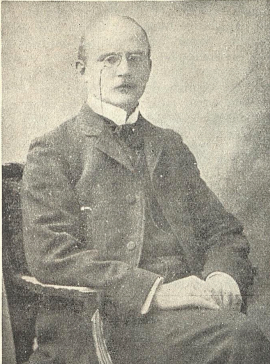
DR. WILHELM MANN
Rector of the Liceo de Aplicación, attached to the Instituto Pedagógico. We should all recognize Dr. Mann as an eminent figure in education and the sciences.
After five months, issues were frequently selling out, leading the publisher to ask readers to subscribe for six months or a year in order to guarantee their copies. Sales statistics from the period are not known, but the weekly itself referred to its commercial success—an assertion that Emilio Vaisse later called into question. El Peneca no. 70 (March 21, 1910) announced: “complete sets are no longer available; individual issues are sold, except for nos. 1, 12, 14, 25, 26, 43, 44, 47, 50, 51, and 60, which are sold out.”
El Peneca was conceived as a publication that wanted to “listen to its readers” and that handed a measure of editorial power to children. It did not call them “consumers” or “subscribers”; it called them “supporters.” Readers were invited to do the work of an editor: to think about structure and about the balance between text and image. It was, in effect, a collective editorial workshop. The questions put to readers included: “Which sections do you like best?” “Are you interested in stories, verse, philately, music, caricatures, history, drawing, science, the arts, games of wit?” And above all, it asked: what did they want to read?
" The El Peneca Mail Section
¡"In the next (próoximo) issue, a big surprise!
An invitation to our readers
EL PENECA, which wishes to please its readers as much as possible, invites them to propose, by letter, a program of their liking for the publication, distributing across the 16 pages the literary material and articles they consider of interest.
We want, in this way, to know even better the taste of our supporters in order to satisfy, above all, the desire of the majority.
Which sections do you like most? Are you interested in stories, verses, stamp collecting, music, cartoons, history, drawing, sciences, arts, puzzles? Would you like many pages of contributions to be published? Should the serials be short or long? What new sections should be opened? Such are the problems that, in a table of contents, our readers must solve.
Let us propose, then, a program that includes the sections the publication currently has, determines new ones, and indicates whether the sections should be permanent or published once or more times a month.
For greater clarity, they may form the table of contents page by page, calculating the length of the articles and the size of the engravings.
We believe that in this way we will realize, at least in part, the ideal of our readers. We want, then, to know if they are happy with EL PENECA or how they would be happy with it.
Communications should be addressed to the Director of EL PENECA, Santiago. Teatinos 666.
Our thanks in advance."
EL PENECA, no. 24, May 3, 1909.
French and English served as bridges to other cultures. Chilean children learned that the world was vast and that they could explore it through the weekly. Knowledge meant building, creating, experimenting, making mistakes, and trying again. The magazine fed children's natural curiosity. History was presented as a tapestry of exemplary lives. National heroes were people who had faced hardship, fought for ideals, and helped found Chile.
Enrique Blanchard-Chessi saw children as the seeds of a freer, more creative, and more just society. He was an innovator, but he did not challenge the status quo of the Chilean elite or question the political system of his day. His formative project therefore operated within the boundaries of the society in which he lived.
Enrique Blanchard-Chessi's farewell address in issue no. 115, dated January 30, 1911, emphasized his role as an educational guide in keeping with “religious moralism.” He insisted on goodness as the path to happiness and warned against vices such as gambling and alcohol. From childhood onward, he sought to instill a “firm energy” capable of resisting destructive behavior. One of the values that mattered most to him was goodness: “I wanted you to be good.”
He acknowledged with regret that limitations of space and time had prevented him from including every young talent, and he spoke movingly of the charitable campaigns led by children, especially during Chile's Centennial in 1910. He promoted Chilean history as an essential part of education, cultivating a sense of national identity. Comparing himself to a “setting sun” withdrawing from the sky, he asked that some of his light remain in readers' memories. He assured them that the magazine was being left “in good hands,” underscoring the strength of the project that had been created. More than a farewell, the speech was an editorial testament that expressed his conviction that the children's press should entertain, but also form conscious and compassionate citizens:
"Farewell from the Director of 'El Peneca' (1908-1911)
Don Enrique Blanchard-Chessi
Santiago de Chile, January 27, 1911
I wanted you to have an enjoyable and useful publication, and 'El Peneca' earned your most spontaneous sympathy. I was thus its Director, from its founding until today, and I was able to understand how much the innocent and spontaneous affection of children is worth: the most sincere.
I wanted you to be good because I know that only by being good can one be happy, in spite of all the sorrows and setbacks of life, and I tried to advise you, with my heart in my hand, so that you would always tend toward the good. I made you see the consequences of bad inclinations and I called your attention, with all my soul, to the intense ills, the irremediable misfortunes produced by gambling, drinking, and all vices in general, so that you would become accustomed to avoiding them, from childhood, with firm energy and determined will.
I advised you, then, as best I could.
I also wanted you to work on the publication yourselves, so that you would have a living, pleasant stimulus, and it was you, under my constant direction, who made, one could say, each one of the issues of 'El Peneca.'
I do regret not having been able to encourage all of you: the space of the publication and time have prevented me. My longing was to gradually make known all the youthful intelligences that came to me, but many, oh so many efforts have unfortunately remained in oblivion, waiting for their turn that never came.
I wanted, moreover, for you to feel the greatest of satisfactions, that of doing good, and with your generosity, so noble, in helping me, we carried out—happy moment of my life!—an act of charity that became an example. How many poor little children were we able to give some joy to, scant, it is true, during the Centennial of our Homeland!
I wanted, further, for you to always have a sincere, intense affection for our Chile, and I tried to make its beautiful history known to you.
I wanted much more: but the end of the journey has taken me by surprise.
I leave you: but do not be discouraged, 'El Peneca' remains in good hands. It has only come too late for me.
Not all die when the sun dies. And if I was for you like a dawn sun, I will now be only like a setting sun, which withdraws slowly and wraps itself in a thin cloak of sadness…
But if some glimmer of the light of my reflections has remained in your hearts, do not forget me, and be certain that I too, dearest readers and collaborators, will always remember you with affection."
Enrique BLANCHARD-CHESSI.
EL PENECA, no. 115, January 30, 1911.
With these moving words, Enrique Blanchard-Chessi said goodbye to his “penecas”. Editorial Zig-Zag had already chosen his successor: an unexpected figure for a children's magazine, but one well known in intellectual circles and already mentioned in issue no. 2, where his praise for the weekly's first issue in the pages of El Mercurio had been noted. He was a French priest, a militant monarchist, and an El Mercurio columnist: Emilio Vaisse.
Blanchard-Chessi's departure did not represent a break but an evolution. If the founder had been the architect of a reading community built on affection and participation, Vaisse would become the rigorous pedagogue who refined the character of that community. Where one had taught goodness as the road to happiness, the other would demand it as a moral duty. Both shared the same faith in El Peneca as an instrument for civic formation.
Emilio Vaisse: The Monarchist Priest at the Helm of a Children's Weekly.
Emilio Vaisse (1860-1935) edited the weekly from issue no. 116 (February 6, 1911) through issue no. 637 (January 31, 1921). His arrival was announced as follows:
"New direction of 'El Peneca'
From the next issue, the following will take charge of this magazine: in the literary section, Mr. Emilio Vaisse, whose pseudonym OMER EMETH is well known to the public, and in the artistic section, Mr. Julio Bozo, a distinguished illustrator who signs with the pseudonym MOUSTACHE."
THE ZIG-ZAG COMPANY.
Vaisse was a singular man: a French priest, monarchist, and critic of modern democracy. Born in Languedoc in 1860, he arrived in Chile as a missionary in 1886. His first posting was San Pedro de Atacama, where he combined pastoral work with teaching. He was also a columnist for El Mercurio, a secondary-school teacher, and a lecturer at the Catholic University. He died in Santiago in 1935. His thinking was influenced by the Action Française movement He criticized universal suffrage and the French Republic, blaming them for “calamities” such as rationalism and liberalism. He defended traditional order and religion as pillars of society. His pseudonym “Omer Emeth” (from Hebrew, “Bearer of Truth”) reflected his understanding of truth as moral dogma. For Vaisse, democracy was not an ideal form of government, and he openly declared himself anti-democratic, stating:
" The ills of this century are due to the French Republic, to democracy, to universal suffrage with all its train of free examination, rationalism, and other calamities.”.
Yet within El Peneca he knew how to adapt. During his tenure he introduced Catholic values through stories with lessons about charity, honesty, and love of country, while still respecting the magazine's plural character. His moral emphasis did not diminish its popularity; on the contrary, it consolidated it. Although he personally rejected democracy, he directed a publication that encouraged children's participation as part of a process of civic formation. He adopted modernizing tendencies and shifted the magazine toward the everyday and the practical: “The evils of this century are due to the French Republic, to democracy, to universal suffrage and all its train of free inquiry, rationalism, and other calamities.” Written in another context, this statement was never explicitly transferred into El Peneca, where a constructive, educational tone prevailed. “Omer Emeth” was an unusual editor for a children's publication: a monarchist priest in a republic, a critic of modernity at the head of an innovative weekly. He knew how to adapt his convictions to an already established cultural project.
On February 6, 1911, Vaisse added the “Contents” section, a detailed index on the first page. Maintained until 1913, it reflected his interest in bringing order and transparency to the magazine by laying out the contents of each issue:
"SUMMARY:
To Our Readers – A Tiny 'Blériot'
an Airplane for Children – Niagara at Home – The Lion and the Macaque, a fable by Don Belisario Guzmán Campos – The Intelligence of Animals, Rats...Rats – A Natural History Lesson (contribution) – Little Segundo the Useless (caricature) – The Cruelty of Von Tinaja (caricature) – Three Longings (poetry) – Little Lord Fauntleroy (serial) – Stamp-Collecting Page – Silent Story (Chinese caricature)."
EL PENECA, no. 116, February 6, 1911.
Vaisse established clear rules for collaborators. Not everything they sent was published. He demanded quality and originality. On one occasion, he responded firmly to a young man who complained about the non-publication of his writings: "A young man from Valparaíso (we will not name him so as not to leave a lasting testimony of his petulance) asks us to account (in a threatening tone) for the non-publication 'of his verses, stories, charades,' etc., etc. What early fecundity and what cheek!"
"We will not name him so as not to leave a lasting testimony of his petulance": in this decision there was a gesture of mercy—not exposing the child to public ridicule—but also an implicit lesson: his attitude exemplified what one should not do. He asked them to sign with their first and last names, to indicate their age and grade. He wanted to evaluate justly and also to protect children from vanity:
"EDITORIAL
A young man from Valparaíso (we will not name him so as not to leave a lasting testimony of his petulance) asks us to account (in a threatening tone) for the non-publication 'of his verses, stories, charades,' etc., etc. What early fecundity and what cheek!
Let it be said, then, once and for all: we will publish only that which deserves to be published, and we reserve the prior right to correct, cut, abridge, and even... to suppress.
El Peneca's purpose is to foster the instruction and education of its readers. It is its duty, therefore, to examine very closely the writings that, as the first fruits of their talent, its collaborators send to it. Thus the publication of those writings, while instructive and educational for all, will favor talent, and not simply the vanity of their authors.
P.S.: We ask each of our collaborators to sign their communications with their first and last names (A pseudonym is not enough if it is not accompanied by the true signature). To this must be added: the author's age, the grade or year of studies. With this data we will be able to better appreciate the contributions and to communicate by letter with our collaborators, if necessary."
EL PENECA, no. 117, February 13, 1911.
The director observed in the writings a lack of drafts and correction. He sought to instill discipline and intellectual humility. He used the affectionate "My little Penequitas" to soften criticism. He mentioned Blaise Pascal and Jacques Bénigne Bossuet (giants of French thought and prose in the 17th century). If they, being geniuses, "erased nine times" out of every ten words, how could children not make drafts? He contrasted the wisdom of the old writer (who has "thought, read, and written so much") with childish inexperience. The moral was that good writing was not the fruit of sudden inspiration, but of craft and work. His final phrase was an ordinance ("they will correct their writings ten times"), but said with the firmness of a teacher who knew that, by making them work harder, he was helping them fly higher:
"DRAFTS?
PART of my task (and not the least interesting) is that which consists of reading not only the letters that the young readers of 'El Peneca' send me but also the articles that, like the tail of a kite, usually accompany them. Curious and instructive reading is this, since, so to speak, it opens for my personal use a window where I look, as from a box seat, at the tiny dramas and little comedies of childish vanity and self-love.
I propose, dear readers, to tell you at least part of what I am seeing every day in those theaters that are the souls of children.
My first observation: the children (and especially the girls) who write for 'El Peneca' do not deign to make drafts. Is it possible?... I know old writers who never send a newspaper a totally improvised piece of work. They could, without much presumption, risk improvising, giving free rein to their imagination and their pen. They are so old; they know their craft, they have observed, they have thought, they have read and written so much!... But they do not improvise. If you saw, my little Penequitas, the manuscripts of Pascal and Bossuet in the National Library of Paris, what a good lesson in modesty you would receive, oh, improvising children and..... improvised writers! Those great men would write ten words and sometimes erase nine, when they did not drown in ink the entire line just written...
Tell me, then: is it natural that you should want, in one single stroke, without study, without reflection, without any correction, to write well, to write things worthy of appearing in print?
No! It is not natural... Only an inflated and sickly vanity, or perhaps lack of experience, makes you dare so much.
Conclusion: from now on our Penequita collaborators will correct their writings ten times before sending them to this, their most affectionate servant."
OMER EMETH.
EL PENECA, no. 119, February 27, 1911.
Blanchard-Chessi had created the “National Gallery,” with profiles of major Chilean figures. Vaisse replaced it with the “Chats,” which took a more everyday and spiritual approach. These columns addressed education, behavior, and current affairs. They were written by Vaisse and his assistant Benjamín Oviedo under the pseudonym “Magister.” Later, other young writers joined them.
In one of his “Chats,” Oviedo wrote about discouragement and the coldness of the heart. He did not deny the world's pain, but he rejected surrender. He ended with an appeal to keep the fire of dreams alive:
„TALKS
THE COLD
Beneath the stern face of space, it extends its formidable empire among the shadows and the mists. Like a pale ghost, it hovers over nature, numbed and sad. It shakes its wings of snow, and at its conjuring, everything is suddenly paralyzed; even life seems to feel overwhelmed.Winter is but one of the phases of this specter; but one of the most horrifying. Cold is the cruelest of the powers of the elements.Do you not feel how all your limbs freeze? Do you not feel how your blood freezes in your veins? Do you not feel how your will freezes, and you remain paralyzed? Do you not feel how life escapes you slowly, without your being able to stop it, with your will dead? And do you not feel the horrifying icy kiss of death that touches you and wraps you in a shroud of cold, in which you will remain a prisoner forever?
Death is Cold.
Fear is Cold.
Pain is Cold!...
Yes, Pain is cold, but the most horrifying and the most terrible of all colds: that of the heart.
Pity those whose hearts have already felt the kiss of the specter's icy lips.
In the wasteland of those spirits, the Roses of Dreaming will never bloom again; nor will the green Fronds of Hope return to life.
Breath of Death, Cold passes leaving behind it desolation and death; and one hears only the sounds of dreams collapsing, amid the black cataclysms of the spirit.
The cold of the heart is anticipated death. It is the murderous daughter that will kill enthusiasm before killing the body. It is the eternal night of distrust and skepticism hovering over the flowering countryside of youth.
Sursum corda!
Lift up your heart; do not let yourselves be wrapped in the shroud of doubt and pain; let your limbs twist with cold, but may the fire of dreaming that lives in the depths of souls never be extinguished."
MAGISTER.
EL PENECA, no. 294, July 6, 1914.
Oviedo explored school nostalgia. He compared the school to a beehive where bees make honey in community. Adult life, by contrast, was dispersion and solitude. The message was clear: school is a protective rehearsal; life, a challenge:
"TALKS
THE BEEHIVES
With the fresh breezes that March brings us, the doors of the schools are about to open. And the whole noisy swarm of boys and girls will once again populate the silent precincts of those beehives, where they, bees that have sipped from the flowers, will elaborate there the honey to nourish their own souls.
Confused among the passersby, I contemplate that parade that swarms through the streets at the hour when schools let out. How distant are those days when I too went there, among those chattering schoolchildren, with my books under my arm and discussing the kindness or harshness of this or that teacher!
No holiday was awaited by me with more longing than the opening of classes. A sudden joy stirred my spirit, and after the vacation days, I returned to the classrooms with a beating heart and full of curiosity...
I was going to find out what new classmates I would have; I was going to find out what new friends I could count on in my schoolboy excitements. And almost always I was satisfied: alongside the faces already known from previous years, which had for me an affectionate smile, I saw faces whose eyes looked at me with deep curiosity, as I looked at them.
Then came those days of intimacy, in which we all felt united by a common duty and by equal tasks. A noble desire to stand out stimulated us, and that was a powerful incentive for our studies.
Those days of ingenuous jubilation and simple joys have passed. The whirlwind of life has scattered us like autumn leaves, and some have gone one way and others another...
Now how different our friendships are!
We are no longer the bees that calmly elaborate the honey that is to nourish us; we no longer work in the tranquil beehives, under the paternal vigilance of the teachers. Trusting today in ourselves, with no guide but our own judgment, we follow the path, almost alone...
Happy are you, bees that sip from the flowers to elaborate the honey that is to nourish you! May it be that when you leave your beehives you have strong wings, a heart swollen with the honey you elaborated; and may you never be obliged to use your sting!..."
MAGISTER.
EL PENECA, no. 433, March 5, 1917.
The collaborator "Equis" valued sincere emotion and the spontaneity of feeling, for he considered that the language of the heart possessed a unique nobility. Themes such as gratitude, humility, purifying pain, and admiration for noble souls had for him a formative value. In his text, he experimented with an internal dialogue between his timid voice and his determined voice, with the latter finally prevailing to claim the right to express love and recognition without fear of imperfection. For "Equis," the sincerity of the heart was worth more than any empty rhetoric:
"TALKS
GRATITUDE
—Yes, my dear little heart... I am greatly afflicted by my impotence to externalize your noble feelings; an impotence that makes me deserving of your reproaches which, despite being loving, make me shed so many tears...
Do not regret the tears, for each one of them erases a stain. Yes... pain purifies... ennobles and sublimates souls... and their souls are like that... great, noble, and pure, and the sublime radiates, and its beneficent lights reach even the dark abyss in which we humble hearts lie; and they make us vibrate with gratitude and love toward them... and at the fire produced by these feelings, our timidity melts, and we burn with the desire to say to them: 'Thank you, a thousand thanks we owe you, noble hearts who from your height descend to your most humble companions, to make us feel sweet and holy emotions.' Yes, they are holy emotions because they console, and correct, and because they are born of souls purified in the sublime crucible of pain... and you forbid me to manifest this gratitude...
—No, beloved little heart, I do not forbid it, but in what form will you tell them what you feel? In a style naked of riches and rich in poverty?
—The form in which I present my feelings to them matters nothing to them, who seek only sincerity; and the words, when they come from me, are always heard by them. Truth and love are beautiful for the very reason that they are simple... and they love and are true... and that is why the magazine in which they print their ideas is so beloved by you, because I have taught you to love what is good... But your cowardice no longer matters to me... we hearts too have our language and we communicate, even though an abyss separates us. From my poor asylum I will tell them of the greatness and the truth of the gratitude and love I feel for all those who spread the aroma of their soul on the beloved pages of 'El Peneca'... And they will hear me; and I... I will remain grateful and satisfied."
EQUIS.
EL PENECA, no. 555, July 7, 1919.
The "Gallery of the Penecas" remained. In it were published photos and portraits of children and families from various social strata, including newspaper vendors and workers. They exhibited photographs of their young readers, penecas of all ages. Through urban and rural scenes, shops and homes, images of cities, countryside, parks, avenues, and homely places, the magazine showed a diverse Chile.
Between 1911 and 1921, the "Literary Contest" section contained stories, fables, and chronicles with a moral, which were usually accompanied by illustrations by Chilean and foreign artists. A transition was represented by shorter and more practical writings, and by a notably greater child participation, which were evaluated by the editorial staff and, ultimately, by director Emilio Vaisse.
Contributions increased considerably, coming to occupy two full pages. The "Miscellany" section gathered varied topics, written mostly by children, such as current news, opinions, and essays.
Contests were held for "charades, “numerical logogriphs”, “anagrams”, and "riddles," and "anagrams," while "pastimes" published the solutions and named the winning penecas as "solvers."
In this same stage, illustrated stories and comics acquired great relevance, created mainly by national cartoonists. It was a period of formation for a great wave of artists who, later, would make an impact on Chilean magazines. The Zig-Zag publishing house managed in the early years to gather, under contract or by commission, some of the best journalists, writers, illustrators, and intellectuals in the country.
Among the collaborators, the figure of Ramón Arminio Laval Alvial stood out, a Chilean folklorist and intellectual, who contributed numerous stories and fables, whether of his own authorship or compilations.
Synthesis.
The period between 1908 and 1921 laid the foundations of El Peneca. It established a structure of solid and well-defined sections, which would remain practically unchanged until its closure. The publishing house reconciled its educational purpose, expressed in the three most important phases of children's literature—to educate, to form, and to entertain—while maintaining above all its commercial nature. In this balance, the magazine planted the roots of a citizenry united by patriotism, forging from childhood a sense of belonging to a common nation. Along these lines, it combined stories with explicit morals, medieval and exotic settings, and a modernist aesthetic, fusing pedagogical traditions of the 18th–19th centuries with the commercial language of the turn of the century. To understand its impact, it is necessary to look closely at its fundamental components: the covers, the children's contributions, the entertainment sections, the social life it generated around its contests and its mail, as well as the comics and literature it published throughout its more than five decades of existence.
2.1.1. Covers, Illustrators and Photographers.
The cover was the magazine's calling card, the first visual bond it established with the reader. To achieve this, Blanchard-Chessi and Vaisse assembled a varied team of artists, painters, photographers, illustrators, and cartoonists whose work connected with children and stimulated their imagination. The covers became a constantly evolving canvas, where illustrations and photographic portraits were combined with changing logos and typography. At times, works by well-known Chilean and foreign painters were reproduced even when they had no direct connection to the contents, published simply for their beauty and thus bringing art closer to children.
Most illustrations and photographs, however, were unsigned. Anonymity was the rule. Photographers in particular remained in the shadows while the children they portrayed became minor celebrities. This reinforced the idea that the weekly centered the reader and the community rather than its creators.
Masters of the Masthead and the Evolution of the Logo.
The first image of the header was designed by José Foradori, who modified it according to the various didactic proposals. In the first stage, it included simple and playful penecas; one of them wore a torn sock, with his big toe sticking out. Later, Foradori replaced the initial three children with a circle of penecas around the word Peneca, including a serene baby that conveyed tranquility. "Pepin" illustrated the header of the "Contributions" section with a moon, where a little one illustrated the moon's face in white colors. Emilio Álvarez, for his part, drew a header set in a classroom, evoking education and formation.
The header was also illustrated by various artists and illustrators (some of them anonymous or using pseudonyms), such as Julio Bozo, Víctor Orellana, F. González, and an artist who signed with the capital letters R. H. On many occasions, the cover only needed the box with the word El Peneca; the illustrations, photographs, and reproductions of works of art were an artistic exhibition that drew attention on their own.
Special editions, such as those for National Holidays and May 21, were particularly elaborate and constituted formative artifacts, in which innovative design, patriotic symbolism, and national spirit emerged. An example of this was the cover of September 13, 1909 (issue 43), where the coat of arms of Chile was printed, unfurling as a national and cultural emblem. The Chilean coat of arms bore a tricolor field (white, blue, and red) with a silver star (white in this case) at the center. Flanked by a huemul and a condor, adorned at the center with tricolor feathers that recalled the presidential hats.
For Christmas, in issue 58 of December 27, 1909, it presented a little musician playing the double bass, reflecting the festive and Christmas spirit of the time:
"Beardless Artist
At the tender age when ideas
reveal themselves late, slow, and confused,
the boy already knows the semi-quavers
and all the science of the semi-fusas."
Chilean and Foreign Illustrators: From Academic Draftsmanship to the Avant-Garde.
José Foradori managed to make children see themselves on the covers. In issue 16 (March 8, 1909), he portrayed children playing on a beach, with the sea and sky merged in blue.
The cover of the first anniversary (issue 53, November 22, 1909) was a synthesis of a family, titled "Birthday." The scene, in violet tones, distributed the roles with precision: the child at the center, as childhood in formation; the father, dressed in black, leaning toward his son, as authority and provider; the affectionate mother and the grandmother, as family tradition.
In issue 105 (November 21, 1910), an illustration signed by "Pepín" appeared: the mischievous "Chambeco" (a character created by Emilio Álvarez), surrounded by children in a circle that immersed readers in a world of fantasy and movement.
The cover of issue 284 (April 27, 1914), "At the Biograph," presented a meticulous illustration probably created by José Foradori, done in black and white, showing the portrait of an elegant grandfather with his grandchildren, dressed in formal attire, as they attended a show at the theater.
Raúl Figueroa Ruiz
(1886-1948) was an illustrator for Editorial Zig-Zag who worked under the pseudonym “Chao.” In issue no. 15 (March 1, 1909), using three colors, he depicted an elderly gentleman seated on a bench in Santiago's Plaza de Armas, a traditional meeting place for the city's residents:
"THE FOUNTAIN OF CASTALIA
In the midst of life and its hardships,
when many springs have already been counted,
in its pages full of brilliance
EL PENECA will offer its readers
a world of youthful memories.
Sketches taken from life in the Plaza de Armas,
by Chao.
"He stood out for combining refined humor with visual storytelling. The satirical portrait in issue no. 3 (December 7, 1908), accompanied by his own rhymes, demonstrated his double talent as illustrator and writer. Figueroa Ruiz had an expressive line capable of capturing the duality of human nature, portraying the human condition somewhere between irony and tenderness. A clear example was the caricature devoted to “Don Samuel A. Lillo, Inspector General of the University.” Figueroa Ruiz defined the art of caricature in these words:
"Don SAMUEL A. LILLO
Inspector General of the University
"Caricature is a portrait with exaggerations. It is a joke like any other. When it is done with wit, or rather with talent, without annoying the person to whom it refers, and it is presented well, with characteristics that make it stand out, it deserves acceptance and, consequently, is worthy of applause."
Emilio Álvarez (1891-1959), known by the pseudonym “EA/Pun TT,” was a multifaceted artist who excelled in graphic storytelling. Under the heading “FOR A LAUGH,” his “Story Without a Punch Line” in issue no. 25 (May 10, 1909) innovated through visual metaphor combined with absurd humor, depicting a father with his three sons. Beneath the drawing appeared dialogue in Spanish imitating a foreigner's speech: “Me have three sons,” said a German, “and all be very good: Juan no drink; Otto no smoke; and Pedro… Nolasco.”
The exhibition held in an El Mercurio gallery in 1915 was an exceptional recognition. “Magister” (Benjamín Oviedo) discussed Álvarez's painting Los trasnochados, praising its “powerful intensity” and affirming the artist's “refined spirit”:
“EXHIBITION OF EMILIO ÁLVAREZ
A few days ago, an exhibition of various drawings opened in one of the halls of El Mercurio, done by the expert hand of our well-known illustrator Emilio Álvarez. The material that makes up the exhibition can be divided into three groups, consisting respectively of Portraits, Caricatures, and Pictures. Among the first, the admirable portraits of the sculptor Canut de Bon and of little Lattanzi stand out, true models of exactness and precision.
Among the caricatured figures, there are several who are quite well known in our intellectual world, such as Messrs. Popelaire and Latorre.
And finally, among the pictures, the one that draws attention for its powerful intensity is that of the 'Night Owls,' in which Álvarez has left much of his sentimental soul and his refined spirit.
Among the phalanx of young artists, the figure of Emilio Álvarez has stood out with marked relief, and his drawings, wherever they are seen, immediately evoke their author, for they bear within themselves a characteristic stamp of energetic originality.
And since, despite all the obstacles inherent to the path, this young artist continues to struggle, we do not doubt that he will finally reach that summit of perfection that every artist longs for and that we wish for him with sincere affection."
MAGISTER.
EL PENECA, no. 362, October 25, 1915.
He drew the caricature “Don Fernando Álvarez Sotomayor” for issue no. 45 (September 27, 1909), sharply capturing the Spanish painter during his years in Chile and honoring him with a verse: “From the warmth of his talent, the works of his brushes have won the fairest laurels for the painter Álvarez Sotomayor.”
His graphic work offered young readers an educated yet accessible perspective through caricatures such as “Doctor Mann” in issue no. 50 (November 1, 1909), identified as “Professor of Experimental Psychology at the Instituto Pedagógico.”
Luis Fernando Rojas (Casablanca, 1857-1942) (Casablanca, 1857–1942) was a Chilean illustrator, lithographer, and caricaturist of the early 20th century. Recognized for his talent since childhood, he trained at the Instituto Nacional and later at the School of Fine Arts in Santiago. Despite the magnitude and influence of his work, his legacy faced a perplexing paradox. Until 2014, an important part of his creations had remained in anonymity, diluted in the vast ocean of periodical publications such as the magazines Zig Zag, El Peneca, La Época, and Sucesos.
His works appeared on the pages of newspapers and magazines of his time, but his name did not manage to cross over with the same force into the graphic history of Chile. This has been especially unusual considering his direct participation in the documentation of the national conflict that was the War of the Pacific. Aware of this risk, as early as 1911, Enrique Blanchard-Chessi attempted to rescue him from oblivion through an article that reviewed his career as a correspondent in the confrontation between Chile and Peru and Bolivia. He not only praised him but claimed for him a place in the memory of Chileans. This early attempt at recognition underscored the contradiction that defined his figure: an artist massively seen in his time and, at the same time, a ghost in official historiography.
He illustrated under the pseudonyms "LFR" and "Marius." An example is the center page of issue 22 (April 18, 1909), where he portrayed the execution of the Carrera brothers. At the foot of the image could be read: "Luis said to his brother Juan José: Remember that we are Chilean soldiers and that we must die as such…"
Along with the texts of "Cabo Moya,", he also created the series "The Adventures of Sánchez." The melancholic premonition that Blanchard-Chessi captured in the pages of El Peneca in 1911, lamenting the artist's unjust oblivion and fearing that his decline would end in poverty, was tragically fulfilled three decades later. In 1942, Luis Fernando Rojas met his death in the most absolute abandonment by the institutions. The only and posthumous recognition, exceptional and symbolic, consisted of receiving burial in the Museum of the Veterans of '79, a privilege reserved exclusively for military men, then conferred on only one civilian in merit of his work as a correspondent of the military feat:
"NATIONAL GALLERY
The Illustrator Rojas
He is too tall to be a Chilean artist.
And yet, he was born an artist, and unfortunately, he has had to live from art.
On his face there is always a bitter smile that, without being ironic, is the most exact expression of continual resignation...
He does not look fifty years old, with his gallant youthful body, despite the gray hairs that stand out in his mustache; but, in truth, he has already lived half a century, and well lost for him.
He should have been much and has been little, in comparison with what he is. He revealed himself as an artist surprisingly, and his life continues to be a surprise, amid the selfish struggle of the moderns... And from his birth to the present he has always been the same.
One night, many years ago, in 1875, he demonstrated with a single effort what he promised to be. He was visiting as a child at the house of Don Carlos Wood, and there, almost in a corner, sitting modestly, he listened silently to his mother's conversation with the owner of the house.
At that moment Don Máximo Cubillos arrived, a young journalist who, on the occasion of the International Exposition being held in Santiago, had just founded an interesting magazine with the title "Correo de la Exposición."
He came desperate. He had searched everywhere for an artist, a lithographic draughtsman, to be able to publish some pencil engravings in his magazine, and he had not achieved his goal.
—In Santiago there is not a single draughtsman who can get me out of this fix, he said. I don't know what to do...
The boy Rojas (he was 17 years old, L.C.) listened anxiously, with true interest, to these words. Little by little he drew closer to the group, and at last he summoned the courage to speak to Mr. Cubillos and said to him:
—Sir, I believe I could do what you wish...
—You?
—Yes, sir.
—You know how to draw, then? Do you know how to work on stone?
—Yes, sir, answered the beardless artist, stammering, with true shyness.
—Good, man, good; we will do a test, replied Cubillos with distrust, but encouraged by hope at the boy's determination. Tomorrow, he added, I will give you a job.
The next day very early, Cubillos arrived in a carriage at Rojas's house and handed him a statuette by Bargaghi, 'The First Friend,' and left him the address so that he could bring him a lithographic proof of the drawing...
Great was Rojas's predicament then, for in truth he did not know how to draw on stone.
He knew a lithographer, Mr. Saling, and he went to see him.
—Could you do me a service by giving me some instructions for drawing on stone?
—With great pleasure, Saling answered. Are you going to draw on stone?
—Yes, sir…
After several attempts, Rojas, full of joy, was able to understand that he was accomplishing the task at hand, and soon, like a madman with delight, having managed to handle the lithographic pencils, he arrived before the good lithographer, who immediately approved the work.
—Let's pull a proof, Mr. Saling said to him, smiling, and he took a damp sponge to pass over the drawing.
—For God's sake, sir! What are you going to do? You're going to erase my drawing...
—Oh! Don't worry, he answered. This is how it's done.
Shortly after, good Mr. Saling handed him a magnificent proof made with lithographic ink.
Rojas, without knowing how, ran out into the street and took it to Mr. Cubillos.
He, with tears in his eyes, embraced him affectionately and gave him all the work for the 'Correo de la Exposición.'
Thus Don Luis Fernando Rojas began his career as an artist. He was, for many years, the only artistic illustrator in Chile. There is no historical or art work from years past in Chile that has not been illustrated by him. Unfortunately, he has lived from art and has not been able to devote himself, as he deserved, exclusively to its worship.
Thus, Chile has lost the best of its artists.
The necessities of life, one could say, snatched away part of his talent."
E. B-CH.
EL PENECA, no. 113, January 16, 1911.
Julio Bozo Valenzuela (Pailimo, Chile, 1879-1942) was a Chilean illustrator known for the distinctive mustache that inspired his artistic name, “Moustache.” Bozo Valenzuela was appointed artistic director of the weekly alongside Emilio Vaisse. He developed a distinguished career in El Peneca and the magazine Zig-Zag during the opening decades of the 20th century. Issue no. 130 (May 15, 1911) published three of his illustrations: one formed the masthead for “Chats,” another accompanied “The Lion,” a Brahmanic tale, and the third illustrated “The Bishop's Beard.” He retired in the 1920s, leaving an important legacy.
Manuel Guerra Urquieta, known as “MaxX” (1878-1941), was a pioneer of comics and graphic storytelling in Chile. One of his innovations was the use of rectangular panels to organize narrative sequences, breaking with the tradition of isolated illustrations or more regular frames. The technique anticipated the language of the modern comic:
"TALKS
A New History of Chile
Dear reader: contemplating these images, your eyes will delight, your mind will be illuminated, and your heart will be kindled with love for Chile.
We ourselves will delight more than anyone at finally seeing fulfilled a desire that we had been cherishing for a long time and that, only for lack of an artist, had not been fulfilled in previous years.
Mr. Manuel Guerra (Max), whose artistic gifts are known to all, has taken charge of preparing the graphic portion of this history, which is, of course, a guarantee of success.
OMER EMETH.
El Peneca, issue 454, July 30, 1917.
Galvarino Lee "Bonsoir" (1879–1952), known for his graphic satire, created popular characters that humorously portrayed the Chilean idiosyncrasy. His work in El Peneca established archetypes of the national imagination. According to Jorge Délano: "He was the caricaturist of popular types; no one like him drew the 'pacos' and the 'maritornes' with such a Creole flavor."
Jorge Délano, under the pseudonym “Coke” (1895-1980), began his career at an early age in El Peneca and was hired by Editorial Zig-Zag, where he worked on a wide variety of publications. His enduring legacy was the founding, direction, editing, and illustration of his own political-satire magazine, Topaze. In 1964 he received Chile's National Journalism Prize.
In a 1914 issue, a former classmate from the Instituto Nacional recalled the student life of this charismatic artist:
"CONTRIBUTION
THE EXHIBITION OF COKE'S CARICATURES
Last Wednesday, Coke closed the beautiful exhibition of pictures that for several days had been the obligatory topic of the newspaper columns and of social gatherings.
The cultured public that invaded the halls of "El Mercurio" laughed sincerely at the ingenious caricatures and had for the young author affectionate smiles and handshakes.
We strolled through the hall evoking old things. Ah, those days when we were classmates at the Instituto! Coke smiled at the memory. He was the one who brought joy to the classrooms."
EL PENECA, no. 350, August 2, 1915.
Juan Francisco González Ramírez “Huelen” (1894-1976) inherited the pictorial legacy of his father, one of Chile's “four masters,” and combined academic rigor with the freshness of popular illustration in his caricatures. “Huelen” studied at the School of Arts and Crafts. From a young age he worked as an illustrator for several magazines, including El Peneca. “Other illustrators joined [El Peneca], such as Juan Francisco Ramírez (Huelen), son of the renowned painter of the same name, illustrating the opening pages and caricatures.”
Pedro Subercaseaux, under the pseudonym “Lustig” (German for “funny”) (1880-1956), studied at the Academy of Arts in Berlin and became one of Chile's most prominent classical painters. He pursued a dual career between academic art and popular graphics, distinguishing himself as both illustrator and cartoonist. He worked with Editorial Zig-Zag, where in 1906 he created the famous “Federico Von Pilsener”. In issue no. 96 (September 19, 1910), beneath an illustration copied by “L. Paper”, the character spoke in comic Spanish mimicking a German accent: “Von Pilsener: Me like very much read El Peneca because have little pictures and I too once was little peneca.” The character was accompanied by his dog, named “Dudelsackpfeifergeselle” (meaning an unmarried man who plays the bagpipes). Pedro Subercaseaux, creator of one of Chile's earliest comic strips, ended his life as an ordained Benedictine monk.
Walter Barbier (1880-1923) was an artist, illustrator, scriptwriter, and comics artist whose work had a vibrant style. Barbier developed a warm visual language combining realistic observation with touches of comedy, irony, and adventure. Although most of his contributions consisted of illustrations for serialized stories, issue no. 115 (January 30, 1911) featured his caricature of an intellectual: “English Institute, Mr. Webster E. Browning—graduate of Princeton University, United States.” The drawing emphasized a strongly defined profile and a use of light and shadow that reinforced the physiognomy of a man of learning.
Issue no. 269, dated January 12, 1914, devoted space to the artist Walter Barbier. The article legitimized his work by noting that he exhibited at El Mercurio and erased the boundary between “high” and “satirical” art, demonstrating that a single creator could master both registers:
"TALKS
Walter Barbier
W. Barbier: there is a signature very popular among us. What reader of 'El Peneca' does not know it and does not appreciate it?
W. Barbier parades through 'El Peneca' week after week the characters of a comedy that enchants children.
With good humor and mischief, the artist paints the Levacorta family, Cain, and Barrabás, Ñor Carmelo, the Miaucitos, and a hundred more whose life and miracles are known and celebrated by our readers and friends.
But just as W. Barbier knows how to draw for children, he also draws—and with mastery—for grown-ups.
Two exhibitions of his works prove it: one, which is called 'El Peneca,' the other which, recently, was inaugurated at 'El Mercurio.'
In the Exhibition Hall of 'El Mercurio,' our readers will find a collection of portraits (portraits-charges) that will awaken the most deserved admiration. From there the mastery of W. Barbier will emerge consecrated."
OMER EMETH.
The contributor Francisco A. Lira D. dedicated a sonnet to him, “Your Imagination,” describing his imagination as a divine, serene, and triumphant force:
"YOUR FANTASY
(For the eminent caricaturist and illustrator W. Barbier)
It has the charm and the celestial robes
of the blue lake and the calm sea;
it is the cherub of marble wings
who secretly dialogues with the soul.
Full of lucidity, filled with peace,
it goes from flower to flower like the breeze;
it nests in Olympian gardens
and divinizes the mystery of Art.
It is the white messenger of triumph
who, as a faithful and eternal companion,
is foretelling for you a fine hope
And with diligent and hurried flight,
through spaces of diamond light,
like incense it ascends to the sky."
FRANCISCO A. LIRA D.
EL PENECA, no. 334, April 12, 1915.
Rodolfo Lenz Danziger (Halle, Prussia, 1863 – Chile, 1938) was a German-born scholar who became a Chilean citizen, earned a doctorate in Philosophy, and was a linguist fluent in thirteen languages. He also ventured into folklore and the graphic arts and worked for both El Peneca and Zig-Zag.
Paul Dufresne (1866-1918) came to Chile from France in the late 19th century. He was an illustrator whose European style enriched the visual catalog of both Zig-Zag and El Peneca, serving as a cultural bridge between continents. The exact date of his arrival in Chile could not be established.
Carlos Zorzi, an Italian engraver, lithographer, painter, and illustrator, arrived in Chile in 1894. He contributed to El Peneca and other publications. There are no clear records of his date of birth or place of death. He developed a long career with the magazine Zig-Zag. His work was distinguished by vivid color, fine detail, and a narrative sensitivity that captured the imagination of the period through accomplished pictorial expression.
Apel·les Mestres (1854-1936), a distinguished Spanish artist and caricaturist, contributed to El Peneca from its very first issue, where he published the comic strip “Bitter Pleasure.” It told the story of a boy who imitates his father by smoking a cigarette and then suffers severe stomach pain. Beneath the four panels making up the strip, the editors included the following note:
"Note: These drawings are by the famous Spanish artist Apel·les Mestres. Little readers fond of drawing can admire on this page and others that we will give, the fineness and delicacy of the work. In this way they will be forming their artistic taste."
EL PENECA, no. 1, November 23, 1908.
Benjamin Rabier (1864-1939) was a French illustrator, caricaturist, and author known for his versatility and his contribution to illustrated comics. His work ranged from satirical drawings to anthropomorphic animal characters, making him an important figure in early-20th-century European popular culture. Issue no. 22 (April 18, 1909) featured “Things Toads Do,” a nearly wordless comic with only a caption beneath each panel, showing a group of toads making fun of a snake. The same issue included “How to Catch a Cat.” Later, in issue no. 130 (May 15, 1911), he published “A Visit in the Duck-Plane.”
The cover of issue no. 73 (April 11, 1910) reproduced a portrait signed by the German artist Franz Defregger (1835-1921). The black-and-white image showed a barefoot boy sitting with his pet in a workplace setting. He wore clothing close to rags and was portrayed in a humble domestic environment.
The August 14, 1911 issue (no. 143) featured a proud young shoemaker rendered in black and white with luminous tonal effects, in a work signed by Emilio Dupré. Dupré was an illustrator and painter active in the late 19th and early 20th centuries and associated with Chilean magazines and publishing houses. Some sources suggest that he may have been of French or Italian origin, or perhaps of French or Italian descent, but there is no confirmation. He contributed to El Peneca and worked for Zig-Zag, illustrating covers and advertisements.
At the same time, as already mentioned, the offices of the newspaper El Mercurio customarily included a room specially arranged for exhibitions. These cultural events did not go unnoticed by the magazine's contributors, who frequently wrote notices and chronicles about painters and artists connected with the publishing world:
“TALKS
IMPRESSIONS
(The painting exhibition of Mr. Alfredo Lobos)
Today I went for the second time to visit the painting exhibition of the young artist Mr. Alfredo Lobos, which is in one of the halls of 'El Mercurio,' and I have returned even more enchanted by that group of small canvases so fine and lovely...
I am neither a painter nor an artist, so I do not attempt to make a critique worthy of those paintings; I only want to convey the impression that this collection of little canvases left in me.
I confess that I have sensed in them much that is true; of nature well interpreted, for in each one I believed I recognized a familiar landscape, a cove seen before... or a pale seascape, calm and beautiful, like those I have contemplated so many times, and it seemed to me then that the author had transported to those canvases shreds of real nature, with its infinite charms... and I admire them, because they have life, because they leave the same impression that a true landscape or seascape gives us.
In my opinion, standing out among that collection of little works is 'The Pearl of the Hall,' as I call it, a night scene titled 'Nocturne' (No. 70), a serene night, so delicate and true, as I had never seen among the painted nights I know. It is a small canvas, but eloquent. It speaks to us of a solitary little street, with its houses lined up very solemn and sad... It is a blue and enchanting night, in which the air whispers melodies... and the shadows of the trees, reflected on the walls, resemble mourning muses. Oh...! I think that the artist, in stamping that night on the canvas... the genius of 'Art' illuminates his brain with the most powerful ray of talent...
I am sorry not to have eloquence with which to better express the impression that this collection of canvases so fine and lovely left in me; therefore it falls to me only to send its author sincere congratulations."
CELIA DÍAZ PALACIOS.
EL PENECA, no. 339, May 17, 1915.
Photographs, covers, and anonymous or pseudonymous illustrations.
A good portion of the covers and interior pages lacked any indication of authorship: some illustrations bore no signature, and photographs were never signed. The use of pseudonyms in illustrations was a common practice of the time. Under an "alias," these artists produced compositions for mass consumption in magazines, newspapers, and advertising, work that was often considered "minor" in its day. The pseudonym allowed them to inhabit both worlds: to protect their seriousness as studio artists while dedicating themselves to commercial illustration.
The cover of February 16, 1914 (issue 274) showed a photograph of happy children making faces, titled "Face-Making Contest." This image was a recurring practice in illustrated magazines between the late 19th and early 20th centuries. The term "visaje" referred to an exaggerated grimace of the face. The contest was an example of how the printed entertainment of the time explored the capture of spontaneity and humor present in everyday life.
It was common for covers to be printed with photographs of children from traditional Chilean families, such as Luisita Hucke Perín, Oscar Braun Menéndez, Julita Durán Bachler, and Raquelita Narváez Quinteros. They likewise showed children riding cows, portraying scenes typical of country life, such as "Playing Blind Man's Bluff," "Country Outing," and urban scenes (such as the one in issue 317, corresponding to December 14, 1914) of children playing marbles in the street, with the subtitle "Playing at Little Holes." The clothing, the urban environment, and the forms of recreation of the time were captured, while at the same time validating a playful tradition that endured for decades in public areas.
The images on the covers and interior pages alternated between two worlds: that of the elites and the children of high society, and that of the common people, with workers and their children in the countryside and the city. This duality was not contradictory and contributed to building a cohesive image of "Chileanness."
Later, the drawings adopted an impressionistic tone that sought to connect readers with the natural and the divine. Religious dates were announced through representations of the Virgin Mary and angels. Images of the child Jesus and of Christ were accompanied by the Virgin and the apostles. The cover of March 20, 1911 (issue 122), created by Emilio Dupré in black and white, titled "Motherly Love," depicted a woman watching over her sick child alongside her other child.
In issue 387, of April 17, 1916, a black-and-white portrait appeared of a young man dressed in a cassock, titled "An Initiate."
Issue 388, of April 24, 1916, included the painting titled "Marter (Mater) Dolorosa” (“Sorrowful Mother - suffering mother), which represented the Virgin Mary seated, carrying on her lap the crown of thorns of Jesus Christ.
In issue 437 (April 2, 1917), an anonymous portrait of the Virgin appeared under the same title. On this occasion, the figure was supported by two companions who, by their appearance, seemed to be saints as well.
The image in issue 391 (May 15, 1916), titled "The Eternal Sleep," showed a deceased baby. For the sensibility of the time, this type of representation constituted a vivid remembrance of the souls of the departed and functioned as a visual resource that helped families process grief.
Issue 574 (November 17, 1919), portrayed María Hilda García praying and dressed for her first communion.
The Fading of Color and the End of an Era (1916-1921).
The enigmatic signature “Leonard” accompanied the publication from the middle of 1916 and disappeared after the departure of its second editor. The face behind the pseudonym was never revealed.
Beginning in 1916, the weekly lost much of its color, although it occasionally managed to print covers in two tones, alternating them from week to week to retain some visual appeal. Especially around the middle of this period, covers often adopted designs of limited appeal to children, generally consisting of portraits of girls and boys in different settings or of animal figures.
Artist-illustrated covers became only occasional, as photographs were increasingly the norm. The magazine nevertheless published covers featuring important artists, such as issue no. 300 (August 17, 1914), apparently reproducing a painting by Jean Geoffroy (1853-1924), famous for his scenes of childhood. Issue no. 322 (January 18, 1915) included a painting by the Greek artist Georgios Jakobides (1852-1932). The central cover illustration in issue no. 442 (May 7, 1917), titled “HOW COLD THE WATER IS!”, was by the Chilean artist Emilio Álvarez.
The cover of issue no. 419 (November 27, 1916) was created by the illustrator F. González, while issue no. 522 (November 18, 1918) featured work by Víctor Orellana L. Very little biographical information survives for either artist: no documentation has been found that sheds light on their lives.
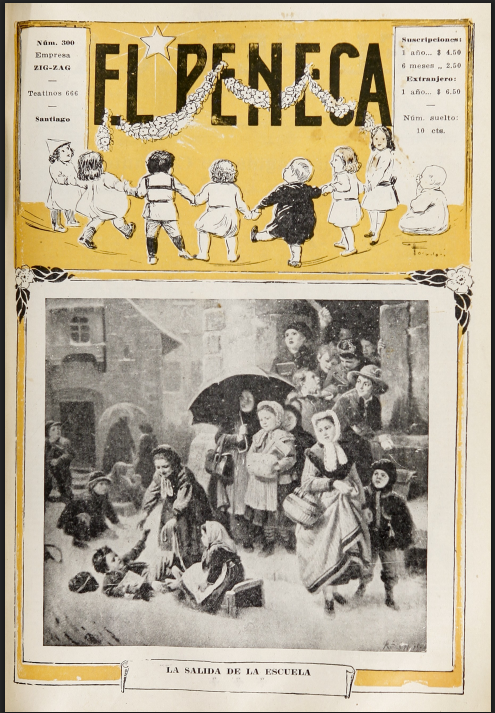
EL PENECA, no. 300, August 17, 1914.
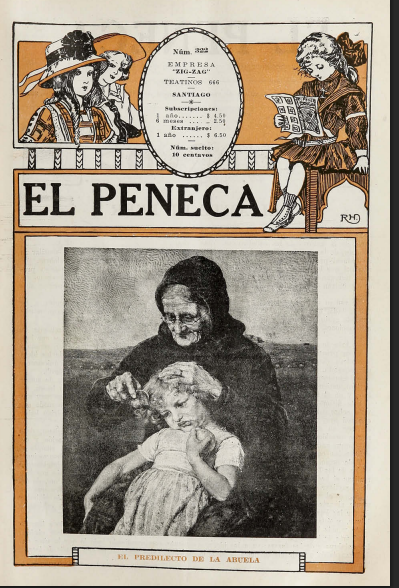
EL PENECA, no. 332, January 18, 1915.
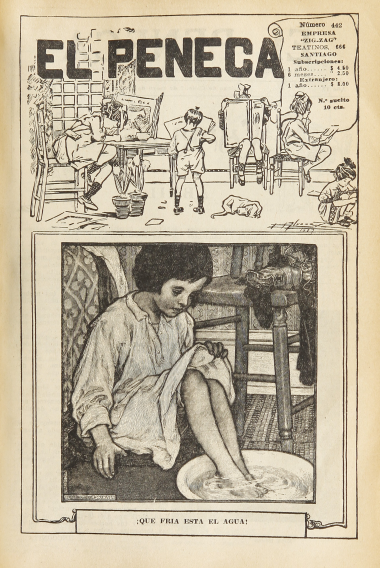
EL PENECA, no. 442, May 7, 1917.
Synthesis.
Some creators faced oblivion. Illustrators, scriptwriters, comic artists, and photographers worked without their contributions being valued. Most received recognition only years later, if at all, or posthumously. Yet their legacy endured. Their creations remained fixed in readers' emotional memory, influenced later artists, and became an inseparable part of Chile's graphic history.
Photographers played a crucial role in visually documenting Chile. Through their lenses they captured everyday life, the urban fabric, architecture, and the country's landscapes, with particular attention to cities such as Santiago and Valparaíso as well as many rural communities. With an eye that was both artistic and documentary, they also portrayed hundreds of “penecas.” This vast body of images forms a unique photographic archive that today allows us to glimpse the appearance and atmosphere of a Chile that has vanished.
The covers, illustrations, and photographs produced between 1908 and 1921 became a field of artistic experimentation where academic rigor met aesthetic innovation and elite portraiture shared space with popular scenes. Covers acted as powerful visual magnets that anticipated the spirit of each issue. The roster of illustrators amounted to a who's who of graphic art at the time and laid the foundations for a distinctive visual language combining European pictorial tradition with Chilean idiosyncrasy.
Anonymity and precarious professional recognition were a constant in the history of these creators. Figures such as Luis Fernando Rojas, whom Blanchard-Chessi tried to rescue from oblivion, died in poverty decades later, victims of an editorial system that condemned them to anonymity.
The period analyzed here represents the magazine's greatest moment of experimentation. Beginning in 1916, the gradual loss of color foreshadowed the decline of this first stage. But the “visual foundations for a golden age of Chilean magazines” had already been laid.
Illustrations · original edition
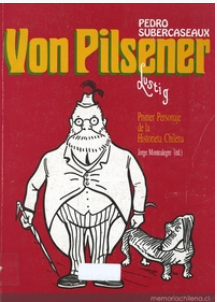
2.1.2. Contributions: The Magazine Answered Letters.
Blanchard-Chessi celebrated the first anniversary by emphasizing that the main objective was to encourage original creation among young contributors, reject plagiarism in order to raise literary quality, and prepare a group of children who could take an active role in the editorial work:
"The Anniversary of 'EL PENECA'
(November 23, 1908 – November 23, 1909)
Happy indeed was the moment when it occurred to us to create this publication dedicated exclusively to tender intelligences, to those who are beginning life or have traveled only its smiling borders and who always have before them beautiful horizons and perspectives.
It was in truth a beautiful inspiration, for which we congratulate ourselves, but without petulance, that we had, of proposing this weekly, to publish it as a delight and at the same time an imperceptible instruction for childhood. And we have been reciprocated!
El Peneca has now lived a year, surrounded by affection and applause. If we were to publish all the letters we have received and continue to receive, encouraging us in the task, constantly applauding us, we would have to fill the pages of the newspaper exclusively with them.
No! We thank all those simple and great hearts who understand our modest effort and who send us their wishes of congratulation and even their blessings; but we must only limit ourselves to thanking them intimately and to continuing, thus, without fuss, and without desiring public applause, the work undertaken.
There is nothing more satisfactory than to struggle with fruit, which morally we obtain, and knowing that the effort begun is gladly accepted.
This is enough for us to be content.
We wish that the readers to whom the publication is dedicated may be entertained and learn something; we want them to become accustomed to developing their faculties and to nourish their intelligence with wholesome readings, always moral, because whoever has bad tendencies falls irremediably; that they write for themselves and, finally, through perseverance, manage to become distinguished writers who honor our homeland.
We still have much to do to realize our ideals; but with the cooperation of our own young collaborators, we believe we will finally arrive at the result we seek.
The pages of the weekly are already becoming few to publish the contributions we receive, and frankly, we would like to please everyone. For this reason we will continue encouraging, to the extent possible, all those who wish to begin, to try their hand at letters; but we will especially endeavor from now on to publish the best, and of course, the original.
Away with plagiarism!
Shortly, in addition to various novelties and reforms, we will give some writing guidelines and news of the various literary genres to facilitate for our good friends the means to write better. We will not conclude these lines without lamenting, on the one hand, not being able to bring to light, now, all the congratulations we have received on the occasion of the anniversary of this publication, and without repeating that we thank from the soul the kindness and affection they show us for 'El Peneca.'"
E. B-CH.
EL PENECA, no. 53, November 22, 1909.
The same anniversary issue praised Raquel Olimpia Martínez Rojas, whose stories were popular with readers:
“"OUR COLLABORATORS
Miss Raquel O. Martínez R.
AMONG the most constant, most modest, and most intelligent and cultured collaborators of "El Peneca," Miss Raquel Olimpia Martínez Rojas occupies an outstanding place.
Countless are the letters we have received regarding her most beautiful fantasies and always moral articles that reveal her lively talent.
There is not a day, moreover, that we do not receive some request from readers that her portrait be published.
If the same request has been made with respect to other collaborators of "El Peneca," none has had as many votes as Miss Martínez."
EL PENECA, no. 53, November 22, 1909.
The “Comments” and “Miscellany” sections published readers' letters containing criticism of behavior, thanks, suggestions, impressions, and even condolences. Contributor Berta R. L. addressed poverty from an ethical-Christian perspective. Her writing sought to transform the way readers looked at those in more vulnerable social positions. Berta recommended a concrete practice of Christian charity: when the less fortunate came to our doors, the response should not stop at merely giving alms. Christian conduct required welcoming them with genuine compassion and meeting their needs as far as one's means allowed. Such mercy, she wrote, brought rewards: God's blessings in this life and the eternal promise of salvation when the earthly pilgrimage came to an end:
"VARIETIES
POVERTY
Poverty is not a punishment from our Creator; for this reason it is not a misfortune to be poor, nor should one look down upon those who stand in a lower place than ourselves.
Bearing the above in mind, we will know how to conduct ourselves toward those unfortunate ones who come to our doors seeking alms; we must attend to them with affection and satisfy their needs, if we can. Conducting ourselves in this manner, we will receive in this life the blessings of our Creator and of our friends. And later, upon leaving this earth, we will find the doors of heaven open."
Berta R.L.
EL PENECA, no. 63, January 31, 1910.
In September 1910, Blanchard-Chessi listed several young contributors and their respective roles, accompanying each name with a brief note and photograph. He expressed gratitude both to the young contributors and to established writers who had helped the weekly grow, and assured readers that El Peneca would guide them toward important places in Chilean literature and journalism. He then added: “Contributors must set an example at school by being diligent students. From now on we shall publish no article by anyone whom we are reliably informed does not study. Obedience and study are the first conditions for anyone who wishes to become something in life”:
"The Collaborators of 'El Peneca'"
Don Abel Guevara. Our illustrator 'Paper.'
Don Oscar de la Barra, collaborator of 'El Peneca,' a poet worthy of encouragement.
Mr. Hernán Díaz Arrieta, awarded in the first contest of 'El Peneca' and today author of a beautiful little book.
Don Manuel Bianchi Gundián, collaborator of 'El Peneca,' awarded in the first literary contest.
Don Nicanor Castro Morales, collaborator of 'El Peneca' with articles on the history of Chile.
Don Carlos Ceppi, collaborator of 'El Peneca,' poet.
Don Luis A. Pezoa, collaborator of 'El Peneca' with various articles.
Mr. A. Toro ('Lancaster'), collaborator of 'El Peneca' with articles on history and geography.
Miss Rosa Williams Ibáñez ('Pierrette'), intelligent collaborator of 'El Peneca.'
Don Misael Concha Aranda, collaborator of 'El Peneca' with various articles."
EL PENECA, no. 96, September 19, 1910.
In the same issue, no. 96 (September 19, 1910), Bernardo A. Cruz wrote an essay under the pseudonym “Anjel Lucero” on the meaning and impact of the Centennial:
"CENTENARY OF CHILE"
Some of these future great writers write for various purposes: one out of love for the homeland (describing historical episodes), others out of love for art (writing sentimental compositions of literary merit), others background articles. Among them stands out Mr. Valderrama, who, in a burst of true patriotism, exclaimed with emphasis in his 'Appreciations': "In 'El Peneca' are nestled the first shoots of the art cultivated by those who will later be called 'literati,' bearing on their foreheads the badge and honor for us of being Chilean."
EL PENECA, no. 96, September 19, 1910.
On November 21, 1910, for the second anniversary, an editorial review took stock of achievements and fulfilled purposes, emphasizing the magazine's educational and journalistic mission. The publication committed itself to improvements in writing and graphic design in order to remain relevant and entertaining. A photographic gallery of contributors was added:
"The 2nd Anniversary of 'El Peneca'
On the 23rd of this month, "El Peneca" completes its second year of existence and has the satisfaction of continuing the task it set for itself from its founding, surrounded by the affection and fame bestowed upon it not only by children, but also by grown-ups who have understood the high mission carried out in national journalism, which tends, with all its heart, to do good, to delight while instructing, and to honor our ever-beloved Homeland. Now it will evolve; it will endeavor to introduce improvements in its editing and to make it, as far as possible, at once instructive—with drawing lessons, language lessons that will be resumed, embroidery lessons, practical examples of morality, etc., etc.—and as entertaining as possible, with many caricatures and current engravings.
We take this occasion to offer our readers some portraits of our collaborators. As is known, in the Centenary issue we published many; now a few more, and soon it will be our pleasure to present them all. We wish, then, many happinesses to all our readers and especially to our collaborators, on the occasion of this anniversary of 'El Peneca,' since the publication belongs to them.
Mr. Domingo Rojas, collaborator of 'El Peneca' with articles of a journalistic nature.
Mr. Eduardo Flores Ibarra, collaborator of "El Peneca" with various articles.
Miss Josefina Robles (Estrella), collaborator of 'El Peneca' with literary articles.
Mr. Agustín Aravena, collaborator of 'El Peneca' with articles and poetry.
Miss Laura Corvalán (Aura), collaborator of 'El Peneca' with stories and fantasies.
Miss Rosa Cucurull (Rosina), collaborator of 'El Peneca' with stories and fantasies."
EL PENECA, no. 105, November 21, 1910.
The theme of the mother occupied a special place, exalting the obedience and affection children were expected to show her. Nature and the land were linked to the cultivation of Christian devotion. At the same time, patriotism and love of Chile emerged as recurring motifs. The following contribution titles illustrate these themes: “The Beggar Woman,” “My Mother,” “Honesty,” “Love of God,” “Christian Charity,” “Homeland,” “Without a Mother,” “Spring,” “Autumn,” “Passion Flower,” “A Good Heart,” “Work,” “Study,” “Poverty,” “How the People of Valparaíso Amuse Themselves,” and “A Pilgrim's Dream.”
In issue no. 102 (October 31, 1910), contributor Abel Guevara, “L. Paper,” caricatured a Chilean teacher and member of Congress against a white background. Presenting a “teacher and deputy” within an honorary frame served as a form of civic consecration. By including such a figure in a publication for children, the magazine granted him public recognition and unquestioned authority. The choice of “Don Armando Quezada” symbolized the fusion of knowledge and civic power: he was the model citizen who placed education at the service of the nation.
In January 1911, Estanislao Hernández wrote “A Huaso's Warning,” notable for an innovative linguistic style that used authentic rural speech, incorporated popular expressions and sayings, and preserved country pronunciation:
"CONTRIBUTIONS
'WARNING FROM A HUASO'
(In popular language)
Now that we are near the month of the souls, a story comes to my memory that they told when I went to the countryside.
Listen, sir, don't go back too late from Mrs. Margarita's place; look, sir, because over there where the patagua grove is, lots of mishaps have happened... I'm going to tell you one that happened to me myself on Saint...'s day, when I was coming back from Mr. Pancho Salazar's place, as you'll understand, sir, they were celebrating their saint's day and I was coming back a little tipsy from where I'd been throwing back drinks and dancing cueca like a devil with the...
—Well, and the story?"
Estanislao Hernández D, Santiago, October 6, 1910.
EL PENECA, no. 114, January 23, 1911.
The Contributions section drew heavily on Christian inspiration: “Prayer,” “Jesus,” “Supplication,” “Charity,” “The Fountain of Life,” “Path of Illusion,” “Christmas Night,” “The Orphan's Christmas,” “Dream,” “Pain and Consolation,” “Evocation,” “Prayer Before Lunch,” “The Garden's Mourning,” “To God!,” “A Soul in Agony,” “In the Month of the Dead,” “To the Condor of Glory,” “New Year,” and “Sacrifice.” In the prose piece “Why I Write,” the contributor using the pseudonym “Adami” sensitively expressed the private motives that drove him to write:
"CONTRIBUTIONS
WHY DO I WRITE?
(For H. Pinochet S.)
The first time I wrote, I didn't even know how it happened; I only know that I did it trembling, out of the just fear of whether my words would be worthy of being published. I was inspired by the adorable light of a pair of eyes. My mother's eyes!
I write when I see my flowering illusions fading; when I feel peace and tranquility in my soul; when the silence of the afternoon reigns and memories of happy days come to my mind.
I write in the hour of mysterious calm; when the first light of morning appears, the little birds let their melodious trills be heard, and the flowers open their corollas. I write upon seeing the adorable light of a pair of eyes full of mystery, sweet and fascinating. Eyes of the color that my sight admires and adores.
I write because in my soul I have memories of sorrow or of joy; memories that it is not enough for me to feel, but to write. I have the conviction that what I write has no merit whatsoever, but I feel infinite pleasure in doing it. It relieves me!
Lastly, I write... because I like to write... These phrases that I dedicate to you, a faithful reflection of my thought, a mixture of joys and tears, I send to you to satisfy your curiosity.
They tell you why I write."
ADAMI.
EL PENECA, no. 186, June 10, 1912.
In October 1912, under the “Chats” section, “Omer Emeth” wrote a brief reflection titled “The Lesson of a Rose.” In it, he proposed that children read something different from ordinary books: the great book of Nature, created by God. Through the image of a rose growing beside the road, he warned them about the moral and spiritual dangers of the street and invited them to value the protection of home:
"TALKS
THE LESSON OF A ROSE
Children today are tireless readers, and I will not be the one to reproach them for their love of reading. No...
Books, when good, are our best friends, the most sincere, the most faithful, those that serve us most and cost us least. What splendid friends they are!... But there is a book superior to all others, and it is, precisely, the one we read least. We have it, day and night, open before our eyes. Its pages are as immense as the earth and the sky. Its letters are made of flowers and stars; its words are not dead like those that fill the pages of ordinary books: they are living beings, that love and suffer, that speak and sing with a truly divine eloquence and harmony...
What title does that book bear?... It is entitled: The World or Nature, and its author is God...
Have you ever read it? Would it not please you to read it and to seek in it the lessons that the "supreme author," the perfect writer, the "poet" of poets, wrote for you? (1)
Certainly it would please you, and that reading would be profitable to you.
Let us open today one of the tiniest pages. Let us draw near to a garden, one of those in Santiago that, with spring, are displaying all their finery. Let us not try to read the entire page... We lack the time for that...
Let us see a single line; even less, a single word; let us consider a "rose."
There it is, at the edge of the path, newly opened. It is fresh and beautiful and says to us: look at me... We look at it and what do we see?
Oh! its beauty is as evident as the light of the sun, but...
There is a but... I look at it and see that the proximity of the path is not healthy for its beauty.
Near it pass automobiles that stain it with the residue of their badly burned gasoline and spatter it with the impure dust they raise; pass carriages and carts that complete the work of the automobile, and there is no lack of some heartless passerby to place his filthy hands upon it...
Poor rose! Not even the space of a day does your beauty last intact... And yet, it is a word written in carmine ink by the hand of God, and that word reads: "Careful!" Careful, boys and girls who read these lines; careful with the proximity of the street, that is, with those who pass by there staining you with the impure dust they raise... The street is not good for children or for flowers... How much more beautiful and more enduring are those that grow in the center of the garden, in the courtyard of a closed house, in a pure and holy home!...
Walk through the gardens and you will see how true what I tell you is. You will see that, far from the paths, the flowers and leaves shine without stain and live secure...
Conclusion: Careful with the street!... Love the peace and security of your home. There, loving gardeners will know how to care for you, and you will bloom healthy in body and soul like the flowers of God... 'Careful!'..."
OMER EMETH.
(1) Poet means Maker or Creator.
EL PENECA, no. 205, October 21, 1912.
An adult reader who identified himself as “one who is not a peneca” responded to “The Lesson of a Rose.” On November 15, 1912, he expressed concern about boys who spent their time in the streets and girls who lingered at windows watching the outside world. He disagreed with corporal punishment and proposed instead Catholic schools, boarding school, and religious discipline. Emilio Vaisse responded that he agreed in substance, while maintaining that punishment administered without anger still had a place in education.
Together, the two passages reflected the anxieties of Santiago's urban middle class in 1912. The city was expanding, automobiles were appearing, and children were gaining access to public spaces beyond adult control:
"TALKS
ON THE SUBJECT OF STREET-WANDERERS AND WINDOW-GAZERS
It seems that the talks of October 21 and the 11th of this month have not fallen on deaf ears.
From the letter we publish below, our readers will see that those talks have been discussed, commented upon, and improved.
"Santiago, November 15, 1912. Mr. Director of 'El Peneca.' Present. — My dear sir:
Most delicate and very apt was your editorial article in 'El Peneca' of the 21st of last October, and a complement to it is what you, answering a letter from a father of a family, say in the editorial of the 11th of this month.
Your 'biblical' remedy of punishment deserves, however, some observations from me, which I will take the liberty of setting forth, without pausing to consider them, in the interest of brevity and clarity: I will merely enumerate them.
Punishment is effective, in my understanding, in part, or rather, relatively; for if the girl or boy is addicted—she to the window and he to the street—or if they are willful or of a hard temperament, corporal punishments will be of little or no use, assuming you refer to them, because they will cause children to lose the shame they have left, or will make them, what is worse, hate their parents.
If they are not corrected by advice and threats, nor by the deprivation of outings, money, gifts, etc., nor by one or another corporal punishment, applied opportunely and without anger, I would venture to propose to you, or to the 'father of a family' who asked you for advice, the following:
1st Withdraw the little girl from the Liceo and place her in a Catholic school, and likewise, if he is not already, place the boy in a Catholic school.
2nd Instill in them at home, seconding the action of the good school, religious sentiments, and have them practice pious devotions, not in excess, so that they do not grow weary of them.
3rd If they still persist in window-gazing and street-wandering, put them in as boarders. In one or two years, being boarders, they will forget windows, street doors, and streets, and the neighborhood friendships and vices that these relationships and the window or the street irremediably give rise to, and, joining the school and the home, they will be good children.
Enough for now. But as it is fitting to expand the 'curative plan' that I have begun in this letter, with observations that are daughters more of experience than of reading, in a future one I will complete it, if you see fit to give publicity to the present one.
From your most attentive and faithful servant, One who is not a peneca."
REPLY
"My dear sir: I am of the same opinion as you, but I believe that, before proceeding to the confinement of the street-wanderer and the window-gazer, some well-applied punishments could yield excellent results.
Today fathers of families are unaware of the virtue of timely and Christianly applied punishment.
But it is necessary to tell the truth: if punishment is to be applied with anger and in a spirit of vengeance, it is better to abstain. The remedy, in such a case, is worse than the evil."
OMER EMETH.
EL PENECA, no. 210, November 25, 1912.
The editor did not hesitate to reject readers' submissions when he suspected plagiarism. His commitment to originality led him to warn publicly against those who, seeking quick personal recognition, chose the easiest road. One striking example was the declaration he published in 1913:
"PLAGIARISTS
But it happens that, though very merciful toward children in all their sins, I cannot tolerate in them, or in anyone, the farce...
A fraud, whether big or small, old or young, aristocrat or commoner, is my personal enemy. He may be the most likeable of men or children, have more talk than a Cicero; he will not convince me nor manage to make me tolerate him. A fraud and a purgative of Palma Christi are, to me, one and the same thing.
The plagiarists are therefore in a very bad situation when, in order to dress themselves in others' feathers, they choose 'El Peneca.'
It is as if a fox, instead of the thickets in which it was born, chose to stroll along the Alameda or the Plaza de Armas.
Good hunting awaits them!"
OMER EMETH.
EL PENECA, no. 223, February 24, 1913.
The story “A Night in the Desert,” sent from Talca on August 24, 1913, by a child using the pseudonym “Zuidersee,” described the experience of becoming lost for a night in the Chilean desert:
"Contributions
A NIGHT IN THE DESERT
Alone, far from every living being, tired already, I gave myself over to sleep.
I must have slept for a long time, for upon waking I found myself covered by a light layer of sand; I sat up, looked around me, beside me lay a smoking skeleton. It had dawned! The light was not yet intense, and not only could I see what I had seen before, but also a flare of gas—it was a will-o'-the-wisp, the ghost of the frozen desert."
Talca, August 24, 1913.
EL PENECA, no. 253, September 22, 1913
Roberto Meza Fuentes's text celebrated the sixth anniversary in issue no. 262, dated November 24, 1913. He named the carefully selected contributors one by one, praising and highlighting the poetry and prose of the young authors. He was convinced that taking part in the magazine would fundamentally change their lives. He described literary activities, debates, and intellectual challenges, mentioning the founders of the “Juventud” academy. He also revisited a debate begun by Celia Díaz Palacios, together with discussions of plagiarism and editorial errors in the weekly. He called on readers and contributors to unite and continue along the path of creative excellence. He wrote that the editor threw first attempts into the wastebasket when necessary, that he never rested, and that his purpose was to teach young writers how to take their first steps in literary life. It was an explicit tribute to the pedagogical and editorial work of “Omer Emeth,” recognizing rigor and dedication as the driving force of the magazine.
Maturity under “Omer Emeth”: Anniversaries, Nature, and Affection.
In November 1914, on the occasion of the seventh anniversary, the editor wrote an editorial reflecting on the obstacles the weekly had overcome in order to survive. He recognized those who had served as pillars along the way. He recalled the founder, Enrique Blanchard-Chessi, and highlighted a group of contributors whose talent and dedication had, in his view, reversed critical moments and consolidated the magazine's growth:
"The Seven Years of 'El Peneca'"
Today 'El Peneca' enters its seventh year!...
For a magazine published in Chile—that is, in a country where journalistic publications die by the dozens, like poorly cared-for infants—to keep on living and, what is more, to keep on growing after entering its seventh year, is quite a feat.
It is true (I confess it): I believe I have contributed to this evident prosperity; but I do not forget either the founder of this magazine, Mr. Blanchard-Chessi, or my collaborators.
There was, some years ago, a moment when 'El Peneca' seemed to wither and draw near the tomb. It was necessary for a doctor to watch over it hour by hour, on pain of death for the poor child...
Summoned in time, two doctors instead of one took it in hand.
One of them was my friend and former collaborator Don Julio Bozo (Moustache), who, combining his medical science with my good will, performed the miracle of resuscitating the dying 'Peneca.'
Since then the magazine has been growing in age and vigor, and today it is one of those that count in Chile and in neighboring countries with the largest readership.
The distinguished poet Don Benjamín Oviedo M. (Magister) assists me with tireless zeal, and to both of us the young Don José M. Molina Guzmán lends his intelligent collaboration.
But we would be unjust if we did not recall here the eminent Walter Barbier and the collaborators who do their literary apprenticeship in the shadow of 'El Peneca.'
In that admirable phalanx, the young ladies Adami (Aída Moreno), Marta Guerra H. (Brisa), Blanca Inda, and Messrs. Roberto Meza F., Carlos Leyton, Francisco Lira, and Antonio Morris stand out."
OMER EMETH.
EL PENECA, no. 314, November 23, 1914.
For the seventh anniversary, contributor Oscar Alfonso Godoy M. paid tribute to his friends and colleagues, whom he described as a generation of young writers formed in the magazine's pages. The passage helps us understand the weekly's role as a literary school:
"CONTRIBUTION
We speak, as will be understood, of the early days of our publication... of those distant days when Enrique Blanchard directed it.
And in the later period, from 1911 onward, since the expert hand of Omer Emeth has guided the weak but valuable little bark across the agitated ocean of opinion, how many young travelers toward the coveted port of Belles-Lettres have not made a long journey in its generous bosom?
There are Benjamín Oviedo Martínez and Francisco A. Lira. Bruja and Brisa, Evaristo Molina H. and Antonio Morris, Adami and Bruma, Carlos A. Leyton and Roberto Meza Fuentes, María Stuardo, Teresa Mogrovejo, José Molina Guzmán and Ángel Custodio Hernández, Celia Díaz Palacios and Teresa Zunino Chacón... to name no more... There are all these young personalities of Chilean letters, formed in the pages of 'El Peneca.'
We have deemed it idle to analyze the work of each of these names, since the readers know it only too well... For this reason we content ourselves merely with sending them a warm applause and shouting to them:
Forward!... Forward!..."
OSCAR ALFONSO GODOY M.
EL PENECA, no. 314, November 23, 1914.
Emilio Vaisse developed a vision of nature as a visible manifestation of the divine, a conviction that led him to publish poems and stories celebrating “Autumn,” “Swallows,” “Spring,” “To the Peasants,” and “Night.” During his tenure, Vaisse anticipated ideas linking natural beauty with appreciation for the rural world in the face of growing urbanization. Reader Sergio Atria's poem “Country Morning” fully expressed this outlook.
"CONTRIBUTION
Country Morning
"There is in the countryside a silence of idyll,
so sweet and deep that it reaches the soul.
From the earth rises a perfume of lily,
and from the sky descends an aroma of calm.
The fresh morning breeze brushes
the grasses. Like a fervent prayer,
the smoke of the huts ascends, slow,
and loses itself in the blue, gently.
Beneath the glory of the sky, the sun laughs
with jubilation, and its laughter melts away,
sparkling through the gold of the wheat.
And over the maternal and good earth
flows a quiet so deep and serene
that I, saddened, bless it…"
EL PENECA, no. 348, July 19, 1915.
On March 6, 1916, in issue no. 381 of El Peneca, Pastora Guerra Olivares offered her classmates a story titled “A Beautiful Proof of Affection.” Through the story of Juana, the author reflected on values such as generosity, sacrifice, and solidarity:
"TALKS
A Beautiful Proof of Affection
(To my remembered classmates of the third year)
From eight months before her mother's name day, Juana's school worries were interrupted by the thought of the gift she might present to her on such a happy day.
After much thinking and reflection, she decided to offer her a gift composed of sacrifices and privations; for this she secretly saved the money she was often given.
When she had enough to carry out her plan, she went to the seamstress, giving her the money so that she might buy fabric and shoes; for the gift for her mother consisted in that, on her saint's day, she would present three little girls, daughters of a poor widow who was very fond of her, well dressed; for misery had taken possession of their humble home."
PASTORA GUERRA OLIVARES
EL PENECA, no. 381, March 6, 1916.
On May 15, 1916, in issue no. 391 of El Peneca, the young contributor María Victoria Bravo published the poem “She Was Not a Woman!”, dedicated to the memory of her deceased teacher, Atilana Silva Reinoso. The teacher's figure is built around two recurring metaphors: the lark, evoking a melodious voice and early-morning song, and the star, evoking light, guidance, and spiritual transcendence:
"CONTRIBUTION
SHE WAS NOT A WOMAN!
(To the memory of the lark who, under the name Atilana Silva Reinoso, passed through the world singing her languid song)
She was not a woman!...
She was not a woman who lived dreaming!
She was not a woman who passed singing!...
She was the lark of light that fled from heaven
and came to this world of sleeplessness
to sing a song.
She was a lark of light that built a nest
with violets, with roses. And hidden
she kept her heart.
She was a star torn from the heavens
and brought to live on this earth
in the form of a woman…
She was a star: she rent the dense veils.
She was a lark: swiftly she took flight
never to return!...
She was not a woman who lived dreaming!
She was not a woman who passed singing!"
María Victoria Bravo.
EL PENECA, no. 391, May 15, 1916.
Benjamín Oviedo Martínez (1894-1974) published his first poetry collection, Ingenua (1913-1918). At sixteen, while in the fifth year of humanities, he published a poem honoring his first teachers. The ode, titled “My First Day at School,” became a testimony of gratitude to those who guided the earliest steps of his education:
"MY FIRST DAY OF SCHOOL
(To my first teachers, Mrs. Amelia Barra and Mrs. Berta Rencoret)
I still preserve the pleasant sensations
of that happy day when I attended class,
of that first day that makes us
conceive the sweetest illusions.
How much love for study, what joy,
awakened in my innocent spirit;
how much happiness and contentment, sweetly,
flooded my soul on that day!
There I found mothers, as affectionate
as the very mother I had,
watchful over my conduct
and careful of all my actions.
You kindle the light that illuminates
man on the path of life,
from tender, sleepy childhood
to old age in the twilight.
To you, who always like a friend,
like a son treated me with gentleness,
I owe the purest of joys,
and always grateful, I bless you!"
BENJAMÍN OVIEDO MARTÍNEZ.
(16 years of age. 5th year of humanities)
EL PENECA, no. 210, November 25, 1912.
These verses captured the festive atmosphere of the New Year, weaving together elements of nature, the meadow, flowers and springtime:
"New Year!
Nature today shows itself adorned with its magical beauty;
today the meadow displays
the beauty of its flowers,
of the flowers that smiling Spring brought to it
and that exhibit their colors
and exhale their delicious perfumes
everywhere.
And there, far off, beyond the hill,
where the horizon stretches,
one hears the plaintive Echo
with its low, strange accent,
which faintly repeats
—like a sigh— Happy New Year."
BENJAMÍN OVIEDO MARTÍNEZ.
EL PENECA, no. 163, January 1, 1912.
From his position as an editor and guide, the relationship between “Magister” and his circle of readers developed into an important literary dialogue. On March 30, 1914, the young author who wrote under the pseudonym “Bruja” composed a piece for him in which aspiring writers found both a demanding critic and an encouraging mentor:
"THE POET'S DREAM
Affectionately, to Mr. Benjamín Oviedo Martínez, a sincere homage of admiration for his talent
Winter night. The wind lets its most sorrowful laments be heard, and as it passes among the bare branches of the trees, they creak, producing a strange noise, like the grim clash of old bones.
In the heavens no star shines, and only one or another ray of light that escapes through the cracks of the doors and windows of some dwelling interrupts the dense darkness.
In his simple room, seated beside a table, is the poet; his pensive brow crowned with beautiful hair, and his eyes, which are the reflection of an intelligent soul, also show the painful trace of a life of sorrows.
Suddenly, he rests his brow between his hands and, fixing his gaze on the shining flame of the lamp, he seems to dream. And in truth, so it is: his spirit, released by the long journeys of thought, transports itself once more to distant horizons.
And he dreams that he finds himself on a great avenue; it is spring; flowers are born at his step, roses fall from the skies, and his wandering gaze, losing itself in the distant confines, sees only flowers... always flowers, beneath the vault of the firmament which, like a single diamond cut in infinity, casts in a thousand diverse rays an immense clarity over the earth.
And he keeps walking (or rather) gliding, for his feet do not brush the ground.
After having walked thus for some distance, he glimpsed at the end of the avenue a superb dwelling, built, it seemed, of moonbeams and flower petals upon a pedestal of rosy clouds. This must be the mansion of the dawn, sighed the poet; but upon trying to place his foot on the regal threshold, a universal concert thundered through space; then he stood astonished, unable to make the slightest movement; so great was his emotion!"
BRUJA.
EL PENECA, no. 280, March 30, 1914.
In the “Chats” section, “Magister” addressed the subjects of character and willpower, drawing on the classical wisdom of Plutarch. Through his reflections, he invited young readers to honest self-examination and to cultivate virtues far removed from vanity:
"TALKS
CHARACTER
Whenever I hear certain people speak about the power of their own will and about the strength their character possesses to command themselves and obey no one but themselves, it occurs to me to wonder whether those people, before making such bold assertions, have studied enough to come to understand all the complications of their spirit.
Because, as I believe, in order for the action of the will to manifest itself freely over our desires and to be capable of subjecting them to its commands and guiding them in its own way, it is necessary that the soul have been purified to such a degree that no impulses remain in it that could oppose those commands or divert those orders.
And that purification of the soul indicates such a high degree of perfection that few are the people who come to attain it, and it is natural to suppose that those who reach such a degree of perfection will be very far from vanity and boastfulness, from praising themselves and proclaiming themselves the sole sovereigns of their actions.
As Plutarch observes, whoever has many vices has many masters, and in order to become the sole master of oneself, one must banish all the vices that can subdue us and struggle against them all until managing to overcome them.
Those boasts that we so commonly make, seeking to convince others of something of which we ourselves are not convinced, are of no use; for that eagerness that leads us to speak continually of virtues and excellences we claim to possess is nothing but desperate efforts to cover and hide defects that we have not been able or have not wanted to correct.
Instead of dedicating ourselves to speaking to every person of good will who wishes to listen to us, or, many times, even to those who do not wish to listen to us, of our supposed virtues, we should dedicate ourselves to combating our vices—which everyone has—and to striving to free ourselves from them and from their hateful dominion, for that will be the only means of achieving complete independence of our actions and the free exercise of our will.
We must never forget Plutarch's phrase and put all our effort into ensuring that it is not fulfilled in us: Whoever has many vices has many masters."
MAGISTER.
EL PENECA, no. 561, August 18, 1919.
J. M. Molina Guzmán introduced and praised the figure of Francisco A. Lira. The text recognized his growing career in the world of letters:
“COLABORACION
CONTRIBUTION
FRANCISCO A. LIRA D.
Quite well known to the readers of El Peneca is the signature of Francisco A. Lira D. It points to one of the most industrious collaborators of that swarm of young literary talents who have as their columns the literary pages of this magazine.
The lines of Lira D.'s intellectual silhouette are already precise; he is a poet of the soul. A great part of his production has seen the light in these columns, and the reading of it even seems to fix his personality.
On many occasions this author has presented himself to us as a valuable landscape artist. The Editorial Staff of El Peneca, in the last literary contest it organized, recognized the value of his work, granting him a first prize.
A great part of Lira's work consists of a collection of sonnets that he titles 'Profiles,' simple compositions with affectionate applause for intelligent children. Of a similar nature, he has written a great number of sonnets dedicated to young intellectuals. In them he unites sincere encouragement with a marked novelty.
His work 'Toward the Ideal' is already in press. It is a composition in verse that synthesizes Lira's soul. It does not contradict in any way the concept I have held of his literary personality, and undoubtedly the same will happen with those who read it. It is printed in a 16-page booklet and is preceded by a 'Frontispiece' by Benjamín Oviedo Martínez.
The genre to which 'Toward the Ideal' belongs had not yet been cultivated by Francisco Lira: his work therefore presents a new phase of his fertile labor. In his new production, if the vivid coloring of his landscapes is not found, one hears, instead, the powerful cry of a noble artist's breast.
May my most sincere wishes reach its author through these lines, that the work he launches into the hands of the public may earn him the applause, if not of all readers, of those who carry in their soul something of that sweetness of life called poetry..."
J. M. MOLINA GUZMÁN.
EL PENECA, no. 334, April 12, 1915.
Under the pseudonym “Flor del Aire,” a young contributor responded emotionally to messages from women readers, revealing the weekly as a meeting place and a community:
"CONTRIBUTION
(For the readers who have asked me to write again, and especially for 'Ida' and 'Flora')
I had thought of leaving unanswered the little bundle of crystalline phrases that two great women's souls dedicated to me in days past, and I have not been able to resist the desire to stitch together these lines, bearers of my gratitude to 'Flora,' 'Ida,' and those compassionate readers who ask me to return. "Why are you leaving 'El Peneca,' Nhina...? We will miss you very much..." the madcap girls and the boys who know me personally have said to me. I feel moved. Those phrases of affection and nostalgia have vibrated in the ruined temple of my heart like an old melody... And I ask myself: Who might that angelic 'Ida' be who pleads for me and loves me in anonymity...? Another unknown little friend like 'Eira' and 'Blanca Lira'?
Oh!... I want them to know that in this passionate heart, a vessel full of pain and Poetry, their memories will live eternally!"
FLOR DEL AIRE.
EL PENECA, no. 512, September 9, 1918.
In 1920, reader M. Teresa Sepúlveda B. sent in a poem containing a prayer taught to her by her grandmother. The poem reflected the oral, intergenerational transmission of faith, showing how grandmothers maintained a spiritual and affectionate bond even beyond death. Publishing compositions of this kind encouraged children's literary expression with religious and grace-filled content-in the devotional sense of the word:
"MY LITTLE VIRGIN
I have at my bedside
a very beautiful virgin;
my grandmother gave it to me
on the day I turned
five years old.
After I die, she told me,
you will always pray to her;
and with great devotion,
and with faith in your heart,
you will commend me to her.
And the years have passed
since she died;
for her an Ave María
I always, always pray,
as it is true, my virgin,
that for me, I pray two."
M. Teresa Sepúlveda B.
EL PENECA, n°589, 1.o de marzo, 1920.
A Living Dialogue: Mail, Letters, Replies, and a National Community.
Beyond the stories and verses, the magazine personally answered every letter, published messages between readers, and became a center of national exchange of ideas. Issue 2, corresponding to the inaugural edition, published an article about "Omer Emeth." He was one of the first collaborators and, two years later, assumed the position of director—a sign of how El Peneca not only formed readers but also those who would later direct its pages.
"INFORMATION FROM 'EL PENECA'
TO OMER EMETH — If gratitude is a duty, and for well-intentioned souls it is in reality a natural satisfaction, we gladly fulfill the duty of expressing to Omer Emeth our most sincere recognition for the most beautiful, generous, and well-thought-out article that he has been pleased to dedicate to 'EL PENECA' from the columns of El Mercurio.
'Omer Emeth' is not only a brilliant and pleasant writer, but also a sociologist, a profound philosopher, rather, who honors the publication of which he is a collaborator. That is why we feel highly honored by his article.
Thank you, a thousand thanks, once again."
EL PENECA, no. 2, November 30, 1908.
The editor (Enrique Blanchard-Chessi) took on the task of speaking directly with the penecas through “Our Replies,” within the “El Peneca Mail” section. The questions and answers were numbered as follows:
"MAIL FROM EL PENECA
Our Replies
Messrs. Guillermo and Pepe Cabrera Mac Millan. Pte. She's still lame, then. May she be complete.
Mr. J. M. Torres. Valparaíso. —With great pleasure; but, little by little. They are well, thank you.
Mr. Eduardo Flores L.—Pte.—He will not be left without a reply.
Mr. Leopoldo Muñoz Cabrera. —Viña. My, what a devil you are! Here we are, then. Many thanks.
Mr. Carlos Ceppi A.—Pte. Please come by our office, from 10:30 to 11:30, any day.
Mr. Pedro Álvarez L. Valparaíso. Your letter has attracted us. Yes, work, forward! You will always have us at your orders. Many thanks.
Mr. J. G. E. Pte. Concerning the artists' entries, we do not determine age. Why not come and see us?
Miss Pilar Hernández. Pte.—You are very kind; many thanks. The Director?... he is simply called Director.
Miss Elena Guzmán. Valparaíso. When pieces are taken from some book, it must be indicated. We prefer originals. Thank you.
Miss María Perla María. Pte. What a remark! But, do you know who the curious one is here? A Mr. Rebolledo... our photographer, a very competent and very good person... So, there will be no need to use the machine. What more do you want us to tell you, then?
Miss Laurita Castillo Vega.—Valparaíso. How your gallantry delights us! Thanks, no? We await it, then. The Director greatly appreciates what you send him. Chambeco too.
Mr. Juan Villarroel J. Valparaíso. We will soon send you a letter.
Mr. Fidel Muñoz Cano. Viña. —The photograph and the rest are in our possession. We will write to you soon.
Miss María Bravo.—Valparaíso. —Many thanks. It is the ideas and the efforts made on its behalf that should be appreciated.
Miss Filomena Carvajal G.—Illapel.—In a sack with a hole? Certainly not. Wait and you will see in the end.
Miss Soledad Rainiere.—Pte. —We are going to publish a list of everything accepted. Patience, then.
Miss Violeta O.M.—Pte.—…But with no commitment as to time.
Mr. Sancho García—Valparaíso has difficulties.—You may calm down.
Mr. C. Heimpel.—Pte.—They are two characters who do not interest us.
Miss María Elena Freferick.—Read what we say to number 244.
Mr. Eugenio Amunátegui M.—Pte.—Come and see us."
EL PENECA, n°25, 10 de mayo, 1909.
Writings, questions and contributions poured in and were published as the weekly took on a life of its own. Those whose submissions stood out were invited to join the editorial staff, working directly on material sent in by other readers:
"Notes and Comments
REQUEST
Valparaíso, July 27, 1909. Mr. Director of 'El Peneca.' Santiago.
My dear sir:
I would be most grateful if you would deign to propose the following to Mr. Moya: that if he finds it convenient, he might be pleased to publish in the distinguished 'Peneca' the beautiful historical pictures of Chile—we read with such enthusiasm the capture of the Morro de Arica and several others that we keep as a remembrance of your distinguished 'Peneca'—and also the portrait of several Chilean heroes, such as, for example, Portales, Rodríguez, etc.
With no more than this, your faithful servant, José C. Domínguez."
"BETWEEN FRIENDS
(To my friend Rosita, who resides in Concepción)
My unforgettable friend:
Although the distance that separates us is enormous, it has not caused the pure affection I profess for you to die out, since the happy day I had the good fortune to call you friend. Friend!
Sweet and caressing word that contains the most noble, the most beautiful! Friendship! Mysterious perfume that emanates from good souls; a small soul is incapable of feeling that celestial gift called love.
But, have you ever considered what that word means? Or do you perhaps believe it is a cold word, without object, without form, pronounced but not felt?
Do not label these poorly written lines as tedious; no, they are the sincere expression of my feelings!
Your friend who adores you. Josefina."
EL PENECA, no. 37, August 2, 1909.
Enabling direct interaction among readers was undoubtedly an innovation for its time. Traditional mail, slow and often the only means available, was then the principal channel of communication. Zig-Zag had established its own distribution outlets for its publications, as had El Mercurio. In this way, hundreds of children in cities and remote rural settlements gradually wove a nationwide network of exchange among young readers. El Peneca became a bond of immeasurable value in a country as geographically vast-and with so many deeply isolated corners-as Chile:
"TALKS AND MESSAGES
(In this section, communications that children wish to address to one another will be published. They must be very short, clear, and respectful, in accordance with the nature of the magazine.)
1. Mr. Oscar Solari Chandón, Santiago. —Are you still fond of hieroglyphs? Answer. Pepe.
Mr. Guillermo 2nd Gibbs, Santiago.—I know that you belong to the Boy Scouts; how could I belong?—Carlos Gómez.
2. Miss Carmela Ibáñez, Talca. Do you plan to come also next summer? Your cousin Isabel."
EL PENECA, no. 77, May 9, 1910.
"8.—Miss Julita Conde B., Valparaíso. You cannot imagine how lonely I find myself now that my little siblings are sick. I have no one to play with. We all miss you at home. What do you think? —Edmundo Escobar M.
12.—Carlos Pérez, Tacna. —My papa will go next week. —Juanita Ivens."
EL PENECA, no. 78, May 16, 1910.
"68.—Mr. Luis R. Correa. —That on the 21st of this month, your birthday, you had a very happy day, in the company of your esteemed parents and siblings, are the wishes of your friends—A. Cesáreo Salcent."
"71. Mr. Carlos Ahumada J., Valparaíso. My dear sir: It has been very flattering for me to read your laudatory letter that you sent me through 'El Peneca,' in which you expressed your admiration for my humble articles and encouraged me to continue with even greater ardor the literary journey I have undertaken from the columns of this magazine. I sincerely thank you, then, for your advice and good wishes, and be assured that they have not been indifferently received by your very attentive and faithful servant, Carlos E. Peterson."
EL PENECA, no. 84, June 27, 1910.
"111. Miss A. Ponce. Dear little friend:
I was very sorry not to have invited you on Sunday when we went to the farm to gather huesillos; but it was because I thought you were in Machalí.
Many greetings to Estercita and Cuchito. C. González.
Rancagua, July 11, 1910."
"112. Miss Olimpia Martínez R.—Perfectly; disdain is almost always repaid with disdain. Is it not true, then, that according to this, that would come to be just? (We regret suppressing a Latin phrase for being incorrect and, for that very reason, incomprehensible). Roberto Sánchez. B."
"113. Miss Raquel Balmaceda L.—Present.—Dear Raquelita: You have judged me very unfairly by calling me 'ungrateful,' for you know that my illness leaves me few hours to dispose of. Regarding what you tell me about the Liceo, I can tell you nothing, for I feel very little improvement, and according to the doctor's opinion I will not return until I am completely recovered. I await you at home next Wednesday. I have many things to tell you. Your friend embraces you. Graciela Silva C."
"114.—A. C. S.—Fearing to disturb the happiness I have wished for you, I did not write to you by mail on the day of your name day, but instead, accept through this magazine my humble congratulations. M. M. T."
Santiago, July 13, 1910.
EL PENECA, no. 87, July 18, 1910.
The editors frequently published notices concerning photographs that had been sent in and needed to be collected, either because they did not meet editorial standards or because the person pictured had not been identified. Readers also asked a wide variety of specific questions:
“CORRESPONDENCE
Daniel Castañeda Marcias. —You may come to collect your photograph, because it cannot be reproduced.
Incógnita. —The book to which you refer was put on sale in the bookstores of the city center.
M. Teresa Zunino Chacón. —Please inform us whether your book 'Tears and Smiles' is still in the bookstores or where it can be found. We likewise request that you send us your address.
Gastón Buollon B. —Address yourself to its authors, general delivery no. 2."
EL PENECA, no. 346, July 5, 1915.
In addition to the “Correspondence” section, where readers' questions were answered, the magazine introduced an innovative section of “telegraphic” messages:
"TELEGRAPHIC CORRESPONDENCE"
Carlos A. Faura. —If the works you promise us are good, they will be published.
Roberto Flores. —The works must come in India ink.
Dewet Bascuñán. —Back issues cost ten centavos and must be requested from the administrator of 'Zig-Zag.' Payment may be made in stamps."
EL PENECA, no. 424, January 1, 1917.
Mr. Leonel. —We agree. We await it.
Mr. Hualo. —Soon.
Miss Malvaloca. —We will gladly publish your composition. Do not lose heart, miss; if at times we do not reply, it is for lack of space or time, but never of will.
Mr. Fritz Conrads. —We pass your query on to the 'questions and answers' section of 'Zig-Zag.'
Miss C. Bernán. —With great pleasure, soon. Thank you.
Mr. Daniel E. Monega. —Soon.
Mr. Enrique Ericksen Q. —There is no doubt that you know metrics well, is there? Well then, in one of the works you send us, there is a detail that inspires strong suspicions in us.
Gallery of Penecas. —We ask those who send us photographs to put the names on the back of them and not in separate letters or papers, for it is very easy for them to get lost and the portraits, without a name, could not be published.
Mr. C. Bernardino López. If the composition you send us as your own were not so well known, we would publish it under the name of its true author, which is Juan de Dios Peza. Let it not happen again.
Mr. L. Dévia and Román. Patience, sir. Your turn will come.
Miss Manuela González. Keep the material of your pastimes for yourself.
Mr. Modesto Ortiz R. We believe that in the 'questions and answers' section of 'Zig-Zag,' a formula for making ink has been given. We possess none, otherwise we would gladly give it to you.
Mr. 'I'm better alone.' You will understand that it is impossible for us to act as messengers. We have no right to meddle in your affairs, nor to involve our readers in things that interest no one but you. As your signature says, 'alone is better.'
Miss María Conque. We have already repeated many times that the only requirement necessary to contribute is to send good work.
Miss Rebeca Retamales. Send something better.
Miss Dirty Face. We are tired of repeating that nothing is charged.
Mr. Oscar Chávez. If you knew how many pastimes we have, you surely would not demand such promptness from us.
Mr. Jorge Steck M. If all the collaborators of this section sent us pastimes as good and orderly as yours, we would save ourselves many headaches and save time. Many thanks.
Miss Sibilia Loreno. —Pay a little more attention when you send us pastimes. Both are wrong; it is enough merely to count the letters of the names of the poets cited and those of the anagram to see the error. The letters of the two poets add up to 39 and those of the anagram to 36. How about that?
This time we have corrected them, but we do not always have time.
Mr. Jorge Hidalgo R. Very good. Many thanks."
EL PENECA, no. 606, June 28, 1920.
Handicrafts and Competitions.
The magazine opened sections on “Sewing” and “Drawing Lessons.” Its “Ingenious Games” offered inventions and ideas for building, creating and entertaining oneself. Competitions awarded prizes to the winners in the following issue or the one after that.
The range of educational games was broad and pursued the goal of training and guiding children through humanistic and scientific learning. Instructions covered different skills related to applied arts and trades, including needlework and basic carpentry.
In 1908, the magazine published a message addressed especially to girls: a letter of advice from an aunt to her niece, teaching her how to embroider a pair of little shoes. In a warm, familiar tone, the aunt evoked the intimacy of the home and sought, through this manual activity, to encourage domestic virtues in the girl:
"HANDIWORK
Let's begin. First of all, you need 20 centimeters of plié fabric; this fabric is made up of four parts, for four equal parts are necessary for the two shoes. Once this is done, trace the design: those fresh and ripe cherries...
As for color, white is always the most elegant; you can take thin silk or light satin and then fold it; choose the one that makes the embroidery stand out well.
I believe, dear little niece, you will be able to make this little surprise to give to your little brother, whom you can make even happier if you fill it with chocolates.
Until next week, dear Inesita; a thousand caresses from your aunt."
DADE.
EL PENECA, no. 6, December 28, 1908.
Issue no. 116 included instructions for children to build a miniature airplane, christened the “Mono Plan,” another example of the magazine's interest in encouraging creativity and experimentation:
“"A TINY BLÉRIOT"
Airplanes for Children
Who wouldn't want an airplane!... Thus, with envy, thousands of children exclaimed, while Cattaneo in his Blériot flew over Santiago... Ah, who wouldn't want an airplane!...
Well, nothing is easier... It is enough to build one.
Every intelligent child can be an airplane builder. Yes, sir: he can be one, and for that he needs only a strip of wood, a bamboo, cardboard, card stock, wire, carpenter's glue, and... skill, which is acquired quickly and without expense.
Look, children, at the very simple drawings on this page, study them carefully, and follow with care the instructions I am going to give you, and within eight days, you will have an airplane that will fly marvelously."
EL PENECA, no. 116, February 6, 1911.
The magazine regularly published “riddles,” “puzzles,” “rebus puzzles,” “mathematical problems,” and a “philatelic” section on the history of postage stamps and collecting techniques. “Drawing lessons” also appeared periodically, such as the one included in issue no. 134 of June 12, 1911.
The “Our Competitions” section, which ran from June 5, 1911 (issue no. 133) through December 27, 1920 (issue no. 632), organized competitions involving “charades,” “numerical logogriphs,” “anagrams,” and many other challenges. Winners and the “solvers” who successfully completed the puzzles were recognized by name.
Two distinct competitions were introduced: a monthly competition for readers in northern and southern Chile, and a fortnightly competition exclusively for those in the capital region:
"TALKS. — OUR CONTESTS
The growing success of the Pastimes and Intellectual Recreations section of 'El Peneca' obliges us to attend particularly to the wishes of our readers in the North and South of the Republic.
From Iquique an enthusiastic peneca writes: "How do you expect us to take part in the solution of problems, charades, logogriphs, and riddles, when, if we send a solution, it always arrives late? Why doesn't 'El Peneca' open a special section for us and accept solutions no matter how late they are?"
Our readers in the North are right. The distance that separates them from the capital makes an innovation necessary. Consequently, 'El Peneca' today opens a series of contests whose deadlines will allow all its readers to show their skill in solving our problems.
Monthly contest. —This contest runs until July 6 and will be followed monthly by others.
The distribution will be done in the following manner: Lists and groups of solvers will be formed, and if, for example, ten solvers have solved the problems of the same series, the name of the lucky one will be drawn at random. We will publish the names of each of the solvers who take part in the contest, noting the number of solutions they got right.
Fortnightly contest. The fortnightly contest will run from today until June 15 and, like the previous one, will be repeated every fortnight.
Solutions must arrive by the 15th of next month.
The prizes will be:
1st prize: a 6-month subscription to 'Zig Zag' or a one-year subscription to 'Selecta' or 'Familia.'
2nd prize: a one-year subscription to 'El Peneca."
EL PENECA, no. 133, June 5, 1911.
“Omer Emeth” defended the publication of “Games and Pastimes.” He argued that the magazine's first purpose was to entertain, not to bore readers with dense scientific lessons. He maintained that mental games-such as riddles, rebuses and puzzles-helped children's cognitive development by fostering critical abilities such as observation, memory and reasoning. He concluded by quoting a riddle and calling the critical reader (perhaps an adult) a ‘jumento’-a donkey:
"EDITORIAL
Puzzles
What purpose, what use can those games and pastimes with which you fill up to two pages of 'El Peneca' have? Would it not be better for you to fill such valuable space with a good lesson in morality, history, or geography, with the explanation of a point of physics or chemistry, with something scientific, in short?... Enough already of charades, logogriphs, riddles, hieroglyphs, and all the other useless things!..."
—Thus speaks one of our readers who surely must have lost his memory, if not his judgment. And if not, let us settle accounts. The first commandment of every magazine, whether its readers are young or old, is: "Do not bore!" This is equivalent to saying that in 'El Peneca' pseudo-scientific bores are not to be admitted, such as those the aforementioned reader usually sends us and which we, with special care, toss into the wastebasket as absolutely useless.
On the other hand, the criticized pastimes are extremely beneficial for the child's mental development.
Let us take our examples from the last issue. On page 14 there is a picture representing a drawing room with its furniture and decoration. According to the "problem," the task is to find in that picture 17 defects that are not visible at first glance. Will the mental work the child performs in criticizing each part of the furniture, the fireplace, doors, and windows of the room be intellectually useless? Is not the gift of observation, memory (which will provide him with models or terms of comparison), and reasoning perhaps developed in the child in this way?
On page 13 there is a numerical logogriph whose solution, though not very difficult, requires of the child some knowledge of geography, grammar, and natural history.
Will it be useless that, while playing, the solver sharpens them in his memory?
The same we will say of the riddle (very easy and beautifully versified) and of the charade on the same page (1).
Those four "pastimes" are so many exercises in mental gymnastics capable of developing, in an intelligent child, curiosity—the mother of science—memory, imagination, and reasoning. Let no one speak to us, then, of useless things, and above all, let no one try to "bore us" with pseudo-scientific pieces that, more than lessons, would be "sleeping potions" for children.
EL PENECA, no. 122, March 20, 1911.
Synthesis.
Enrique Blanchard-Chessi and Emilio Vaisse established clear rules that encouraged originality, rejected plagiarism, and required young collaborators to reconcile their literary vocation with study and obedience. They addressed an astonishing variety of themes: from ethical-Christian thoughts on poverty and charity to moving elegies dedicated to mothers, deceased teachers, and absent classmates, including rural poetry that celebrated nature as a divine manifestation.
The directors carried out a meticulous and demanding pedagogical labor and, at the same time, publicly recognized the talent of young people who, trained in its pages, could become writers.
El Peneca acted as a messenger between readers from different regions and published messages addressed from child to child, weaving a national network of child exchange that constituted an unprecedented communication phenomenon.
"Pastimes" and "Practical sections" responded to an explicit editorial conviction: to develop the gift of learning and the humanistic and scientific curiosity of children, as "Omer Emeth" defended in his editorial "Puzzles."
Anniversaries became propitious occasions for directors and collaborators to take stock and consolidate a collective identity. The "Contributions" section constituted the heart of the editorial project: a field where readers ceased to be mere receivers and became active protagonists.
2.1.3. Social Life.
Dispossessed Childhood: A Dramatic Context.
When El Peneca was founded in 1908, the situation of children in Chile was dire. Infant mortality exceeded 20 percent across much of the country, with malnutrition, endemic disease and labor exploitation among the main causes. Thousands of children worked from an early age in inhumane conditions: in mines, they completed full shifts underground; in agriculture, they served as cheap labor; and in cities they performed street trades as shoe shiners, newspaper sellers-the so-called canillitas-or servants in affluent homes. Childhood survival was precarious and a daily struggle; abandonment and early death were common fates.
“One case that has in fact been studied by historians in this field is that of the boys and girls who for many years were employed in glass factories. Figures are available for the percentage of workers employed in the pottery, ceramics and glass industries between 1903 and 1926, and it is striking that during this period children accounted for almost 30 percent of the total workforce and never less than 20 percent”. This reality reflected both the absence of effective labor legislation and society's tolerance of child exploitation. It was not until August 26, 1920 that the first Compulsory Primary Education Law (Law No. 3,654) was enacted, requiring four years of schooling for children between the ages of seven and thirteen. Enforcement was slow and uneven, and child labor remained widespread for decades. And although poor families could not afford to buy it, El Peneca planted an idea: children deserved something better.
Education as Redemption.
Blanchard-Chessi and Emilio Vaisse knew this. From its earliest years, therefore, the magazine carried on a sustained campaign on behalf of children. It published portraits of intellectuals devoted to education, photographs of secondary schools and elementary schools, and articles encouraging children to value study.
It showcased emblematic institutions such as the Valparaíso Boys' Lyceum and Santiago's Instituto Nacional. In this way, the abstract idea of the “homeland” descended into classrooms and schoolyards. It also portrayed children from humbler schools, such as the pupils of Ovalle's public school, whose photograph appeared in issue no. 94 on September 5, 1910. Through photography, the magazine showed that children with few resources, too, were on the path of education.
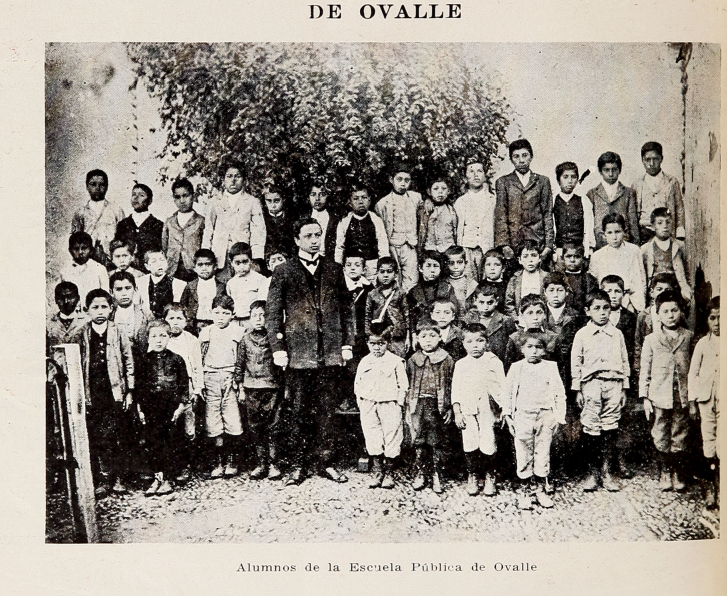
The Centennial and the Celebration for Poor Children.
In 1910, Chile celebrated one hundred years of independence. El Peneca marked the occasion with a concrete act: it organized a charity campaign for poor children.
The magazine asked for donations of clothing, toys and food. It also called for volunteers-especially artistically talented children-to organize a benefit event. Through this platform, it mobilized material resources and children's volunteer labor; at the same time, it experimented with a distinctive way of incorporating children's participation into the national story.
The appeal was clear: donate, volunteer, and register children and families from poor communities so that they too could celebrate Chile's Centennial:
"GREAT SPECIAL CENTENARY ISSUE!
THE DIRECTOR OF 'EL PENECA'
requests that charitable persons be so kind as to send him
LITTLE CLOTHES AND TOYS, NEW OR USED
to distribute to poor little children during the days of the Centenary.
He will also thank the COMMERCIAL HOUSES for anything that might be useful to poor little children and that they may wish to offer him for that purpose.
Let us make the children happy!
Let us give them little clothes, food, sweets, and toys!"
"TO THE READERS OF 'EL PENECA'
who wish to help us with their personal work in this effort we are making for the joy of poor little children during the Centenary, we will be grateful if they would be so kind as to come by our office, from 11 to 12 A.M. and from 6 to 7 P.M. If they know music and singing, so much the better, in order to carry out an idea in this regard: we wish to organize a charity festival."
ADDRESS: SANTIAGO, TEATINOS 666.
EL PENECA, no. 90, August 8, 1910.
To that end, the editorial staff opened a national dialogue and invited readers to send ideas on how the celebration might be held with special consideration for poor children:
"Centenary Celebration
TO THE READERS OF 'EL PENECA'
I come to call your attention to a point that it seems you have not noticed; for I too wish to have my small part in Miss Posada's idea and to give another direction to her suggestion.
All of you are good; all of you have in your hearts a seed of charity and love; awaken, then, the first and direct it wisely toward the second.
Miss Posada says that we should gather money and give it to the 'poor' children. Her idea is excellent, worthy of her child's soul; however, I say something else: give it to the 'orphan' children."
Raquel Olimpia MARTÍNEZ. R.
EL PENECA, no. 76, May 2, 1910.
The editor worked actively with the magazine's clubs to raise money, announcing the sums collected and the names of donors. In issue no. 95 (September 12, 1910), he announced that a “GREAT CHILDREN'S CONCERT” would be held on September 14 at the TEATRO VARIEDADES, located between Huérfanos and Agustinas streets in Santiago.
After the event, the magazine published photographs of the young artists who had taken part. It also provided details about the organizers, reinforcing its message of solidarity:
"The Children's Festival
The Great Concert of 'EL PENECA'
Due to the shortness of time, we were unable to give in the last issue a complete account of the great concert organized by 'El Peneca' for the benefit of poor children, a concert that took place on Wednesday the 14th of this month at the Teatro de Variedades.
Before anything else, we must record the good will and unlimited generosity of the managers of the Biógrafo Kinora of the Compañía Cinematográfica del Pacífico, who placed at our disposal both the theater and the biograph for this work of charity; and the same we must say of the distinguished maestro Don Fernando Navarrete, who philanthropically helped us, accompanying the children at the piano in some numbers, and who was a valuable cooperation that saved us from more than one mishap. We must also thank the good will of Don Eleodoro Nieto for performing the role of Maestro Chambeco."
EL PENECA, no. 97, September 26, 1910.
On October 3, 1910 (issue no. 98), the toys and money raised were distributed. Thousands of families gathered outside the Zig-Zag publishing offices at Teatinos 666, waiting to receive the gifts.
Zamorano: The Archetype of the Dignified Worker.
El Peneca also portrayed humble workers with respect. One example was Miguel Zamorano, a newspaper seller at the Portal Fernández Concha on Santiago's Plaza de Armas. The author described him as a dignified, hardworking man, well regarded by the citizens who regularly bought their newspapers and magazines from him. Although he was never formally a member of the journalists' association, Zamorano was called a “journalist” because of his close connection to news and the public. He represented the “honest poor man”:
“ZAMORANO
Yesterday afternoon I went with my mother downtown to buy certain items for the house.
Suddenly, as we passed by the Portal Fernández Concha at the corner of Estado, I bought 'El Peneca' from the likeable lame Zamorano, as this invalid is affectionately called, who has known how to discover the secret of earning an honest living without needing to resort to public charity as so many do who should be working.
Contact with men from different social strata, with ladies, young people, politicians, and students who come to his rough desk in search of newspapers, has made Zamorano quite a character. There on the western sidewalk of Estado Street, forming an angle with the Plaza de Armas, one sees him, without missing a single day, from sunrise to sunset, seated on a rough wooden box, when not standing, gracefully leaning on his wooden leg beside his other inseparable box in which he has for sale as many newspapers and magazines as see the light of day in Santiago and Valparaíso.
Such is Miguel Zamorano, the lame and one-armed man of the Portal Fernández Concha, a journalist who, as he says, has nevertheless not entered the Journalists' Circle.
Everyone loves him because he is in truth worthy and honorable and thoroughly hardworking.
Long live Zamorano, then!"
Inés ESPEJO DÍAZ.
EL PENECA, n°89, 1.o de agosto, 1910.
Solidarity Beyond Chile's Borders.
When an earthquake struck Italy, the magazine and its readers organized a campaign to raise funds for the victims. Under the heading “The Children's Offering,” the editors praised the solidarity shown by Chilean children:
“WE shall never forget the spontaneity with which our readers answered the appeal we made on behalf of the orphans of Italy after the earthquake that devastated Messina and Calabria.”
EL PENECA, no. 21, April 12, 1909.
The Newsboys' Home: Illustrated Charity.
The same issue included a photographic record documenting the lives of working-class children in Valparaíso. The images showed humble classrooms and pupils taking part in school plays, as well as children jumping in public parks and along cobbled streets, newsboys and newspaper delivery boys. These portrayals and everyday scenes revealed both childhood innocence and the harsh realities of child labor. El Peneca portrayed the philanthropist Don Manuel Acevedo, who founded and ran the newsboys' home in Valparaíso. Photographs of these children were presented as illustrated charity and as an example of “benevolent protection”:
"NEWSPAPER VENDORS' SHELTER OF VALPARAÍSO"
Thanks to the initiative of the industrious local businessman Don Manuel Acevedo, Valparaíso has a beneficial establishment for those cheerful and boisterous messengers called "suplementeros," who carry from house to house the printed pages of Valparaíso and the capital.
The Newspaper Vendors' Shelter serves as a lodging for the children who sell newspapers and also, thanks to its director and founder, who has thought of everything, as a home for feeding both body and soul. The "suplementeros" have there, at Avenida Colón 2, a good dining hall and countless study classrooms."
EL PENECA, no. 21, April 12, 1909.
Catholic Kindergarten: Order and Obedience.
At the same time, in 1908 El Peneca published a photograph of pupils at a Catholic kindergarten. The children, dressed in sailor uniforms, were photographed in disciplined poses that exalted obedience, order and submission to authority-central values in the education of the period:
"AT THE CATHOLIC KINDERGARTEN
Sergio Lecaros F., Eduardo Laval M., and Osvaldo del Río A., three students who obtained unanimous distinction.
With outstanding success, the prize distribution ceremony was held not long ago at the Catholic Kindergarten directed by Mrs. Fanny de Retamal Balboa."
EL PENECA, no. 6, December 28, 1908.
Children of the Elite.
This section formed part of a narrative that celebrated the country's educated and political elite, reinforcing the idea that charity was a moral duty of the upper classes.
On June 7, 1909 (issue no. 29), Don Fernando Ramón Orrego Vicuña was portrayed. He was the son of a man of letters and had begun wearing long trousers, a symbolic rite of passage into adolescence.
In issue no. 46 (October 4, 1909), the magazine published a photograph of members of the Río Montt, Río Aldunate and Río Castillo families. These families belonged to the country's political and social elite.
The images linked bloodline, surname and power, suggesting that national leadership was hereditary. On May 23, 1910 (issue no. 79), the grandchildren of naval hero Arturo Prat appeared: “Arturito and Camilito Undurraga Prat.”
The “Social Life” section elevated the nation's military and political figures. Among those featured were Jorge Huneeus, Minister of Justice and Public Education; Enrique Barrenechea, director of the library of the Instituto Nacional; and Commander Don Jorge Barceló Lira, director of the Military School.
On July 11, 1910 (issue no. 86), it published an image of Williams Rebolledo Ibáñez dressed as a sailor, presenting him as “the descendant of two illustrious Chileans,” “grandson of Admiral Williams Rebolledo and of Don Adolfo Ibáñez.”
International Prestige and National Talent.
Alongside these children, the magazine introduced infant prodigies such as six-year-old Claudio Arrau, nicknamed the “Chilean Mozart,” whose artistic precocity was used to celebrate national talent:
"A MUSICAL PRODIGY
IT is truly a pleasure for us to be able to present to our readers the portrait of little Claudito Arrau León, a true prodigy, a musical talent who is not yet six years old and plays on the piano the works of masters such as Beethoven, Mozart, Bach, etc. He has had no musical studies other than those he himself, spontaneously, has done through observation and his endless questions."
EL PENECA, no. 46, October 6, 1909.
A Window onto the World.
The magazine also showed children from other parts of the world. It published news about European princes, heirs to fortunes and children of tsars-images that constructed an imaginary world of prestige and sophistication. On July 5, 1909 (issue no. 33), it announced the birth of the “future Germanic emperor. Prince Wilhelm, eldest son of the heir to the German throne. Born July 4, 1906.” The item reflected admiration for European aristocracies and validated a social order founded on lineage. On July 11, 1910 (issue no. 86), brothers Marshall and Henry Field, heirs to one of the largest American fortunes, appeared alongside Tsarevich Alexei Nikolaevich, heir to the Russian tsar.
The President as Father of the Nation.
The text presented Ramón Barros Luco (1910-1915) not simply as a head of state but as an almost patriarchal figure who personally attended this charitable event. The title “His Excellency” and the emphasis on his physical presence (“with the attendance of H.E. the President of the Republic”) sought to invest the occasion with an aura of solemnity and supreme legitimacy. By distributing toys to “little orphans,” Barros Luco embodied the father of the nation caring for its most vulnerable children. It was an image of the State as family, with the president as provider and protector:
"NEWS
FOR THE POOR CHILDREN
An act as beautiful as it was likeable was carried out last Monday at the house of the Protectora de la Infancia, where, with the attendance of His Excellency the President of the Republic, Don Ramón Barros Luco, a distribution of toys was made to the little orphans, purchased with money gathered by the half-day students of the Instituto Nacional. This act of charity should be an example to be imitated.
We must, indeed, remember the poor children who have no comforts and who much less can enjoy the delights that the possession of a toy brings them.
Now we also have the pleasure of informing our readers that 'El Mercurio' gathered, as we did during the Centenary, toys as well to give to poor children at New Year.
It is, then, highly satisfactory to us that today other persons continue the work we carried out in September, with the help of our collaborators."
EL PENECA, no. 111, January 2, 1911.
Rockefeller: The Myth of the Self-Made Man.
Set against the solidarity promoted by the weekly, the story of Rockefeller told by contributor Antuco Bezadenell, when transplanted into the Chilean context, took on an ironic quality. A child working in a mine or factory had virtually no chance of imitating those immigrants who, according to legend, had risen from nothing-even if they took turns wearing the same clothes simply to survive. If a child worked twelve hours in a glass factory or in a mine shaft and died of consumption, or of silicosis eating away at miners' lungs, at the age of twelve, then under this logic the blame lay neither with the employer nor the system, but with the child himself for lacking sufficient “fortitude.” The anecdote was thus reduced to a moral as simple as it was cruel: “Rockefeller, one of the richest men in the world, began his life in the most terrible poverty.”
"DIFFICULT BEGINNINGS
We must never become discouraged by poverty and difficulties at the beginning of our lives. The anecdote you are about to read gives an excellent proof of this. It shows how Rockefeller, one of the richest men in the world, began his life enduring the most horrifying misery.
Rockefeller left his homeland very young to go to the United States to try his fortune. At the same time and with identical intentions, a friend of his named Schmidt also departed. Rockefeller and Schmidt were, at that time, so poor that they had no more clothing than what they were wearing.
One day, returning from the factory, already in New York, where both worked, they were so distracted that Rockefeller accidentally stepped on a dog sleeping on the sidewalk. The animal let out a cry and, enraged by the pain, attacked Rockefeller. Fortunately, it did not manage to bite him, but it did tear his clothing, leaving it in a state that made it impossible to wear. The future millionaire was left in despair. His few savings did not allow him to buy new clothes. What would he do? How would he go to work the next day?
He was reflecting on this when his companion had an idea.
The factory operates day and night. The next day he asked for night work, to which the boss consented.
In this way, Rockefeller would go to the factory and work the entire day, return home, undress, and Schmidt would dress and work at night.
Today both are extremely rich. For this reason, it is clear, no one should despair at being poor. Work and courage can carry a man from the most grueling misery to the most astonishing opulence."
Version by
ANTUCO BEZADENELL RIVEZ B.
EL PENECA, no. 325, February 8, 1915.
Synthesis.
The "Vida Social" section of El Peneca articulated a representation of Chile grounded in contradiction. Within its pages, the figure of the impoverished child receiving a toy during the Centenary coexisted with that of the affluent child construed as the future inheritor of power. The publication thereby offered its readers a mirror in which social inequality was naturalized, mitigated by charitable gesture yet left unchallenged as a structural phenomenon. Nonetheless, through its dignified portrayal of poor children and its respectful depiction of laborers, El Peneca cultivated an incipient social consciousness. Concurrently, the Zig-Zag publishing house functioned as a catalyst for Chile's economic and cultural modernization: almost unwittingly, it participated in the education of the underprivileged and the "rotos," symbolically integrating them into the national imaginary. In this sense, the magazine constituted both a reflection of its historical moment and a modest foreshadowing of forthcoming transformations.
Illustrations · original edition
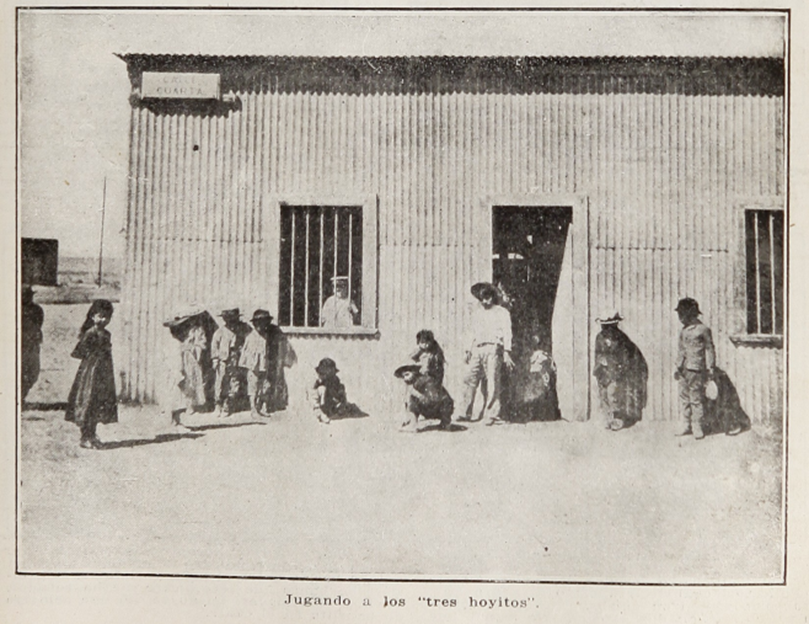
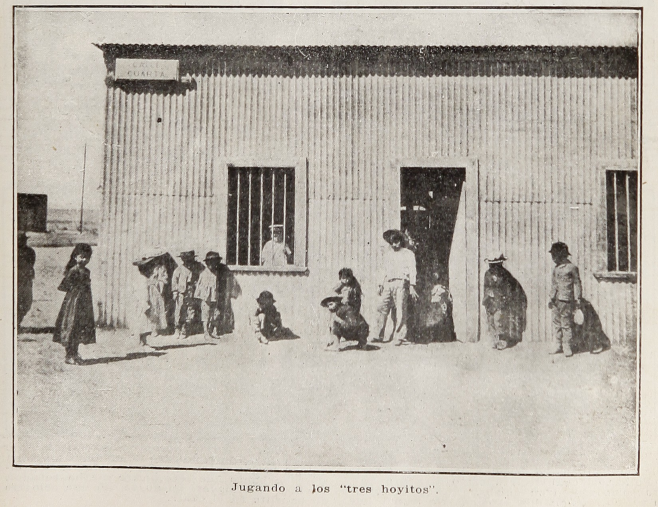
EL PENECA, n°295,13 de julio, 1914.
2.1.4. Comics and Illustrated Stories.
The development of illustrated stories as a mass entertainment medium had its roots in Europe before becoming consolidated in the United States. In 1865, the German artist Wilhelm Busch published "Max und Moritz, eine Bubengeschichte in sieben Streichen" (Max and Moritz, a Boys' Story in Seven Pranks)” in the newspaper Fliegende Blätter (Loose Pages). This illustrated story, considered a precursor of the modern comic, presented a sequential narrative with panels accompanied by humorous verses. The repeated and malicious pranks of Max and Moritz against their neighbors triggered a collective revenge, resulting in an ending at once humorous and grim for the two child protagonists.
In 1895, Richard Felton Outcault created "The Yellow Kid, published in Joseph Pulitzer's New York World. Speech balloons and a defined narrative structure (with captions) were introduced, consolidating the comic format in the American press. The cultural exchange between Europe and the United States marked a milestone in the evolution of comics: German illustrators who emigrated to the United States, such as Rudolph Dirks, creator of "The Katzenjammer Kids" in 1897, inspired by Max and Moritz, adapted the European style to the North American market. Artists influenced one another, while others copied characters and techniques, giving rise to new series. This genre emerged as the first mass cultural phenomenon of the modern era. Daily comic strips and the first comic books revolutionized the newspaper market, demonstrating an unprecedented capacity to boost the sale of newspapers, magazines, and evening papers. An innovative narrative language combining image and text was created. Chile did not remain aloof from this revolution. Pioneering publications such as El Peneca adopted this format and skillfully integrated comics and illustrated stories with traditional literary content. This fusion represented a unique contribution to Chilean popular culture.
The distinction between comic and illustrated story presented no notable differences, for both formats shared characteristics that were frequently intertwined. Both comics and illustrated stories could be self-contained (a complete story in a single installment) or serialized. Illustrated stories tended to be more literary, with a style close to the illustrated tale, where the " box captions" carried a great part of the narrative weight. Comics, by contrast, tended toward greater visual autonomy, with sequences of panels that flowed through action and dialogue in balloons. Faced with the high cost and copyright restrictions affecting foreign productions, mainly European and North American, the strategic response of the Zig-Zag publishing house was to create its own versions of these formats, drawing on national creative talent and meticulously adjusting to the consumption habits and cultural particularities of the Chilean public.
The first half of the 20th century in Chile was a period of effervescent innovation, led by a pioneering group of illustrators, caricaturists, journalists, writers, and scriptwriters. In this dynamic environment, creators produced comics and illustrated stories and experimented with panels of various formats. The pages housed a mosaic of brief comics, some of only three panels, while others occupied the full page. Some had an ephemeral life; others endured by being the main attraction, such as "Chambeco," which became a beloved and memorable figure.
In issue one, of November 23, 1908, the first image of a panel appeared, covering half a page and depicting a father admonishing his son while the mother appeared in the background. It was not a comic in the strict sense, but rather an illustration with a caption that told a small story. But it laid the foundations for what, in time, would become one of the magazine's most popular sections:
The father: Be obedient, son, and don't cry, and remember that in this world there is but one mother.
The child: Thank God there is only one, for at this rate I would already be in the next world.
In issue 2 (November 30, 1908) were published: "How to Hunt a Fly," "At the Barber Shop," and "Silent Story." Issue 11 (February 1, 1909) included "A Surprising Swing," a strip of only three panels showing children amazed by their own mischief.
In issue 16 (March 8, 1909), the panel "Zis zas, Cataplum chinchin" was designed in a minimalist style and anonymously. Issue 12 (February 7, 1909) presented "In the Last Exams: Examined and... Penecas," where the panels were small and varied. This technique of panels of different sizes overlapping created an agile, modern, and bold rhythm for the time.
The story "The Adventures of Calígula the Donkey" appeared in issue 21 of April 12, 1909, across two pages. It portrayed the rivalry between the donkey and his master, Don Esculapio, with scenes of absurd humor between animals and humans.
In comics such as "The Old Cat," "The Wooden Man," and "Jumbo Detective," sixteen tiny panels on a single page showed a narrative advanced for the time. The series "Things of Little Chinese Boys" and "The Adventures of the Little Chinese Boys" (issue 21 of April 12, 1909) portrayed three Asian children whose long braids were used as a comic and narrative device. Today it may seem a stereotype, but in its time it was a way of bringing Chilean children closer to other cultures.
In "The Drawbacks of Progress," published on January 13, 1913, in issue 217, it predicted what food would be like in the year 1997 and presented a futuristic vision in which people, instead of eating fresh products, consumed food pills. In the story "The Night Tailor," published in issue 268 of January 5, 1914, the author used two-color sequences. It paid homage to those trades practiced solely by virtue of innate talent.
The silent story "The Best Is the Enemy of the Good" in issue 273 (February 9, 1914), dispensed with dialogue, relying solely on visual humor. "The Springs" (same issue) used semicircular panels, replacing the traditional square structure.
In issue 314 (November 23, 1914), the characters escaped the limits of traditional panels. It used round frames that interacted freely in the space of the page to simulate an action scene where they ran after their pets. This device transformed the entire page into a unique playing field. In "The Two Enemies" in issue 391 (May 15, 1916), the panels were square, rectangular, and semicircular, aligning with one another without leaving empty space between them. Issue 436 (March 26, 1917) presented "The Gambler and the Devil," with characters with disproportionately large heads, breaking with conventional anatomy.
Father: Be obedient, son, and don't cry, and remember that in this world there is only one mother.
Boy: Thank God there's only one, because at this rate, if there were another I'd already be in the next world.
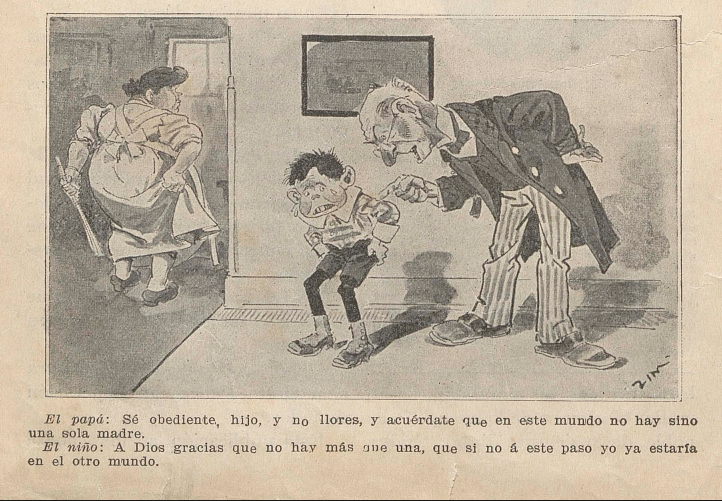
In issue 2 (November 30, 1908) were published: "How to Hunt a Fly," "At the Barber Shop," and "Silent Story." Issue 11 (February 1, 1909) included "A Surprising Swing," a strip of only three panels showing children amazed by their own mischief.
In issue 16 (March 8, 1909), the panel "Zis zas, Cataplum chinchin" was designed in a minimalist style and anonymously. Issue 12 (February 7, 1909) presented "In the Last Exams: Examined and... Penecas," where the panels were small and varied. This technique of panels of different sizes overlapping created an agile, modern, and bold rhythm for the time.
The story "The Adventures of Calígula the Donkey" appeared in issue 21 of April 12, 1909, across two pages. It portrayed the rivalry between the donkey and his master, Don Esculapio, with scenes of absurd humor between animals and humans.
In comics such as "The Old Cat," "The Wooden Man," and "Jumbo Detective," sixteen tiny panels on a single page showed a narrative advanced for the time. The series "Things of Little Chinese Boys" and "The Adventures of the Little Chinese Boys" (issue 21 of April 12, 1909) portrayed three Asian children whose long braids were used as a comic and narrative device. Today it may seem a stereotype, but in its time it was a way of bringing Chilean children closer to other cultures.
In "The Drawbacks of Progress," published on January 13, 1913, in issue 217, it predicted what food would be like in the year 1997 and presented a futuristic vision in which people, instead of eating fresh products, consumed food pills. In the story "The Night Tailor," published in issue 268 of January 5, 1914, the author used two-color sequences. It paid homage to those trades practiced solely by virtue of innate talent.
The silent story "The Best Is the Enemy of the Good" in issue 273 (February 9, 1914), dispensed with dialogue, relying solely on visual humor. "The Springs" (same issue) used semicircular panels, replacing the traditional square structure.
In issue 314 (November 23, 1914), the characters escaped the limits of traditional panels. It used round frames that interacted freely in the space of the page to simulate an action scene where they ran after their pets. This device transformed the entire page into a unique playing field.
In "The Two Enemies" in issue 391 (May 15, 1916), the panels were square, rectangular, and semicircular, aligning with one another without leaving empty space between them.
Issue 436 (March 26, 1917) presented "The Gambler and the Devil," with characters with disproportionately large heads, breaking with conventional anatomy.
Raúl Figueroa, “Chao,” created the comic character “Cachencho,” embodying the outsider archetype. His first episode, “Seven Days in the Life of a Finger-Sucker,” debuted in issue no. 3 (December 7, 1908). This series, structured in a single panel, occupied one page per installment and warned young readers, through seven caricatures, about the dangers of bad habits. On March 29, 1909, Figueroa published “The Sad Story of Cachencho: What Happened to Him in Six Days” in issue no. 19. The character's success prompted a second installment in issue no. 21, dated April 12 of that year. Through the protagonist's misfortunes, the comic conveyed a clear moral lesson about the consequences of disobedience and lack of virtue:
“THE SAD STORY OF CACHENCHO.
WHAT HAPPENED TO HIM IN SIX DAYS.
1. Cachencho also had the bad habit of eating dirt.
2. One day he had the misfortune to swallow a cherry pit along with the dirt.
3. The consequences were not long in coming. A cherry-tree shoot sprang from his liver.
4. And that shoot grew into a shrub.
Illustrations · original edition
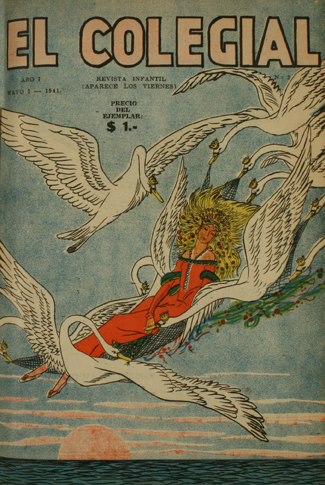
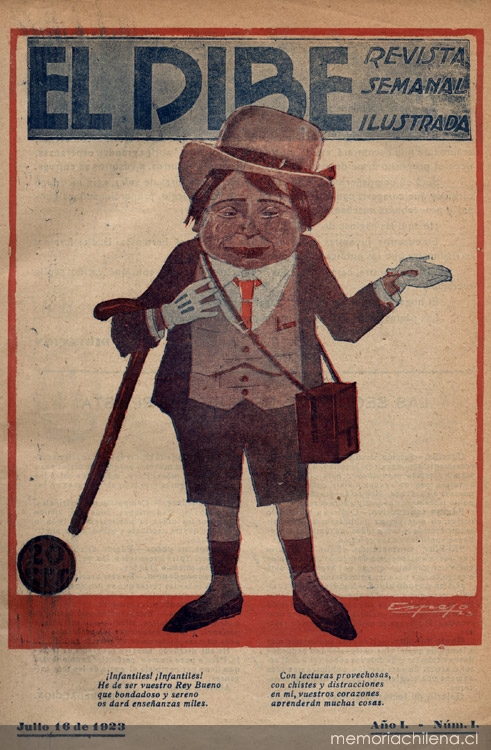
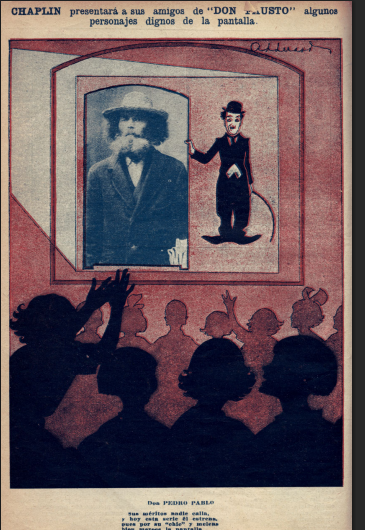
Don Fausto. Dibujante Alfredo Adduard, 1 de agosto 1924.
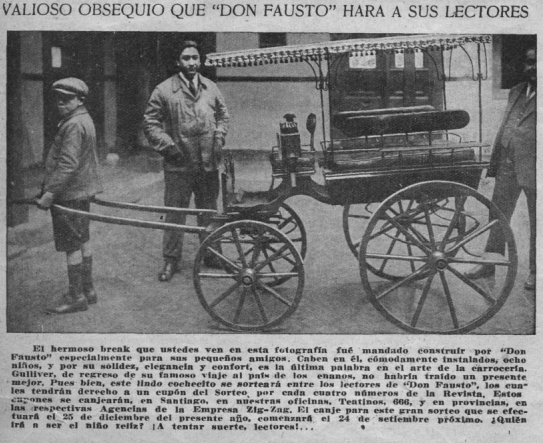
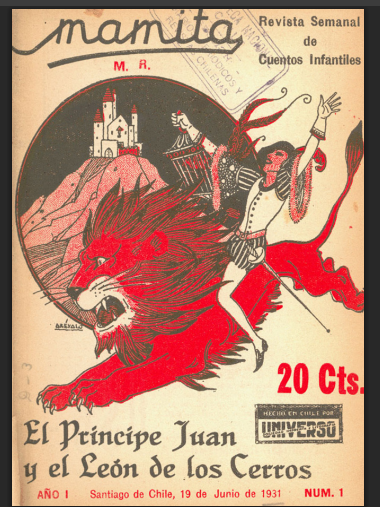
Ilustrador Jorge Arévalo
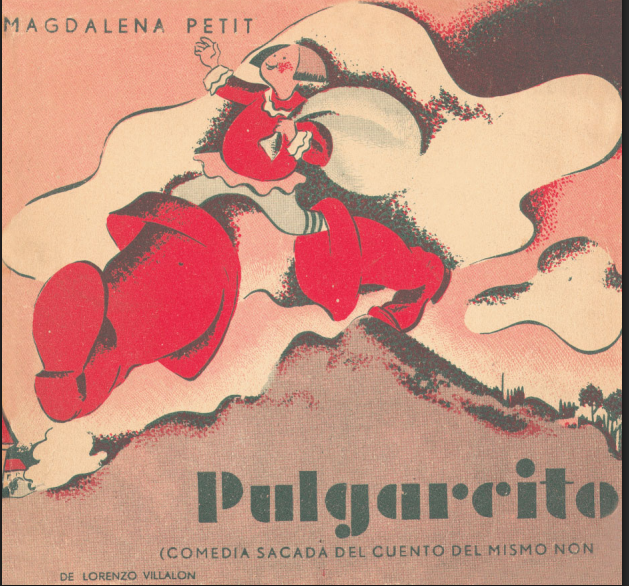
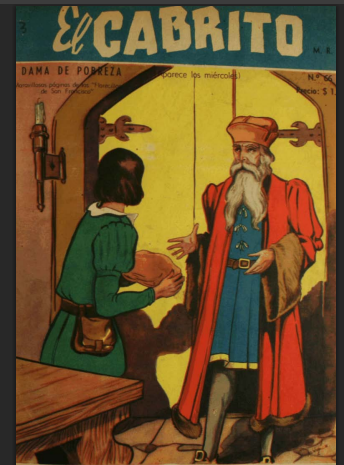
Dibujante Alvial
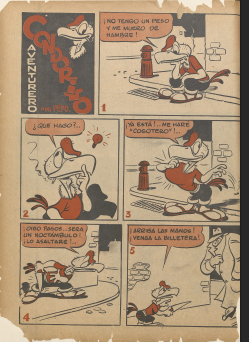
Condorito en la revista Okey
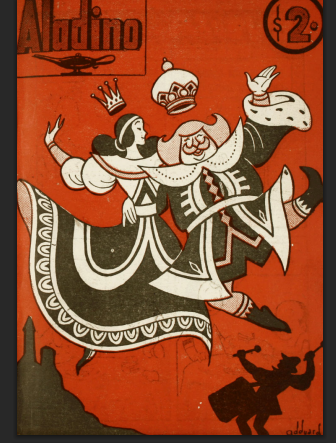
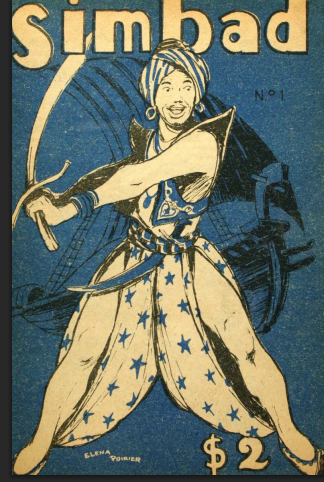
Dibujante Elena Poirier
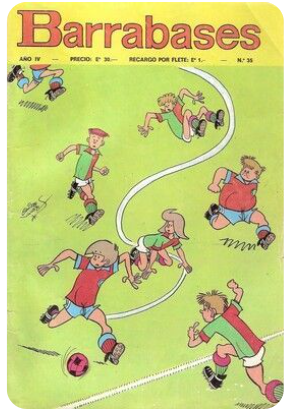
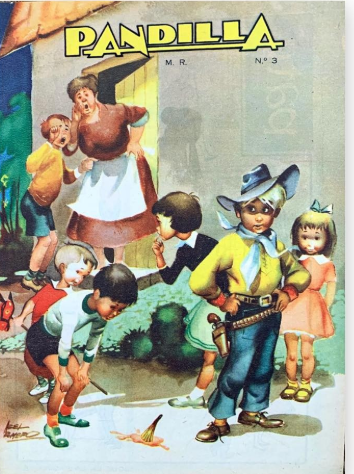
Dibujante Abel Romero
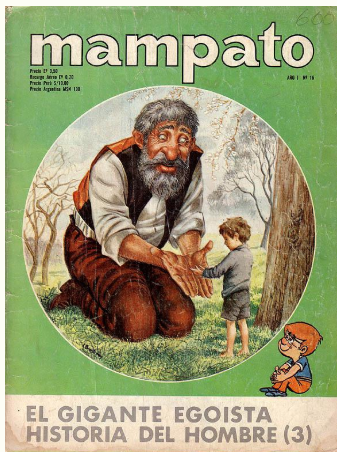
5. And the shrub into a little tree, which he himself watered unconsciously with his tears.
6. Until at last it turned him into a gigantic tree, from whose branches children hung to eat the cherries it produced in abundance...”
EL PENECA, no. 21, April 12, 1909.
“The Adventures of Sánchez, words by Cabo Moya, illustrations-without music-by Marius” (Luis Fernando Rojas, “Marius”) began in issue no. 108 (December 12, 1910) and concluded on January 23, 1911, in issue no. 114. The series followed the chaotic adventures of Sánchez, a poor and courageous but immature and stubborn character. Sánchez longed to become a contributor to El Peneca. His first failure was absurd: he could not even manage to insert his manuscript into the mailbox. Tormented by poverty, he developed a fixed idea of emigrating to “America” to seek his fortune. The obsession drove him through a succession of misadventures: stealing bicycles, stowing away aboard ship, being swallowed by a whale that sneezed him back out, becoming a sailor, and seeing his American dream cut short when he was returned to Valparaíso. There, having learned nothing, he fell into still more trouble, ending with his final disappearance: he climbed into a balloon and vanished forever among the clouds.
In "Efectos de un año de colegio" ("Effects of a Year of School"), from issue number 21 (April 12, 1909), created by Emilio Álvarez, 'Pun-TT', the challenge of children staying orderly during a school year was satirized. It also gave life to one of the most emblematic characters since the first issue: "El Maestro Chambeco" ("Teacher Chambeco"). This singular clown-pedagogue became the soul of the weekly publication, fusing education and entertainment with mastery. His physiognomy was unmistakable: a sharp nose, a slender silhouette, and elastic movements. He had an ingenuous and wise character, a mixture of kindness and tenderness. He taught the alphabet through pirouettes, games, and rhythmic verses. The story included an infant child nicknamed "Bebé" ("Baby"), proud of knowing the alphabet and arithmetic. "Chambeco" put him to the test and, upon verifying that "Bebé" had not yet mastered the letters well, consoled him and began to teach him, forming each letter with his own body:
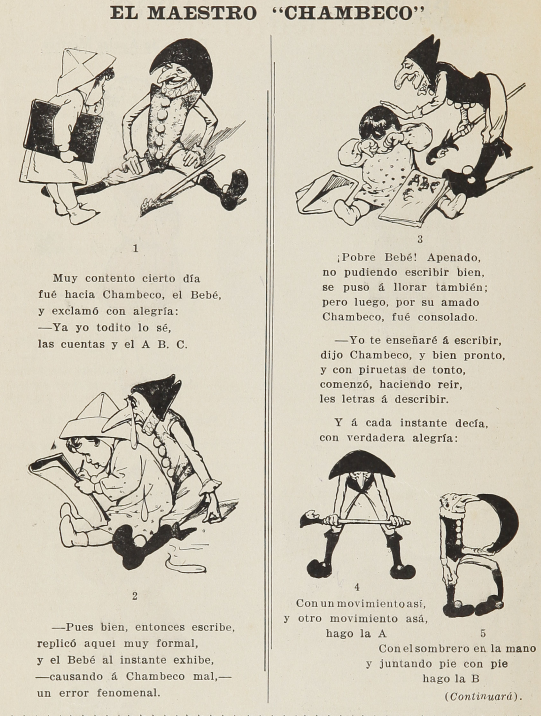
EL PENECA, no. 1, November 23, 1908.
In issue no. 2, dated November 30, 1908, “Chambeco” could be seen teaching his pupil Bebé by performing the letters “C” and “D” with acrobatic poses. The little boy interacted with his teacher, expressing his delight in verse:
"Bebé, with great joy,
watched Chambeco
perform the pirouettes he did for him,
and at each trick he said:
This is what I was hoping for!
If I have already learned the A and the B
by myself, thanks to you,
with your fun game,
now teach me the C,
and I will be grateful to you."
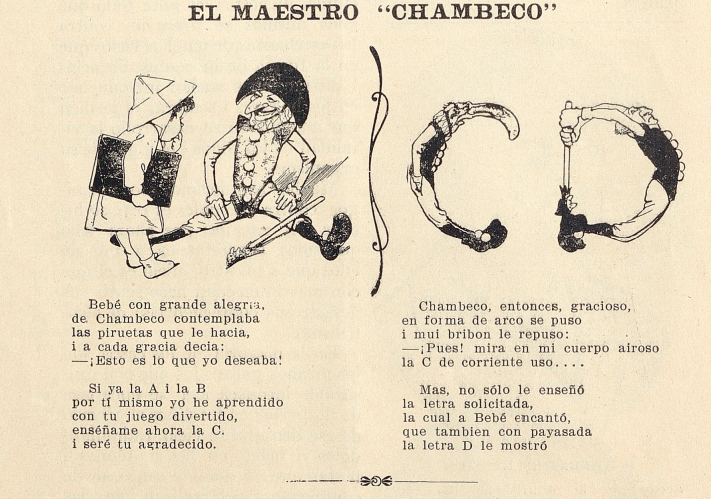
"Chambeco" became the children's favorite character. The poems that accompanied the vignettes reinforced the lessons and created a unique bond of complicity, demonstrating that learning could be a graceful adventure.
In issue number 25 (May 10, 1909), José Foradori immortalized "Chambeco" with a close-up portrait that took up the entire cover. This image, charged with expressiveness, showed the pedagogical clown in his full splendor.In issue number 63 of January 31, 1910, "Pepin" illustrated only his face alongside a Peneca waving from atop a globe.
The character generated an unusual devotion among the child audience. The children eagerly awaited his lessons and antics. When the teaching of the alphabet was completed, readers became worried about his fate; some even wondered whether he had died. The mourning over his unexpected departure provoked a collective reaction: "The children loved him, missed him, and demanded his return." For many readers, the character was not a fiction, but a real teacher, and his disappearance created an emotional void that the magazine's management had to address. The response came in later issues, where the children's voices were incorporated:
"The Tributes to the Tireless Teacher 'Chambeco' Continue
Santiago, July 30, 1909. – Present – Mr. Director of 'El Peneca' – Dear and respected Sir:
The same thing happened to me as to Miss Blanca Rainerie Lanes, that my tears alone would have been enough to form a river, upon learning through 'El Peneca' the terrible and sad news that Bebé had eaten our teacher Chambeco.
But you too, Sir, cannot imagine the joy it gave me to read the latest issue of 'El Peneca', in which you tell us that Chambeco is alive; but poor and old, and that he is so alive that he asks us to write to him if we are happy with him. I think we are, at least to me he has inspired such a deep sympathy, so deep, that I cannot express it either to you or to him. With respectful regards, A. S. S. (your obedient servant).”
Celia Diaz Palacios
EL PENECA, no. 34, July 12, 1909.
"Viña del Mar, July 6, 1909 – To the illustrious Teacher Chambeco:
I hope that you, Chambequito,
will soon come out,
on the pages of 'El Peneca',
to make us laugh.
Come out, then, my teacher,
for I promise you
to be a diligent student,
and to learn very, very much.
We love Chambeco,
whether big or small,
whether child or old man,
whether poor or rich.
Accept, Chambequito,
my humble inspiration,
may God will that soon
your heart may soften."
Anina Sanhueza Rodriguez.
EL PENECA, no. 34, July 12, 1909.
"The Tributes to the Tireless Teacher Chambeco Conclude
„Tell Chambeco that I am very sad because he has gone away, and that I was pleased with his wise lessons.
A reader who loves 'El Peneca' bids farewell."
S.S.S. (your faithful servant) María Castro A.
EL PENECA, no. 35, July 19, 1909.
With the departure of editor Enrique Blanchard-Chessi, the magazine officially announced the “Death of the Honorable Chambeco” with a commemorative illustration in orange-sepia tones and a melancholy poem formally marking his departure:
"DEATH OF THE HONORABLE 'MAESTRO CHAMBECO'
With my heart now dried out from so much weeping, I know I must sadden you, for it is very sad for me to announce that 'Chambeco' has passed away.
The professor's health grew worse by the moment: he was no longer the wise writer, nor the creator with the constant little laugh....
He no longer smoked 'cigarettes'; his appearance was funereal... To cure himself of the illness, he set out on a journey to Catillo and afterward to Chillán.
'Bebé,' always eager, followed him attentively: the boy asked for it, and his plaintive tone moved the teacher!....
The boy is devastated... for the cruel illness has him bedridden. Bebé murmurs at his side: Lord... have mercy on him!
Chambeco is going to die now.... and Bebé, before a table, in that cursed room, thinks that with his trickery he will stand in the way of death,
–I am going to make my will... goodbye, beloved magazine!.... Do not erect a monument to me... (At this moment Bebé sobs with heartfelt tears!...).
And he tried to speak... but could not, he no longer had reason... he only uttered "forgiveness"; death, with its rough air, blew upon his heart!
His soul, like a white dove, took flight in haste: the forest moaned in anguish, and the sun, behind a lost hill, hid its weeping face!!!..."
JULIO DELL ORTO PRIETO.
EL PENECA, no. 115, January 30, 1911.
In November 1911, Walter Barbier undertook the revitalization of the beloved character "Maestro Chambeco." He reintroduced him in a new comic strip format, preserving his essential traits—the sharp nose and the slender body—which made him unmistakable. The public enthusiastically welcomed his return; the editorial office was flooded with letters celebrating the teacher's comeback.
"MAESTRO CHAMBECO
(first series)
Our readers have not had news of Maestro Chambeco for a long time. You should know that poor Chambeco was unemployed for a long time and in the greatest misery. Such was his poverty that once, from a single sardine, he had to make three portions for three days."
EL PENECA, no. 156, November 13, 1911.
Walter Barbier consolidated his place as one of the greatest exponents of the comic or illustrated strip genre with series such as "Los Levacorta," "El Dieciocho, de ño Carmelo," "Paco, Quico y Caco," "Barrabasita," "Aventura de Huauhuau," "Pepino Carpintero," "La guerra de las empanadas," and "Semibreve y su acordeón." He accompanied the weekly publication for years, also as an illustrator who complemented numerous literary issues. Humor and satire also had a prominent place, as demonstrated by the series "Las vacaciones de Caín" ("Caín's Vacation"). In issue number 174, corresponding to March 18, 1912, this installment appeared, starring the incorrigible "Caín 2nd Piña," a mischievous and carefree character whose adventures usually ended in amusing mishaps. With a simple graphic style and a text that combined irony with an implicit moral, it hinted at certain lessons about the consequences of impulsive acts:
"CAÍN'S VACATION
Day VIII
Walking along the riverbank, the incorrigible Caín 2nd Piña spots a fisherman's net spread out in the river.
'A good opportunity to get myself a hammock to take a nap!' Caín says to himself—and since the word 'belonging to others' does not exist for him, he takes the net and drags it to his house with the greatest nerve, with one or another silverside fish tangled in it.
He installs the hammock between two trees. And after depositing on them the Tie, Vest, and Sock….
He climbs up too, and the four animals prepare to take a comfortable nap.
But man proposes and God disposes. The meshes of the net, which had been made to hold silversides and not Caíns, broke, and everyone fell flat.
And the nap that day was very incomplete, for from the blow Caín's legs and tailbone fell asleep."
EL PENECA, no. 174, March 18, 1912.
Walter Barbier was among the most beloved artists. Week after week he drew laughs from young and old alike. Behind his graphic humor he hid a personal history marked by suffering. In issue number 273, of February 9, 1914, the contributor Aida Moreno, under the pseudonym "Adami," dedicated these lines to revealing the artist's intimate side, offering a moving portrait that contrasted with the joy Barbier captured in his vignettes:
"WALTER BARBIER
'Laughter is a mask that disguises pain.'
For a long time I had admired and loved the author of the amusing characters of 'El Peneca.' But I was mistaken. I believed that just as he made others laugh, he in turn laughed; but can he who carries the weight of his misfortune laugh? Walter Barbier could tell us.
I know little of his life: I know that he is a great artist with a privileged soul, for he has understood that the public, in general, would care little about his sadness, which he could have portrayed faithfully, and so he devoted himself to caricature, delighting young and old alike.
Few will have suffered with his tranquility the physical and moral pains; but he has known how to struggle and his will has triumphed. In his broad and thoughtful brow, petty ideas have found no place, and that is why Walter Barbier lives for the happiness and good of his homeland.
Nature, sparing toward him, deprived him of the delights of childhood and perhaps also of the illusions of youth—even more terrible, for the heart understands better and feels more the need for affection. My soul has understood that of Walter Barbier, and he can be sure that he has found a kindred soul who admires him from afar and rejoices in his triumphs. And you who laugh as you read the mishaps of the Levacorta family, love Barbier dearly, for he needs the affection of his fellow beings. I present him to you only briefly; but know and do not forget that his life has been very sad..."
ADAMI.
EL PENECA, no. 273, February 9, 1914.
In January 1918, Walter Barbier published a letter in the Santiago newspaper La Opinión claiming exclusive authorship of the series “Los Levacorta.” The publisher's response, led by Emilio Vaisse, was categorical: the intellectual property in the series belonged to the company. According to the official position, Barbier had created the comics during his employment relationship and under an editorial contract, which made the characters institutional property. In the interpretation prevailing at the time, the fact that the strip had been published by Zig-Zag barred any claim by the artist.
Barbier was seeking what today we would call recognition of authors' rights, in a context dominated by verbal or informal agreements. While the publisher regarded “The Levacorta Family” as a replaceable product within its commercial machinery, Barbier saw it as a personal and non-transferable creation. Zig-Zag backed its editor's position, consolidating the company's control over material published in the weekly. The dispute foreshadowed tensions between artistic creation and industrial logic.
"TALKS
The Levacorta Family
This is a family predestined to all manner of adventures.
Those it has already experienced in the pages of the magazine are not enough for it.
Discontent with the latest mishap—that is, with the horrendous kidnapping it has been suffering in the Cerrillos de Teno at the hands of bandits—it seeks journalistic adventures in Santiago. It is a desire for publicity truly strange in one who has appeared for so many months in print and in cartoons of various colors…
But one must take people as they are. An example of their oddities: the Levacortas are not satisfied with having been born in the house of 'El Peneca.' Now Mr. Walter Barbier wants to be their author and, therefore, their owner.
In 'La Opinión' of Santiago (January 12, 1918), that distinguished artist writes to the Director of 'El Peneca' a letter in which he sets forth this claim.
To all the reasons adduced by Mr. Barbier we reply:
The idea of the Levacorta series is the property of the Director of 'El Peneca.'
And not only is the fundamental idea the property of the aforementioned Director, but the development of that idea also belongs to him.
Mr. Barbier has forgotten that, for each issue of 'El Peneca,' the Director of the aforementioned magazine sent him a handwritten sketch or detailed outline, whose development or realization in the form of a drawing was entrusted to the aforementioned Mr. Barbier.
This fact is of public notoriety at 'Zig-Zag.'
It is strange, then, that Mr. Barbier should have published a letter such as the one alluded to above…
I have no objection whatsoever to recognizing that Mr. Barbier, through his drawings, contributed to the success of the Levacortas; but I do not accept in any way that he claims to make himself the owner of the Levacorta series in the capacity of author.
All the series of any length published in 'El Peneca' (such as Los Levacorta, Ño Carmelo en Europa, Cain 2nd Piña, Mr. Savage's Electric School, etc., etc.) were devised by me.
This, I repeat, is a well-known fact.
Furthermore, the original drawings published in 'El Peneca' by Mr. Barbier under the title of Bromas (which constituted series of loose pages) are the only ones in whose production I have not contributed.
It was to these that I referred in a letter cited by Mr. Barbier, in which I told him that 'his replacement would know how to respect the drawings and series devised by him…'
Those Bromas have been, are, and will be respected…"
EMILIO VAISSE.
(Omer Emeth).
Director of El Peneca.
EL PENECA, no. 480, January 28, 1918.
Although his claim did not succeed, it set a significant precedent regarding authorship in the field of national comics. Barbier lost the legal dispute. The publisher thus reaffirmed its model of serial production, where creators were considered replaceable and comic strips mere cogs in an expanding industry. In issue number 447, of January 7, 1918, the cartoonist "Leonard" took over the series. However, in the midst of this controversy, the cartoonist published in issue number 484, of February 25, 1918, "Los Levacorta (see appendix)," which interrupted the usual series. The image portrayed the politics of the time, possibly with the intention of arbitrating or, at least, making visible the debate over author's rights. More than an explicit taking of a position, the strip seemed to operate as a visual commentary on power relations at the national level. At the bottom of the page, it was announced that "Los Levacorta" would return in a week, but that return never happened.
Previously, "Leonard" had chosen to create the illustrated strip "Chaplin en Chile," published on April 30, 1917 (issue number 441). The farewell of this character took place in issue number 460, of September 17, 1917, when he appeared dancing a Chilean cueca in homage to "Chaplin." Finally, issue number 470, of November 18, 1917, marked the definitive end of the series. However, by then only the title retained the name "Chaplin en Chile," since the content had lost all connection with the famous international character.
Synthesis.
Between 1908 and 1921, El Peneca consolidated itself as a true laboratory of comics and illustrated strips. Stylistic resources from Europe and the United States were adopted—from silent panels to borderless pages—but the publication knew how to stamp them with its own seal, characterized by absurd humor, implicit moral lessons, and the tenderness of characters such as "Maestro Chambeco."
This early experimentation demonstrated an understanding of comics as an autonomous language, long before the medium was recognized as such. The weekly publication knew how to combine foreign influence with local creation, thanks to the work of cartoonists such as Emilio Álvarez, Raúl Figueroa, Walter Barbier, and many others, who forged a recognizable style close to the child audience.
The pedagogical function reached its highest expression in "Maestro Chambeco," a clown who taught the alphabet with pirouettes and whose fictional death triggered a moving collective reaction among child readers—evidence of the emotional bond that the publication had managed to build with its audience.
However, this creative flourishing was not exempt from tensions. Anonymity and the precariousness of professional recognition ran throughout the entire period. An emblematic case was the conflict between Walter Barbier and director Emilio Vaisse over the ownership of "Los Levacorta," which set a significant precedent regarding authorship in national comics and laid bare the unfair conditions in which its pioneers worked.
Taken as a whole, the comics and illustrated strips section of El Peneca constituted a narrative and visual laboratory of the first order. This panorama allows for a better understanding of part of the origins of comics and illustrated strips in Chile, their coexistence with other literary forms, and the emergence of the first popular icons, thus laying the foundations of a national comic tradition.
2.1.5. Children's Literature.
Children's literature has its roots in oral traditions and in the early pedagogical attempts of figures such as Comenius, whose Orbis Sensualium Pictus(1658) established a fundamental precedent. However, it was during the Enlightenment (18th century) that Antoine Galland translated and published The Thousand and One Nights, a collection of wondrous tales, fairy tales, exotic worlds, and magical stories, gathered between the 8th and 9th centuries in the Middle East, India, and Persia.
These astonishing tales from distant lands, together with European popular narratives and the old tales—also fairy tales—that began to be recorded in writing, consolidated a genre that, at the beginning of the 20th century, would find in El Peneca an exceptional vehicle for its adaptation and native creation in Chile.
Blanchard-Chessi and Emilio Vaisse, moved by a deep commitment to the nation's children, turned the magazine into a fundamental exercise in creative interrelation. Their method consisted of translating and disseminating tales and narratives from Europe and the Middle East, but also of publishing Chilean folk tales, moral fables, and local legends. The repertoire ranged from contemporary stories to adaptations of universal classics and great adventure stories, without neglecting pedagogical essays in a colloquial tone. In this way, El Peneca knew how to blend the cultural identity of the West with the narratives of Chilean country folk, offering its readers a universe in which recurring themes appeared: the overcoming of trials, prudence in the face of danger, respect for social norms, humility before pride, and the reward of effort or kindness. Alongside these values, there also dwelled in its pages palaces, wonders, and a magic that favored the protagonists in moments of greatest risk.
In its first issue, El Peneca published the story "The Fisherman and the Spirit" (issue 1), in which a fisherman was freed by the genie of a bottle. The spirit rewarded him by taking him to an enchanted lake, where the princess, under a spell, had to whip her husband. The king killed the sorcerer, broke the curse, and love triumphed.
This tale distilled the charm of the wonderful stories of the East — magic, princesses, kings — and closed, like fairy tales, with a happy ending:
"IN those times there lived on the shores of a lake a poor fisherman and his family. As usual, one day he went out in his boat to cast his nets, eager to obtain a good catch, for misery and hunger scourged his home. But fortune proved elusive, and when he drew in his nets, after a long wait he found as his only booty a wretched metal bottle, sealed and lacquered. Spurred on by curiosity, he opened it, and in that instant thick black columns of smoke began to escape from the neck, which, spreading out, took on in their upper part the appearance of a horrifying face with a thick, disheveled beard, and in its center had two eyes that seemed to shoot rays of fire with their gaze.
The spirit spoke: 'O you, the most fortunate of mortals,' it said to him, 'you have done me a great good, freeing me from that narrow prison in which a wicked fairy had confined me; I shall reward you for your action.' And taking the humble fisherman among the masses of smoke, it carried him like a cloud through the air to the shores of an enchanted lake. There the spirit left him and disappeared. The fisherman, seeing himself with so much fish in sight, felt intense pleasure. How much bread he could give his poor little ones with the product of what he was about to obtain!
He was still speaking when he heard the footsteps of the princess nurse, who was coming to fulfill, as every day, her sad mission of whipping her husband. The king, deeply moved, hid behind some curtains and then began to slip secretly toward the neighboring room, to the place where the sorcerer's bed was. Once there, he suddenly unsheathed his sword, lunged at the defenseless old man, and cut off his head.
Then something very strange happened. From all sides voices and joyful murmurs were heard; from the countryside palaces and beautiful houses emerged, and numerous inhabitants crossed the streets happily, embracing each other effusively. The enchantment had ceased.
The prince and the princess, full of joy and gratitude, arranged great festivities in honor of their savior and afterward accompanied him to their kingdoms, where they met the fisherman through whose cause they had returned to real life, and they showered him with great benefits."
EL PENECA, no. 1, November 23, 1908.
On December 21, 1908 (issue 5), the story "How the Shoemaker Maruf Became King" appeared, also of Eastern origin. The shoemaker was rewarded for his innocent soul. Fortune reserved a surprise for him when he entered a hall, where he found fairies who put a ring on him so that he might make a wish. The king granted it and gave him his daughter in marriage, and he asked: "I want to be king to do charity for all my people."
"Thumbelina" was the first story serialized in the "Folletín" section. Its publication began in the first issue (November 23, 1908, it was not published until issue 2) and concluded on January 11, 1909 (issue 8). This fairy tale, based on the text by Hans Christian Andersen first written in 1835, was adapted for the weekly publication. It told the story of a tiny girl who, after overcoming dangers, found her place in the world. The ending was a lesson in belonging and transformation.
The serialized story was "Hansel and Gretel" between January 18 (issue 9) and February 7, 1909 (issue 12). They reproduced it in the "Folletín," and it was based on the 1812 collection of tales by the Brothers Grimm. The children lost in the forest, the house of nougat and sugar, the wicked witch. It was a dark tale, but also a lesson in cunning and survival.
Alberto Mauret Caamaño's story "the story of a bad king and a lively flea," with illustrations by Emilio Álvarez, was a serialized poem that began on February 22 and concluded in issue 18 of March 22, 1909. The flea bit the king without ceasing, until the subjects rebelled. It was a political satire disguised as a children's tale and ended with a moral: the flea forced the king to abandon the country, and the people, freed from their tyrant, constituted themselves as a republic and achieved happiness:
"A LOVELY TALE IN VERSE
We recommend to our readers the appealing reading of The Story of a Bad King and a Lively Flea, which we begin publishing in the present issue. It is a lovely tale in verse, by the distinguished poet Mr. Alberto Mauret Caamaño and talentedly illustrated by the young cartoonist Mr. Emilio Álvarez."
EL PENECA, no. 14, February 22, 1909.
"What do you want from me, flea,
that you cause me such torment?
–That you abdicate at once,
and depart far from here.
The people suffer dark sorrows,
between hunger and horror;
and today, thanks to my courage,
the people break their chains.
The king submits to his fate;
and followed by his dog,
into death and exile
he takes the harsh road.
At last, the fierce misdeeds
were forgotten by the monarch;
and throughout the region
all the people were happy.
Children who listen with delight
to the story of the tyrant king,
learn from an early age
to practice justice.
So that later, when valiantly
you enter the world to struggle,
as you know how to respect,
you too will be respected."
A. MAURET
EL PENECA, no. 18, March 22, 1909.
“Khan Kilin-Kon-Kun” (issue no. 19, March 29, 1909) was a story with a moral. A king demanded that his son marry a woman capable of embroidering the imperial coat of arms on the point of a needle. A young woman rejected the task with irony. The story questioned the absurd demands of power. One young woman in the kingdom refused the challenge in an ironic letter:
"…that she be capable of embroidering the imperial arms on the tip of an ivory needle of the kind His Majesty uses to scratch his ears when they itch."
"Sire: what Your Majesty asks in order to grant the hand of your son is an impossible thing. Keep Your Majesty your Crown Prince and stock up on ivory for the hundred thousand backsides that will have to be adorned on the day of the contest; but surely mine will not be counted among them—Luz de la Selva."
EL PENECA, no. 19, March 29, 1909.
“Solomon's Treasure” (issue no. 125, April 10, 1911) carried readers to the East. Two friends found a mysterious map and traveled to Jerusalem. The treasure was guarded by the legendary King Solomon. On their return, they received diamond nuggets. It was a story of adventure and reward.
“The Adventures of Baron Münchhausen,” written by Rudolf Erich Raspe and published in 1785, appeared in issues 270 and 271 (January 19 and 26, 1914) under the credit “Copied by El Tatarita,” almost certainly the pseudonym of the translator and adapter. In the first installment, “The Baron's First Journey,” his early passion for travel was described as having been inspired by his father's stories. This nobleman wandered the world, exaggerated his exploits and invented incredible encounters. The result was humor, fantasy and a critique of vanity.
The Arabic tale “The Fingers of the Hand,” published on January 15, 1912 (issue no. 165) and adapted by Luis Larraín of Valparaíso, reflected on social order and justice. Larraín told of a political conflict between a rebellious poet and the caliph, with social structure symbolized through the anatomy of the hand: the thumb meant work and thus the people; the index finger represented art, intelligence and ingenuity; the ring finger symbolized strength; the little finger personified woman and grace. The sovereign was the heart, which governed the whole and directed the hand's movements. If one of the five disappeared, harmony ended. Confronted with the people's demand, the caliph surrendered power to the poet; once in possession of it, the poet proved incapable of exercising sovereignty. The caliph recovered his authority and proclaimed:
"I forgive the poet his boldness and I give to his sister all my riches that were awarded in the poem. Inequality is in Nature. But be comforted; equality comes at the hour of death.
Amer left to posterity his name, which illustrated Islam in the East.
His finger, enclosed in a little bag of green velvet embroidered with gold, is still preserved in the great mosque of Baghdad, and his poem 'Khamsa' (the five) is the wisest and most complete treatise of philosophy of those that have been written in the Arabic language."
Luis Larraín, Valparaíso
EL PENECA, no. 165, January 15, 1912.
“The Virgin of the Ruins” (issue no. 249, August 23, 1913), by Fernán Caballero, told the story of a shepherdess who ascended to heaven. The Virgin carried her away. It was a tale of faith and redemption:
“When they approached the hut they saw a very great brightness and imagined that it was burning, so they quickened their pace; but when they entered it, they saw no fire, only some youths whose white tunics shone so brightly that they caused that light. Near the little shepherdess was a very beautiful lady, resting the girl's head upon her breast, and when they drew near they saw the little shepherdess smile, sigh, and die. Then the Lady signaled to the beautiful youths, who came closer and took the little shepherdess in their arms—she who, even dead, still kept her smile—and they carried her to heaven, for those youths were angels and the Lady was the Virgin of the Ruins, and she returned to her niche to win more souls for heaven."
Fernán Caballero.
EL PENECA, no. 249, August 23, 1913.
"The Ferocious Hunter" (issue 201, September 23, 1912), an Alsatian legend, dealt with the lack of faith. A baron and his daughter despised Christian traditions. Both died in a hunt. The baron passed into memory as "the ferocious hunter." It was a warning against arrogance.
"The Treasure of the Alhambra" (issue 223, February 24, 1913) was an Arabic tale about charity and cunning. A Spaniard aided a dying Moor. The latter revealed to him the location of a treasure. The mayor tried to steal it, but the Moor's cunning allowed the Spaniard to recover his share. The story vindicated generosity and intelligence.
On February 20, 1911, in issue number 118 of the magazine, the fable "The Donkey and the Dog" was published, with text by L. Ehrer and illustrations by "Moustache." In it, a dog taught a selfish donkey about mutual aid as a natural law, exemplified by lichens, in which algae and fungi support each other. The donkey ended up devoured by a wolf, while the hungry dog begged him for help in vain. The author was listed as L. Ehrer, though it could have been E. Lehrer, perhaps due to a printing error:
"Helping one another is a natural law…
Thus our latest scientific reading taught us with the example of the lichen, that is, of that 'vegetable society' called Lichen, composed of an alga and a fungus that help each other to live, feeding and protecting one another.
A beautiful example that all of nature gives us at every step!...
But we frequently see that men and even children refuse to learn and put into practice such a splendid lesson.
La Fontaine, disguising men as animals, tells us that, however categorical the law of mutual aid may be,
'Nevertheless the donkey one day refused to respect it...'
What shall we say? Masters, donkeys, dogs, and wolves—there are among men... and the 'donkey-men' or, if you prefer, dear reader, the 'men-donkeys,' selfish and heartless pleasure-seekers, sooner or later have to or will have to deal with Mr. Wolf."
In issue 141, dated July 31, 1911, a story titled "The Poet's Roses" appeared, by the writer Hafiz of Shiraz (c. 1315–1390), a Persian poet whose real name was Khwaja Shams al-Din Muhammad Hafiz-e Shirazi. In the city of Shiraz, known in Persia as the "city of roses," a poet one day observed a young woman secretly cutting the roses in his garden.
Instead of stopping her, he felt curious and decided to follow her in silence. As he walked behind her, verses began to flow in his mind: "Leave the rose to the rosebush. Cut, it will die, and thus you will lose its beauty and its perfume. Leave the rose to the rosebush."The poet compared the young woman to the bee, which extracts honey from flowers without ever damaging them. He advised breathing in the perfume, admiring the beauty, but respecting the life of the rose. And he warned: if you leave it, they will say of you:
"Can you not, perhaps, without destroying it, make use of all that is exquisite in it? Breathe its perfume, admire its beauty, respect it! The bee takes honey from flowers, but does not harm them in the least. Leave the rose to the rosebush.
'Of you, if you leave it, they will say: oh, wise one! oh, merciful spirit! and if you do not leave it: oh! cruel hands, oh! heart without pity!' Leave, then, the rose to the rosebush."
The girl, however, did not steal out of wickedness. She sold the roses to a noble lady for a high price. With that money she bought cloth and food to take to a poor and dying woman. Upon discovering this selfless motivation, the poet's heart filled with joy. The story was one of compassion.
In the same edition, "Omer Emeth" issued a challenge to young poets. The contest consisted of translating into Castilian verse the prose verses of the Persian poet. The prize for the winner was an annual subscription to the magazine "Selecta" or "Familia." Second place would receive a subscription to El Peneca. Both translations would be published with portraits of their authors.
But there was a problem: the letters did not arrive on time. The addresses of the participants were not well indicated, and it was necessary to extend the contest deadline. Despite the setbacks, the call was a success:
"A Contest
I recommend to my young and intelligent readers the reading of the story titled 'The Poet's Roses,' which is the jewel of this issue. In it they will find a poem by Hafiz, the famous Oriental poet, which, although dressed in humble prose, is a model of finesse, delicacy, and beauty.
In pointing it out to you, dear readers, I am moved by the desire to provoke you to translate it into Castilian verse. Among you there are poets or aspiring poets. Will not someone be encouraged to restore to Hafiz's verses the harmony of which the prose of our translation deprives them?
There you have, oh young poets, a lovely theme to exercise yourselves and display your skill. I open, then, a contest for the verse translation of Hafiz's stanzas. To the best translation 'El Peneca' will give as a prize an annual subscription to 'Selecta' or 'Familia.' To the one judged second, we will give an annual subscription to 'El Peneca.' Both will be published in this magazine with the portrait of the respective translator. To work, then, oh young poets! In struggling with the Persian bard you will learn to discern the perfume of true poetry, and inspiration will spring from your souls as roses spring from the rosebush."
OMER EMETH.
EL PENECA, no. 141, July 31, 1911.
"Prize-winning Compositions
'LEAVE THE ROSE TO THE ROSEBUSH'
(First Prize)
'–Do not touch that rose. Look, little girl,
for thus it loses its virginal charm.
Do not steal its beauty and its perfume.
Leave, little girl, the rose to its rosebush!
'Can you not, tell me, perhaps, without destroying it,
make use of all that is exquisite in it?
Breathe its perfume and admire its beauty,
without withering its charm.
'The bee, from the flowers, careful,
takes the honey it carries to its hive
and does not cause them even the slightest harm...
Ah! leave the rose to its rosebush!
'Of you, if you leave it, oh merciful one!
they will say: oh, wise one, immortal spirit!
If not: what a heart, what cruel hands!
Leave, then, the rose to its rosebush!'"
M. TERESA MOGROVEJO.
EL PENECA, no. 145, August 18, 1911.
In issue 141 (July 31, 1911), "The Snow Queen" by Danish writer Hans Christian Andersen appeared in chapters (accompanied by drawings by "Moustache"), a story that concluded in issue 146, on September 4 of that same year. This tale, imbued with charm and wonder, conveyed a message about friendship and loyalty. Gerda, the valiant heroine, undertook the search for her beloved friend Kai, whom the mysterious "Snow Queen" had kidnapped. Throughout the journey, she crossed rivers, forests, and unknown worlds, guided and transported by birds and animals that led her toward kingdoms of extreme coldness. Finally she arrived at the house of a Finnish woman, who gave her a reindeer and indicated the place where she could find and save Kai. It was a story about friendship, love, and perseverance.
The artist Apel·les Mestres wrote a parable, "The Horseshoe," published on August 21, 1911 (issue 144), and accompanied it with a drawing. A man who found a horseshoe on his path and nailed it to his door, believing it would protect him from any harm. He suffered three misfortunes: first, a wolf killed his sheep; then, thieves robbed his house; and finally, lightning set fire to his dwelling. On each occasion, the neighbor ridiculed his faith in the protective power of "the horseshoe," but the man insisted that faith in that "horseshoe" had saved the door, while he completely ignored the reality of the losses.
"Christmas Eve Across the Globe," published in issue 162 of December 25, 1911, was a text written in Madrid at the end of the 19th century by the anonymous "A. de C." In it, the Christmas customs of different countries were described, thus reflecting the magazine's interest in bringing its young readers closer to universal traditions and fostering a cosmopolitan vision from childhood:
"Germany preserves in large part the same customs as England during Christmas, as a people born of the same origin.
The rest of the Christian world follows, according to the origin of the nations, in the footsteps of Spain, France, England, or Italy, but always celebrating this holy night, Christmas Eve, of pure joy in the home, of sublime solemnity in the temple; a night in which everything seems to live and feel and rejoice at the memory of the first wails of a Child; in which the joyful noise of tambourines and zambombas drives away all sorrows and all cares, and awakens, even in the most hardened heart, those holy echoes of childhood that make one lift one's eyes to heaven, seeking there the lost innocence, and finding perhaps forgiveness and repentance, as one of our best novelists beautifully says."
A. DE C.
Madrid, December 1897.
Serial Novels.
El Peneca published short novels and serial fiction. “The Five-Peso Coin” (issues 96 to 115, 1910-1911) told the story of a thirteen-year-old boy who worked tirelessly. Finding a five-peso banknote symbolized the arrival of better times. By the age of twenty-eight he was a wealthy industrialist. It was a story of effort and reward:
"His money found itself thus placed in a way not only to secure his fortune but to triple it, so that he married at once a young and good girl whom he loved, but who had nothing.
Having become one of the richest merchants in Paris, Santiago Morlot thought very often of his childhood, of the road he had had to travel to reach his present position, and above all of the day on which he had found the five-peso bill.
Thus it was that for this reason, on the 15th of every month, Santiago never went to bed without having opened his window, whatever the weather might be, and thrown into the street a five-peso bill, praying to God that it might fall into good hands, and that He might at the same time allow it to benefit the person who found it."
EL PENECA, no. 115, January 30, 1911.
“Little Lord Fauntleroy,” the 1886 work by Mrs. Frances Hodgson Burnett (1849-1924), appeared in installments from February 6 (issue no. 116) through March 13, 1911 (issue no. 121). Set in a contemporary world, the story addressed values such as sincerity and the goodness of a child heir who had been rejected by his aristocratic grandfather. Their reunion idealized childhood goodness as a transformative force capable of overcoming social differences.
Stories such as “The Island of Toys,” “The Apple Blossom,” and “Always Do Good” functioned as moral machines. The good were rewarded; the wicked punished. Transgressors faced exemplary punishment, as in “The Devil's Three Hairs.” The usurping regent was condemned for resisting divine design. It was a lesson in humility and acceptance of destiny:
"The young man arrived at the royal palace and handed the King the three hairs of the Devil. The King was satisfied upon seeing the four donkeys loaded with money, and said to him:
–Live with your wife. But, my son, tell me: where did you get so much money?
–I gathered it from the opposite bank of a river that I crossed.
–Could I gather as much? the King asked him.
–And much more, the young man replied. The greedy monarch set off on his way, and upon reaching the river he signaled to the ferryman to take him across. The ferryman made him get in, and as soon as they reached the other side, he put the oar in his hand and jumped out. The King remained as a ferryman as punishment for his wickedness, and must still be one to this day."
EL PENECA, no. 128, May 1, 1911.
Ramón Arminio Laval Alvial (1862–1929) was a storyteller and collector of Chilean oral tradition. He worked as a civil servant for more than three decades at the National Library, where he came to hold the positions of deputy director and, in two periods (1909 and 1921), interim director. He also served as a founding member of the Chilean Folklore Society in 1909. Laval stood out as a central figure in the collection of rural and urban narratives. He was a pioneer in the study and research of Chilean folklore. His work gathered legends, myths, and stories transmitted from generation to generation, thereby preserving the cultural identity and popular language of the early 20th century.
The story "The Three Pieces of Advice" (August 30, 1915, issue 354) was collected by Ramón A. Laval and illustrated by Walter Barbier. A poor man without employment decided to leave to find work and support his family. Juan sold the furniture for a thousand pesos, kept three hundred for the journey, and left seven hundred to his wife Rosa and his son. On the road he met an old man who sold advice. Juan bought them with the little money he carried. Bringing his lips close to Juan's ear, the old man murmured: "These are the three pieces of advice that will make you happy if you follow them: 'Do not leave the old for the young; Do not ask what does not concern you; and do not be carried away by the first piece of news.'"
"The Tree of the Three Golden Apples" (October 4 and 11, 1915, issues 359 and 360) described how a kingdom depended on a magical tree. A rich monarch had three sons and they lived in a palace where an apple tree grew, with a silver trunk and bronze leaves. The tree produced three golden apples each year. A mysterious thief stole them for three consecutive years. Despite the armed guard, the sentinels fell into an irresistible sleep before midnight, which allowed the theft and threatened the fate of the kingdom.
This narrative constituted an example of syncretism in certain Chilean narrative traditions. On the one hand, it presented similarities with the old European tales and the tales of "The Thousand and One Nights," especially with the stories of fairies and wonders, in its heroic structure, the presence of magical elements (such as the tree of precious metals and the golden apples) and the motif of the repeated theft under a spell of sleep. On the other hand, it incorporated descriptions of customs deeply rooted in Chile, such as the ceremony of mate, comparisons of wickedness with "gall," the use of herbs such as cedrón and orange peels to prepare the infusion, and the close dealing with the "comadre" or neighborhood figure.
The following fragment, extracted from "The Tree of the Three Golden Apples," perfectly illustrated this fusion:
"The Tree of the Three Golden Apples
(Collected from oral tradition by Ramón A. Laval)
He walked on for several more days, following roads and crossing forests in which he found no one, until at last he came to a hut that stood on the banks of a stream. At the door sat a little old woman of pleasant appearance, calmly drinking her mate, which she poured for herself. The prince greeted her affably and asked whether she could tell him where he might find the eagle of the golden feathers and the princess it held prisoner. The little old woman replied that she surely could give him some news that would interest him, but that it would be good for him to get down from his horse so that he might enjoy a little mate and rest. The prince agreed to the old woman's wishes, who poured him her good mate with cedrón leaves and orange peels, and afterward led him to a room in which there was an excellent bed, which the prince—who had not rested in a bed since he had left the palace—found softer and more pleasant than the one he had in his chambers."
EL PENECA, no. 360, October 11, 1915.
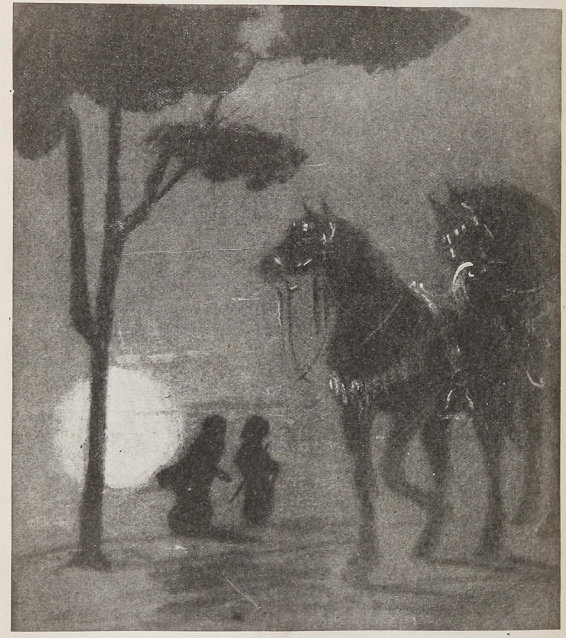
Ilustración de Walter Barbier para el cuento “El árbol de las tres manzanas de oro”
In the section “Chilean Folk Tales,” Laval's version of “The Malverde Bird,” related by Raimundo Vera, age 46, of Santiago, appeared from issue no. 192 (July 22, 1912) through issue no. 196 (August 12, 1912). Although the story followed the structure of wonder tales, its setting was Chilean, and its connection with local oral tradition revealed the syncretism of national folklore. A king was blind and sent his sons one by one to find a feather from the “Malverde bird.” The first and second became trapped along the road by love and never returned. Only the third, aided by a “little Black magician,” succeeded in bringing the “Malverde bird” to the palace; his brothers then set a trap for him. The king recovered his sight and discovered that his two older sons had stolen the bird from their younger brother in order to gain prestige and honors.
On June 10, 1912 (issue no. 186), a costumbrista story described rural life in Casablanca, a farming town near the port city of Valparaíso. Pedro was a six-year-old boy raised by a peasant woman, Juana María, while his parents worked on the Panama Canal. After years away, the parents returned to Chile to collect Pedro. What mattered here was the narration of emotions and situations common in many people's lives. The same issue included the short story “Fatal and Fortunate,” while the Northern Chilean legend “The Marvel of Chile,” written by E. Blanco and illustrated by Walter Barbier, appeared in issues 345 and 346, June 28 and July 5, 1915.
Benjamín Oviedo coordinated texts and adaptations and frequently rewrote the material. He produced versions such as “The Mole King” and “The Magic Bottles,” published in issue no. 314 (November 23, 1914). In “Tom Gin's Nose,” published on December 2, 1918 (issue no. 524), “Magister” told the story of Tom, a Parisian aristocrat and alcoholic. Hoping to free him from his vice, someone promised to arrange his marriage to a cousin. When she arrived in Paris, she found him completely drunk and fled in horror. In the end, he overcame his addiction, married, and gave up alcohol forever-a story with a miraculous ending.
Oviedo adapted “The Enchanted Oven,” “The Decoration,” “The Mystery of Pavia,” “The Two Brothers,” “The Fairies' Grotto,” and “The Princess and the Shepherd.” He coordinated the work of young translators and writers, among them “Clary” (a pseudonym), José Pino, Marta Castro Simms, “Tatarita,” and many others.
“El Lobo mañero” (The Cunning Wolf) was published as a serialized story in issues 378 and 379, dated February 14 and 21, 1916, with illustrations by Walter Barbier. The princess remained imprisoned for years in a cave where she never saw daylight. Although the furniture and table were enchanted and food appeared every day, her captivity was perpetual and dark. Her mother, the queen of Portugal, aided by the fairy queen disguised as a little old woman, set out to rescue her. Finally, after seven years, they succeeded. While the mother and fairy acted with secrecy and patience, “the cunning wolf” was locked inside his own cave, where he starved to death.
“From Bad to Worse,” published in issue no. 628 (November 29, 1920), featured Don Timoteo, a man who, after working all his life, retired and refused to leave the house, insisting that he was perfectly well even as he began to lose the use of his limbs. His elderly wife, worried, called the doctor, but Timoteo ignored her advice. A visiting friend, seeing how weak he was, persuaded him to consult a witch. She told him that for three weeks he must search the forest for certain mushrooms. Restored to health by his daily walks in the woods, Don Timoteo discovered that the witch was actually the doctor's wife. The revelation turned the whole episode into a lesson against stubbornness-the lesson that had saved him.
Synthesis.
Between 1908 and 1921, El Peneca developed a coherent and ambitious editorial project in children's literature. Far from limiting itself to translating or reproducing foreign stories, the magazine built a carefully selected pedagogical program that combined tradition with modernity and universal culture with local roots. It circulated fairy tales, fables, legends and serialized novels from world literature, but its most distinctive contribution was the incorporation of Chilean oral tradition and national folklore. The systematic collaboration of Ramón A. Laval, a pioneer in Chilean folklore studies, allowed young readers to encounter stories such as “The Tree of the Three Golden Apples,” “The Malverde Bird,” and “The Cunning Wolf,” in which the structure of the European wonder tale blended with scenes, customs and popular Chilean speech: mate flavored with lemon verbena, comparisons with “bile,” the figure of the comadre, the peasants of Casablanca, and anonymous workers on the Panama Canal.
Likewise, the section demonstrated a capacity for formal and interactive experimentation. It encouraged active participation through poetic translation contests, such as the one inspired by the Persian poetry "The Poet's Roses," as well as literary competitions and collaborative writing. In pedagogical terms, El Peneca's children's literature operated as a moral machine of subtle and constant effectiveness. The reward of the good, the exemplary punishment of the proud, selfish, or wicked, the exaltation of mutual aid — as in the fable of the donkey and the dog, inspired by lichens — and the condemnation of greed, as in "Solomon's Treasure" or "The Fingers of the Hand," shaped a narrative universe in which ethics was the very axis of every story. Children learned, almost without noticing it, that generosity, perseverance, and humility were rewarded, while arrogance and selfishness led inexorably to ruin.
Finally, it should be emphasized that this literary production would not have been possible without the work of a stable team of writers, adapters, translators and coordinators, many of them anonymous or writing under pseudonyms. The group was led first by Enrique Blanchard-Chessi and later by Emilio Vaisse (“Omer Emeth”), with key figures such as Benjamín Oviedo, Luis Larraín, Alberto Mauret Caamaño, José María Salaverría and many others.
This first period, however, was far from exhausting El Peneca's editorial project. In 1921, the magazine would begin a new stage under the direction of a figure who would profoundly mark its history: Elvira Santa Cruz Ossa, who, under the pseudonym "Roxane," would lead the weekly toward its brightest moment. Her arrival not only meant a change of direction, but also a profound transformation in the tone, contents, and sensibility of the publication, as will be seen below.
Illustrations · original edition
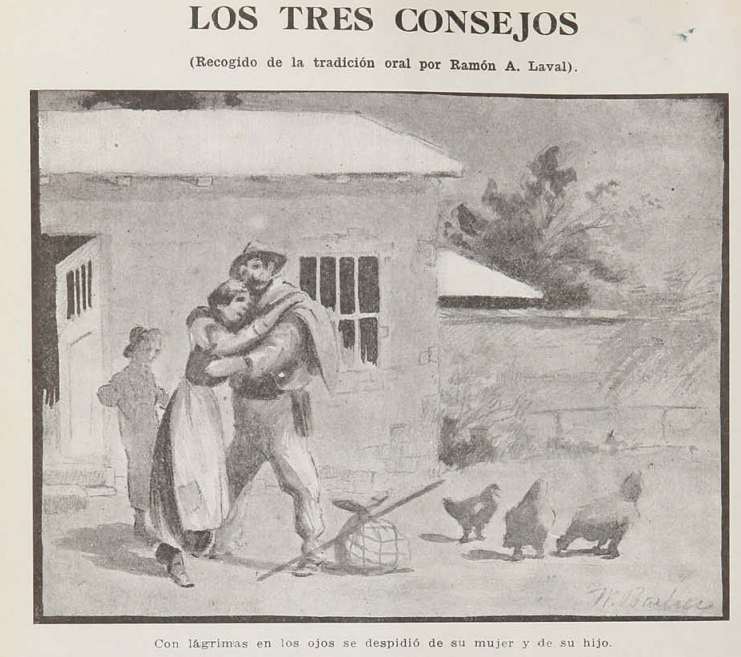
2.2. Second Period: 1921-1951. Elvira Santa Cruz.
With the arrival of Elvira Santa Cruz Ossa as director in 1921, a new stage opened in the history of the weekly. Zig-Zag had bet on a young, cultured, well-traveled, feminist, and decidedly modern woman, whose imprint would profoundly mark the character of the magazine.
She worked with a multidisciplinary team of Chilean professionals, artists and intellectuals. This group was responsible for content creation, translations, scripts, illustrations and photography. Particularly notable was the participation of Blanca Santa Cruz Ossa, Elvira's sister, who worked with the publishing house on various occasions.
Elvira Santa Cruz Ossa adopted the pseudonym “Roxane.” The name referred to the beautiful heroine beloved by Cyrano in Edmond Rostand's French heroic drama Cyrano de Bergerac (1897). Elvira herself explained the origin of her literary name on October 3, 1921 (issue no. 672), revealing something intimate about her personality:
"My Pseudonym
My literary initiation was delightful. With the tip of the pencil between my lips, I spent the hours devising the most outlandish episodes, the most fantastic adventures: 'What if I were to describe that as a shipwreck in which, having nothing to eat, we dulled our hunger with suicidal readings?' and then it occurred to me to transform the wooden platform of the bathing huts into an Indian pirogue and the coasts of La Serena into a savage country. In such musings I lost two whole days, until finally on the third and last day, I know not what benevolent muse inspired me with the idea of narrating the events just as they had happened and my impressions with the naturalness with which I had felt them. That is what I did.
Of this, my first literary article, I remember only the final phrase which, undoubtedly encompassing my joy of living, the grandeur of the earth, of the sky, and of the sea, made me conclude in a rapture of enthusiasm, exclaiming: 'How good God is...!'
When I wanted to stamp a pseudonym at the foot of my composition, my pen did not hesitate for a moment, and with energy it wrote beneath the vigorous final phrase this name of 'Roxane,' which two lustrums of my life have made so familiar. Edmond Rostand formed at that time my greatest literary enthusiasm, and we were continually reciting at home scenes from Cyrano de Bergerac... The pen merely seconded the thought of an unconscious, unreflective act: in such a way had the poet's verses impressed my spirit that the name of his heroine became identified, almost unconsciously, with my own being."
Barely a week later, on February 7, 1921, with issue no. 638, “Roxane” officially took over as the third editor of El Peneca. Her relationship with the publication predated the appointment, since she had already contributed as a writer to the “Chats” section from an unspecified date. With an audacious personality and a strong intellectual background, she brought a renewed style fully attuned to the social and political changes then taking place in Chile.
2.2.1. Elvira Santa Cruz Ossa (“Roxane”): Her Life and Team.
Elvira Santa Cruz Ossa was born in Valparaíso on March 21, 1886, into a wealthy family. She attended the Catholic Sacred Hearts convent school and later studied sociology in France, specializing in women's work and child protection. During her travels through France and the United States, she became aware that another world existed beyond the conventions of Chile's upper class. She witnessed the long American tradition of the struggle for women's suffrage (Congress approved women's suffrage in 1920, while Chilean women would not obtain it until 1949). In 1916 she published her first novel, “Flor Silvestre,” in the United States and won first prize in literature at the University of California.
In 1918 she joined the editorial staffs of El Mercurio, La Nación and the magazine Zig-Zag, where she remained for nearly four decades. Around the same time she became a member of the Club de Señoras, founded in 1916, and participated in conferences on the right of women to vote. She died on November 7, 1960. Her epitaph reads: “The marvelous journey has ended. Reduce me to earth so that I may return to the light.”
We shall now examine the most important aspects of her life, work and legacy, including the exclusive testimony of two close collaborators.
Her Thought: The 1923 Lecture on Chilean Women.
On October 14, 1923, El Mercurio published a speech by Elvira Santa Cruz on "The Activities of Chilean Women in the Past, Present, and Future," delivered at the Women's Conference of the 12th ( original Titel). There she presented a summary of her work. In this essay she traced a map of three times. In the past, she rescued the silent heroism of women: alongside caudillos, in epidemics and floods, and in the War of the Pacific. In the present, "Roxane" described a feminist awakening influenced by the world. Chilean women were already gaining access to university degrees, but they clashed against two walls: social prejudice against the working woman and a civil legislation that turned a married woman into a minor, without the right to her own property. Even so, action flourished in schools, unions, the anti-tuberculosis struggle, child protection, and art. Toward the future, she did ask for a clean politics: public health, protection of the weak, eradication of vices. Economic emancipation was the key. The ultimate goal was the fraternal union among women of the world, for she believed strongly that, when women reigned, wars would cease:
"The Women's Conference of the 12th
"Similar institutions to those already established are often founded when, with a little tolerance on one side and a little selflessness and disinterest on the other, they could be united, since the same ideal animates them. In the United States there exist those national associations of social welfare in which the helpless child finds, step by step, that protection which it receives at birth, which helps it in its first years of nursing, which leads it by the hand to school and then forms and guides it in its early youth.
The current President of the Republic, Mr. Arturo Alessandri, has sent during three years of his Government repeated messages to the Chambers, asking that the humiliating civil condition of Chilean women be modified; but those reforms, repeatedly requested by our first magistrate, have not yet been achieved.
Meanwhile, as I said at the beginning, it is our legislators who are the backward ones and the ones attached to tradition, or perhaps the indolent ones who do not wish to deal with these vindications. One would say that the parliamentarians do not understand the injustice they commit by keeping Chilean women in that state of subjection—the strong and courageous woman, intelligent and good, that woman who struggles and sacrifices herself to combat social ills, to reduce infant mortality, to teach those who do not know…
How is it that, without economic independence, subject to the whim of the man or the husband who can even snatch away her earnings and wages, how is it that Chilean women have managed to equal men in all social activities?"
Elvira Santa Cruz Ossa. (Roxane)
El Mercurio, October 14, 1923.
Social Activism: The Summer School Colonies.
In 1917 she joined the School Welfare Board, an institution that provided breakfasts and lunches to poor children. There she created a center for collecting children's clothing for distribution throughout Chile.
The “Presidente Alessandri” School Colony was an initiative that combined “Roxane's” efforts with the support of President Arturo Alessandri Palma. The project began in 1927 when the School Welfare Board established the first Vacation School Colony. In 1935, thanks to the support of her friend President Alessandri, the institution was able to construct its own building in Reñaca. Celia Pérez Ureta described it this way in a text published on October 20, 1945, in issue no. 1923:
“"SCHOOL COLONIES OF CHILE.
Dreaming of the sea…Under the loving and beneficent eaves of that palace which was built 10 years ago by the love of the great visionary, our former president Mr. Arturo Alessandri, and the incomparable perseverance of Roxane, our frail schoolchildren come to take shelter, like a flock of timid doves."
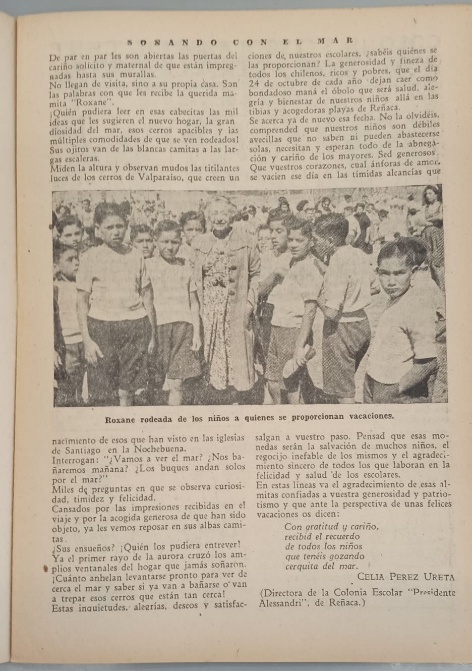
EL PENECA, no. 1923, October 20, 1945.
In 1947 this initiative was summarized with deep compassion by a contributor writing under the pseudonym “Caracol”:
NATIONAL COLLECTION FOR SCHOOL COLONIES
PAGES WRITTEN BY A SNAIL
"It may seem strange that I, a snail, should be a writer. But there can be wisdom even in the smallest and humblest beings.
I write in the sand and with an ink that my own body exudes, a silver ink, which, if it were to be kept, would not be in a common inkwell, but in a star.
…I live in Montemar, and, generally, I am stuck like a limpet to a large rock. Other times I roll down to the sand, and, on some occasions, I also navigate.
I met a group of children who belonged to a School Colony. They came frightened. Many did not know the sea. Several young ladies watched over them like a flock of chicks. I do not know what flocks of chicks are like; but I know that this phrase gives a very exact idea of a group of restless ones, who must be protected with tenderness. That is how it was in that colony.
From my rock I watched those children. I always observe men, and I admit that they are intelligent, bold, and courageous. The type I know best is the sailor and the fisherman. I know that man is considered the king of creation. But (I asked myself, examining those children), will these weak, pale, and frightened little ones ever be able to be kings? A wave, bursting against a rock, filled them with dread. The burning light of the sun forced them to seek refuge in the shade and to close their eyes painfully…
…At first it is always like this—I heard one of the caretakers say—. They come exhausted by the poverty of their homes. They have no spirit to sing and play. They have suffered hunger, cold, and helplessness. Their parents, not even with the greatest sacrifices, can provide them with good food. In their dwellings there is no well-being, no sunlight, no breathable air. There is no hygiene either. Roxane is right when she says that one cannot censure a poor person for spending his money on bread to appease hunger, instead of investing it in soap to wash himself….
….I have learned that on Tuesday, September 30, the collection for School Colonies takes place, and I have not been able to resist the desire to write this story, so that you, little readers, may know the miracle that I witnessed and help it to continue being realized. I believe that you are all generous and that you will not refuse to cooperate nobly. Furthermore, speak with your parents, and they too will want to demonstrate their goodness by contributing to the collection of Tuesday, September 30."
EL PENECA, no. 2023, September 20, 1947
Elvira Santa Cruz never stopped supporting these initiatives. In 1948 she appealed to young people from affluent families to contribute to this work of solidarity, seeking funds for sick children and those with few resources:
“"COLLECTION FOR SCHOOL COLONIES
Roxane makes a call to her readers and begs them to be generous. On September 30, when help is requested of them, let them not deny it, and moreover, let them give of themselves as much as they can give in favor of the primary school pupils of Chile.
There are three establishments to attend to the schoolchildren of Santiago: the 'Presidente Alessandri' School Colony, in Reñaca; the 'Puga-Concha' School Colony, in Cartagena, and the 'Roxane' School Colony. The latter, situated in a mountain region, was inaugurated in 1947 and carries out a magnificent work on behalf of the children who, due to their bronchopulmonary conditions, cannot withstand the maritime climate."
EL PENECA, no. 2076, September 25, 1948.
Literary and Journalistic Work.
Elvira Santa Cruz wrote the plays “La familia Busquillas” (1918) and “El voto femenino” (1920). These works broke with traditional conventions. “El voto femenino” portrayed women's organized struggle for suffrage, culminating in a political victory. The boldness of its subject brought her severe criticism in social circles. One friend wrote to her:
"The Busquillas Family
Miss Elvira Santa Cruz
Most distinguished friend,
I congratulate you and I pity you. I wish to be your first executioner, forced as I am to be your friend. You have entered upon a new literary path that will bring you infinite sorrows: it is the most tortuous, the most obscure, and, at the same time, the most suggestive of all the paths that intellectual inclination traverses, and I congratulate you in imitation of all the others who have been invited to your house to applaud you, but I do not congratulate you with full conviction; and, as I feel myself to be your sincere friend, allow me not to drown reality in the frivolous and sometimes unhealthy formula of fulfilled but deceitful etiquette…”
On August 5, 1923, she published an article in El Mercurio titled “A Chilean Working Woman,” demanding legal reforms to expand the property rights of married women. She denounced the way the Civil Code of the period allowed husbands arbitrarily to administer their wives' property and wages, particularly harming working-class women. “Roxane” directly challenged privileged women:
"If now all Chilean ladies were to come together, all of us who have a warm home and an affection that comforts the soul, if all of us united were to go and knock on the doors of the powerful in Congress…
…if in the reforms of the Civil Code the articles that refer to the administration of inherited property or to the possession of parental authority meet with opposition, at least let those be approved that grant women the free administration of their wages and salaries."
El Mercurio, August 5, 1923.
In the section “The Book of Nature,” Elvira Santa Cruz wrote a poetic essay on the meaning of nature as part of the earthly universe. Through the month of April, she described Aprilis, the Roman goddess of flowers, as a figure who brought life and vegetation. She concluded by stressing the importance of physical and intellectual work to human progress:
"THE BOOK OF NATURE
–THE MONTH OF APRIL–
Very different from the terrible god Mars is the goddess who gives her name to the fourth month of the year. Following the heavy chariot of the warrior god is a spirit at his side, light and subtle as the breeze, covering with flowers the tracks of the creaking wheels. She is APRILIS, that is, 'the one who opens.' Although not in all countries does the unit of time keep the same relation with the movements of the earth, and consequently with the different seasons of the year, for the Romans APRIL was the month that opened the doors of life to nature, lethargic and numbed by the colds of winter. Of this month they said with admiration 'Omnia aperit,' that is, 'it opens all things,' for the Roman fields, valleys, and forests were clothed in greenery and seemed to awaken from a long dream of solitude and sadness.
In the southern part of our hemisphere, with the month of April autumn begins, and the earth, tired of producing, gives itself over to its well-deserved autumnal rest, preparing in its entrails the sap that will make the fields green again in the future days of spring. Autumn also has its charms, for having nature reached the fullness of its splendor, it offers us its ripe fruits and its seeding flowers.
It is the time of the grape harvests and the grain harvests; the landowner fills his granaries and the tenant farmer dries on the roof of his hut the chuchoca, the figs, the dried peaches, and the chili pepper. The trees begin to lose their yellowish and coppery leaves and remain naked like skeletons exposed to the cold storms of winter. All of nature seems to rest while man, woman, and child, who enjoyed a long rest during the days of summer, return to work and study comforted by those brilliant days of sun and joy.
Let us work, for it is a law of the universe to develop energies and contribute to the progress of the world—some with the labor of their hands and others with intellectual work."
ROXANE.
EL PENECA, n°646, 04 de abril, 1921.
At a time when women of her class were expected to devote themselves to home and charity, “Roxane” built a professional career, fought for labor rights and, through the pages of El Peneca, taught her women readers to believe in themselves. Her editorial vision transformed the publication into a vehicle for change, where optimism, far from simple naïveté, became a pedagogical tool, and solidarity and joy became engines of transformation:
In the 1923 column “Toward Optimism,” she wrote:
“One is happy when one wishes to be, and happiness always comes to the one who knows how to value his life, to whom, once persuaded, nothing else is worth so much. Like the joy of the moment—which nothing surpasses—the well-being of the present hours adapts itself to the divine will of eternal things.”
Politically, she showed an affinity with the liberal ideas of Arturo Alessandri Palma, leader of the Liberal Party who governed Chile in two periods (1920-1925 and 1932-1938). Alessandri (1868-1950) came from a distinguished family and stood out for his social commitment. At the age of twenty-four he wrote the innovative thesis “Housing for Workers.”
He was elected senator for Curicó in 1891, where he spoke of the need to democratize Chilean life. On becoming president, he promoted policies with a popular orientation, earning him the nickname “The Lion of Tarapacá” for his connection with the working, mining and laboring masses of northern Chile.
On August 26, 1920, President Juan Luis Sanfuentes enacted the Compulsory Primary Education Law. During Alessandri's administration, which began on December 23, 1920, the policy was extended nationwide and made universal. Recognizing the value of this reform, “Roxane” embraced the cause and declared herself a follower of these ideals:
"When in January 1921 the manager of the Zig-Zag company offered me the direction of El Peneca, my first movement was one of rejection.
'My spirit is more inclined to found a revolutionary magazine,' I answered the manager, 'and not a magazine for children.'
The previous era had been one of ardent struggle for democratic vindications. Alessandri had risen to the presidency, and all of us supporters were intoxicated with political and social ardors. 'Reflect!' said our intelligent 'director' to me; I thought of the good I could do for the children; think of them in turn, they would bring cradle softnesses into my life; I thought that I would make of my position as director a spiritual mission.
In all my woman's spirit there are germs of mother and of teacher."
EL PENECA, no. 940, November 22, 1926.
To understand the human and editorial dimensions of Elvira Santa Cruz, nothing can replace the voices of those who worked beside her for decades. In 1988, while examining the archives of the National Library, I had the opportunity to interview two of her closest collaborators: Odilia Navarro, known by the pseudonym “Ketmis,” and Olga Villalón, who had been Roxane's personal secretary from the 1930s until the magazine closed.
Both were elderly women by the time we spoke. They had begun their relationship with El Peneca as young literary contributors, publishing stories and poems. Later they were hired by “Roxane” herself and became key parts of the editorial machinery.
The interview took place in Santiago on some day in 1988. I remember only the year. I recorded the conversation on an old cassette recorder. Soon afterward, my house in Macul was burglarized, and the original recorder was stolen.
Before the theft, I faithfully transcribed their words on a typewriter. Those yellowing pages are all that remain of that meeting. I have preserved them in their entirety.
What follows was a direct dialogue between two women who, from behind the scenes at El Peneca, collaborated in the development of the weekly.
The literal transcription of that conversation follows:
“From the time Elvira Santa Cruz took charge of El Peneca, she generally chose women as assistants. Her first secretary was Matilde Rubilar. Later came Silvia Azocar and, finally, I-Olga Villalón-held the position from the 1930s until the magazine ceased to exist. Around that same time Odilia Navarro, ‘Ketmis,’ joined as editorial secretary. We began working there while still young, having previously been literary contributors to the weekly. Odilia was responsible for selecting, translating and adapting foreign literature that arrived for El Peneca from France, England or the United States. My knowledge of those languages was basic; I generally had only a vague understanding of the texts and tried to preserve the content of the story. I-Olga-selected the countless reader contributions and classified the children's literary pieces, as well as other submissions that were appealing. Elvira Santa Cruz decided the general editorial line and worked directly with the magazine's artists and creators.
Elvira Santa Cruz had a dominant personality. She did not accept criticism and closely supervised our work. Only her nephew Mario Silva Ossa was allowed to draw freely.
The editor intervened directly in our way of life; she encouraged us to live autonomously and independently. She was optimistic, and Elvira transmitted independent values to us. She pressured us to rent our own apartments and learn to live alone-something that, at the time, represented a major test of women's liberation.
We worked more than twelve hours a day at the publishing house, coordinating writers, scriptwriters, often official translators, illustrators and readers' letters. We managed to put out more than 240,000 copies every week. That success inspired Elvira Santa Cruz to export El Peneca throughout the Spanish-speaking world.
After the working day we assisted Elvira Santa Cruz in organizing the ‘Summer School Colonies’-the name of President Arturo Alessandri was later added to the Vacation Colonies. They operated for two months, January and February, in Reñaca, Viña del Mar. Schoolchildren from low-income families who stood out for their good grades were invited to spend their holidays there.
Funding for these ‘Summer School Colonies’ came from contributions by various businesspeople and other public figures, as well as from the traditional ‘onces’organized by Elvira Santa Cruz with her ‘Club de Señoras,’ and from the financial support of her great friend Arturo Alessandri Palma.
By the end of the 1940s, the changes taking place in communications and the massive influx of new foreign comic magazines into the Chilean market were clearly visible. ‘Roxane’ had no interest in changing her editorial line. She wanted her niece to succeed her in the position and began preparing her months in advance, but the initiative failed.
After her retirement in 1951, the magazine gradually disappeared from the market. The owners of Zig-Zag had no interest in reviving El Peneca. Proof of this is that none of my initiatives-I, Odilia Navarro, being one of the last editors-received the necessary support.
On November 7, 1960, Elvira Santa Cruz died of a heart attack. She wanted her philosophy of life to continue inspiring new generations of young Chileans, and she wanted these words carved on her gravestone:
“The marvelous journey has ended. Reduce me to earth so that I may return to the light.”
No newspaper of the time mentioned the real reasons for her departure. Elvira Santa Cruz wrote a brief typed letter to Bello upon leaving the magazine. She revealed that she withdrew "through the back door," while orders were given to omit any mention of the fact in the Chilean media and she was denied the payment of her labor benefits:
"Mr. Joaquín Edwards Bello
My dear friend:
As you have always been so kind to me, I wish to speak with you about my retirement from El Peneca, sending you as well my sentimental farewell, My Farewell to El Peneca. 1920–1951.
I am stepping away because at the Zig-Zag Company they become annoyed when a magazine declines and begin to harass the director. Roxane tolerates little…
It seems that Gustavo Helfmann found my decision excellent. He did not call me even out of courtesy and has given orders to the magazines to silence my departure, perhaps for fear that the readers of El Peneca would decrease.
Besides, the sum I earned was not fabulous, as many believe.
My salary did not reach a living wage: $3,800.
Commissions of 30,000 copies and above: 3 centavos per copy, and 1 centavo for those sold abroad. Total, more or less $4,800 weekly.
At the Zig-Zag company I have worked 38 consecutive years.
They say I have no right to severance pay because in 1947 they distributed the sum ordered by Law 8,332.
I give you all these data in case you might wish to comment on my retirement, that is to say, the retirement of Roxane.
For me it has truly been a liberation, and I will be able to give all my time and money as well to the School Colonies, which are the reason for my long—very, very long—life…
With admiration and the same affection as always, your friend Roxane
Handwritten signature of Roxane."
That letter was a moral reckoning. At the Zig-Zag Company, when sales began to fall, the hostility toward Roxane became evident. While the numbers rose, she was untouchable; when they began to decline, she became a hindrance. They did not want it to become known that the creator of the success was leaving, for they feared it would affect the business. Gustavo Helfmann did not call her "even out of courtesy" and ordered the magazines to silence her departure. They hid it to protect the brand, not out of respect for her person.
Many believed that Roxane earned a fortune. She herself denied it: a base salary of 3,800 pesos, plus commissions that barely reached 4,800. pesos weekly. For a woman who directed the most important children's publication in Chile for three decades and who worked 38 consecutive years at the company, it was a pittance disguised as a privilege. The letter to her dear friend Joaquín Edwards Bello, who was part of the Edwards family, was a denunciation written with the elegance of someone who had nothing left to lose. Roxane documented and passed judgment. And in doing so, she left for history the portrait of a publishing house that knew how to exploit the talent of an exceptional woman, but that never lived up to her greatness. Ten years later, the death of Elvira Santa Cruz, on November 7, 1960, coincided with the definitive closure of El Peneca (December 25, 1960), symbolically sealing the end of an era.
Illustrations · original edition
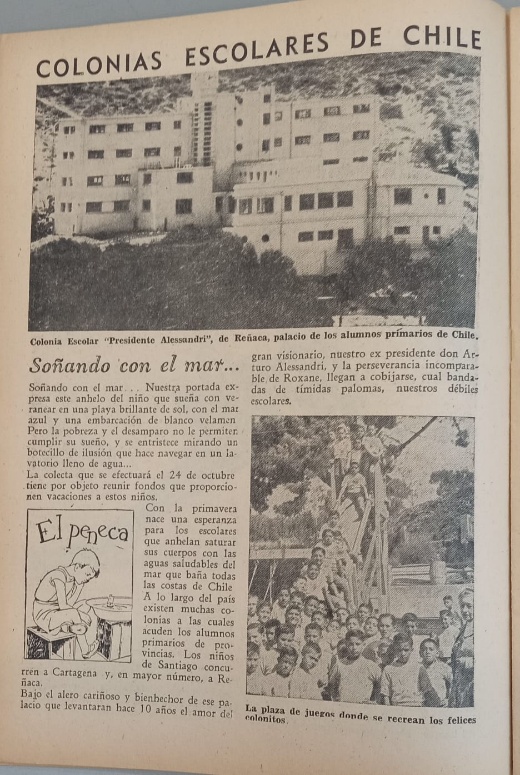
2.2.2. Her Editorial Direction (1921-1951).
In issue no. 637 (January 31, 1921), she presented a detailed program of work. She divided the contents into twelve areas, each with a clear purpose:
"TALKS
On February 7, Miss Elvira Santa Cruz Ossa, known in the world of letters by the pseudonym Roxane, will take charge of this magazine.
Her work program is as follows:
'So that the readers of EL PENECA may form a slight idea of the new direction we will give to this magazine, I will divide the main themes into sections, making a summary of each:
1st Section – Children's Life – Social, school, and humorous news. To maintain the interest of this section, we will accept correspondence, data, and photographs.
2nd Section – Famous Men and Women – Short biographies of all the notable figures of history, of all the wise men, musicians, artists, discoverers, and inventors of the world. The glorious anniversaries of the homeland will have a place in this section on the date of their commemoration.
3rd Section – Stories, Tales, and Legends – Fantastic stories, Chilean legends, fairy tales, magicians, and sorceresses with beautiful illustrations will be given. Our little readers will travel through the world of the improbable with great delight.
4th Section – Penequita's Whys – This section requires no commentary or exposition. Its purpose is to resolve a multitude of questions that naturally arise in the awake and curious spirit of children.
5th – Folletín – Works chosen from among the best readings for children, by great European and American authors.
6th – Graphic Stories – Pages by our best cartoonists.
7th – Kingdoms of Nature, Illustrated – General classifications, instructive and full of amenity.
8th – Plates for Coloring and Pages to Assemble – In this section we will teach how to mix colors to illuminate the sketches presented for competition, and we will also teach the way to build bridges, churches, houses, and furniture with matchboxes, cardboard, or paper.
9th – Games and Pastimes – Lessons in magic and children's sleight of hand; riddles, charades, and puzzles. Solutions to previous issues.
10th – Children's Contributions – We accept verses, tales, charades, etc.
11th – Important Correspondence – From the director to the readers and from the readers to one another. 'Honor Roll' of the different schools during all the months of the year.
12th – A Little of Everything – Caricatures, photographs, literary contests, anecdotes, wonders, celebrities, jokes, idioms, sports, etc., etc.
There will also be some pages of advertisements with humorous illustrations."
THE EDITORIAL STAFF.
EL PENECA, n°637, 31 de enero, 1921.
“Children's Life”: A New Way of Speaking to Children.
The “Chats” section was replaced by “Children's Life,” which appeared on the first page. At the foot of the page it specified: “No indiscreet information will be accepted. Letters for this section must be addressed to ‘Children's Life’ at El Peneca.” These items described social, medical, school and religious events involving children from the upper society of the period. On occasion, they also included news about less affluent readers:
"CHILDREN'S LIFE
'El Corderito' will spend the holidays studying for his exams. Poor little thing!
Mínima Chispita has become sullen because they are not taking her to Viña del Mar. To console her, her mother has promised to subscribe her to EL PENECA.
The child dancers Max and Marcelo practice fantastic dances on the picturesque terrace of Zapallar."
EL PENECA, no. 638, February 7, 1921.
"Olguita Rioja spends all day with Prince Fernando, who has taught her to balance on the bicycle when crossing the bridge.
Alfonso Diaz will go to the French Fathers. We predict an honor medal for him.
Perlita is very proud because all her little friends have greatly celebrated her report on La Maravillita. She says that once a month she will offer us her contributions and that she plans to interview the Boy Who Went Out to Roam the World, Norita Netby, Blanquita Villaroel, the Petit Pierrot, and Mario Alessandri for being the son of the President.
Mario Undurraga is summering in Viña del Mar, dazzling his friends with the Packard."
EL PENECA, no. 639, February 14, 1921.
"On Sunday the 19th, a lovely Easter party was held at the Club de Señoras. All the children were given toys, sweets, and refreshments. Mariita Brieba sang some very amusing tonadas. Delita Reyes Izquierdo also sang 'Cielito Lindo,' and 40 won a great carousel in the raffle.
Among the children attending we noticed the Echeverría Baeza, Balmaceda Ossa, Vicuña Ossa, Viera Gallo, Vicuña Barros, Ahumada Prieto, Vial Freire, Jara Barros, Pereira Correa, Pérez de Arce Plummer, Prieto Casanova, Corvallo Stagg, Walker Vial, etc., etcetera.
–Little Pedro Echeverría Baeza was recently operated on for his throat; the doctors were astonished by his bravery; we know he is better now and we are glad of it, wishing him a speedy recovery and health.
–On the occasion of making his First Communion at the church of San Ignacio, on Sunday the 11th of this month, the little boy Federico Navarro Álvarez offered a matinee at 4 in the afternoon at his home to a group of his little friends. The hours passed fleetingly, thanks to the attentions shown them by the host and his sisters, doing honors to the splendid buffet, where pastries, ice cream, sandwiches, and chocolates abounded, accompanied by pleasant music."
EL PENECA, no. 684, December 26, 1921.
Poetry and Literature: A Commitment to Children's Sensibility.
In 1921, El Peneca added the section “Chats and Poetry.” The initiative responded to contemporary cultural needs by connecting young readers with a new form of artistic creation.
One example is the poem published in issue no. 650 on May 2, 1921. Its author, “Incógnita,” described a nocturnal garden scene infused with intense emotions such as nostalgia, sadness and a desire for revenge. The text, “Revenge,” narrated a conflict over forgotten dreams and the search for redress through nature.
It was significant that a text carrying such intense emotional weight should be included. This revealed young readers' capacity to connect with complex emotions and with poetry that was both Romantic and modern. The author invoked nature-the breeze, gnomes, the north wind-as instruments for destroying painful memories: “those dreams of mine torn apart by oblivion.” The poem reached its climax when she asked the wind to kill those memories. True revenge did not consist in destroying the past, but in discovering that her own capacity to love and remember remained intact. That is why it ended: “You are avenged already.”
"VENGEANCE
For Flor de Mayo
The moon, a host of light, raised by divine and invisible hands above the altar of the forest, adorned with fragrant and flowering draperies, has just illuminated it... I lift the heavy curtain of honeysuckle that separates me from it: the lulling music, the favorite fragment, spills over the garden, enchanted by the spell of the silvery light, a cascade of memories!
Were they here...? Are they protected by the night...? Does the Moment bring them from another distant and perfumed garden, before whose hermetic corolla my dreams sob, forgotten...? I too want to close my garden: I too want to wound as I am wounded; I will close the gate, let the glacial breeze numb those memories, let the malignant gnomes tear off their wings and let them die of pain and cold beneath the silvered splendor of the moon! Oh, yes, I will take vengeance! and that same music that lulled my chimeras will lull the stinging intoxication of my vengeance! —
Breeze, grow colder, colder still, bring in your mantle that murderous ice of the steppe. Gnomes of the forest, push your cruelty to the utmost against these reckless dreamers who come to call at my garden... Thus, breeze, thus, let the north wind come to your aid... have no pity, no — did anyone have pity for those dreams of mine that oblivion tore apart?
Kill them, north wind, I said, and my heart, opening its bosom and lovingly sheltering those memories, answered me joyfully: Little one, ask no more! You are already avenged! "
INCOGNITA.
EL PENECA, no. 650, May 2, 1921.
A poem written on January 31, 1921 by E. De la Barra A. portrayed a proud combatant entering the metaphorical arena of life to struggle against fate and its challenges. He trusted in faith and in his own heart as armor. Mounted on horseback, he symbolized the pursuit of ideals and the determination to overcome obstacles and attain victory. It was an invitation to courage and resolve:
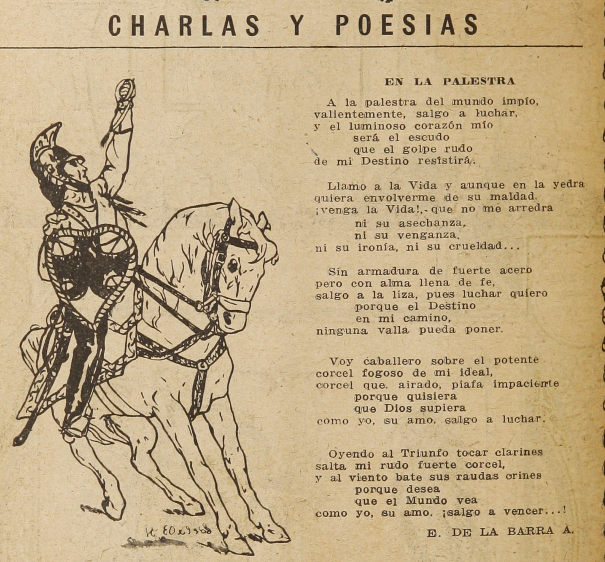
EL PENECA, no. 637, January 31, 1921.
“Famous Men and Women”: Making Women Visible.
“Roxane” created a section that broke with convention: “Famous Men and Women.” For the first time, women had a place as historical figures, intellectuals and fighters. She published numerous biographies of women who had made a difference in history. The profiles highlighted varied models of female excellence. Examples included the biography of “Cornelia, Mother of the Gracchi,” presented as a symbol of republican virtue through the education of her sons Tiberius and Gaius Gracchus, and a profile of Marcus Tullius Cicero, master of oratory, which completed the picture of civic and intellectual virtues:
"FAMOUS MEN AND WOMEN
'Cornelia, the Mother of the Gracchi'
Cornelia Scipion, daughter of the great conqueror of Carthage, lived in Rome in the 1st century before Jesus Christ. Married to the Roman tribune Tiberius Sempronius Gracchus, she had from this marriage two sons, one called Tiberius and the other Gaius.
Cornelia loved them with passion, educated them in virtue and nobility, and resolved that they should be worthy citizens of Rome.
One day she received the visit of an elegant patrician woman, who could only speak to her of her dresses and jewels, until she finally said to her: 'I know that you also have very precious jewels. Would you not want to show them to me?'
Cornelia rose, left the room, and reappeared a short while later leading by each hand her two sons, now somewhat grown. 'These,' she said, 'are the only jewels of which you have been told.'
Those sons became heroic men, and all Rome recognized that they owed to their mother their being so brave and just.
Tiberius Gracchus worked to improve the conditions of the people and to oblige landowners to divide those great estates cultivated by slaves who suffered tyrannies and torments. Defending the rights of the plebeians, the valiant Tiberius fell, wounded in a skirmish against the old patricians who monopolized fortune and power.
Gaius continued defending the ideals of Tiberius, and thanks to his eloquence he managed to humble the nobles who had put his brother to death. In the midst of his popularity he never despised the helpless or the needy, and he died like a brave man.
These brothers always honored their mother, and even in life they raised a statue to her with the inscription 'Cornelia mater Grachorum,' that is, 'To Cornelia, mother of the Gracchi.'
A great destiny it is to be the mother of heroic men."
CRI-CRI.
EL PENECA, no. 651, May 9, 1921.
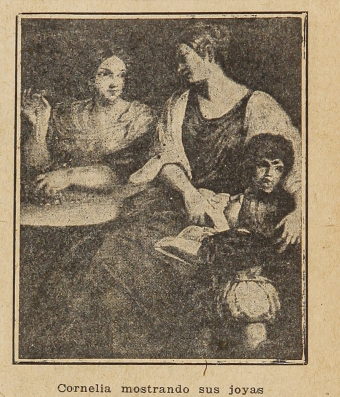
The July 25, 1921 edition (no. 662) presented a text about the life of “Doña Javiera Carrera de Valdés,” sister of the independence heroes, who fought beside them. She also accompanied them into exile and endured the execution of all three brothers. Although her life was marked by dramatic events, after returning to Chile she continued the struggle to repatriate the remains of Luis, Juan José and José Miguel Carrera, who had been shot in Mendoza:
"FAMOUS MEN AND WOMEN
'Doña Javiera Carrera de Valdés'
This illustrious matron was born in Santiago in 1871. Her parents were Don Ignacio de la Carrera and Doña Francisca de Paula Verdugo, belonging to the colonial aristocracy. Very young, she married Don Manuel de la Lastra, by whom she had two children, becoming a widow at the early age of 19. In 1800 she married for the second time Dr. Don Pedro Díaz Valdés. The great prestige of Doña Javiera and the ascendancy she had over her three brothers—José Miguel, Juan José, and Luis Carrera, high-ranking officers of the army—made her the heroine of the Old Homeland, as in the New she was the martyr. Thus in 1810, launching her brothers into the arena of agitation, she made a great political name for herself and became almost a power in the Republic. A year later, pushing José Miguel, recently arrived from Europe, and her other brothers into the vicissitudes of the revolution, she constituted herself, through the success of her enterprise, into a supreme authority; and finally, in 1812, when they reigned with all their splendor and all their excesses, this lady was the pinnacle of the revolution and the irresistible counsel of its promoters.
After the Carreras were proscribed following the battle of Rancagua, Doña Javiera accompanied her brothers to the other side of the Andes and followed their fate, suffering great hardships in their company.
Doña Javiera's existence was miserable and agitated for two years, and at last her sorrows were joined by the death of Luis and Juan José, who were apprehended in Mendoza, tried as conspirators, and executed in the public square on April 8, 1818. The unhappy lady could not save her brothers from the scaffold, despite the efforts she made. When it became known in Buenos Aires that José Miguel had returned from the United States and had joined General Ramírez in Entre Ríos, the city's Government arrested Doña Javiera in her house. Later it exiled her to a fort in the Pampas, from where, with her health broken, she was transferred near Buenos Aires, and afterward confined in a convent. Having obtained her freedom, and because her brother José Miguel had joined the army of Upper Peru, she escaped on foot from Buenos Aires and took refuge in a Brazilian warship, later seeking asylum in Montevideo. Having entered Buenos Aires victoriously, José Miguel—Doña Javiera went to embrace him for the last time. At the end of September 1821, she learned in Montevideo of the death of José Miguel, who had been shot in Mendoza on September 4 of the same year. This catastrophe struck her down to such a degree that her life was feared for during several months. Miraculously restored, she voluntarily prolonged her exile until the fall of the O'Higgins administration. In 1824 she arrived in Valparaíso.
In her last years, as throughout her life, Mrs. Carrera gave proof of being very charitable. Being about to die, she left many legacies for works of Charity.This illustrious lady, whose virtues and misfortunes have made her name so famous, died on August 20, 1862, and her funeral rites were worthy of her high merit.. "
The magazine included figures such as “Gabriela Mistral,” future Nobel laureate in Literature, and national heroines such as “Doña Paula Jaraquemada” and “Antonia Salas de Errázuriz,” the latter recognized for saving lives during the struggle for independence:
“Antonia Salas de Errazuriz
Benefactress of the Nation.
The illustrious matron was born in Santiago on June 13, 1788, and her parents were the celebrated philanthropist Don Manuel de Salas y Corbalán and Doña Manuela Palazuelos y Aldunate, both belonging to the most distinguished families.
Endowed with a cheerful and festive temperament, Mrs. Salas de Errázuriz was seen, from her tenderest years, to be the inseparable companion of her charitable father, and in his daily visits to the hospice, of which he was founder, as well as to the jails and prisons, often carrying in her tender arms the clothing that was to cover the nakedness of the needy.
Inspired by the ideas of liberty that germinated in her heart and that made her esteemed father and husband one of the first martyrs of our independence, Mrs. Salas de Errázuriz conducted herself as a great patriot and a great matron. Her fortitude and resignation did not abandon her for a moment in that fateful era. Not a single complaint was heard from her for the sufferings caused her by the exile to Juan Fernández of her elderly father and her husband: on the contrary, spirited and resigned, she occupied herself now in seeking resources to cover the heavy contributions imposed on her by the Spanish government, now in sending provisions to the exiles, now in acquiring news by which she could communicate with them and which might console them in exile, and for which she had to elude the Government's surveillance by a thousand ingenious means, until, with the victory of Chacabuco (February 12, 1817), they returned from their exile."
(written by) JONES.
EL PENECA, no. 671, September 26, 1921.
The publication also maintained its tradition of historical and intellectual profiles, presenting “Plato and Aristotle” as foundations of Western thought, Alexander the Great as a paradigm of leadership, and “Julius Caesar” as an exemplary military strategist. Among the short biographies were those of “Wolfgang Amadeus Mozart” and Chilean pianist “Claudio Arrau.” The latter received a tribute that included a text by Santa Cruz about his youth and a revealing footnote: “Claudio Arrau has told us that he was an enthusiastic reader of El Peneca and that in Berlin he often sighed with longing to have the magazine.”
“FAMOUS MEN AND WOMEN
'CLAUDIO ARRAU'
In Germany the Compulsory Education Law is enforced very strictly, so that Claudio Arrau, even though a foreigner, had to attend school. He therefore had to study humanities, languages, and also attend the different courses of the Music Conservatory. At present he knows 4 languages and possesses brilliant scientific, artistic, and literary knowledge.
From the moment German teachers first heard Claudio Arrau play, they unanimously declared him a genius and devoted themselves to instructing him with great enthusiasm, particularly his professor, Maestro Krausse, who affectionately called him his 'child prodigy."
ROXANE.
EL PENECA, no. 653, May 23, 1921.
Tribute was paid to Guillermo Zañartu Irigoyen, the aviator who became a martyr in 1921 when his act of self-sacrifice in attempting to save his copilot moved the nation:
“FAMOUS MEN AND WOMEN
GUILLERMO ZAÑARTU IRIGOYEN
Midshipman Zañartu will be an example for all Chilean youth; it will never forget that impressive and sublime lesson of selflessness, sacrifice, and supreme patriotism that will forever magnify the memory of the young martyr…
What a beautiful tribute it would be if all the PENECAS opened a subscription, in order to collect money to place a bronze plaque on his tomb with an inscription that read:
'The PENECAS of today to the martyred comrade.'"
PERLITA.
EL PENECA, no. 643, March 14, 1921.
Contributor Dante Varas Aratta highlighted the meteoric career of Renato Zanelli (1892-1935), a Chilean-Italian baritone and later tenor who conquered the world's most prestigious operatic stages, including the Metropolitan Opera in New York, Teatro San Carlo in Naples, the Royal Opera House in London and the Rome Opera House. During the 1920s he reinvented his voice as a tenor, specializing in heroic roles such as Verdi's Otello. His premature death from cancer in 1935 at the age of forty-three cut short his career. Today he is remembered as one of the great dramatic tenors of his era:
"RENATO ZANELLI
Among the most famous artists, we will count Mr. Renato Zanelli, a notable national baritone who has reaped brilliant ovations in the United States.
He was born in Valparaíso, his parents being Mr. Ottorino Zanelli, of Italian nationality, and Mrs. Margarita de Zanelli, the latter belonging to one of the best-known families of the country.
In 1916, he debuted in the official opera season in Santiago, where the public paid him enthusiastic applause and the critics predicted a brilliant future for him.
Later he made a contract with one of the most competent impresarios, committing himself to sing for four years in the seasons held at the Metropolitan Opera House, whose fame as the world's foremost coliseum it would be daring to dispute. His debut in the great New York city was brilliant, standing out in the role of 'Amonasro' in the opera Aida, a work that has immortalized the famous Verdi. This notable colossus of lyric art is under contract with the Victor Company for the recording of his admirable and well-timbred voice."
DANTE VARGAS ARATTA.
EL PENECA, no. 657, June 20, 1921.
A particularly significant moment came in 1921 with the publication of Gabriela Mistral's (1889-1957) poem “The Thistle.” At thirty-two, she was beginning to establish herself as a literary voice in Chile. The publication is especially revealing because she had not yet achieved international recognition; the Nobel Prize in Literature would come in 1945. She was combining pedagogical work in rural schools with poetry while seeking outlets for her writing. “The Thistle” presented a Christian parable in which a humble flower, symbol of resilience, was the only one able truly to see Christ, highlighting the beauty of the marginalized.
This early publication, today almost a collector's piece, can be read as a metaphor for Mistral herself: like that thistle, rising from arid ground to glimpse the divine in art:
"THE THISTLE
By Gabriela Mistral
ONCE a garden lily, from a rich garden, asked the other flowers about Christ. Its owner, passing by, had named Him while praising its newly opened flower. A rose of Sharon, of vivid purple, answered:
–I do not know Him. Perhaps He is a rustic, for I have seen all the princes.
–I have never seen Him either– added a jasmine, small and fragrant, –and no delicate spirit has failed to breathe in my small flowers.
–Nor I– added the camellia, cold and impassive. –He must be a bumpkin; I have been on the breasts of the most beautiful men and women.
The lily replied:
–He would not resemble me if he were, and my owner remembered Him upon looking at me, passing by, this morning.
Then the violet said:
–One of us must surely have seen Him; it is our poor brother the thistle. He lives at the edge of the road and knows all who pass, and he greets them all with his head covered in ash. Although humbled by the dust, he is sweet, for he gives a flower of my hue.
–You have spoken a truth– answered the lily. –Without doubt, the thistle knows Christ; but you have been mistaken in calling him our brother. He has thorns and is ugly as a malefactor. He is one too, for he keeps the wool of the little lambs when the flocks pass by.
But, but hypocritically softening its voice, it cried out, turning to the road:
–Brother thistle, poor little brother of ours, the lily asks you whether you know Christ.
And on the wind came the tired and, as it were, broken voice of the thistle:
–Yes; He has passed along this road and I have touched His garments, I, a wretched thistle.
–And is it true that He resembles me?
–Only a little, and when the moon gives you sorrow. You raise your head too high. He carries His a little bowed; but His hand is white as a flake and you are quite fortunate to resemble Him. No one will ever compare Him to the dusty thistle.
–Tell me, thistle, what are His eyes like?
The thistle opened a blue flower on another plant.
–What is His breast like?
The thistle opened a red flower.
–Thus goes His breast– it said.
–It is too crude a color; it hurts– said the lily.
–And what does He wear on His temples as a garland, when it is spring?
The thistle raised its thorns.
–It is a horrible garland– said the camellia. –The roses are forgiven their small thorns; but those are like those of the cactus, the bristling cactus of the hillsides.
–And does He love Christ?– continued the lily, troubled, –What is His love like?
–Thus does Christ love– replied the thistle, sending the luminous little plumes of its dead corolla flying to all the winds.
–In spite of everything, said the lily, –I would like to see Him. How could it be, brother thistle?
–To watch Him pass, to receive His gaze, make yourselves a thistle of the road,– he answered.
–He always goes along the paths, without rest. Passing by, He has said to me: 'Blessed are you, for you flower among the dust and gladden the feverish gaze of the traveler.' Not even for your perfume will He stop in the garden of the rich, for He is scanning the wind for another aroma: the aroma of the wounds of men.
But neither a lily, which they called His brother; nor the rose of Sharon, which He cut, as a child, on the hills; nor the braided honeysuckle, wished to become thistles of the road; and, like the princes and worldly women, who refused to follow Him through the scorched plains, they remained without ever seeing Him."
THE END.
EL PENECA, no. 649, April 25, 1921.
In a note written by Elvira Santa Cruz in issue no. 663 of August 1, 1921, she informed readers: “This distinguished writer (Gabriela Mistral) has promised to send her finest stories to El Peneca.”
El Peneca's anthem was, in essence, Elvira Santa Cruz's civic testament after a decade as editor: a reminder that beyond hardship there existed a common territory and a shared honor worth defending. Any child, regardless of social class or city of origin, could feel part of the same sacred ground. Citizenship was not inherited through blood, but through inhabiting that territory.
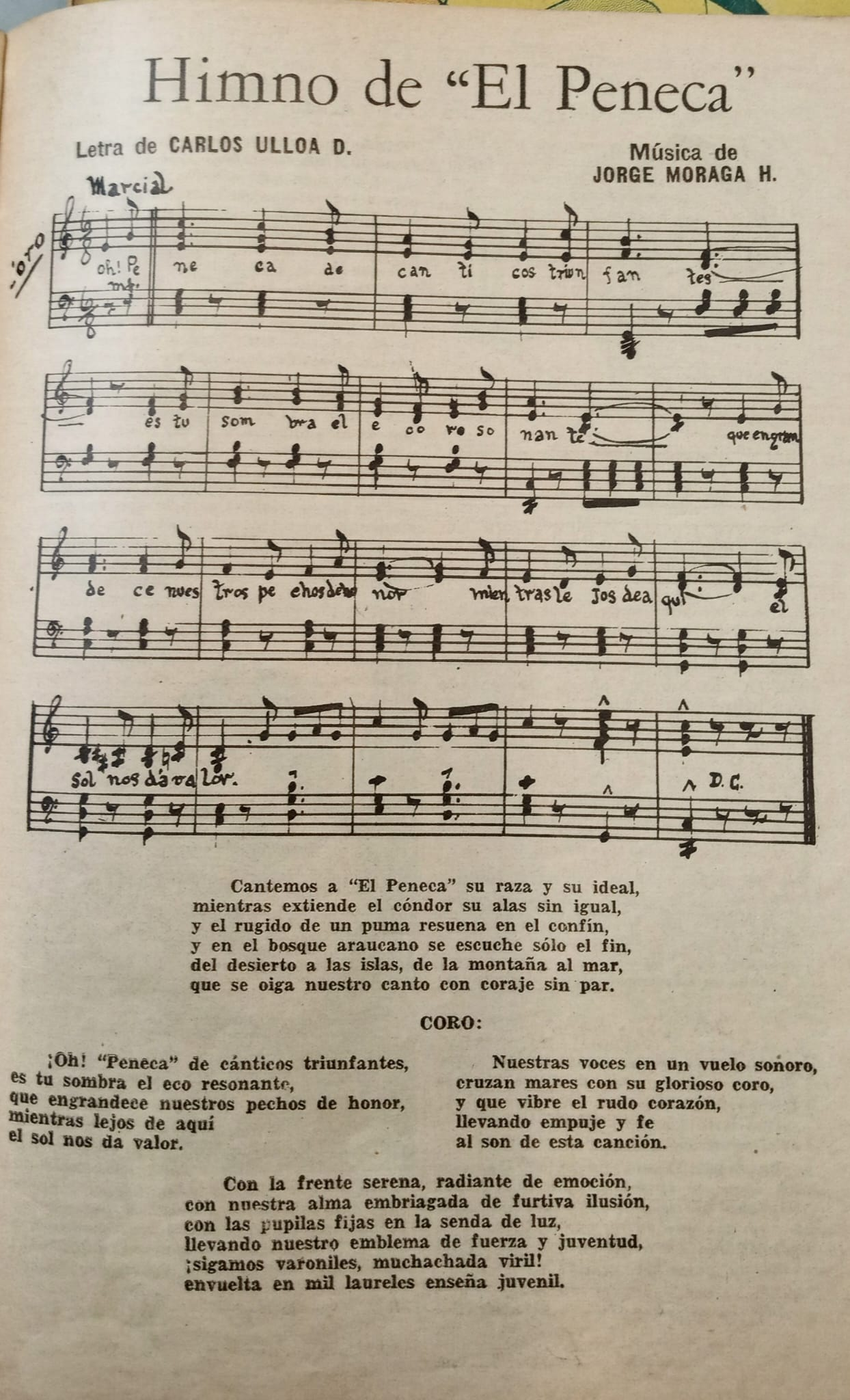
EL PENECA, no. 1203, December 7, 1931.
Elvira Santa Cruz changed the relationship between editor and child readers by establishing an affectionate model that served as a counterpoint to the approach of her predecessor, Father “Omer Emeth.” While “Emeth” had conceived of the weekly as a “sacred trust” of Catholic values, “Roxane” articulated an alternative pedagogy in which tenderness and dialogue replaced authority. A passage from 1922, whose exact date is unknown, revealed this new path:
"…it soon passed into the hands of Omer Emeth, the intelligent and kind priest, who delivered it as a sacred deposit to a woman citizen; perhaps when children grow and feel full of vigor and a will of their own, they bend more easily before the affection of a mother, who disarms their outbursts and whims with tenderness and coddling, than before the severe and rigid authority of a man."
EL PENECA, 1922, no exact date.
Elvira Santa Cruz began directing El Peneca in a Chile that, under the government of Arturo Alessandri Palma and the Constitution of 1925, was beginning to broaden social rights. She translated that reformist spirit into the language of the magazine: a call for fraternity among all children, regardless of class, as she expressed in November 1922 when inviting El Peneca to “open its arms” to rich and poor, children and workers alike. It was a declaration of cultural rather than partisan principles, conceiving reading as a bridge between different social worlds:
"TO EL PENECA
Uncover yourself, then, before all of them—before the rich and the poor, before the child and the worker, before those who adorn you and those who sell you—open very wide your robust youthful arms in a gesture of love, of gratitude, and of brotherhood that embraces them all.
…and then return to the maternal lap of your 'Roxane."
EL PENECA, no. 732, November 27, 1922.
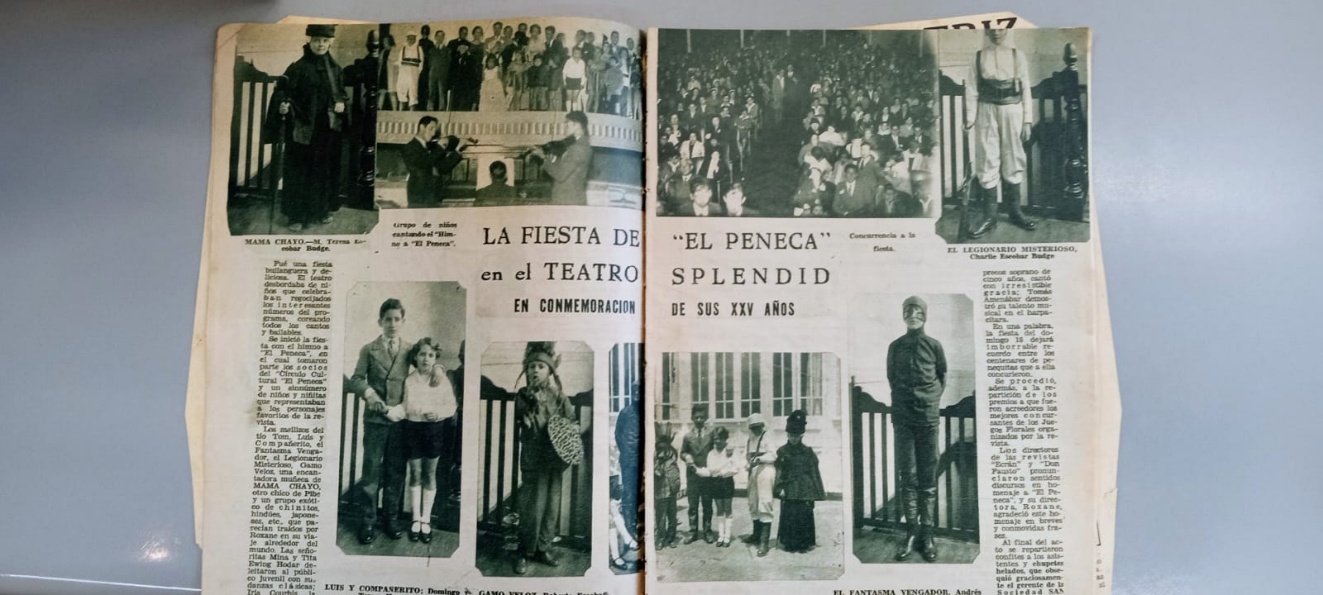
EL PENECA, no. 1282, July 10, 1933.
The Comic Strips: "Quintín, the Adventurer" and the Serial Success.
Initially, she worked with the material inherited from the previous directors. Maintaining this line, she began to seek new comic strips. She incorporated in the center pages the illustrated strip "Dreams of a Penequita," which ran from February 14, 1921 (issue 639) until April 18, 1921 (issue 648). "Adventures of a Circus Impresario" premiered on April 25, 1921 (issue 649). The strip "Adventures of Two Twins" achieved great popularity, being published from May 2, 1921 (issue 650) until issue 675 of October 24, 1921. A strip that undoubtedly surpassed all expectations of success and remained in print for decades was "Quintín, the Adventurer." This series managed to conquer thousands of children, inviting them to dream of journeys to every corner of the world and to live extraordinary and, for the time, unimaginable experiences. It was a "dream machine," offering a window to a world of unlimited possibilities, broadening the horizons of what they could imagine for their own lives. The announcement itself perfectly captured this spirit:
"QUINTÍN, THE ADVENTURER
Next week we will begin the stupendous series of adventures of a boy hired by a film company on his journey around the world. The novel is of thrilling interest and great topicality."
EL PENECA, no. 675, October 24, 1921.
The penecas exchanged it and wanted to follow the adventures. This phenomenon was particularly relevant, since those interviewed in this study still remembered it clearly.
It is worth noting, as an anecdote, the inclusion of Quintín in El Peneca No. 645 (March 28, 1921), with the strip "The Strange Adventure of Quintín," illustrated by A. Alvial Bensen. Its narrative structure, similar to that of tales, presented a kidnapping that was resolved with the appearance of a genie who returned the protagonist to his home. Alvial Bensen's linework reflected the introduction of real dangers, always neutralized by magical solutions.
Competitions, surveys, advertising and reader participation.
The sections "Collaborations", "Correspondence", "Sports", "How Adolfito interprets what he reads in El Mercurio", "How Adolfito interprets what he reads in La Nación", "How Adolfito interprets what he reads in Diario Ilustrado", "Games", "Pastimes", "A Little of Everything", "Survey" and "Page to Assemble", together with competitions, raffles and prize-winning contributions — with or without advertising from companies and products — alternated in the weekly magazine. It is interesting to note that El Peneca, during Santa Cruz's period, never stopped including advertising. A great variety of competitions and raffles were introduced to attract new groups of children: the penecas were invited to take part in music competitions, contests about Chilean rivers, and competitions on fairies and fables. Participation was active in events such as parties, anniversaries and various clubs.
"SURVEY
HOW WOULD YOU LIKE EL PENECA TO BE?
Regarding the question formulated in the previous issue, the only thing I would change would be to put the cutouts on loose sheets, because when they are cut out they damage some little novel or other interesting things that EL PENEQUITA brings us."
Yours affectionately and faithfully, Red Hair.
EL PENECA, no. 645, March 28, 1921.
"Hugo Coello. My opinion is that EL PENECA, instead of 24 pages, should have color plates and also reserve a page for collecting a series of poems by different well-known authors, and as it currently is, it is not to my liking.
Eduardo González, Jorge Peña, Julio García, Jorge Tapia, José Caballero, Oscar Berrios, Ignacio Sepúlveda Garcés, Sergio Azócar, E. González M.-Pte. We have agreed that no one should buy your magazine because it comes out very ugly.
We want it illustrated and with many charades: even more, with a prize of an illustrated book.
I assure you that if you do not change your opinion soon, your magazine will go under; because we have spread the word throughout the Liceo Amunátegui (1) that if it does not come out more or less as before, no one should buy it; we have also given a deadline until Monday, March 28; and whoever buys it will get a beating.
Nenita. I like EL PENECA just as it is directed, by a firm, valiant, and intelligent person such as you are, and I believe this magazine will be and is the ideal of all the 'penequitas."
(1) Roxane wishes to know if that is the opinion of the entire Liceo Amunátegui.
EL PENECA, no. 646, April 4, 1921.
"L. Matus. As I believe, I have the right to complain, since, as a student of the Liceo Amunátegui. Not all of us think the same way. I would like it to have 28 pages, one of these dedicated to sports. The page to assemble and color should be blank on the opposite side. For this magazine directed by an intelligent person such as you are should be better.
Julio Sepúlveda, Raúl Braun C., Manuel Durán, Eduardo Díaz T., Benjamín Arceu, Héctor Morello, Waldo Parraguez. Pte.-All of us are from the 'Liceo Amunátegui,' and as you wish to know if the whole Liceo is of that idea, which came out in the previous issue, we assure you that it is not, and that all of us have bought it.
We are of the idea that it should continue the same, but that it should bring 20 or 24 pages, so that they do not take so long to publish the pastimes and contributions that are sent, and that the page to assemble and color should come blank on the other side, and that it should continue having Mama instead of Papa.
With great astonishment we have seen in today's EL PENECA, in the survey section, that some gentlemen take the name of 'the whole Liceo Amunátegui,' to give a beating to this beautiful and flourishing magazine.
The signers González, Peña, García, etc., are nothing more than vulgar usurpers of opinion, for 'the whole' Liceo is not represented in such gentlemen.
Your magazine, miss, is highly appreciated in our Liceo; only some unbalanced individuals pretend otherwise.
After all, what would EL PENECA gain by being read by the nine usurping types?
Please excuse our rough vocabulary, for the article that goes against our Liceo irritates us greatly.
We subscribe as your faithful servants.-Dante Alighiere. Charles Noramoza.
Jorge Finch. I would like EL PENECA to have 20 to 24 pages, and to come with color plates; I would also like it if they continued with the dreams of a penequita and I hope it will be so."
EL PENECA, no. 647, April 11, 1921.
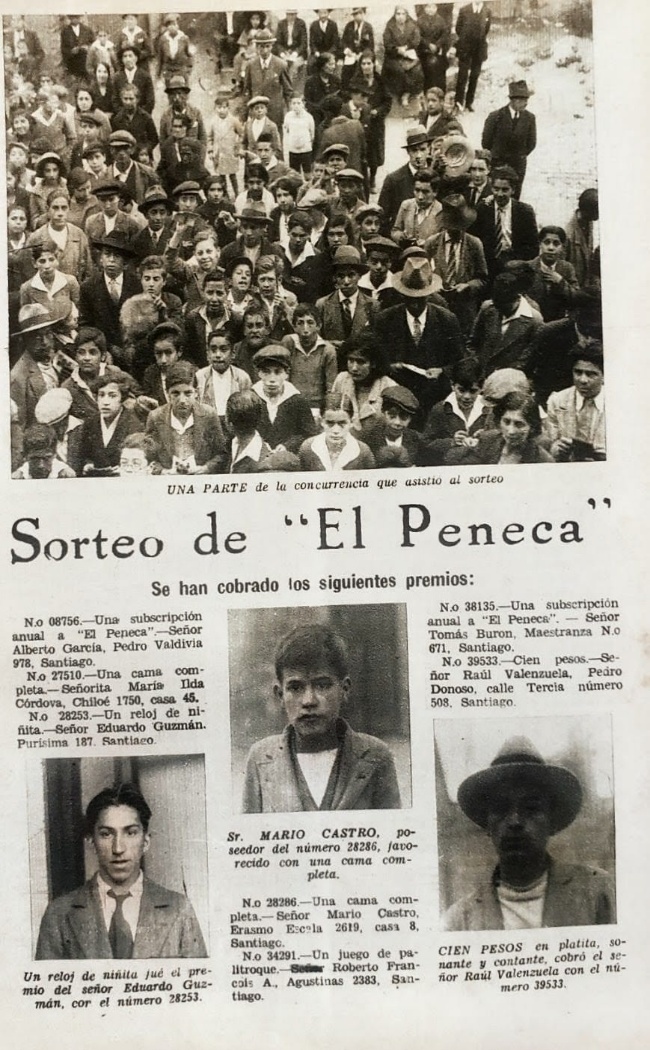
EL PENECA, no. 1161, February 16, 1931.
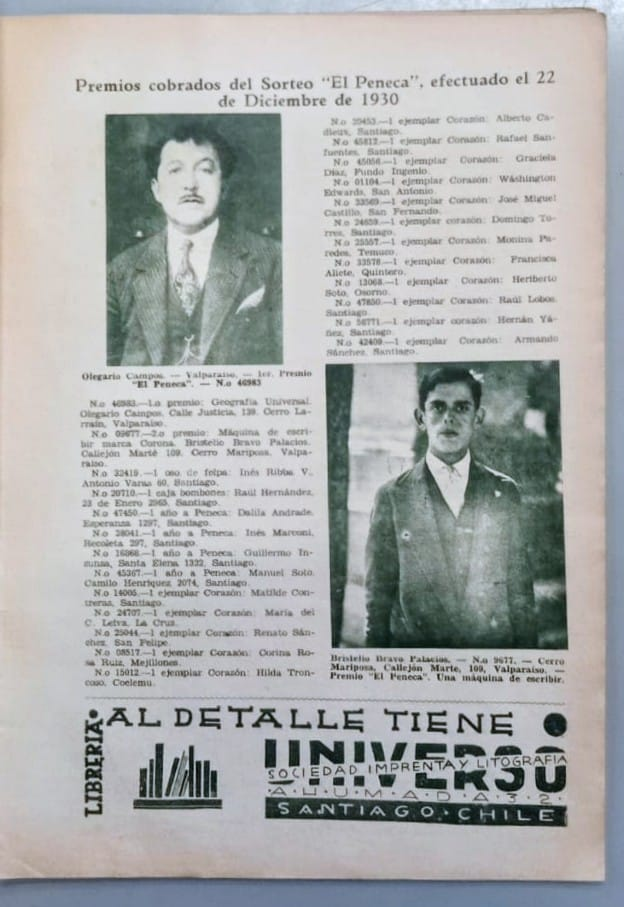
EL PENECA, no. 1161, February 16, 1931.
Editorial Growth: Figures and Successes.
The impact and acceptance of this project were confirmed decades later, in the 1960s, when “Roxane” described her work and philosophy in an interview with the newspaper El Mercurio:
"EL MERCURIO
I never wrote a story that contained violence, vengeance, or base passions. I gave the child a romantic tale. Each reader, of diverse temperament, found in 'El Peneca' a reading that enthused them. Thus, from 6,000 copies with which I received the magazine, it reached 240,000."
On November 14, 1921, in issue no. 678, a special edition full of surprises was announced, confirming the bond between her and the readers:
"CHILDREN'S LIFE
In the next issue 'EL PENECA' will celebrate its anniversary. For this reason it will bring 24 pages of most interesting reading, an article by Roxane to her little girls, and other surprises.
Marcela and Gonzalo Vieragallo have already settled into the third floor of their lovely house on Moneda Street. Soon they will give a children's matinee to inaugurate their little parlor.
María Pascal Lyon is one of the most enthusiastic contributors to EL PENECA. They tell us that she has written a very lovely story, but that she does not wish her pseudonym to be known, because her cousin Virginia despises this children's magazine and finds it good only for babies.
Guillermo Santa Cruz is driving the little nuns who have the patience to teach him to read crazy. His little friend Raúl beats him by far in diligence.
Alejandro Herreros Nebel has become a model of perfections. He already knows German better than the Kaiser.
Rebequita Varas Herreros still always speaks and thinks in French. They say she no longer knows how to speak Castilian."
“Roxane's” commemorative article of 1923 offered an exceptional lens through which to understand the phenomenon: beyond the spectacular figures, she proclaimed it “The Most Widely Read Magazine in Chile”:
"Economically the triumph has been complete. From a magazine that barely printed 10,000 copies, we have made a weekly publication so desired and sought after by children that, upon completing my two years as director, I see the present issue come out with 50,000 copies. EL PENECA breaks the record never before reached by any other Chilean magazine. EL PENECA is the most widely read magazine in Chile."
EL PENECA, no. 744, February 19, 1923.
On the fifth anniversary of her editorship in 1926, the magazine recorded major commercial success. According to Zig-Zag's records, weekly sales reached a record 68,000 copies.
"Five years have passed since March 22, 1921, until today. Five glorious years, if one may say so. And why not? This child, eternally a child, has triumphed in all its phases. Economically it carries a print run of more than 68,000 copies. And according to its director, it is the magazine with the largest circulation in the country."
EL PENECA, no. 905, March 22, 1926.
The fact that El Peneca printed 150,000 copies in 1938 was extraordinary, revealing that Chile had a child and youth readership large enough to sustain a weekly run of that size, supported by an efficient network of newsstands and subscriptions. If one considers that a single copy was read by several people-siblings, cousins, neighbors, schoolchildren, and others-the magazine's real reach was greater still.
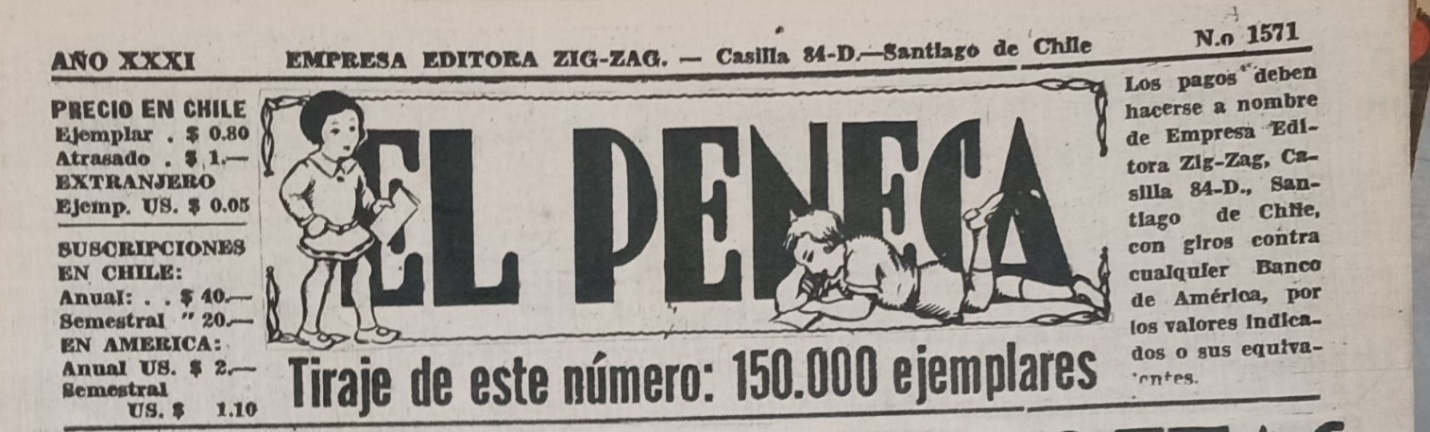
The Golden Decade and the Stability of the Team. 35th Anniversary, November 2, 1942.
With a magnificent photograph of Elvira Santa Cruz and texts in tribute to her, the issue reaffirmed the affection and respect she inspired. Mirthala's poem “Greeting” and the testimony of “Ketmis,” who worked with her at the Reñaca School Colony, presented an editor viewed as a maternal figure and spiritual guide. “Ketmis” summarized it by saying that “Roxane” was “the brain, the nerve of ‘El Peneca,’” and that her success lay in the fact that “she has looked deeply into children's hearts” and “always knows what her readers like”:
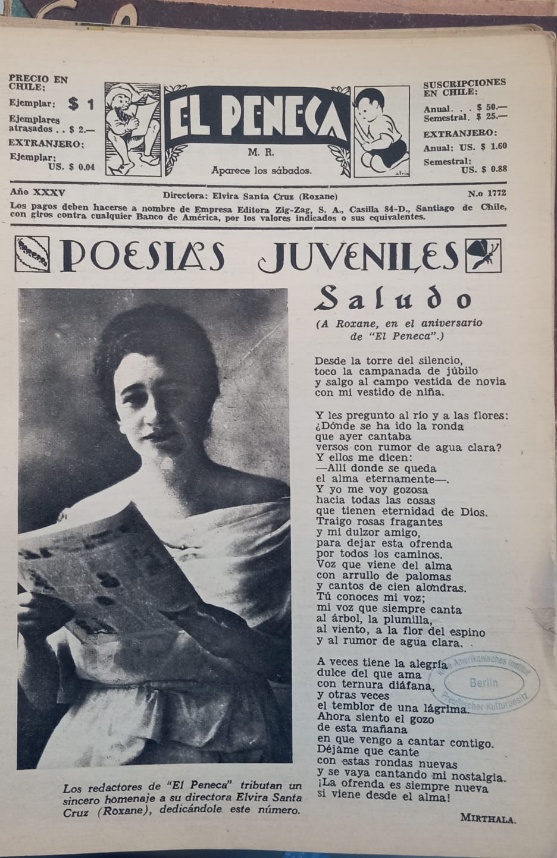
EL PENECA, no. 1772, November 2, 1942.
Issue no. 1928 of El Peneca, dated November 24, 1945, celebrated its 38th anniversary. The edition was conceived as a tribute to the people who made the magazine possible, emphasizing the longevity and loyalty of figures such as “Ketmis,” “Coré” and Atria, who demonstrated that El Peneca was a “home” where the team grew and stayed. The implicit message was: “If our creators have been here for so many years, it is because the magazine is good and trustworthy (L.C.).”
The edition included a portrait of “Roxane” and “Coré” in the printing workshops, as well as illustrations introducing other prominent members of the team, among them Olga Villalón (general secretary), “Ketmis” (editorial secretary), Elena Poirier (artist) and Alberto Lungenstras (artist).
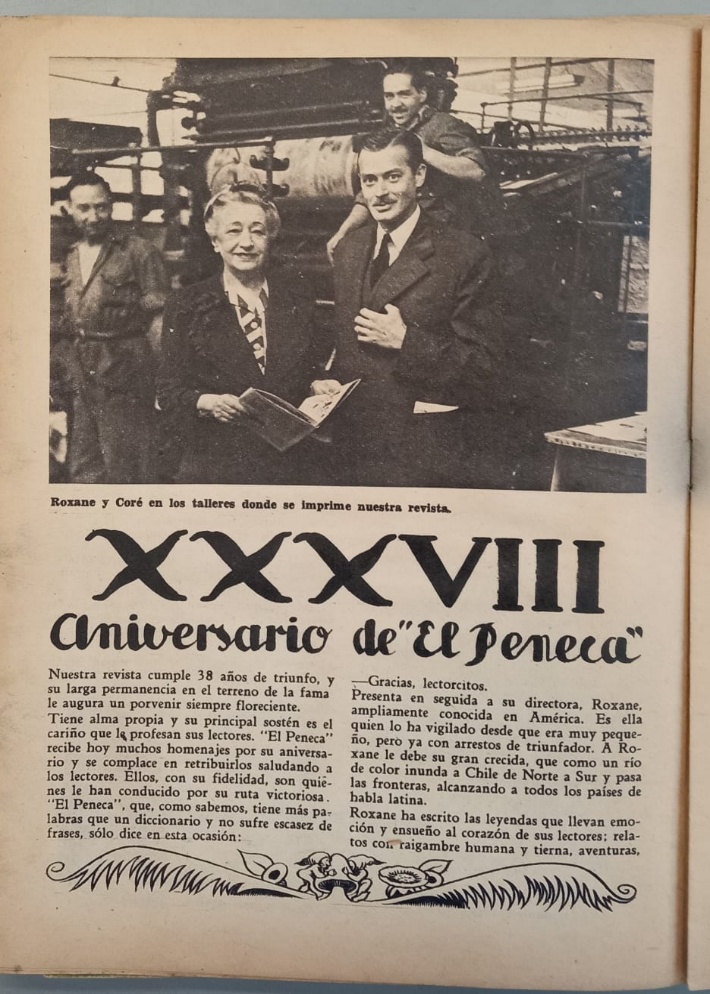
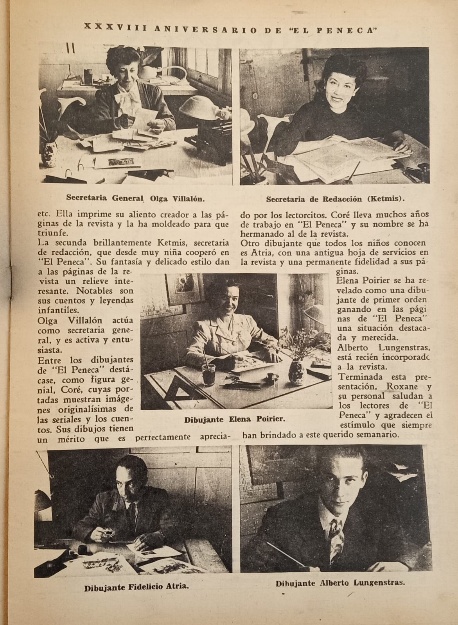
Issue no. 2188, dated November 18, 1950, was a farewell poised between success and loss. It recalled the figures: 9,000 copies at the beginning, more than 200,000 later. The number itself was proof of a dream that had crossed borders and become a childhood companion across Latin America. “Thirty years, dear readers, is an immense period for you. It is for me as well, but I have not felt it that way, perhaps because in the whirlwind of work there is no time to calculate how life passes.” It was her way of drawing close to the children, telling them that she too had once been young in that adventure.
Her nephew, Mario Silva Ossa, had disappeared in March. No one knew how, where or why. Only that he went out “to get some fresh air” and never returned. True to her style, she opened the pages so that Atria, Elena Poirier and everyone who loved “Coré” could say goodbye. She herself, however, remained silent in that issue.
And in the editorial for that number she wrote: “Two or three generations of passionate readers are accompanying me on this XLII anniversary of the triumphant ‘Peneca.’ To all of them Editor Roxane sends an affectionate greeting, as she descends toward the sunset of life without bitterness or discouragement, because everything is made beautiful by the love her favorite children-the readers of ‘El Peneca’-have always shown her.”It was her farewell. Softly, without drama, like someone closing a door without making a sound.
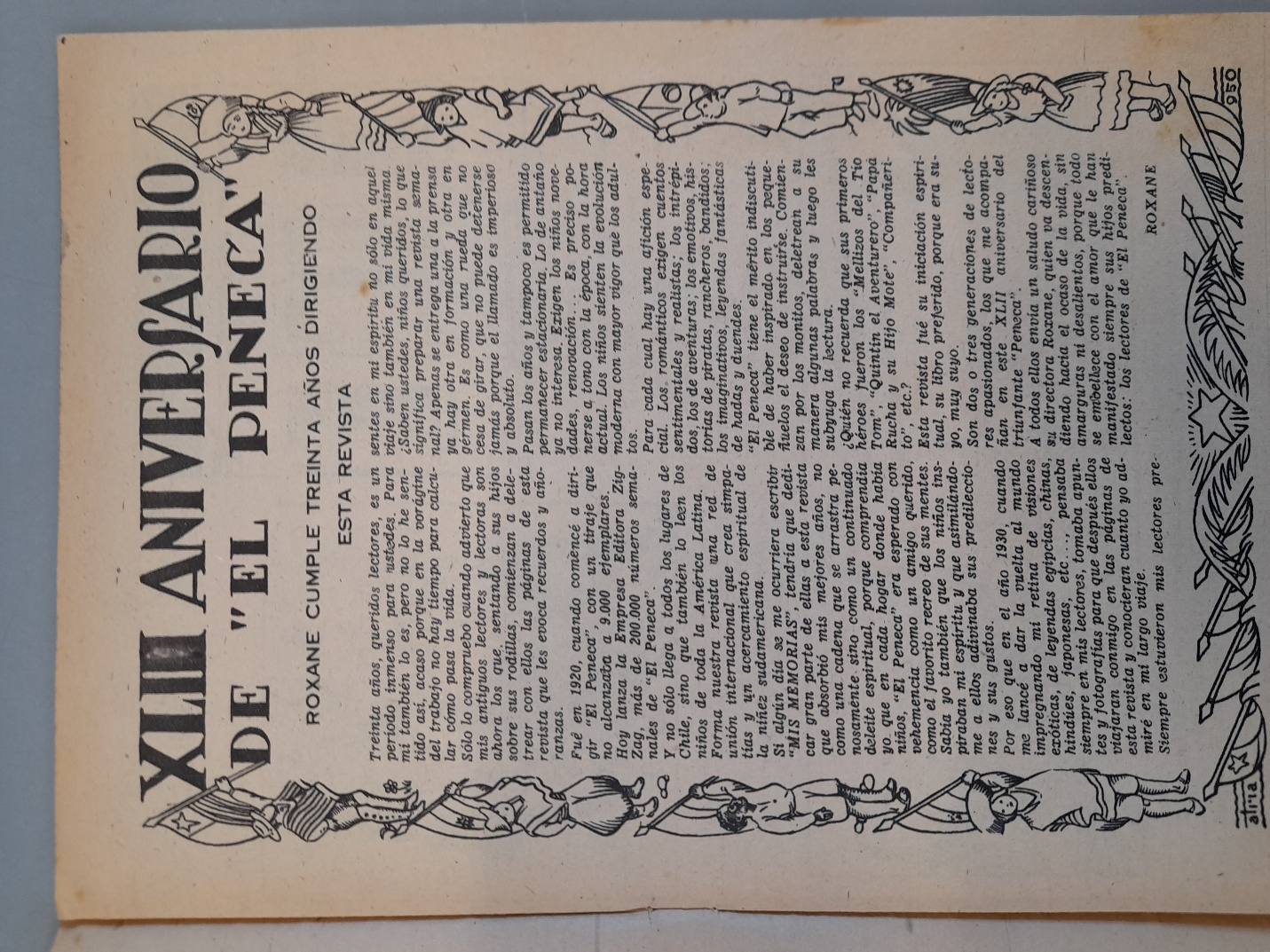
The Farewell and the Legacy (1951).
At the end of her editorship in 1951, Elvira Santa Cruz formulated in a farewell text a lucid theory of children's emotional needs that anticipated principles of a new era:
"The child is by nature demanding; he asks for constant renewal, something new that startles and impresses his senses, that makes him dream, laugh, or think."
EL PENECA, no. 2233, September 22, 1951.
She explicitly acknowledged the collective work that sustained the magazine's success, particularly emphasizing its contributors:
"I remember the precocious and insistent Kukufate (Rial or Ketmis), Manuel Huebner, and many other colleagues in their literary compositions; in drawing, Coke, Fidelicio Atria, the Monteolas, the Almae, Elena Poirier, and the brilliant Coré, whose covers and drawings immortalized his name."
EL PENECA, no. 2233, September 22, 1951.
Across its trajectory from 1921 to 1951, El Peneca consolidated a literary and graphic model that harmonized tradition and modernity, as its issues from 1926 and 1948 reveal. This diachronic view demonstrates that the magazine preserved its identity as “the favorite reading of thousands of children.”
The persistence of comics and increasingly long serialized novels, together with the delicate balance between instruction and entertainment, rested on multiple factors. Among them stood the aesthetic renewal of the covers, which shifted toward a more agile visual language, and the emergence of Mario Silva Ossa (“Coré”), whose drawing from 1932 onward would give the publication its definitive graphic identity. The format also expanded to thirty-six pages, giving the whole greater thematic and visual cohesion.
Two Moments in the Weekly's History: 1926 and 1948.
A comparison of the 1926 and 1948 editions demonstrates the magazine's editorial vitality and offers a snapshot of two moments in its history: the 1920s, at the dawn of the cultural industry, and the 1940s, the golden age of Chilean magazines-from the Chile of the early century to the accelerated urbanization of the mid-twentieth century:
In EL PENECA issue no. 864 (January 4, 1926),
the cover featured the illustration of "Beauty and the Beast," surely drawn by one of the Alvial brothers. Inside pages included "Talks and Poems," illustrated vignettes that narrated, in serialized format, the story of "Carmañola, the Brave." Additionally, in the same issue the serialized comic strip "Quintín, the Adventurer" was offered, along with "The Sufferings of Aunt Cutufa" and the serialized novel "The Inheritance of Tomás Seytón." The comic "The Excursionist and His Helpers, Major Palote, Pegote, and Papiro" also appeared. In the center pages, the comic series "Charlie Chaplin" stood out, alongside sections such as "Our Contributors" and "Miscellany." The comic "A Dangerous Sneeze," "Games and Pastimes," "Puzzles," and short stories by young contributors such as "The Doctor of the Calves" (dedicated to the contributor Lautaro) completed the content. Advertising announcements, a new episode of "Quintín, the Adventurer," and finally, on the back cover, the serialized comic strip "Rosita the Intrepid" rounded out this edition.
And in the edition of EL PENECA number 2089 (December 25, 1948),
there was a cover illustrated by Coré, which presented in full color the Virgin Mary and her son, surrounded by little angels. Inside pages included the illustrated comic strip "Brave Heart" in serialized format, along with "Youthful Poems." The serialized novel "Adventures of Chiche" appeared, followed by the long-running comic "Durga-Rani, Queen of the Jungle." The story "The Fourth Wise King," illustrated in black and white by Fidelicio Mardones Atria, shared space with "Christmas Carols" (appropriate for the Christmas issue). New episodes of "The Tsar's Courier," "Riddles," "Two Braves," and "School of Vagabonds" were added to the content. The beginning of the series "Captain Audacity" was announced, along with advertising announcements. The comic "The Two Crazies," the continuation "The Return of Sandar," the section "Correspondence," and a new edition of "Brave Heart" on the last page completed the weekly. The back cover showed a full-color illustration of "The Tsar's Courier."
Synthesis.
Elvira Santa Cruz selected some of the best-known works of world classical literature for children and young people, adapting them into continuous serials that captivated entire generations. Together with her team, she transformed these stories through language accessible to young readers eager to discover enchanted worlds, fantastic landscapes and unfamiliar characters.
This innovative vision turned the weekly into an unprecedented creative force and established new standards. It transcended its role as an editorial product to become a genuine platform for children's collective expression. In essence, it was a social network decades before the digital age.
Illustrations · original edition
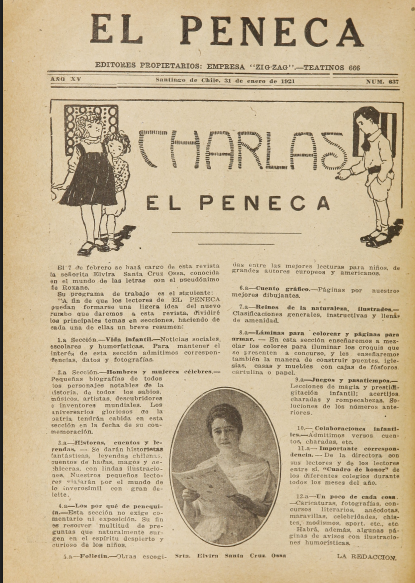
2.2.3. Covers, Illustrators and Photographers. Interview with Gabriela Silva Ossa.
Under the direction of Elvira Santa Cruz Ossa, El Peneca reached its maximum visual splendor. The covers were a central element of its identity and a key factor in its success. They were characterized by their great artistic quality, with vivid colors that sought to capture children's attention at the newsstands. The intention was that, just by seeing the cover, the reader would know they would have a good time with the magazine. Generally, the covers were related to the narrative series or stories published inside that issue. This created a visual unity and allowed the reader to follow the development of a story simply by looking at the covers each week.
The weekly publication filled itself with color, movement, and fantasy, becoming a reference point for Chilean children's illustration. It was the era of the great illustrators, who often trained in the very pages of the publication to become central figures of Chilean culture. In this period, names such as Mario Silva Ossa ("Coré"), Fidelicio Atria Mardones, Elena Poirier, Alfredo Adduard, René Ríos "Pepo," Themo Lobos, Alberto Lungenstras, Renato Andrade, and Raúl Manteola stood out, among many others. Some of these artists, whose names and signatures—both recognized and anonymous—were difficult to trace in this research, formed part of the group of key cover artists and cartoonists who consolidated this period of great artistic richness.
First covers under Roxane's direction
The covers initially preserved the contents and designs of her predecessors, presenting portraits of children from affluent families, such as that of Adrianita Schroder Saelzer, who appeared on February 21, 1921 (issue 640) and, in the following issue (641), where she was portrayed alongside her mother. On the cover of March 21, 1921 (issue 644), a photograph was published of a group of girls with their maternal grandmother: "Olga and Aninat Gómez Albrecht with the grandmother from Boroa." On March 28, 1921 (issue 645), a black-and-white photograph of "A Porteña," an inhabitant of the port city of Valparaíso, was displayed. The portraits of Mimi Huebner, Enriquito Pascal, Teresita Calvo Vial, Estercita Matte Alessandri, Alicia Larraín, and Mariita Subercaseaux Vial reflected a traditional and family-oriented tone. At the end of 1921, this approach was complemented by introducing the caricature of "Charlie Chaplin." The transition from photographic to caricature marked a shift toward popular culture, tuning in with the global phenomenon of Charles Chaplin in silent cinema, an omnipresent figure in the 1920s.
Lautaro (1901-1986) and Aníbal Alvial Bensen.
Among the first cartoonists who collaborated with Elvira Santa Cruz, the brothers Lautaro (1901–1986) and Aníbal Alvial Bensen stood out. On the cover of issue 648 (April 18, 1921), Lautaro published "The Girl of the Fountain," a two-color illustration signed with his name. This artist, in particular, was recognized with the National Journalism Prize, drawing mention, in 1970. An example of the fusion between drawing and literature was found in issue 669 (September 12, 1921), where the Alvial brothers displayed their talent in an illustration that captured the essence of the Brothers Grimm tale "Hansel and Gretel." At the foot of the cover it read:
"HANSEL AND GRETEL.– After being lost in the forest for three days, Hansel and Gretel found a house whose walls were of nougat and whose windows were of rock candy. As they were very hungry, Hansel tore off several pieces, which both siblings began to eat. Suddenly the door opened and an old woman appeared, very old, with a terrible face. The children, frightened, dropped the sugar and nougat, but the old woman, instead of scolding them, invited them to enter."
"HANSEL AND GRETEL.– After being lost in the forest for three days, Hansel and Gretel found a house whose walls were of nougat and whose windows were of rock candy. As they were very hungry, Hansel tore off several pieces, which both siblings began to eat. Suddenly the door opened and an old woman appeared, very old, with a terrible face. The children, frightened, dropped the sugar and nougat, but the old woman, instead of scolding them, invited them to enter."
The cover "Magic Oven" (issue 651, May 9, 1921) referred to tales and legends published inside the pages. Others, such as that of issue 652 (May 16, 1921), introduced stories like "The Magic Little Bell." On the cover of issue 657 (June 20, 1921), the illustration "The White Elephant" included a text integrated into the drawing, inviting the reader to read the story of a prince turned into an elephant by a spell.
The Mysterious Pseudonyms.
Issue no. 818 (July 21, 1924) featured a striking cover illustrated by “Dicky Spark,” a pseudonym whose real identity has never been established. It showed a girl seated on a cushion against a white background, absorbed in contemplating her reflection in an ornately carved mirror.
A few months later, issue no. 841 (December 29, 1924) included an illustration signed with the pseudonym “Norfolk”. The image portrayed a tender blond, blue-eyed baby, reinforcing the publication's lyrical, dreamlike style. With this contribution, “Norfolk” joined the list of unidentified artists.
Víctor Orellana: A Case of Recognized Authorship.
In issue no. 896 (January 18, 1926), Víctor Orellana signed and illustrated the cover “Getting Ready for Summer,” in which a plump, charming little girl radiated happiness. The following month, in issue no. 897 (January 25, 1926), he drew the same girl again, this time winking playfully, accompanied by the question: “Did I pass?”
Although his biography has not been reconstructed, Orellana's style—with rounded figures and exaggerated features—revealed clear influences from comics and caricature.
Recurring Themes on the Covers.
Beyond the signatures, the covers of El Peneca portrayed children absorbed in their games or given over to the placidity of everyday life, underscoring innocence and a sense of community, as could be seen in issue number 834 (10 November 1924). Tales and legends also paraded across them, such as Beauty and the Beast in issue number 894 (4 January 1926), where a princess approached the beast, broken by her absence. At the foot of the image one could read: "The Beast fell ill with grief because of Beauty's absence."
In its early years, Elvira Santa Cruz invited artists and illustrators from diverse backgrounds to collaborate with the weekly magazine. There was not yet a defined graphic line. That is why the covers were varied and lacked a designer who stood out in this new challenge.
It was necessary to relocate the experimental covers that came to an end with "Atria" as the illustrator of the interior pages and "Coré" as the principal cover artist, for it was they who finally took charge of the magazine from 1932 onwards and inaugurated a line of design that would lead El Peneca towards an inexorable success.
Fidelicio Atria Mardones (1904-1965).
Fidelicio Atria Mardones, known by his signature "A," was one of the most stable and long-lived illustrators of El Peneca. His training at the School of Fine Arts allowed him to develop a specialty in black-and-white chiaroscuro, handling lights and shadows with great technical precision to create depth, atmosphere, and emotion in each drawing.
He joined the magazine in 1921, illustrating a story by his friend Ralph Stanssel, and for decades he was responsible for giving visual life to the interior pages. His work ranged from illustrating series such as Snow White (issue 948, January 17, 1927) to sections such as "Talks and Poems," pastimes, and occasionally covers. The Zig-Zag publishing house, together with the Universo printing press, commissioned him with the designs for the "Fantastic Library" edition, which demonstrated the recognition of his talent beyond the magazine. His influence was so notable that many disciples imitated his style, adapting their work to Atria's characteristic line.
His career was captured in issue 1149, when Jorge Aldunate G. wrote: "In this section we do not take Atria into account, because it would be futile to do so." Atria was consecrated, and his name was synonymous with quality and trajectory. The magazine itself, in issue 834 (November 10, 1924), described him as "a cartoonist in the broad sense of the word," highlighting the "mysterious charm" of his works.
In 1932, Atria and Silva Ossa shared the podium in the contest for the XXV Anniversary of El Peneca (issue 1250), where Atria won Second Prize (Out of Competition). A week later, on December 5, 1932, he illustrated the cover of issue 1251 with "Congo, the Titan," an image printed in two colors that revealed his ability to create volume and depth through the contrast of lights and shadows.
Among his most remembered works are the illustrations for "The Standard-Bearer of the Nation" (issue 2022, September 13, 1947), "The Discoverer of America, Christopher Columbus" (issue 2078, October 9, 1948), and "The Wise Broom" (issue 2086, December 4, 1948). His illustrations remain an example of craft, technique, and artistic sensibility, accompanying the childhood of thousands of Chilean children.
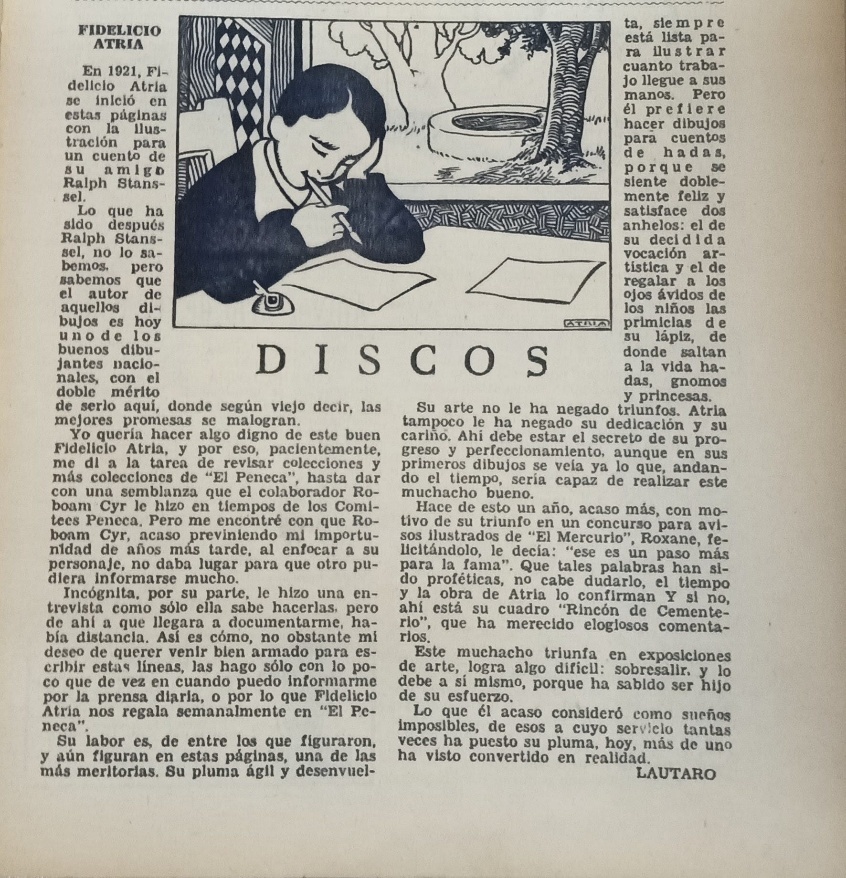
"OUR CONTRIBUTORS
Atria: Why repeat to you once more that you are a cartoonist in the broad sense of the word?
Your works have a mysterious charm. I admire the black lilies, the disheveled tulips; the Japanese interiors; the fascinating and elastic cobras, and, in short, everything that is original and exotic. How then not to admire the cartoonist who reveals himself little by little?
I have heard so many words of praise regarding your work; there is so much sympathy for you among young people that, if I began to dissect and make histories one by one, you would become prouder than the Sultan with the blue beard. And that, no. It might perhaps make you fall asleep on your laurels and with that bring about harm. Is it not people like you that the intellectual world needs? "
Greetings: MENPHIS."
EL PENECA, no. 834, November 10, 1924.
EL PENECA, no. 1251, December 5, 1932.
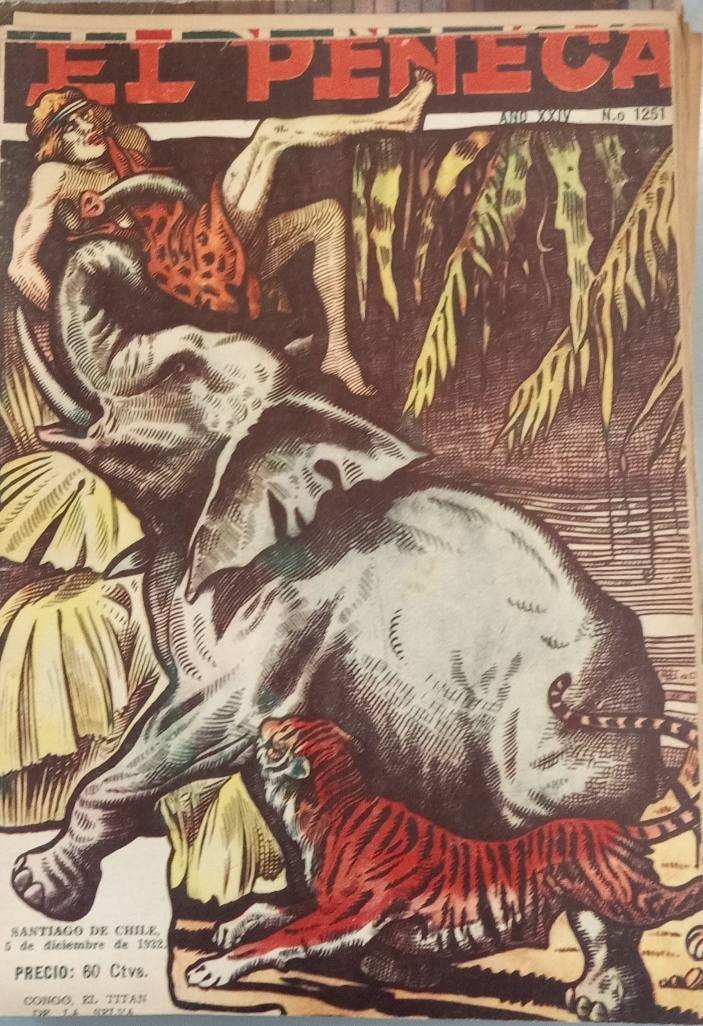
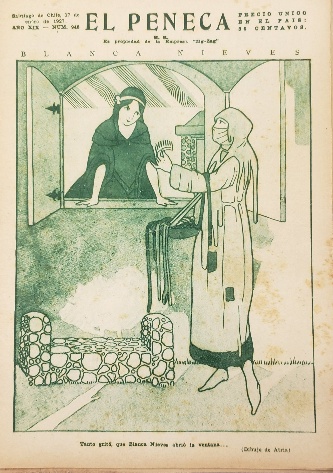
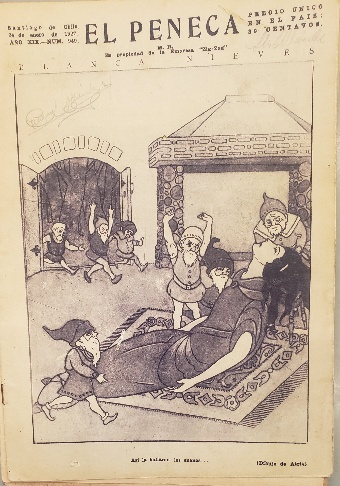
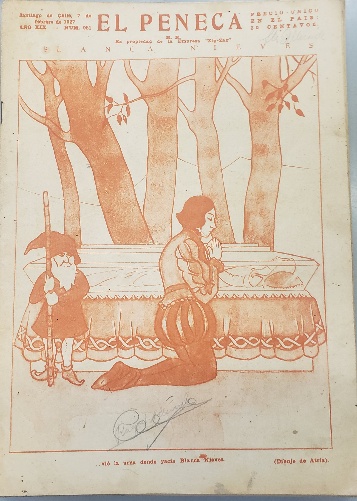
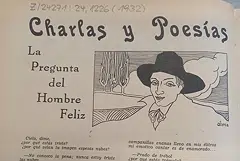
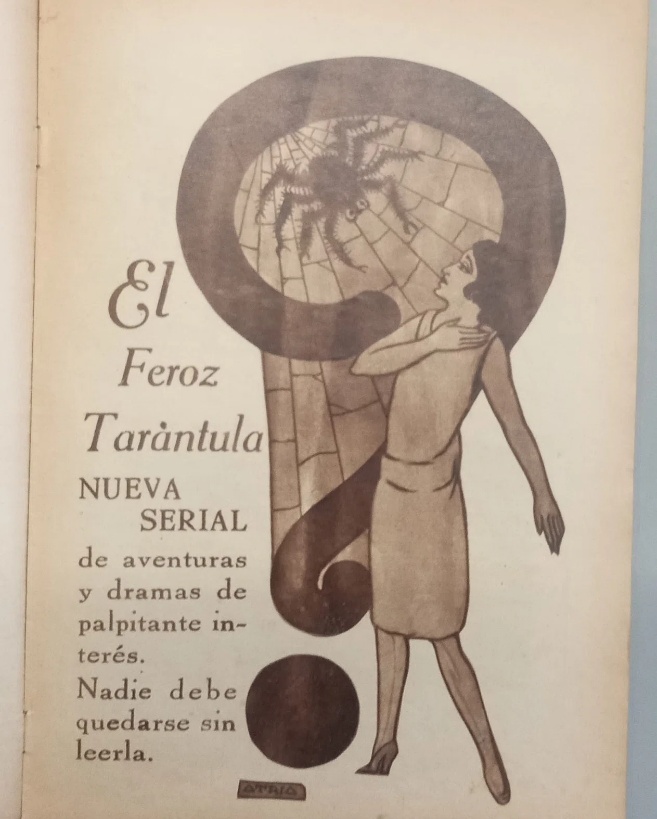
René Ríos Boettiger "Pepo" (1911–2000).
René Ríos Boettiger, known worldwide as "Pepo," was one of the most influential caricaturists and cartoonists in Chile. He was born in 1911, and from the age of seven he filled entire notebooks with drawings, an early talent that would lead him to become a central figure of Chilean graphic humor. Although his family pushed him toward a "serious" career, he even enrolled in Medicine at the university, but his vocation was stronger, and he enrolled in the School of Fine Arts of Santiago.
In 1932, at only 21 years of age, he began a collaboration with the renowned cartoonist Jorge Délano (known as "Coke"). From that alliance was born "El Pobre Diablo" (The Poor Devil), a picaresque character that anticipated the popular humor that years later would explode in Condorito. He later worked in the magazines El Pingüino and Can-Can, where he polished his agile, expressive style, close to common speech.
"Pepo" arrived at El Peneca during the third stage, a complex period in which the magazine could not consolidate itself after the withdrawal of director Roxane. There he coincided with first-rate colleagues: Elena Poirier, Themo Lobos, Renato Andrade, and Alfredo Adduard, among others.
In 1949 he created Condorito, the magazine that would house Chile's most emblematic character. The comic strip, starring a mischievous, good-natured condor always in trouble, transcended generations and remains in print to this day, with translations into different languages.
In the context of this research, I had the opportunity to interview René Ríos Boettiger (ca. 1990). Unfortunately, the recording of that conversation was stolen along with other materials in a robbery suffered at my home in Macul. Nevertheless, I retain in my notes some comments worth recovering: "Pepo" remembered that at El Peneca the cartoonists worked with pen and India ink and that the director asked them to make children recognize their own neighbors in the panels. Humor, he said, was born from the direct observation of the neighborhood.
The Mysterious Pseudonyms.
Issue no. 818 (July 21, 1924) featured a striking cover illustrated by “Dicky Spark,”
"The Experimental Art of the 1920s.
In this era, covers such as "Ali Baba and the Forty Thieves," "The Hunchback Prince," "Puss in Boots," and "My Friend Pierrot Departs for the Moon" navigated between the figurative and the abstract, bathed in a palette of pastel colors.
The faces of the Pierrots, both the protagonist and his companions, and the moon itself shared a visual language of rounded forms that were repeated even in the balloons of the basket rising to the sky. Circular silhouettes came to dominate a large part of the composition. Markedly experimental in character, these images evoked the spirit of modern art of the 1920s, in which forms freed themselves from conventions to explore new visual styles.
These examples illustrated the diversity of criteria that coexisted in El Peneca regarding the authorship of drawings. From absolute anonymity to the explicit recognition of the author, passing through the intermediate use of pseudonyms that, while preserving a certain creative credit, allowed the safeguarding of real identity.
The editorial policy in this regard was flexible, varying according to the historical period and, very probably, according to individual agreements with each artist.
Analysis of Emblematic Covers (Foradori and the Facsimile for the 24th Anniversary).
To commemorate its twenty-fourth anniversary, El Peneca paid tribute to its founders by reissuing its first cover. This iconic image, originally created in 1908 by José Foradori, was reproduced as a nostalgic homage and as a reaffirmation of the magazine's editorial continuity. It honored the publication's graphic heritage and established a visual dialogue between new generations of readers and the first children who had witnessed its birth. It was also a bridge between two eras: the beginnings, marked by Foradori's academic, European line, and the magazine's editorial maturity, which already counted on the talent of illustrators such as Fidelicio Atria and, from 1932 onward, Mario Silva Ossa (“Coré”):
“EL PENECA (Facsimile of the cover of the first issue of ‘El Peneca’
Today Chilean children celebrate with universal rejoicing the twenty-fourth anniversary of the magazine that was born at the dawn of the twentieth century, radiating light and joy throughout the world of childhood. The little Peneca grew, grew more beautiful, and acquired wisdom. Today it is an important and prestigious weekly, increasingly beloved by Chile's youthful ranks.
Long live ‘EL PENECA,’ and long live Chile!”
EL PENECA, no. 1201, November 23, 1931.
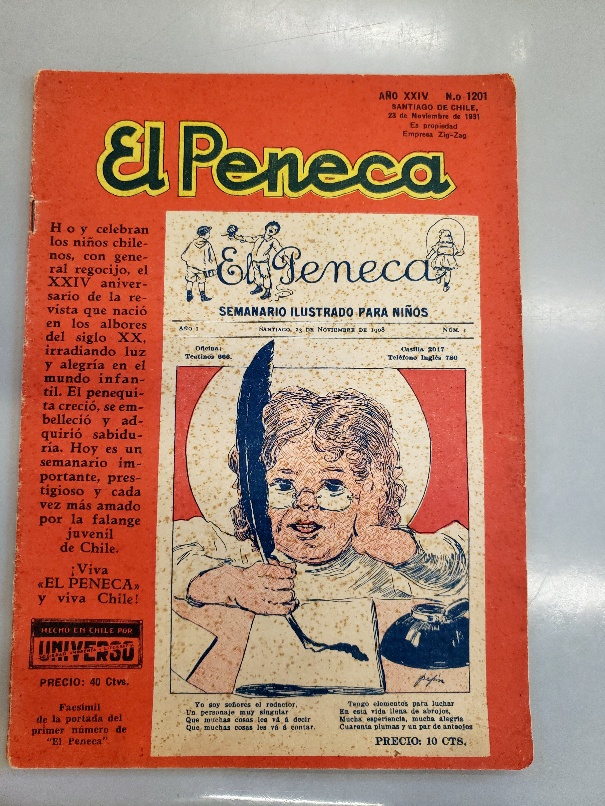
Elena Poirier (1921-1998): The Illustrator of Magical Worlds.
Elena Poirier was a Chilean illustrator and visual artist, recognized for the prolific and delicate work that gave life to covers and interiors of books, especially in the field of children's and young adult literature. Born in Chile in 1921, she demonstrated an exceptional talent for drawing from an early age. Her professional career began when the father of one of her friends, an employee at the Zig-Zag publishing house, showed her sketches to "Coré," who immediately invited her to collaborate. Poirier wove magical worlds in her illustrations. Her work was, in essence, to guard a realm of fantasy for children, making the fantastic seem to sprout from the everyday: a bridge between the imagined and the perceivable.
Her versatility unfolded both in color and in black and white. In full color she stood out on the back cover of issue 2005 (May 17, 1947), while in black and white she tackled historical adaptations such as Ben-Hur (issue 2051, April 3, 1948). She also ventured into adventure classics such as The Tsar's Courier and The Scarlet Pimpernel, as well as fantastic tales such as "The Last Pharaoh," adapted by Odilia Navarro ("Ketmis").
A representative example of her narrative method was the cover of issue 2188 (November 18, 1950), where she divided the cover into four panels, a choice that generated an innovative visual dynamic. Each panel presented a micro-story, capturing a different moment of the adventure. This device functioned as a kind of "preview" or graphic trailer, condensing four different characters, settings, and situations into a single image.
But it was in issue 2216 (June 2, 1951) that Poirier reached one of her most evocative peaks with the illustration "Silvanus and His Treasures," which showed a prince under the sea, surrounded by mermaids. For readers of the 1950s, the seabed was a setting as exotic and mysterious as the moon or the African jungle. The presence of the mermaids, far from being merely decorative, represented the enigma and danger of the ocean, rescuing the classical tradition where these creatures were not sweet, but powerful and fascinating beings.
In the most intimate and religious sphere, Poirier demonstrated equal sensitivity in issue 2297 (December 20, 1952), by making the faces of a boy and a girl occupy the entire cover. With this device, she placed the focus on the emotion and reaction of these two "penecas" before a tiny stable and the birth of the baby Jesus, humanizing the Christmas mystery through the child's gaze.
Poirier left Chile in 1957, but she never stopped sending her illustrations to Chilean publishers, keeping alive that magical bridge she had built decades earlier. She died in Rome in 1998, leaving behind a legacy that accompanied the childhood of several generations.
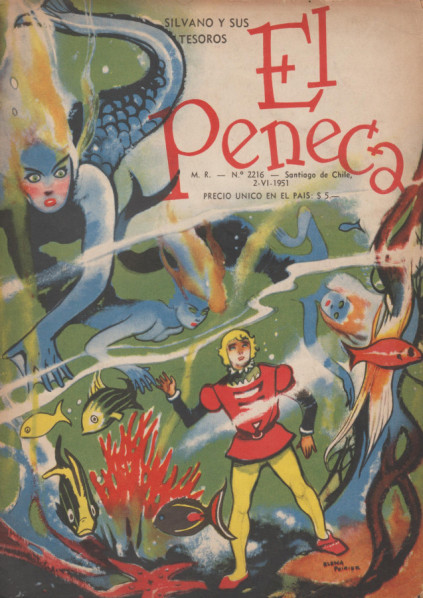
In the more intimate and religious sphere, Poirier demonstrated the same sensitivity in issue 2297 (December 20, 1952), allowing the faces of a boy and a girl to fill the entire cover. Through this device, she placed the focus on the emotions and reactions of these two “penecas” as they faced a tiny stable and the birth of the baby Jesus, humanizing the Christmas mystery through a child’s gaze.
Poirier left Chile in 1957, but she never stopped sending her illustrations to Chilean publishing houses, keeping alive the magical bridge she had built decades earlier. She died in Rome in 1998, leaving behind a legacy that accompanied the childhood of several generations.
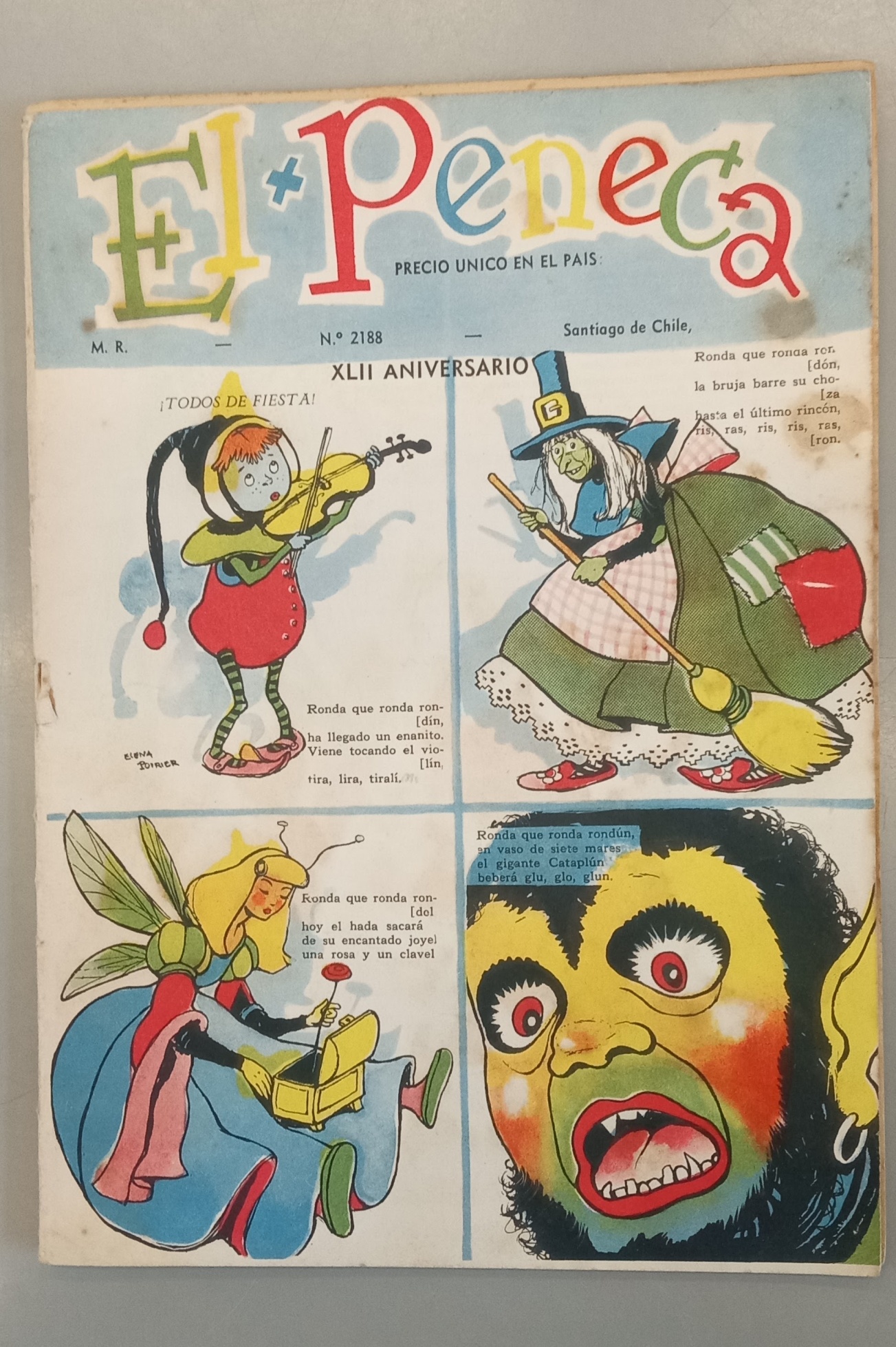
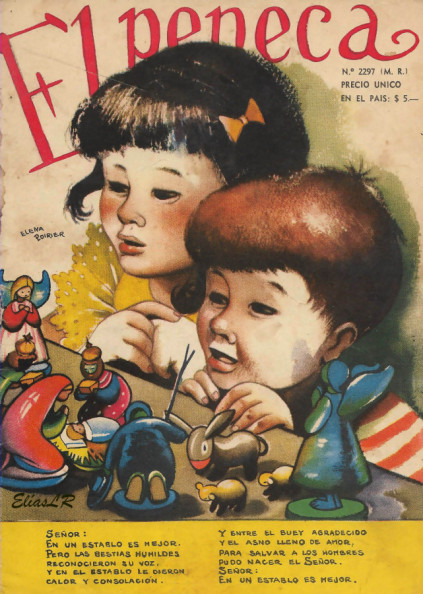
Mario Igor Vargas, Born on September 20, 1929, in Puerto Montt, he was one of the most versatile and long-lived illustrators of the second period of El Peneca. His career began precociously: at 14 years of age, he began sending his illustrations to the magazine, where they were accepted immediately and began working under the direction of Mario Silva Ossa. Later, he expanded his work to other publications of the Zig-Zag group, such as the magazine Okey and the celebrated Condorito, which demonstrates the confidence the publisher placed in his line.
His natural talent for drawing, his charisma, and his elegant dress among colleagues earned him the nickname "the black prince," a nickname that accompanied him throughout his professional life. Mario Igor possessed an unmistakable and energetic line that imbued with magic every corner of his panels, from the backgrounds and stones to the garments of his characters, whether they were mythological heroes or grotesque beings. His narrative genius shone in the mastery of facial and bodily expressions, the fluidity and coherence of his compositions, and the masterful use of black and white as an expressive resource. Each page was a work of art worthy of a museum, confirming him as an absolute master of drawing and an exceptional cartoonist.
After the death of "Coré," Igor Vargas took charge of the covers of El Peneca alongside Elena Poirier and Alfredo Adduard, forming a trio of illustrators that kept alive the visual identity of the magazine in its mature years.
Outside the pages of El Peneca, Igor maintained a close friendship with Abel Romero, with whom he shared work at the Zig-Zag publishing house. When this company passed into the hands of Quimantú in the 1970s, Igor continued working there and, later, at the Gabriela Mistral Publishing House, few artists managed to sustain themselves in times of radical political change.
Despite his extensive career and the affection he generated among readers, Igor Vargas died in 1995 in precarious economic conditions, a paradoxical fate for one who had filled with color and fantasy the childhood of thousands of Chilean children. His legacy, however, remains in the yellowed pages of El Peneca, waiting to be rediscovered by new generations.
Alberto Lungenstras: The Man Behind “Quintín the Adventurer.”
Alberto Lungenstras worked at El Peneca from a very young age. He had a natural talent and an early vocation for drawing.
Amid stories and adventures, Lungenstras repeatedly brought the character “Quintín the Adventurer” to life whenever installments from abroad failed to arrive on time. The character became so closely associated with the illustrator that the editorial staff nicknamed him “Quintín.”
Nicomedes Guzmán “Ovaguz” (1914-1964): the pencil and the word. He began drawing for El Peneca at the age of fifteen, demonstrating that the magazine was a talent pool from a very early age, just as had happened with Mario Igor. He moved naturally between illustration and literature, something uncommon at a time when disciplines tended to be more compartmentalized.
La sangre y la esperanza (1943): His best-known literary work, marked by a strong social and popular character, established him as a writer committed to the realities of his time. The pseudonym “Ovaguz” was a typical wordplay among contributors of the period.
The poem “La modorra” (February 15, 1937, issue no. 1947) was a perfect example of the fusion between the arts that made El Peneca unique. Atria’s image, engaging in dialogue with Guzmán’s words, created a complete aesthetic experience in which pencil and pen complemented each other. The poem itself, with its atmosphere of a summer afternoon in the countryside, that “deseo de no hacer nada” beneath the “fronde alada” and the “brochazos de oro,” was a small gem of Chilean popular poetry.
The career of “Ovaguz” reinforced an idea we had already seen with Mario Igor: El Peneca was an space for artistic experimentation where illustrators, poets, critics, and storytellers came together:
"TALKS AND POEMS
Drowsiness….drowsiness:
summer dog days…;
desires to do
nothing,
desires to
rest, sleep,
under the winged frond
of the green season
with strokes of gold…
The trees, all,
fall silent.
they silence their laxity…
only a willow
tells its sorrows
to the river…"
OVAGUZ.
El Peneca no. 1947, February 15, 1937.
Themo Lobos (Temístocles Lobos, 1928-2012).
was a cartoonist, comic illustrator, and creator of Chilean characters. Born in Santiago in 1928, he showed artistic talent from a very young age. His career began precociously at El Peneca, where he first contributed small drawings and later formally joined the team of illustrators between 1951 and 1960. There he found inspiration in characters such as "Quintín, el aventurero" (Quintín the Adventurer), and it was "Coré" who, in his own words, "instilled in him a love for drawing."
He studied at the School of Applied Arts and worked for various publications: the Zig-Zag publishing house, the newspaper La Nación, and the magazines El Pingüino and Barrabases, among others.
In 1968 he took part in the creation of Mampato magazine, designed by his colleague and great friend, the architect and illustrator Eduardo Armstrong (1921–1973), who also created the main character together with Óscar Vega (1945–2007). In those pages, Lobos designed figures that became unavoidable references in Chilean culture: the Kilikilis, the Golagolas, Ogú, Alaraco, and many others.
Mampato synthesized four key elements that made it unique: history, humor, social criticism, and science fiction.
Thanks to his singular ability to combine history with an unmistakable graphic and narrative style, Themo Lobos left a significant contribution to Chilean comics. He died in 2012 in Valparaíso.
Alfredo Adduard (1899-1969): One of the Illustrators Who Replaced “Coré.”
Alfredo Adduard (1899–1969): one of the illustrators who replaced "Coré." Although he studied medicine, his passion was drawing, and he set that profession aside, as Jorge Délano recalled, to devote himself fully to illustration. He was a master of Chilean illustration. In the period following the death of Mario Silva Ossa "Coré," he stamped a distinctive style: crisp strokes, refined lines, and a palette of warm colors. He illustrated the cover "Los chanclos de la fortuna" (The Galoshes of Fortune) in issue 1789 (March 1, 1943), as well as the covers of issues 1790, "Sandar, el Titán" (Sandar the Titan), (March 8, 1943) and 1791, "La cabeza de la Medusa" (The Head of Medusa), (March 15, 1943).
In issue 2160 (May 6, 1950), titled "La princesa Zulima" (Princess Zulima), Adduard depicted a young, athletic man with a sculptural physique in combat against a furious tiger; the knife gleamed, giving the scene a moment of dramatic tension.Issue no.
2161 (May 13, 1950) presented “What the Plain Saw,” in which two geishas in silk kimonos played chess under the watch of a guardian, encapsulating a harmony between culture and nature.
In issue 2179 (September 16, 1950), two children in rigid military posture saluted a Chilean flag unfurled against a golden-yellow background.
In 1951, issue 2231 (September 15, 1951) offered a commemorative illustration for the Fiestas Patrias (National Holidays). In it, a cadet soldier raises the Chilean flag. The white, blue, and red of the national emblem stood out elegantly, contrasting against a pastel-yellow background that heightened the intense red of the national banner.
Adduard was an illustrator and creator of the character "Don Bilz," who appeared in El Peneca as a three-panel comic strip drinking Bilz soda. He contributed to children's and entertainment magazines such as Don Fausto, Mamita, Aladino, and El Cabrito. He created material for Zig-Zag, illustrated for the Argentine publisher Atlántida, and for the Nuevo Silabario by Amanda Labarca in 1960.
In 1965, he received the National Journalism Award in the Drawing category, crowning a dedicated career. His works educated and entertained generations of Chilean children.
Raúl Manteola (1905-1974): The Portraitist of Women. The Portraitist of Women. Raúl Manteola was a Chilean illustrator and painter with a renowned career in Argentina for much of the 20th century. In Chile, he became known thanks to his long collaboration with El Peneca starting in 1922. He was also an illustrator for the cinematic weekly Ecran, during its era of "large format and elegant presentation."
However, despite his talent, the Chilean market did not offer him the same opportunities as the Argentine one. That is why, in 1935, he emigrated to Argentina in search of better prospects. Success was immediate: that same year he began working for Para Ti magazine, published by Editorial Atlántida, the highest-circulation women's weekly in Latin America.
Manteola specialized in pastel portraits of elegant city girls, and he knew how to capture the detail, the expression, and the soul of each of his models. He also worked illustrating female figures for Vosotras magazine in the 1950s.
Raúl Manteola was an example of that Chilean talent that had to emigrate in order to be recognized, and who, from abroad, left a mark on the visual culture of Latin America.
Photos from Ecran magazine in El Peneca, issue no. 1239. September 12, 1932.
“Los Almaes”: The Pseudonym That Kept a Secret.
"Los Almaes" were given this pseudonym by Elvira Santa Cruz in her farewell as director, on September 26, 1951. Their real names were never known. The fact that she named them in her farewell speech as director of El Peneca implied that they were not minor contributors. To deserve a mention at such a significant moment, they must have made a very important and prolonged contribution to the magazine. For now, the name "Los Almaes" remains a valuable secret of El Peneca, a reminder that even in the information age, there are stories that still wait to be told.
Renato Andrade (1921-2006): Creator of “Pirulín,” “Cachupín” and “Cucharita.”
Renato Andrade discovered his vocation in adolescence, inspired by the comic magazines of the time. His talent led him to become an illustrator for the Zig-Zag publishing house. Among his notable characters were "Pirulín" (a character created for Cabrito magazine), "Cachupín," and "Cucharita."
He contributed to the football magazines Barrabases and the risqué humor magazine El Pingüino, both created by the renowned editor Guido Vallejo. He remained at El Peneca until the late 1960s, witnessing and taking part in its end.
The Photographers: “Roxane's” Singular Gesture.
Before Mario Silva Ossa "Coré" turned illustration into the visual soul of El Peneca, there was another way of looking at children: photography.
In its early years, the magazine published portraits of children, but it almost never revealed who was behind the camera. Anonymity was the rule.
However, during Elvira Santa Cruz's tenure as director, something exceptional happened. She decided to break with that practice and name some of the photographers. In a gesture unique in Chilean children's press of the time, the pages of El Peneca displayed credits such as "K. Nanyo" (the studio of Japanese photographer Gennosuke Kakegawa), Jorge Valck, Odber Heffer, and Carlos Charlín Munizaga. Behind those names were fascinating stories: a Japanese photographer trained by portraitists of the imperial household, a pioneer of cinema in Valparaíso, a Canadian who championed photography as art, and a persevering Chilean who founded university laboratories.
Gennosuke Kakegawa (“K. Nanyo”).
Japanese photographer trained in his home country under the tutelage of his uncle, a portraitist of the Japanese imperial household. He arrived in Chile and in 1915 founded the photographic studio "Nanyo," under whose name he worked for El Peneca. His signed photographs first appeared on the covers of issues 671 (September 26, 1921), 675 (October 24, 1921), and 676 (October 31, 1921). He portrayed figures of Chilean society such as Gabriela Riesco Stuven, Luchita Bulnes Sanfuentes, Roberto Vargas Biggs, and Luis Subercaseaux Aldunate. In 1960, he returned to Japan, closing a significant chapter in the history of Chilean photography.
Jorge Valck (1853-1933).
On the covers of issue 677 (November 7, 1921) and issues 680 and 682 (November 28 and December 12, 1921), the photographs bore the signature of Jorge Valck, a member of a pioneering family in the field. His father, Enrique Valck, had arrived in Chile in 1852. Jorge, in partnership with Félix Leblanc, established a studio in Valparaíso dedicated to portraits and landscapes. Valck also ventured into cinema, founding the production company "Valck Films" in 1924. He took photographs of Albertito Tuteleers, Fernando Torres Maillard, Rebeca Schiavietti-Schiavetti, and Olga Vijil Simson.
Odber Heffer (1860-1945).
The Canadian photographer Odber Heffer, considered one of the precursors of artistic photography in Chile, captured the portrait of Lucy Jara Barros that appeared published in issue 659 of El Peneca (July 4, 1921).
His professional career began in 1887, when he arrived in Valparaíso, at that time the country's main port and cultural center, where he established his first photographic studio. After consolidating his reputation as a portraitist, he sold the Valparaíso studio to the photographer Jorge Valck and moved to Santiago, dedicating himself for decades to photographing the Chilean elite.
Heffer not only worked as a professional photographer, but was also an active promoter of photography as an artistic expression, standing out for his defense of amateur photography as a creative practice. His legacy marked an important point in the cultural appreciation of the photographic discipline in Chile.
Carlos Charlín Munizaga (1890-1950).
Chilean photographer who portrayed Pilita Subercaseaux in issue 661 of El Peneca (July 18, 1921). His life was marked by perseverance: despite losing his business on several occasions, his passion for the image kept him active. In 1948 he took charge of the photographic laboratory of the Directorate of Information and Culture (DIC), which later became part of the University of Chile. He contributed to the creation of the university's Department of Photography and Cinema, directed the laboratory until his death, and left a legacy in the training of Chilean photographers. The University of Chile named the laboratory he himself organized after him.
Mario Silva Ossa (1913-1950): The Artist Who Illuminated Generations.
Origins and Training.
Mario Silva Ossa, known under the pseudonym "Coré," a name of biblical origin that alludes to the defense of equality and that for the young artist represented the search for his own creative path, began his official collaboration with El Peneca in 1932. However, his connection to the publication began earlier, when his aunt Elvira Santa Cruz Ossa repeatedly invited him to illustrate.
He was born on March 9, 1913. From childhood he began to draw. He was educated at the Colegio de San Ignacio and went on to study architecture, where he completed up to his second year. He began working and contributing his drawings to El Peneca from the 1930s onward. This is very interesting, because from his first illustrations one can appreciate the path toward the development of his covers; although it was still noticeable that he was an apprentice, he was already in the process of developing and establishing his own style, in keeping with the literary and communicative agenda of the weekly. This is verified in his first contributions to the illustrated covers of 1932 and 1933. His covers later became a cultural thermometer. He did not only illustrate stories and serialized novels; his images built complete atmospheres. His children, fairies, goblins, and fantastical characters came to possess an ethereal elegance, with large and melancholic eyes, and a vibrant chromatic treatment, highlighting the use of watercolor, which lent transparency as well as luminosity.
El Peneca celebrated its 25th Anniversary (Silver Jubilee) in November 1932. To celebrate, it deployed a twofold strategy: on the one hand, a raffle with prizes that powerfully drew attention — a children's car, a 1,800 pesos radio-phonograph, a film camera, and more; and on the other, a literary and artistic contest that sought to discover new talents and breathe new life into the magazine's content.
The jury was composed of heavyweight figures in Chilean literature of the time: Hernán del Solar, writer, critic, and academic, who would later win the National Literature Prize; Luis Enrique Délano, short story writer, novelist, and journalist; and "Roxane." The presence of this jury lent the contest prestige and seriousness. In addition, it sought to renew the bond with young readers and discover new graphic and literary talent. The most outstanding among the contestants were "Coré" and Fidelicio Atria.
The first prize (out of competition) went to Mario Silva. This category was usually used for works of such outstanding quality that the judges decided to award them above the regular competition, or else for regular contributors who already had a name. But in this case, dealing with a young man of 19 (Coré was born in 1913), it was a way of singling him out.
A Style of His Own: The Elegance of the Pen Nib.
Coré's illustrations stood out for their fine, balanced aesthetic style, marked by sinuous curves and strokes of Baroque influence. They transcended their complementary function to become autonomous drawings, in which a masterful command of pen and Indian ink, along with watercolours in vibrant tones, lent them a unique vitality. Each creation possessed meticulous details and technical precision, establishing a visual dialogue both with literary classics and with the magazine's anonymous authors. In Coré's pages, he interpreted classical literature, lending it an appealing texture; a popular verse became a theatrical scene thanks to the interplay of light and shadow that the artist knew how to draw from his inkwell.
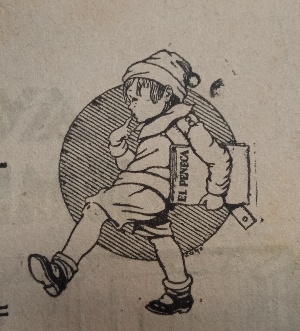
El Peneca n°1286, 7 de agosto, 1933.
As a testament to his creative process, El Peneca included the original black-and-white sketch alongside the final colour version, for example, on cover number 1761 (12 September 1942). This comparative exercise has made it possible to appreciate his technical mastery in the treatment of shadows and volumes, from the preliminary phase to the finished work. The sketch revealed how the artist balanced his ink line with precision before granting absolute freedom to colour.
Book Illustrator and Publisher.
In 1943, he produced the illustrations for the young readers' book Lautaro, joven libertador de Arauco, written by Fernando Alegría. He enriched with drawings the Chilean young readers' edition of Corazón (1886), the celebrated work by the Italian writer Edmondo de Amicis (1846–1908).
He brought to life with his illustrations the first edition of Cocorí (1947), by the Costa Rican writer Joaquín Gutiérrez (1918–2000), who years later would take part in editorial projects linked to Quimantú. This book was originally published by Editorial Rapa Nui and would later receive the Premio Rapa Nui.
Coré promoted his own publishing house under the name Editorial Cervantes S.A., which reflected his constant search for creative autonomy and his commitment to Chile's graphic and literary art.
The Latin American Syllabary: pedagogy and art.
A momentous contribution was his collaboration with the pedagogue Adrián Dufflocq (1905–1993) on the creation of the Silabario hispanoamericano, published by Editorial Zig-Zag in 1945. This work, intended for Spanish-speaking children, formed part of a literacy project. Hundreds of generations of children were taught with the method developed by Adrián Dufflocq, while Mario Silva Ossa, as illustrator, graphically accompanied these children in their first steps towards reading, fusing pedagogy and art. This didactic material, enriched with Coré's drawings, remained treasured in the hearts of those who remember that first childhood lesson: ma-me-mi-mo-mu.
The portraitist of marginalized childhood.
Mario Silva Ossa assumed a testimonial role: he repeatedly portrayed the young street vendors, emphasizing their dignity, effort and strength. His drawings immortalized scenes of marginalized childhood — shoeshine boys, street vendors, newsboys — becoming a social mirror of the era. Far from the complacent or compassionate gaze that tended to reduce these children to mere symbols of poverty, Silva Ossa elevated them to full-fledged protagonists. Their faces, furrowed by premature exhaustion yet lit by a spark of rebellion or surviving innocence, looked at the viewer from a position of equality. The pen stroke described stooped shoulders, small but skilled hands, gazes that had learned to read the world before knowing how to read letters. The watercolours, far from the vibrant reds and yellows of his literary works, at times turned to earthy tones, ochres and bluish greys — the palette of asphalt, mud, and cold sunsets on the corners of the city. Among the most representative editions were:
1354 (illustration of a small newspaper boy, 29 October 1934),
1510 (a peneca newspaper boy running and announcing El Peneca, 25 October 1937),
1667 (illustration of a boy reading El Peneca, seated on a globe, 28 October 1940),
1672 (a stooped old man, tenderly and delicately carrying a baby on his shoulders, 2 December 1940),
1714 ("Children's Week", close-up of the face of a peasant boy with black hair and a simple hat, 22 September 1941),
1766 ("Children's Week", a little girl embracing a rag doll, 21 September 1942),
1772 (the weekly paper being delivered at full speed by a village boy, with his faithful stray dog running alongside, 2 November 1942),
1923 ("Dreaming of the Sea", a small poor boy with a sad, nostalgic face and broken shoes, sitting in front of a large jar filled with water and a toy boat, 20 October 1945),
2027 ("Children's Week", a little boy and his faithful dog looking at a shop window full of toys of the future, 18 October 1947),
1933 ("Happy New Year", an old Second World War veteran, stooped, carrying a baby on his shoulders, representing hope. In his hand a rifle, and on its stock rested a white dove of peace, 29 December 1945) and
2131 ("Children's Week", a small shoeshine boy, with holes in his soles, sitting around his cleaning box and paired with the cleaning implements, 15 October 1949).
These illustrations sometimes had a yellow, golden or bright mustard background that enveloped the entire scene behind the figures, with no textures or details to distract.
National holidays: the hero close at hand and the festive people.
The national dates — Independence, the Naval Battle of Iquique and the commemoration of the national day — found in Coré an exceptional visual interpreter. The illustrator adorned the covers of El Peneca with portraits and commemorative scenes, in an era when Chile dressed in its finest. The illustrations brought heroic figures closer to the child audience while at the same time capturing the festive spirit of 18 September and 21 May, days on which the Chilean people proudly celebrated their traditions and their history. A sample of these covers includes:
1757 (portrait of "Bernardo O'Higgins", 20 July 1942),
1762 (portrait of "José Miguel Carrera" with a yellow background, 24 August 1942),
1918 ("Viva Chile y el dieciocho", a group of peasants in a Chilean ramada, enjoying independence, 15 September 1945),
1970 (portrait of Chile's first government junta, 18 September 1810),
2022 (illustration of a Chilean soldier in full dress uniform, marching and with firm hands raising the Chilean flag on the mast in all its grandeur in celebration of the national holidays, on a flat, bright solar-yellow background, 13 September 1947) and
2075 (a misspelled sign reading "VIBA CHILE" accompanying a cart full of humble people celebrating Independence Day, 18 September 1948).
The literary universe: fairies, gnomes, classic tales.
As his sister Gabriela Silva Ossa related in the interview granted for this research, Coré was an avid reader who, through his illustrations, encouraged thousands of Chilean children to discover the classics of world literature. His drawings were portals to distant, enchanted worlds, populated by fairies, gnomes, castles and fantastical landscapes that captivated the imagination of generations of penecas.
He brought to life classic works such as Gulliver's Travels, Treasure Island, Robin Hood, Herne the Hunter, Marco Polo, The Magic Flute, Sandokan, The Czar's Courier, The Thousand and One Nights, Tom Thumb, Robinson Crusoe and The Scarlet Pimpernel, among others.
Coré had the merit of rescuing and elevating numerous anonymous works that the weekly magazine published regularly, granting them an artistic dimension. His work humanized literary writings through characters with vivid expressions and scenes charged with emotion. He raised the artistic standard of children's magazines, inspiring future illustrators and creating a lasting iconography that today forms part of Chile's graphic heritage.
Some of his most important illustrations were: "Las sandalias de Chasqui" ("Chasqui's Sandals"), "Sandar traicionado" ("Sandar Betrayed"), "La escuela de Monte Águila" ("The Monte Águila School"), "El Maestro paravientos" ("The Windbreak Master"), "La Ciudadela" ("The Citadel"), "Pamela y Jaime" ("Pamela and Jaime"), "La doncella encantada" ("The Enchanted Maiden"), "La flecha de oro" ("The Golden Arrow"), "La Rosa de la Alhambra" ("The Rose of the Alhambra"), "Tres halcones" ("Three Falcons"), "Era un espía" ("He Was a Spy"), "El príncipe gigante" ("The Giant Prince"), "Ancho, largo y ojos de brasa" ("Wide, Long and Ember-Eyed"), "Descubrimiento de América" ("Discovery of America"), "XL aniversario de El Peneca" ("XL Anniversary of El Peneca"), "El tambor mágico" ("The Magic Drum"), "El mandarín y el pescador" ("The Mandarin and the Fisherman"), "Jorge, el diablo" ("Jorge, the Devil"), "Durga-Rani, reina de la selva" ("Durga-Rani, Queen of the Jungle"), "La marmita mágica" ("The Magic Pot"), "La Bola de oro" ("The Golden Ball"), "Loriol, el cobarde" ("Loriol, the Coward"), "Corazón valiente" ("Brave Heart"), "El hada de la aritmética" ("The Arithmetic Fairy") and "La viejecita que vivía en un zapato" ("The Little Old Woman Who Lived in a Shoe"). His work is considered a national milestone and belongs to the field of children's and young adult literature research.
Invitation from North American industry.
When North American industry was promoting initiatives to revolutionize comics and illustrated strips, it recognized the genius of this Chilean illustrator, extending him an invitation to join the United States market. Nevertheless, he chose to keep his work within the national sphere — a decision that, while it limited his international projection, guaranteed him the creative freedom to explore multiple artistic expressions.
Death: a persistent enigma.
The sudden death of Mario Silva Ossa in the 1950s, at the age of thirty-seven, left a creative abyss in the heart of El Peneca and of Chilean graphic arts.
With profound sorrow, El Peneca bade farewell to one of its most luminous talents. Through the words of Elvira Santa Cruz, it paid tribute to an artist whose life, though brief, left an indelible mark. Death found him at the peak of his genius, robbing him of years of creation — but not the eternal brilliance of his work. El Peneca and its readers treasured, like a treasure, the light of those blue eyes that had once illuminated its pages:
"He arrived at the magazine, at El Peneca, at the age of 18. Youth was already blossoming in him, with its longing to be an artist of genius — tall, slender, with his blue eyes, so luminous and brilliant that one had to look away, because their light burned like sunlight, and his restlessness was contagious, like a fever of the spirit.
'Is it true that children liked my hands?' I am always dissatisfied with my work. I would like to create something better — that which boils in the brain, that which I have inside me. …Preserving his preference for the medieval and the fantastical, he had reached the fullness of his genius. Death came upon him at the age of 37, when a glorious future awaited both the artist and the man."
EL PENECA, no. 2162, 23 May 1950.
On May 30, 1950, in issue no. 2163, Odilia Navarro, “Ketmis,” portrayed Mario Silva Ossa under the title “It Is Difficult to Describe Mario”:
"It is difficult to describe Mario. There is no word that reflects his immense spirit, nor stroke that captures his restless physique. He used to pace nervously, to speak while his hands changed gesture with the gaze of his ideas, to sink his gaze into a friend's eyes to share his problem, his longings or his emotion. He shared his confidence in life, in happiness and in beauty. We never saw Coré motionless. His drawings are not motionless either. Every cover of his has living breath. His goblins leap, his sorceresses sweep across the pages, his queens smile, his kings speak, his vagabonds trot, his princesses sigh."
EL PENECA, no. 2163, 30 May 1950.
In issue number 2188, dated 18 November 1950, Elvira Santa Cruz opened the pages of El Peneca so that the collaborators — Ketmis, Atria, Elena Poirier and Olga Villalón — could bid farewell to Coré:
“The Stone Angel
Roxane was tireless. Everyone accepted joyfully and looked at each other, tireless as well, as was the small group that supported her: Ketmis, Atria, Lungenstras, Elena Poirier, Olga Villalón, Coré. One day Coré, who was the favourite photographer of dream beings, left behind his enchanted pencil, his friends, and all the children:
—I am leaving.
No! —they all exclaimed—, it is not possible…
Yes, he is waiting for me. It was time. The little intertwined hands that tried to hold him could do nothing. Coré slipped away skillfully and flew very high. The little angel, upon learning of this, abandoned the altar of Saint George for the second time and, joining Mario, accompanied him on the journey of no return. Everyone was overjoyed to relive their Supreme Maker, very high above, smiling.
For each birthday of this beloved magazine, we learn in another way how it was born.“
EL PENECA, no. 2188, 18 November 1950.
It was the fabled version of his death, narrated as if the storybook character were rising up, taking with him the little angel who abandoned the altar of Saint George for the second time to join Mario on a journey of no return. Although death may have physically taken Coré away, it could never tear him from the magical universe he himself had built.
The letter from Ernesto Baeza Palacios(no. 2188, 18 November 1950.) was a testimony of affection for Coré. In it, he affirmed that as long as there existed a child who believed in fantasy, Mario Silva Ossa would remain alive in memory.
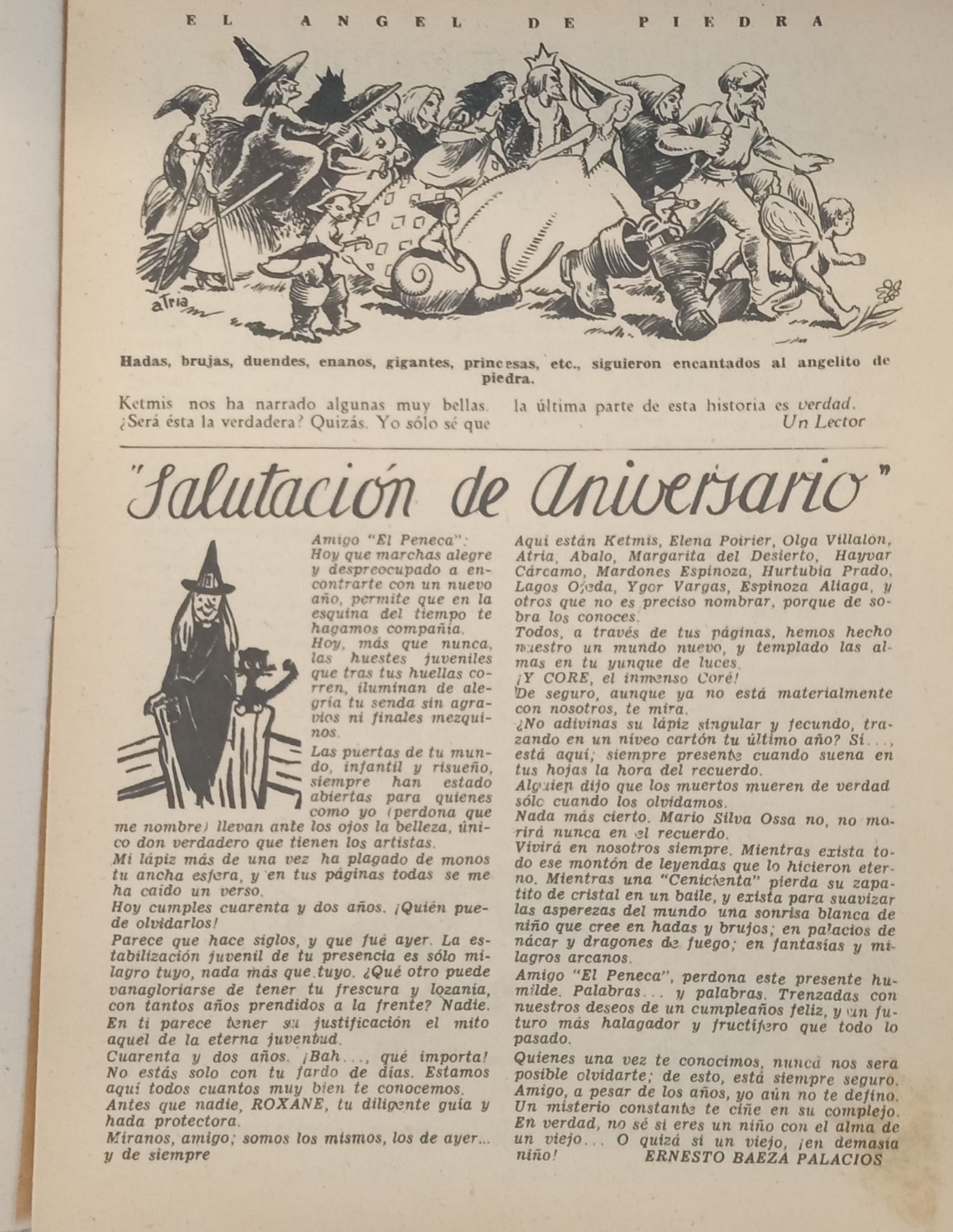
In the winter of 1986, the magazine La Castaña, a key space for Chilean poetry and graphic art of the time, published an article in which Enrique Lihn reflected on Coré's work. His words lucidly capture the illustrator's magical universe and his bond with El Peneca's readers:
"Although he neither wrote nor chose the texts, the fact that his readers were children encouraged another modernist peculiarity: a certain historicism. Since 'The Maiden of the Snowdrifts' or 'The Transparent Princess' live in the anti-time of ONCE UPON A TIME, when Coré was not obliged to a vague nineteenth century, with Jules Verne, or to this century with chaste and beautiful explorers and inexpressive explorers, he transported himself joyfully to that sort of Middle Ages without temporal obligations to which Grimm and Perrault refer.
A copious and well-accomplished body of work such as his presupposes a sacrificing profession and, with it, the need for compensations. Coré was able to find them through the work itself. It must have been fascinating to him as it was to his recipients, who still enjoy the possibility of recognizing it, of attempting to think it, and of prolonging the nostalgia for a 'magical world' — forgive the expression — that Coré's drawing made exist. As world and as nostalgia, on paper, without gravitation or historical weight or apparent psychological depth.
Many of the children of that time, I am sure, upon seeing Coré's drawings NOW, will recover an equally imaginary 'then', in which those drawings and our memory illustrate each other. She, too, does not make history, but fable.”
In the magazine Mundo, he was described as a reference precisely for maintaining a timeless style. His consecration was due to that ability to turn limitations into virtues, creating universes where fantasy, even the wildest, always proved habitable:
"His drawings, made with the scrupulousness of a craftsman who had at his disposal reproduction techniques less sophisticated than today's, and to which he imparted a personal poetic style, clothed in a certain innocence that creates a reassuring world — even when corsairs, dragons or witches visit it.”
The Mystery of His Death: Gabriela Silva Ossa's Testimony.
In October 1990, Gabriela Silva Ossa, the illustrator's sister, spoke with this research about her brother. These words, unique and moving, deserve to be reproduced in full:
"My brother Mario was born on 9 March 1913. From his childhood he began to draw. He was educated at the Colegio de San Ignacio and went on to study architecture, where he completed up to his second year. It was then that Elvira Santa Cruz Ossa, our aunt, proposed that he take charge of the drawings that would accompany the stories in the magazine El Peneca. As he needed a pseudonym, he remembered a biblical name that perhaps, for him, matched all his aspirations, which is why he chose 'Coré'.
From that date onward, my brother devoted himself to the craft of illustration. His principal work, then, is El Peneca. Proof of this is his rejection of Walt Disney's offer to join the company's team. Mario was a creator and, (his sister affirms), would hardly have been willing to submit to the Disney line. Moreover, his attachment to his homeland was immense, and his love for Chilean children influenced his decision to stay in Chile. My brother was a highly cultured man, a habitual reader of classical authors. On many occasions I would read selected authors to him while he created the characters of his figures. Go to Macul Street — there is a restaurant-café there that has furniture carved by my brother.
Mario died on 13 March 1950, run over by a train, or so I believe, but the real reason for his death remains an enigma to this day. On that day, the 13th of March, after having worked all night on his drawings, he said he wanted to get some fresh air, left the house for a walk, and never returned. My brother's personal physician recalled that, after a stroke he had suffered years earlier, he had been predicted to face paralysis in his right hand, which would have meant giving up drawing forever. To this day I remember him and suffer over his inexplicable disappearance."
In 2006, the photographer Juan Domingo Marinello made a fortuitous discovery at the flea market in Valparaíso: a batch of original illustrations by Mario Silva Ossa. The material gave rise to the book Coré, which reaffirmed his place as "perhaps the greatest illustrator that the Chilean publishing industry has ever produced”
In Coré, el tesoro que creímos perdido (Coré, the Treasure We Thought Lost, 2012), Jorge Montealegre undertook a biographical reconstruction of Mario Silva Ossa (“Coré”), grounded in rigorous research into both his personal and professional life. The edition included, as a valuable contribution, magnificent reproductions of the artist's work.
An illustrator who transcended the history of illustration.
The first great transformation introduced by Elvira Santa Cruz's directorship, and which Coré embodied like no one else, was the shift from anonymity to recognized authorship. During the early years, many illustrators and photographers remained in the shadows. Names did not appear; faces were unknown. Roxane reversed this logic: she hired the best and consecrated them as public figures.
Coré was the main beneficiary of this policy. His name became a brand. A cover signed by him was a weekly event. He professionalized the illustrator's craft, elevating it from artisan to creator.
The paradox of Coré's "social gaze": One of the most moving aspects was his portrayal of marginalized childhood: the newsboys, the shoeshine boys, the poor children who sold newspapers on the streets. At first glance, these drawings seemed an act of social denunciation, or at least an attempt to make them visible. Coré drew these children with dignity, idealizing them within the margins of the patriotic narrative that El Peneca promoted. The small newspaper vendor was a silent hero who contributed to the national effort. The rags did not denounce structural inequality: they demonstrated that, even in poverty, a Chilean could be honourable, hardworking and patriotic. Social criticism thus remained an edifying moral.
The enigma of death as symbol. His death at the age of 37, run over by a train under circumstances never clarified, has become a symbol of the fate of the golden age. Like the Zig-Zag archives burned in 1973, like the anonymous photographers whose names were lost, like the original drawings scattered in flea markets, Coré's disappearance condensed a loss that was never fully processed.
The testimony of his sister Gabriela, the Disney offer, the stroke that put his right hand at risk, the walk from which he never returned: all these episodes added layers of meaning that go beyond biography. Mario Silva Ossa did not merely die young; he died at the precise moment when his genius was reaching its highest point, when North American industry was beginning to recognize him. Death cut short his work, but his legacy endures in the collective memory, even though most of his originals have been lost.
The legacy. A Chilean iconography. Coré succeeded in building a recognizable visual universe that readers identified as their own. His fairies, his gnomes, his medieval castles were not copies of European manuals: they had an unmistakable style, made of sinuous curves, flat mustard-coloured backgrounds and a blend of delicacy and strength that still moves us today.
That iconography defined the visual imagination of three generations of Chileans. When the interviewees in chapter 3 recalled "Coré's drawings", they were not evoking mere isolated images, but a way of looking at the world learned in childhood and never forgotten. Coré is not merely an illustrator; his name resonates in the memory of Chileans of all ages, even those who no longer remember exactly where it comes from.
Synthesis.
The history of El Peneca was the story of a visual revolution that transformed the way generations of Chileans learned to look, imagine and recognize themselves in the pages of a weekly magazine. Under the visionary direction of Elvira Santa Cruz Ossa, the publication moved from anonymous portraits of children from well-to-do families to a vibrant graphic universe, where illustration and photography ceased to be mere companions to the text and became autonomous languages, charged with aesthetic and social meaning.
El Peneca's distinguishing hallmark during its golden age was a deliberate editorial policy that knew how to surround itself with the best talents and, above all, knew how to recognize them. Roxane's decision to break with the anonymity that enveloped many illustrators and photographers was a fundamental gesture: by signing the covers and interior pages, the magazine not only gave credit to its creators but elevated them to the category of authors, of public figures whose name was a guarantee of quality and fantasy. The golden age of Chilean illustration that also took shape in El Peneca, with Coré as its most luminous figure, left an indelible mark on the collective memory.
Illustrations · original edition
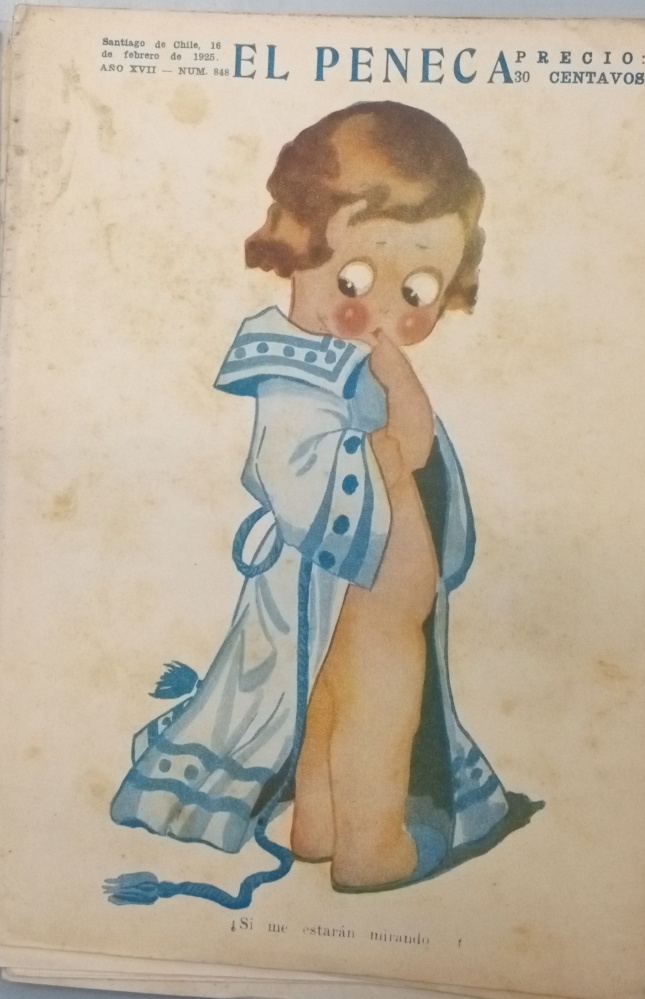
EL PENECA, n°848, 16 de febrero, 1926.
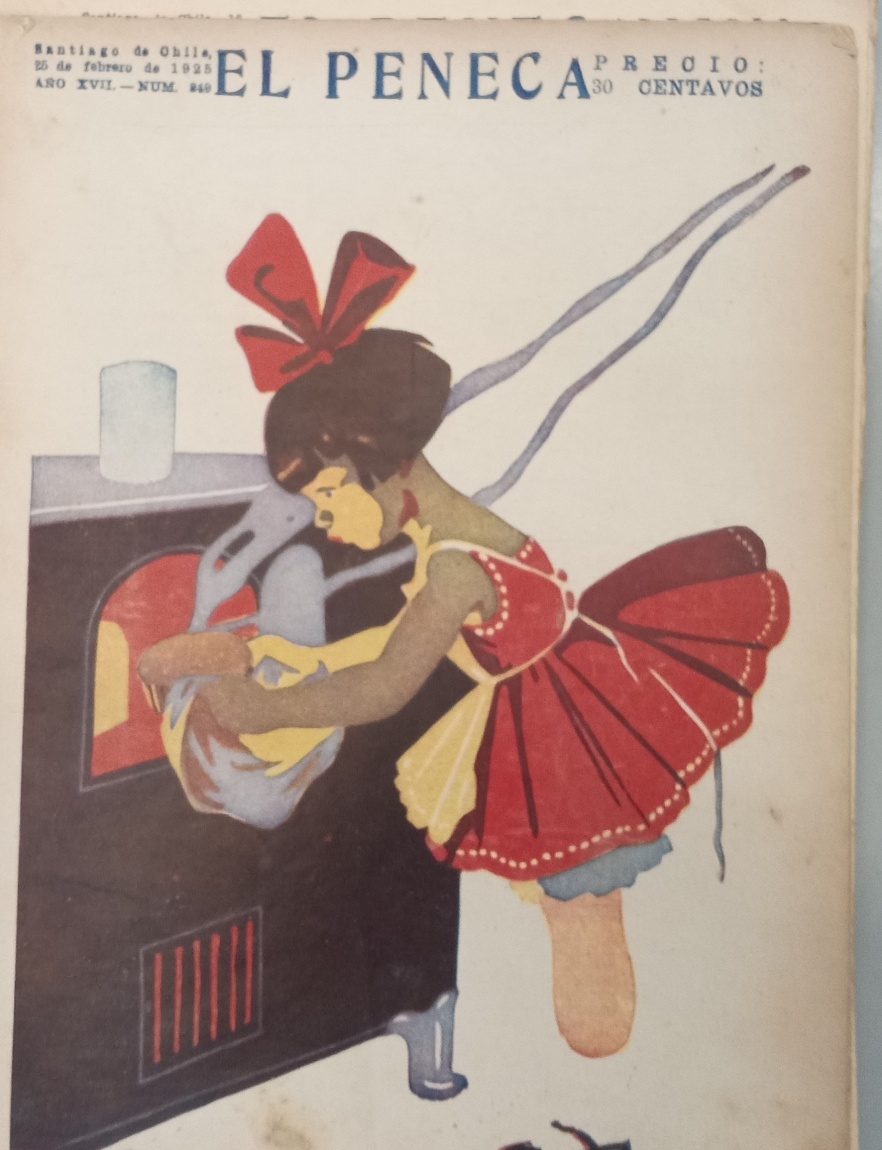
EL PENECA, n°849, 25 de febrero, 1925.
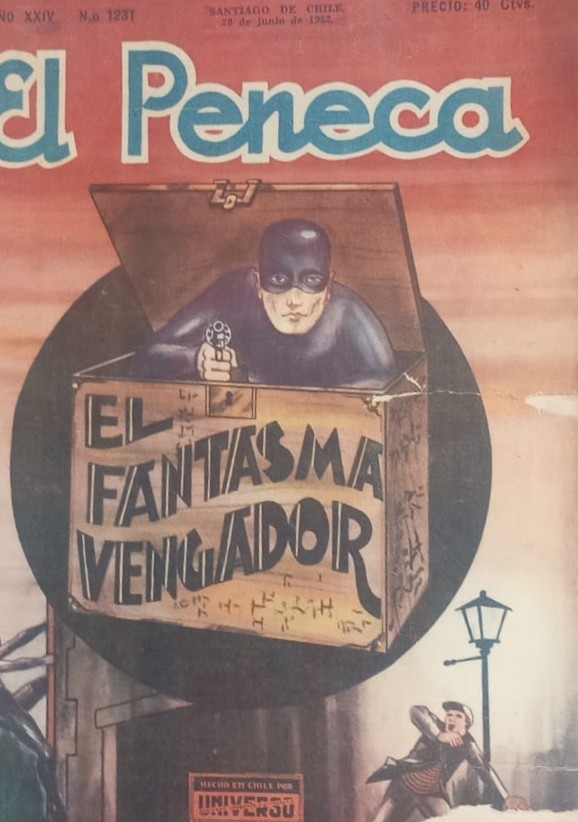
EL PENECA, n°1231, 20 de junio, 1933. Anónimo.
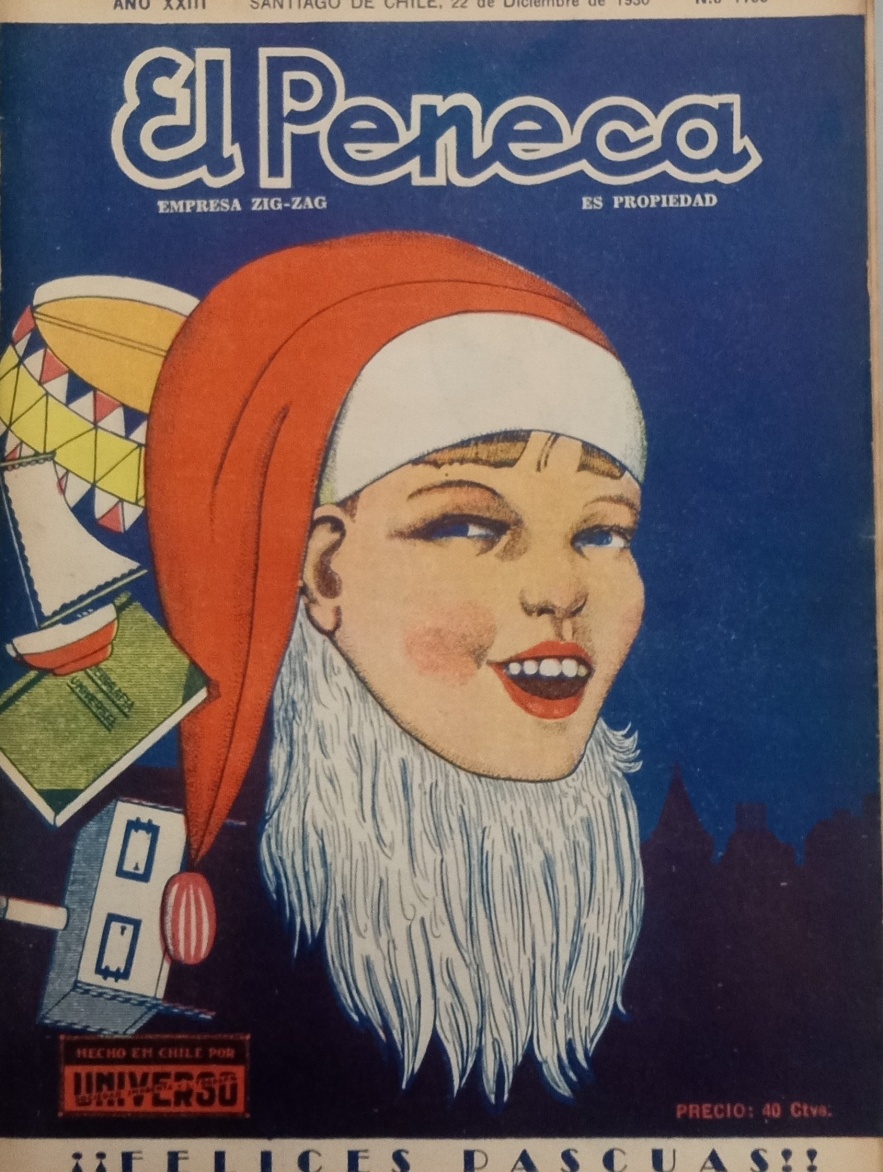
EL PENECA, n°1153, 22 de diciembre, 1930. Anónimo.
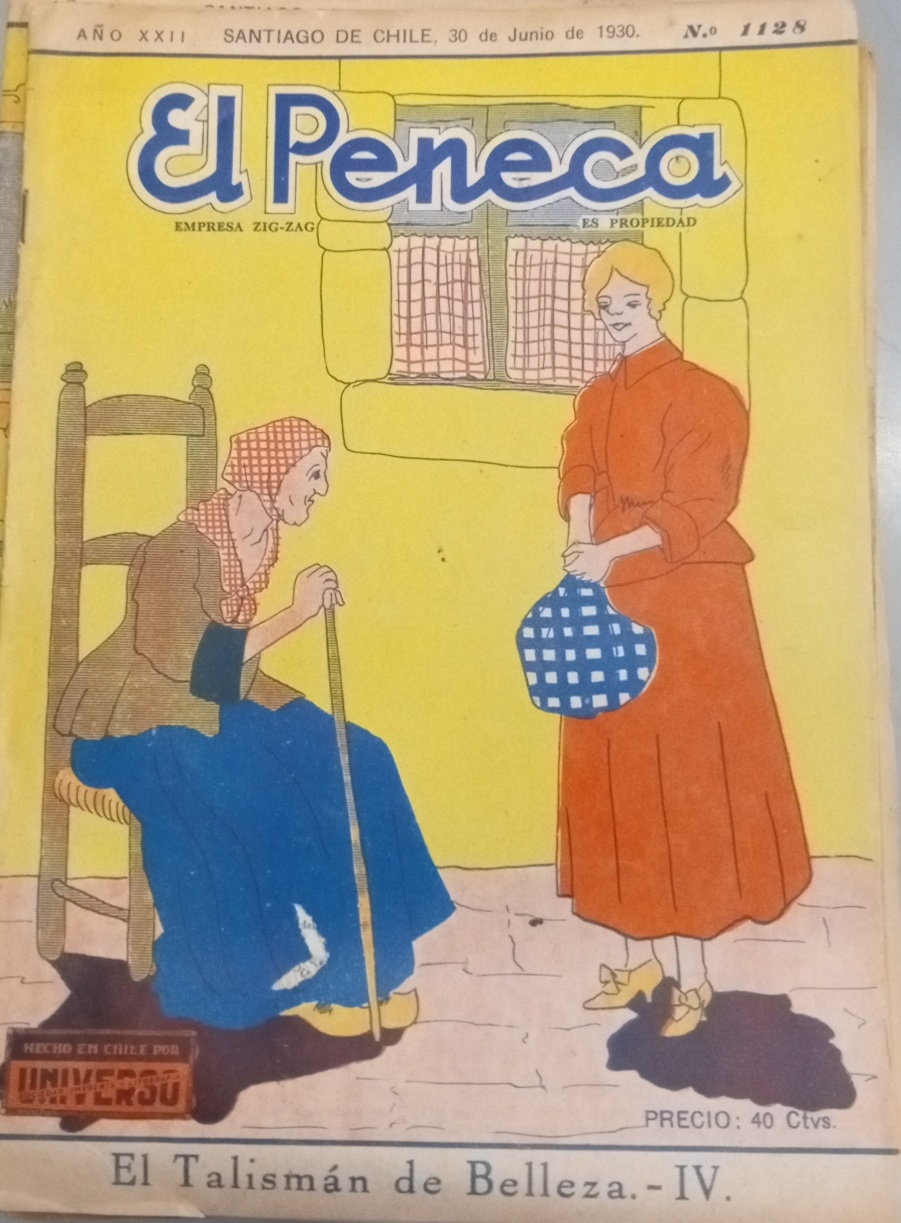
EL PENECA, n°1128, 30 de junii, 1930. Anónimo.
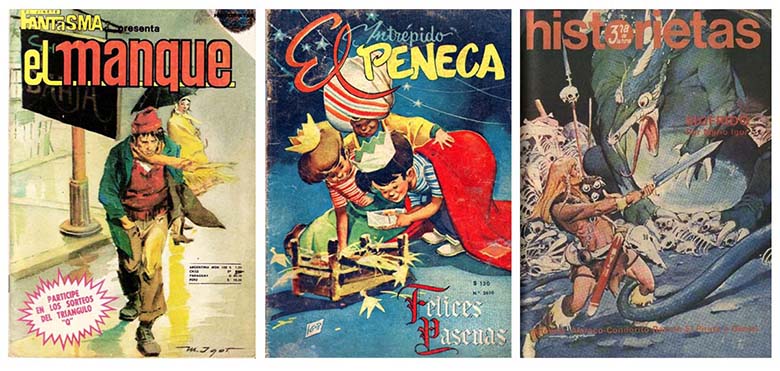
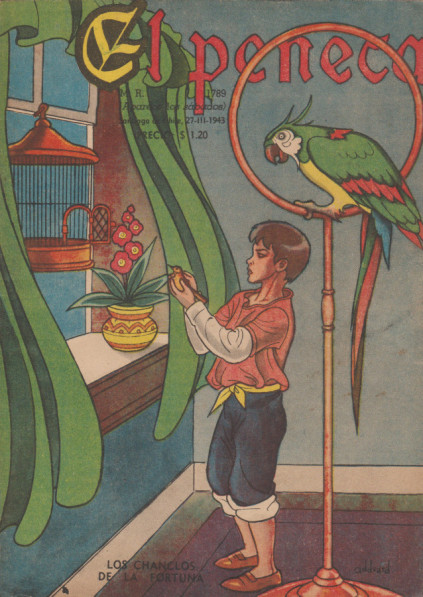
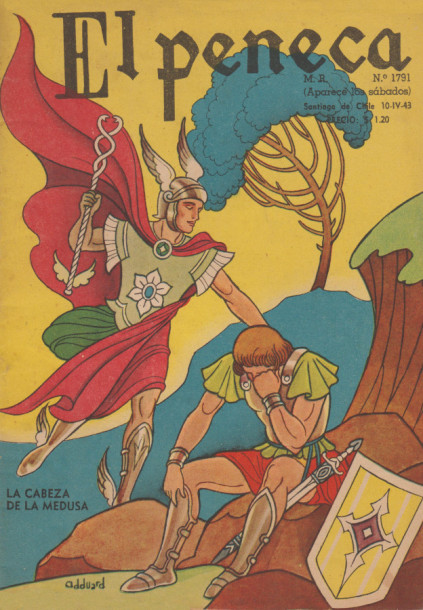
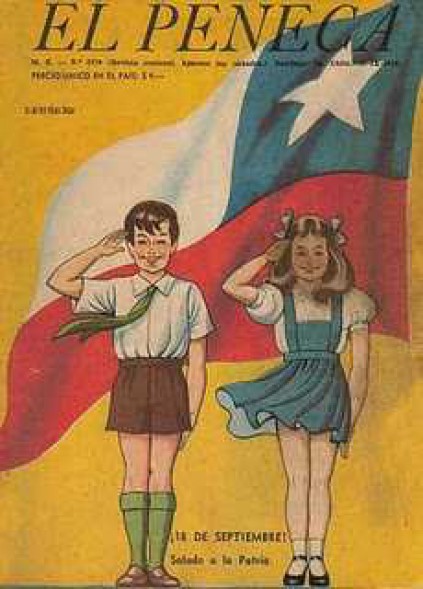
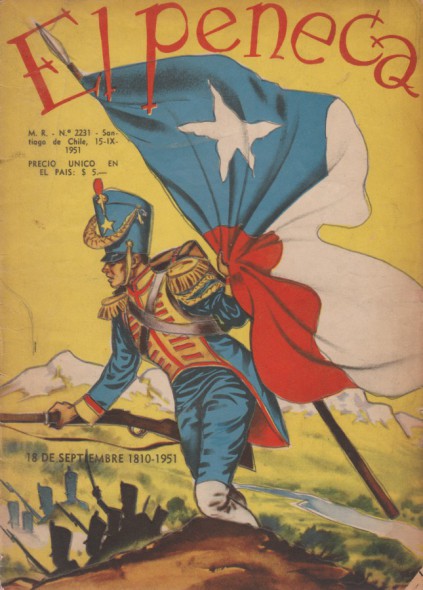
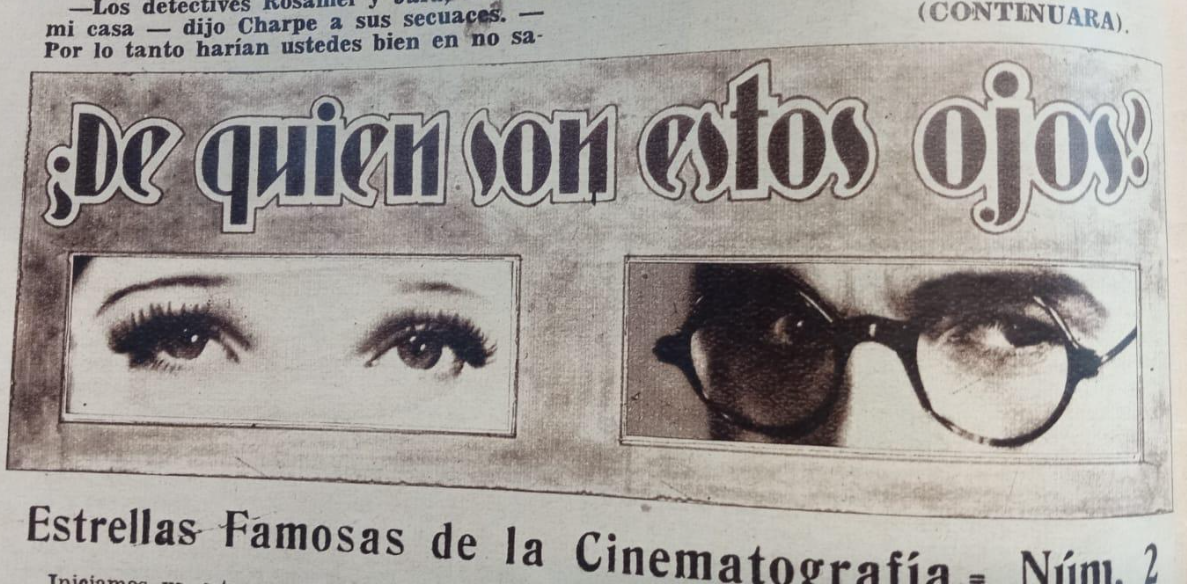
Fotos de la revista Ecran en El Peneca, nro.1239. 12 de Sept, 1932.
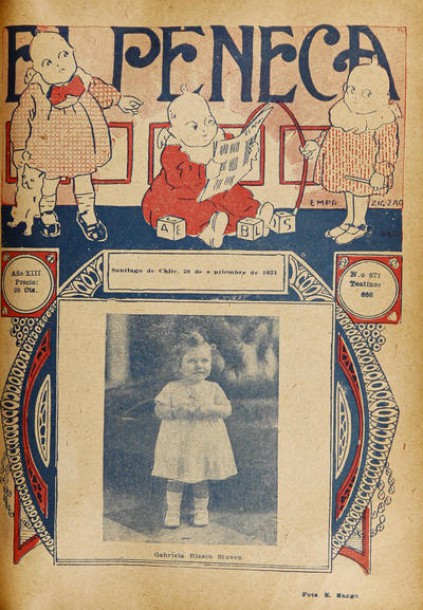
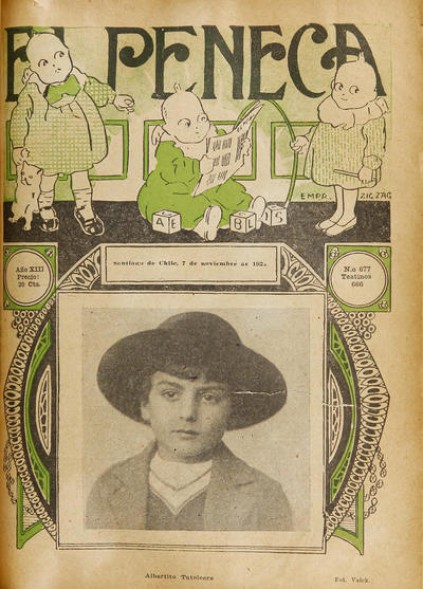
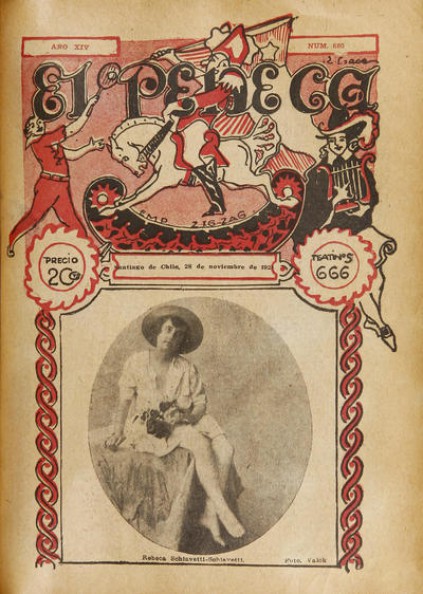
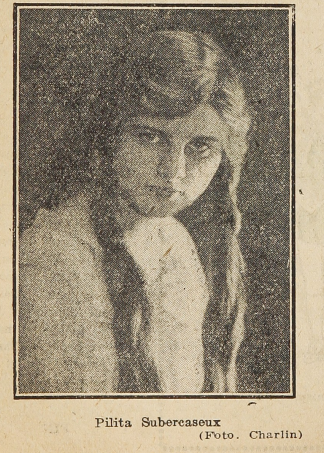
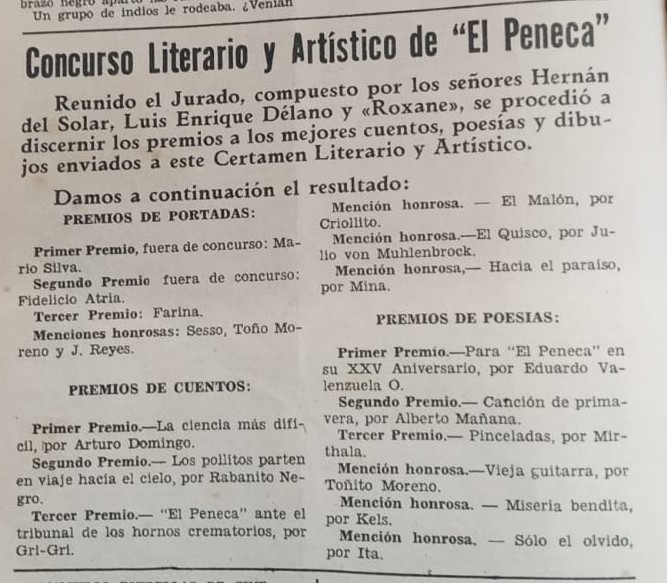
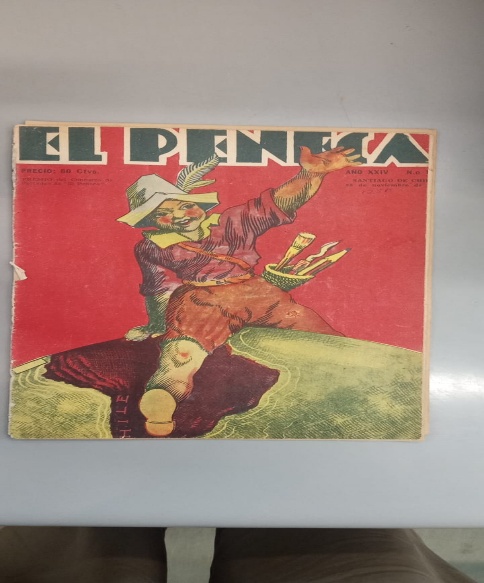
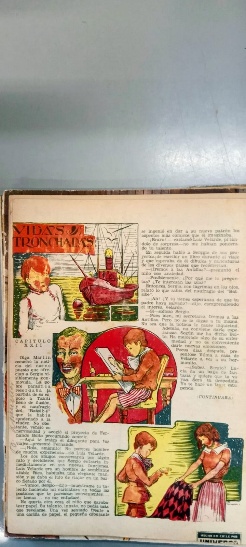
El Peneca n°1250, 28 de noviembre, 1932. TAPA Y CONTRATAPA
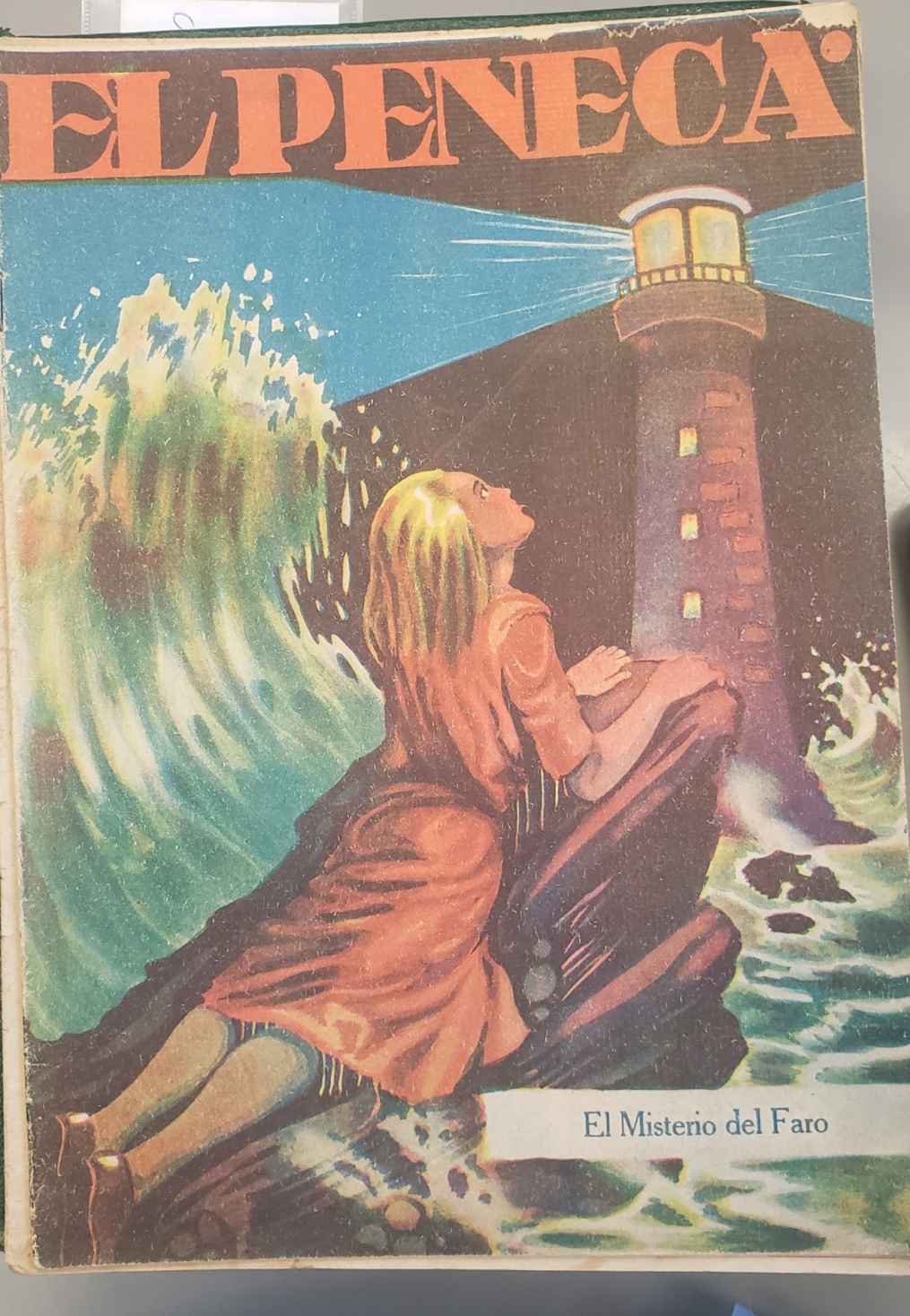
El Peneca n°1300, 13 de noviembre, 1933.”CORE”
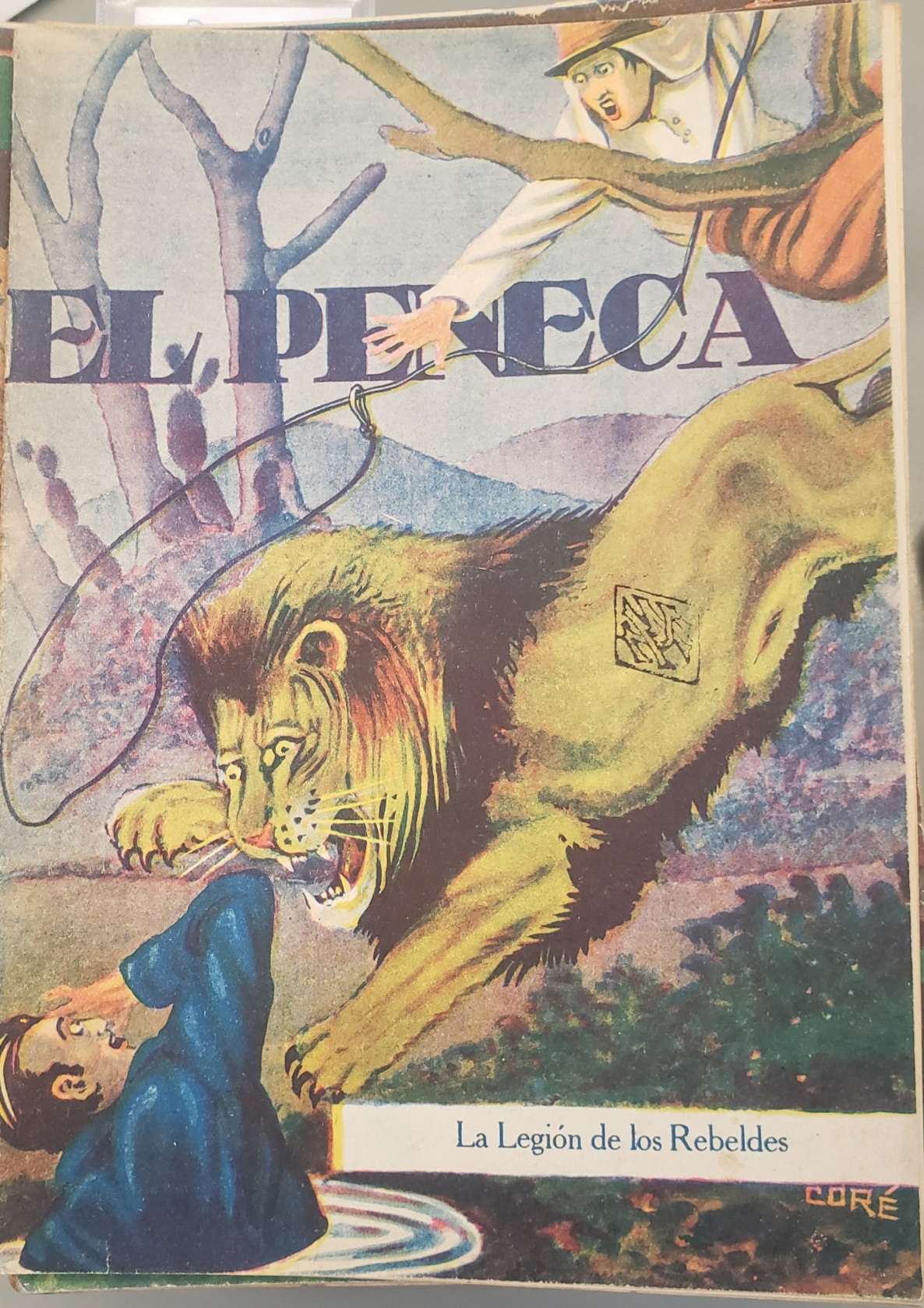
El Peneca n°1303, 4 de diembre, 1933.
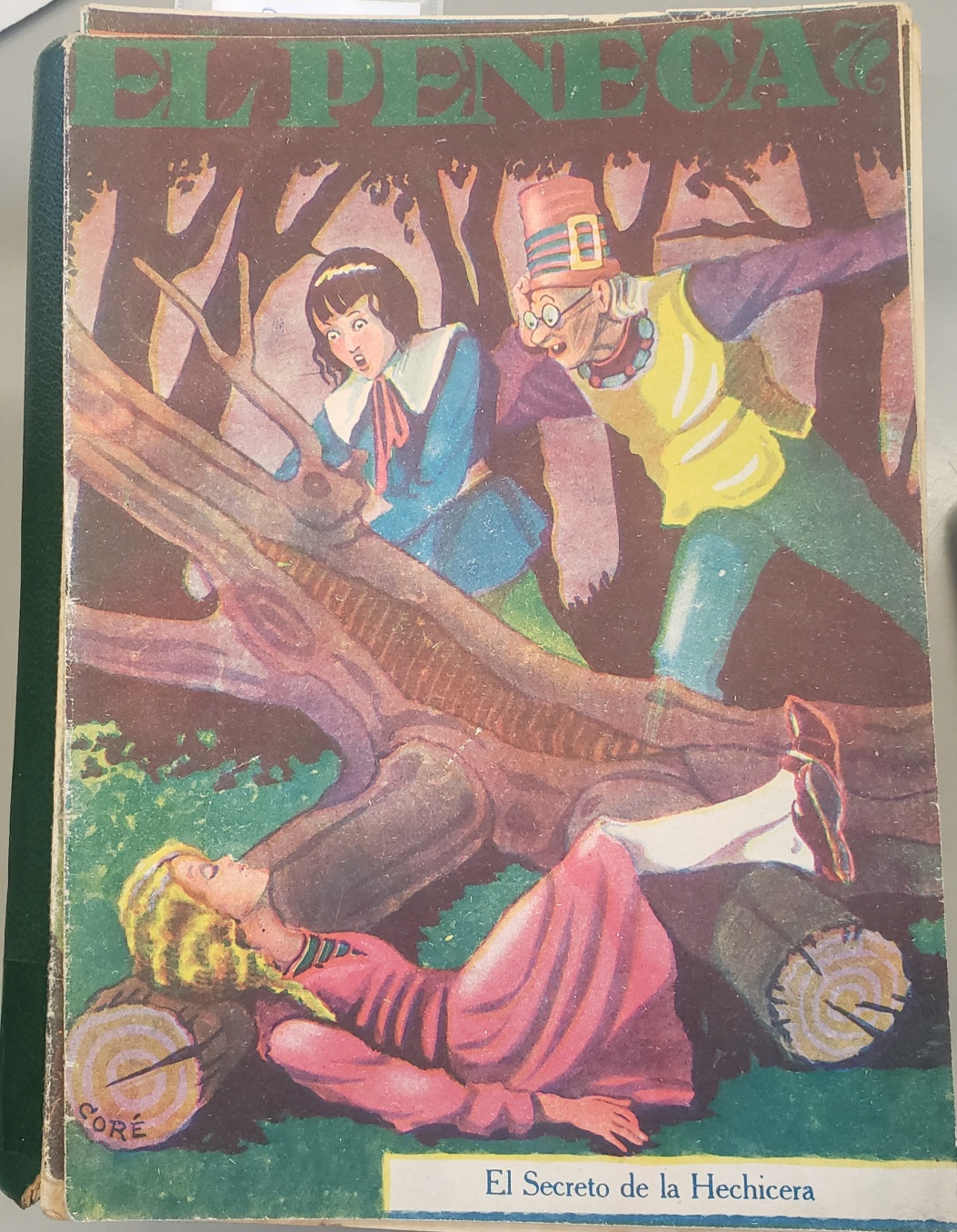
El Peneca n°1302, 27 de noviembre, 1933. “CORE”
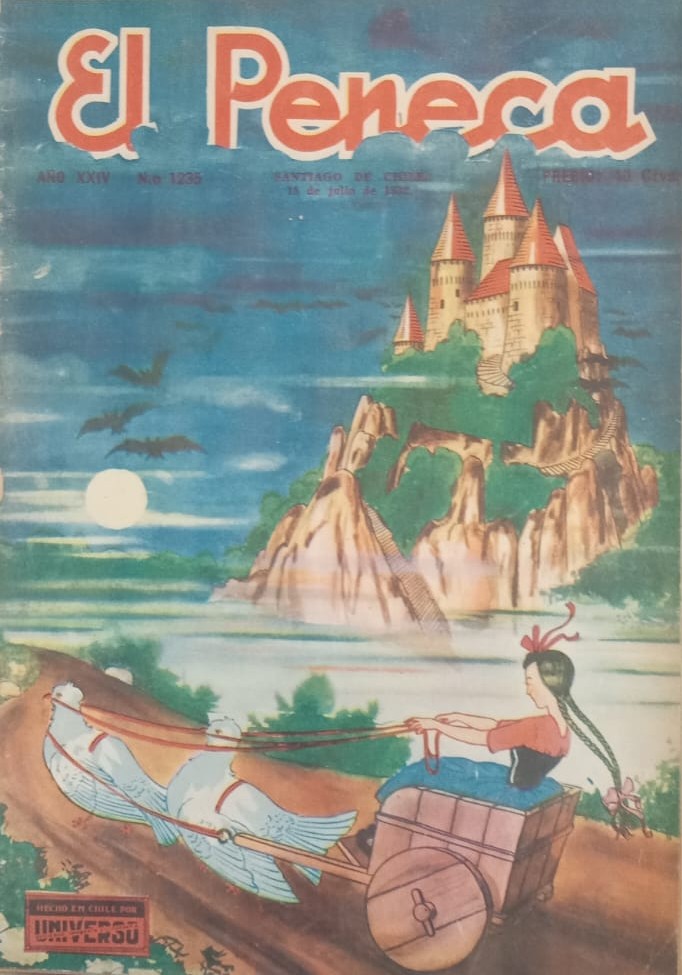
El Peneca n°1235, 18 de julio, 1932. “CORE”.
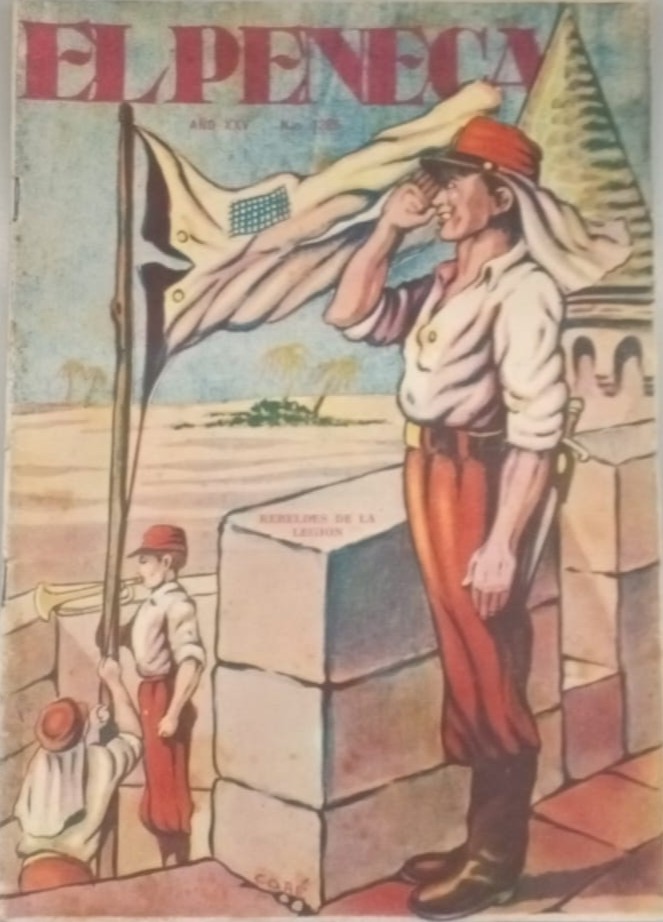
El Peneca n°1286, 7 de agosto, 1933. “CORE”.
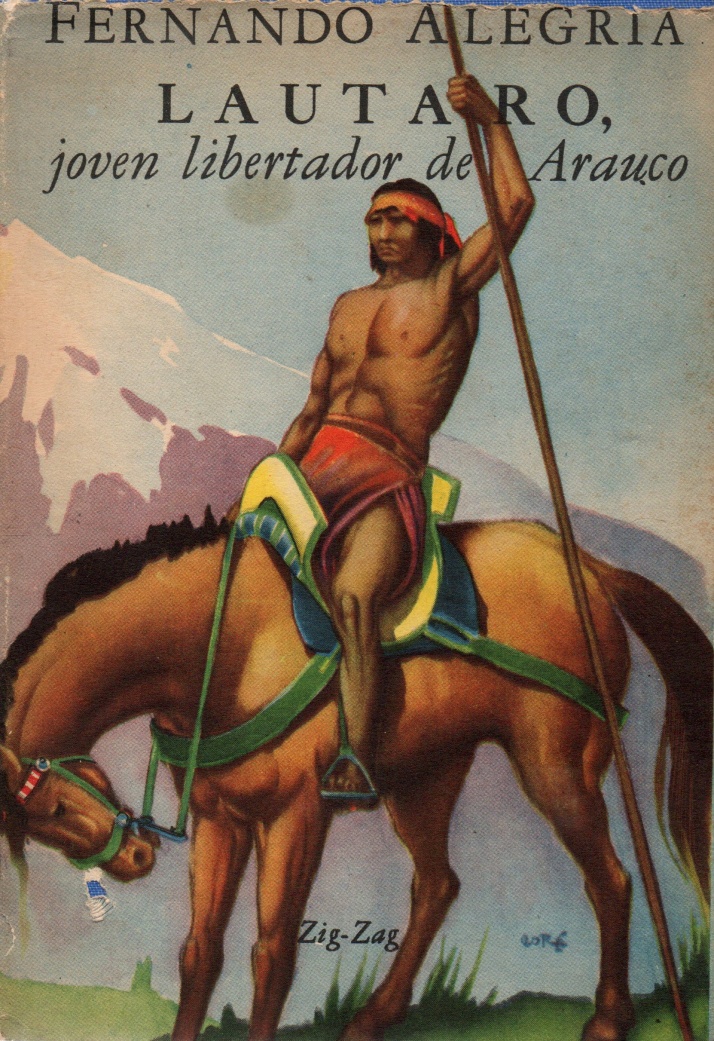
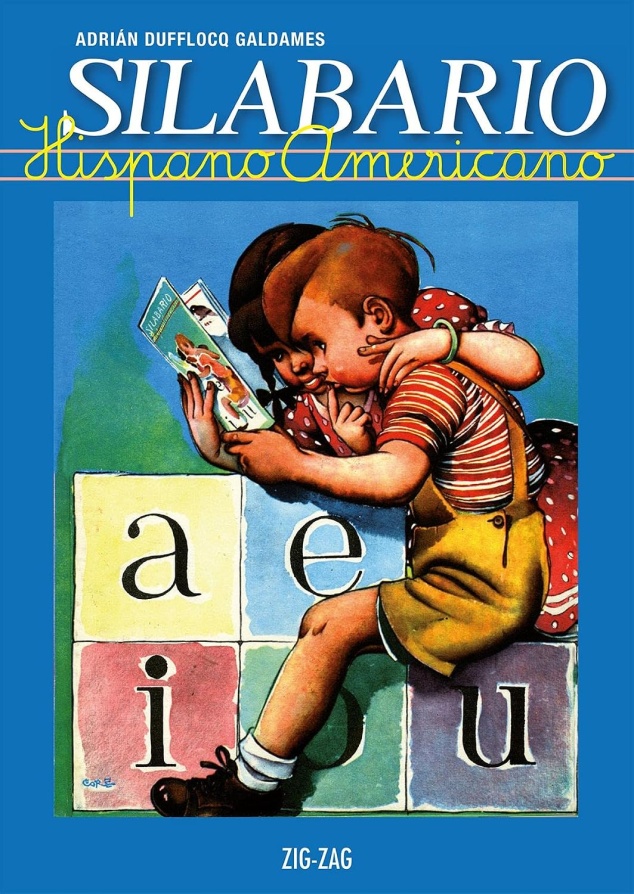
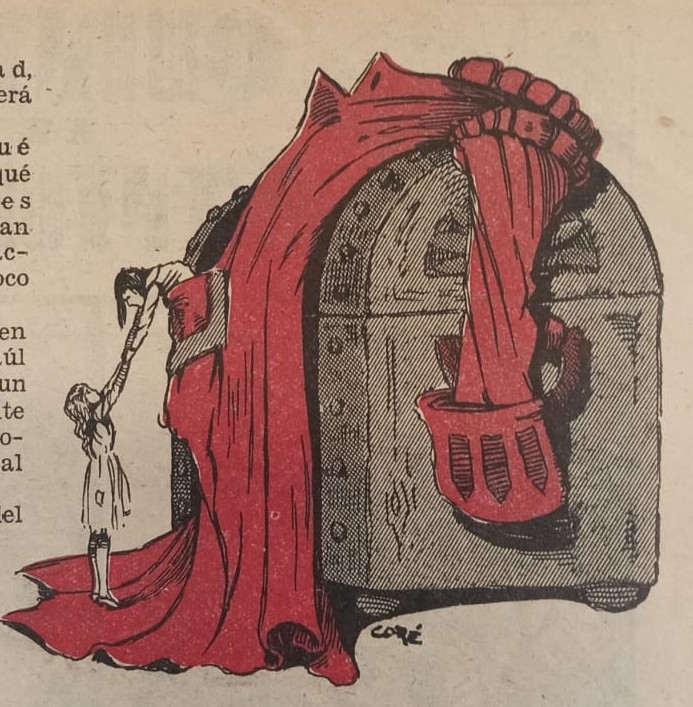
El Peneca, nro. 1288, 21 de agosto,1933.
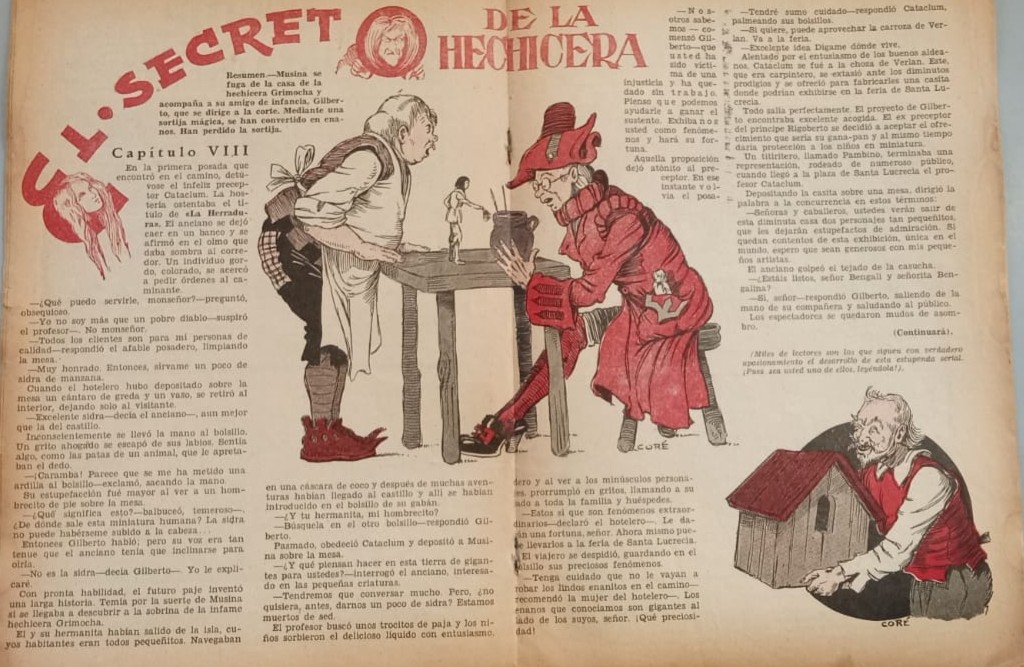
El Peneca, nro. 1289, 28 de agosto,1933.
2.2.4. Contributions and Interaction with Readers.
Elvira Santa Cruz advanced in collaborations, attracting more readers to the editorial staff, both young illustrators and new writers. On 21 February 1921 (issue number 640), a letter appeared in the "Collaboration" section signed with the initials J.M.O. The author examined the transformation that El Peneca had undergone over thirteen years. He highlighted the value of the collaborators and underscored the significance of the directorship being held, for the first time, by a woman:
"COLLABORATION
LETTER
Each year two or three novices join the ranks, and just as many desert, sure of their pen, feeling capable of wielding it in more important newspapers. And that is why I say that its changes of mentor harmonize better with the character of our magazine. Many times we miss a signature in some literary newspaper, and it is Roxane's: she is always where there is refined intellectuality, where there is art and also where there is activity, tendencies toward progress and social improvements. The children's weekly is, therefore, guided by one of the first intellectual women of the country…"
In issue number 675 (24 October 1921), one of the collaborators, under the pseudonym "Annanke", explained how El Peneca was edited and produced, with the aim of familiarizing readers with the workings of the production workshop at the Zig-Zag printing house:
"HOW EL PENECA IS MADE
Once the originals have been read and corrected, the suitable ones for the issue in question are set aside and sent to the foreman of the typesetting and linotype section, who distributes the titles to the former and the composition to the latter. Once the articles have been set, using pieces of type made of antimony, the proof-puller takes them, pulls one or several proofs and transfers them to the correction desk, where two good people, quite well versed in grammar, correct the errors and punctuation that the linotype operator, the typesetter or the author may have made."
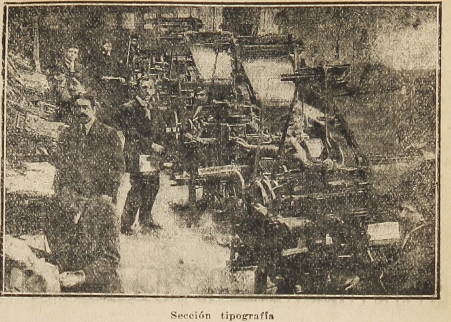
In her youth “Roxane” had been a reader of El Mercurio, where she published her first
contributions:
"TO MY KIND COLLABORATORS
It was in La Serena, in the year 1912, when for the first time I saw my writings in print…! What an intense emotion!... Days earlier I had sent to El Mercurio of Valparaíso a long correspondence about the stay of the Squadron in Coquimbo… Dances, festivities and outings had enlivened the society of La Serena and Coquimbo, and the sailors who wintered there left in our spirit the most delightful memories.
A week later, I lost all hope that the newspaper would publish my contribution… An anxiety mixed with sadness and discouragement overwhelmed my soul… Could I, too, be thinking of the dreaded wastebasket of editors?
On the first page, in large characters and across four columns, one could read this:
'A charmingly feminine letter'
… A writer announcing herself, etc., etc.!
My article occupied almost the entire first page."
ROXANE.
EL PENECA, no. 817, 14 July 1924.
The text "Our Director", under the pseudonym "Gipsophilia", was an important piece for understanding an editorial transition towards the end of 1921. Through a dialogue between two former collaborators, it was mentioned that Benjamín Oviedo "Magister" had ceased working for the weekly magazine, although his contributions continued to appear for some time. His stories, versions and translations of tales could be read until mid-year; proof of this is the "Magister" version of "The Dancing Slippers" in issue number 659 (4 July 1921):
"OUR DIRECTOR
An interesting dialogue between two former collaborators of EL PENECA
Well, don't you find it sad that, having spent seven years fluttering through the pages of a magazine under the tutelage of a director who, for us enthusiasts, has been the best teacher and friend, we now have to say goodbye to him?...
—Quite right! Moreover, nothing is more moral and worthy of trust for the young than
to place the feelings born of the soul in the hands of a priest as wise, prudent and kind as Omer Emeth. Miss Elvira Santa Cruz will be, I imagine, a very good director — that goes without saying; and as for the starry-eyed youngsters, well, need I say more! Yes, she will be the promised mother, perhaps even an indulgent one… But…! How sad it is to have to say goodbye to the one who is leaving…!
—And Magister and the typesetter Ipsilon, will they leave too?
—Perhaps; it is not yet known… and I assure you it would be another sorrow, because it would be impossible to forget that they too were good friends and generous contributors to our artistic ambitions."
EL PENECA, no. 652, 16 May 1921.
A peneca who signed with the pseudonym “Florisel,” and belonged to the contributors' group, welcomed a new reader joining their circle:
“FEDO
It has not yet been a year since we counted among the good collaborators of our magazine this young poet, whose valuable contribution already has sincere and enthusiastic admirers.
His vast literary output cannot be appreciated solely by what has been published here, for given the purely childlike nature of our weekly, only simple verses, suited to the souls of children, have appeared.
His warm, vigorous pen, which at times vibrates with the nerve of virile indignation before the injustices of Life, becomes caressing, tender, sweetly emotive when speaking to us of his affections, of the idols of his heart that he jealously guards from profane gazes.
I do not know him personally, but someone gave me his prose and verse to read, and through them I was able to understand this generous, loyal young man who seeks neither applause nor the tinsel of popularity, because there is no glory comparable to that of being understood by a kindred soul, and that unique glory, Fedor possesses.
May our enthusiastic and sincere sympathy reach him, along with the joy with which we have received his appointment as Honorary Director of our small group."
FLORISEL.
EL PENECA, no. 818, 21 July 1924.
The magazine worked to reaffirm important values in children, publishing those works that represented the essence of being an authentic man, above appearances:
"COLLABORATION
Reflect, dear little readers, that one day it may happen that you wear a mended dress or suit while your companion wears a brand-new one. And, since you will be neither better nor worse for your patch, you will not like it if people laugh at you or scorn you solely because of it.
Consider that, if they put you in a king's uniform or a queen's gown, the habit of a Cardinal, or place upon you the sash of a President of the Republic, you will not suddenly become a king, a queen, a President, or a Cardinal. You will remain what you are.
That is, unless you put on the uniform, the gown, the habit or the sash to pretend to be what you are not.
In that case, you will turn out to be a fraud.
Finally, reflect, dear little reader of EL PENECA, on the most important point that the theme of these two anecdotes signifies and constitutes for you: your future and eternal happiness."
MAPOCHO.
EL PENECA, n°794, 4 de febrero, 1924.
Nicomedes Guzmán, under the pseudonym "Ovaguz", published poems, stories and chronicles before achieving fame. In the "Sports" section, Guzmán wrote profiles of national athletes and himself drew the portraits of these sportsmen, fusing word and image:
"SPORTS SECTION
Our Athletic Representation at the Los Angeles Olympics
The journey of Vicente Salinas, our laurelled champion, to Los Angeles (U.S.A.) is now a reality, in order to prepare himself to take part in the Olympics to be held in that city in July of this year.
The outstanding performance he has achieved in recent times on the athletic tracks has placed him among the best South American sprinters, in addition to his having already been twice continental champion in the 400 metres flat with the splendid time of 49 seconds."
Ovaguz.
EL PENECA, no. 1211, 1 February 1932.
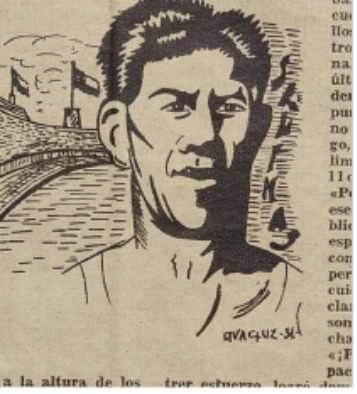
"Un Rasgo" ("A Trait") was an early work by Nicomedes Guzmán ("Ovaguz"), written when the author was barely 19 years old. Published in issue number 1231 of 5 December 1932, this story showed his immersion in the criollista current of the time, with a vivid register of popular speech (dialectal turns such as "güaina", "taita", "jué") and of Chile's rural customs in the 20th century. The story was illustrated by Fidelicio Atria. On the occasion of the fourteenth anniversary, the editorial team addressed a message to collaborators and readers, in which it acknowledged the legacy of those who had shaped the weekly magazine. It promised to guide them with the patience of one who knew that a timely mother's caress could overcome even the strongest character:
“EL PENECA
This Chilean children's magazine turns fourteen today…
EL PENECA is now a beautiful and arrogant adolescent awakening from the dream of childhood, adorned with all the graces of the spirit; educated and moderated by the intelligent and solicitous hands of its directors. It was given being by the eminent writer Mr. Blanchard-Chessi; then it passed into the hands of Omer Emeth, the intelligent and kindly priest who entrusted it as a sacred deposit to the care of a woman; perhaps because children, when they grow and feel full of vigour and a will of their own, bend more easily before the affection of a mother, who disarms their outbursts and whims with tenderness and caresses, than before the severe and rigid authority of a man.
Thus it was that on 7 February 1921, this haughty, capricious, demanding and authoritarian little boy called EL PENECA came into my hands — or rather, into my arms.
At first he received his new director with distrust; there were protests, some discreet, others irate. In them Roxane saw no personal offence, but rather came to know the grateful soul, the beloved counsellor, the friend of children, the one who placed all her affection in them and made them the object of all her devotion. And a profound joy spread through all the children's hearts, which from then on vibrated alongside that of the new director who always welcomes them with attention and affection.
In my work I have found intelligent collaborators and exquisite souls such as those of Incógnita and Malvaloca, whom, with the forgiveness of my other children, I place very close to my heart; Fernando Milto, Dante Smile, Celeste Imperio Perlita, Cricri, Gabriela Huick, Kukufate, Viola, Luciérnaga, Colombina X, and so many others who have also been my good friends and who have contributed most effectively to the magazine's growth. I also have magnificent illustrators such as Alvial, Oscar Valdés, Marcolfa, Ricardo Lorca, etc., to whom I foresee a great future in the field of art."
EL PENECA, no. 679, 21 November 1921.
A portrait showed Roxane reviewing and answering the penecas' correspondence. The publication included photographs of Perlita, “Malvaloca,” Sonia, Clara Zanolleti, Pedro Creisell, Pavino, M. Teresa Sepúlveda, Segundo Jelves, Carlos Carrasco Armijo, Itello, Ernestina Severin, Crehington Hale, Isabel Ayala, Matilde Embry L., Alejandro Mario Fulle, Kady, León Prieto Casanova, Fernando Sanhueza, Gloria Valdez Aldunate and “Rey de la Pradera.”
Perlita, one of the most faithful collaborators of that period, published in issue number 649 (25 April 1921) an article entitled "Perlita converses with Roxane". She visited the director's house, then located on Dieciocho Street in Santiago. She answered her questions, announcing the addition of new topics and collaborators:
"PERLITA CONVERSES WITH ROXANE
Could you tell me about some of your projects to make our magazine greater?
—From 2 May we will increase the number of pages. This is a great concession made by the Company, for as you know, Perlita, with the economic crisis we are going through, the fall in the exchange rate and the rise in wages, it is extremely costly to put out a magazine for twenty centavos. We will have, then, twenty pages. On the cover will go the illustration of the story included in that respective issue; on the second page I will open a section of Talk and Poetry, in which selected contributions of a sentimental and poetic nature will be published; then will come Children's Life, which writes itself, for the correspondence arriving at this section is plentiful…"
The creation of "Literary Clubs" was encouraged to foster artistic aptitudes and inclinations among readers. One of the members expressed it thus:
"The president, in beautiful words, sketched in broad strokes the programme that will govern the destinies of the institution, namely: to seek the literary improvement of the members, giving special importance to everything that signifies an advance in this sphere, such as a theatre section, lectures, literary competitions, poetry, a library section and criticism.
As for the latter, on the suggestion of the president and the secretary, and thus fulfilling, in part, the debt of gratitude owed to our Director for the infinite care occasioned by the overwhelming work she has taken upon herself, since she wastes precious time classifying the originality of the works, reading compositions that are not in keeping with the nature of the magazine, etcetera,… it was agreed that this work would be resolved by a special committee, and to that end some names were put forward: Incógnita, Mario Fulle, Gabriela Huick, Celeste Imperio and Fernando Mirto."
EL PENECA, no. 705, 22 May 1922.
Life presented itself as a challenge that demanded to be lived with authenticity:
"While from the sky Phoebus —God of the Sun— sends forth his last rays,
in the water, among the stems,
the frog launches its song.
And already a star begins to beat in the blue,
and gazing upon it
I see in it the key to the future."
EL PENECA, no. 760, 11 June 1923.
"I like this crown because I consider EL PENECA to be the king of magazines. Everyone reads it: children, young people, the elderly, poor and rich; within its pages are contained wholesome and enjoyable readings, the fruit of the intelligence of its young collaborators. Our beloved director has offered us her pages, where we can realize our ideals."
EL PENECA, no. 784, 26 November 1923.
The spirit of this new stage was reflected in the magazine's pages, where readers' voices responded favorably to social change. An emblematic example was the publication in 1925 of an Argentine reader's candid impressions of President Arturo Alessandri Palma:
"As you know, my habits are quite democratic, and only because of the exceptional nature of the occasion did I put on this suit which — truth be told — I bought in Buenos Aires, when President Alessandri passed through there.
To go to Chile, on this occasion, perhaps unique in my life, when the people of Chile were preparing to pay homage to His Excellency Mr. Alessandri, the apotheosis I witnessed in Santiago, thereby demonstrating the deep roots and affection that the great president holds in the heart of all Chileans."
EL PENECA, no. 859, 4 May 1925.
The “Our Contributors” section strengthened communication among readers and encouraged friendships. One example was a conversation between “Nelly Blytte” and “Nella D'Amore”:
"OUR COLLABORATORS
WITH NELLY BLYTTE
—Which section do you like most in El Peneca?
It may not be to your liking, Nella, but the one that teaches me the most is Correspondence.
—Correspondence?
Naturally. In it I see who greets and congratulates whom. That is how I go about studying the abilities to appreciate the works, the characters and the moral worth of each of the congratulated ones. For example, there is a certain colleague out there, whom I know from correspondence, for I have never seen a work signed by him, without that being any obstacle to his frequently sending congratulations to so-and-so or such-and-such.
—And of your works already published, which do you like most?
—The one you don't like: Pelusita, and next Flor de Zapallo."
EL PENECA, no. 894, 4 January 1926
On February 28, 1921 (issue 641), a one-page story titled "El negrito" was published. It portrayed a hungry, dark-skinned boy who arrived at a house to ask for bread. The family, nicknaming him "negrito" because of his skin color, ended up feeling sorry for him and took up the habit of welcoming him into their home:
"THE LITTLE BLACK BOY
Juanito is a great personage of five years. His round little face, always animated by his likeable smile, attracts irresistibly. His colour is dark, so dark that it seems to me a little piece of coal, exquisitely sculpted, for his features are correct and his eyes. Ah! Juanito's eyes are without doubt the best thing in his face. Cheerful and talkative, they seem always to be laughing, even though many times I have surprised tears in them."
"The Little Miner", published in issue number 895 (11 January 1926), revealed a passage from the harsh life of a young boy who had worked in mining since the age of eleven. The author, who wrote under the pseudonym "Reynold", portrayed a humble boy nicknamed "Pan Negro" ("Black Bread"), in allusion to the coal he extracted. The centre of the narrative was how the child suffered his first great disillusionment upon being disappointed by an older miner (described as a "robust roto"):
"They called him 'Pan Negro'
THE LITTLE MINER
Miguel felt the punch like a bucket of cold water that doused his enthusiasm, his frenzied admiration for the robust roto — for him, whom he had considered so good, incapable of unjustly striking anyone and always ready to defend the weak.
He felt the knife deeply, seeing so deeply rooted an illusion brutally vanish; but soon the reaction came: his admiration suddenly turned into a little fear mixed with a great deal of contempt.
It was the first painful disillusionment suffered by Pan Negro."
The contributor "Enano Azul" faithfully recreated the conventions of the wonder tale. A young prince was pledged to marry an abandoned newborn princess, referred to as "guagua" in colloquial language. When the young woman came of marriageable age, she surprisingly easily passed the three trials that the mysterious old man had imposed on her, and the prince married her:
"THE THREE TRIALS
Many years ago there was a queen who had a very spoiled son named Gerardo.
One day the prince took it into his head to go hunting; but as he did not know the road well, he got lost. Night fell and he came upon an old man, from whom he asked lodging.
—I have none, he replied, but there is a little shed over there.
There they went to spend the night. The prince saw that the old man went out many times and asked him why he went out. And the old man replied:
—The guagua who is to arrive will have to overcome three trials and will marry a prince…"
ENANO AZUL
EL PENECA, no. 1470, 15 February 1937.
In 1923, the story entitled "Angélica", set in the dramatic moments following an earthquake and a fire, highlighted the instinct for survival that transcended even death:
"A charitable lady then approached the dying woman, trying to question her; but the poor young woman half-opened her faded eyes and could only stammer a name: 'Angélica', and while in the agony of death she convulsively clasped the little girl in her arms, her lips kept murmuring over and over: 'Angélica', 'Angélica'.
…And the innocent smile of the little girl in the midst of such a horrifying scene moved the lady so deeply that, overcome with weeping, she called to a gentleman who was near her, and in a pleading tone said to him: Pedro, would you like us to adopt, in memory, the one we lost?"
EL PENECA, no. 737, 1 January 1923.
For the twenty-fourth anniversary, new collaborators took part, and the magazine paid tribute to new child writers, who appeared portrayed with their names or pseudonyms: "Mariposa de las Alas de Oro", C. H. von Criz, "Lautaro", "Athos", "Li Ho Chang", Sergio Sereno, Toñito Moreno, Mario Rojas, Nelly Stuelzel, Rhoda, Daniel Ortiz P., Luney, "Eloy", Ruddy Juano, Silvia Silvestre, Florencio Zorrilla, Karl, Alexander Blackett, "Diamond" and "Almendrita".
"Gallery of El Peneca Collaborators
Anniversary
Twenty-four years!
The word is powerless to present in a single moment what such a span of time encompasses.
Far off is the date when the first issue of El Peneca appeared. This event, small then, ceases today to be great, and is immense.
Many events have stirred life and convulsed spirits since then.
Sometimes misfortune has fallen upon those whom the Magazine itself has formed. To name them is unnecessary. Some have undertaken the journey that is made only with closed eyes; but well we know that for them there is a tender and affectionate remembrance.
The smile that is the property of angels and of children heals wounds, brings joy and delights those who come, those who will come…
And it is that El Peneca understands its motto, its reason!
Eyes widened, there were exclamations of astonishment, and the Magazine was believed to be on the verge of disappearing when Roxane received it. It was not a flattering gift.
The Miracle.
Affection!
One word, and here are the years that El Peneca has walked with Roxane.
Someone once asked her what she brought to achieve the resurgence of a magazine already without strength. And she replied:
—Affection!
This word is the little magic wand that is at work wherever it may be, and here is the secret of its present greatness, which the future shall not abandon, as long as there is what its Director gives it:
Affection!"
LAUTARO.
EL PENECA, no. 1201, 21 (23) November 1931.
El Peneca was distributed in other Latin American countries: Mexico, Venezuela, Peru, Bolivia, Costa Rica, Brazil, Panama, Cuba, Ecuador, Guatemala, Honduras, Uruguay and Spain, issuing a call to collaborators to improve the quality of their works, since Chilean children were to set the example for Hispanic American youth:
"Collaborators must take greater care with their productions, and illustrators must strive to reveal their artistic gifts in a tournament that will awaken the noble and patriotic spirit…
…we prefer anecdotal themes, moral talks, ephemerides, glorious anniversaries, etcetera."
EL PENECA, no. 1288, 24 July 1933.
The magazine selected the best contributions from foreign readers:
"YOUTHFUL POEMS
TO A GRANDMOTHER
How much I love you, dear grandmother, with all my heart!
And in His infinite goodness, I know that God Our Lord
will grant you yet many years of greater happiness,
for I always pray to Him for you, with the utmost fervour."
France.
EL PENECA, no. 2014, 19 July 1947.
"YOUTHFUL POEMS
Sky of My Eyes
There is a sky in my eyes
and much light in my soul
and my restless heart
sings with joy.
Much sky in my life,
in my plain life,
while in my eyes
the morning dances."
Francisco Abalo.
Buenos Aires.
EL PENECA, no. 2053, 17 April 1948.
"YOUTHFUL POEMS
THEY ASK ME FOR A VERSE
They ask me for a verse in which I sing of children,
joyful and vibrant…, vibrant…, vibrant…
They ask me for a verse like sweet caresses
from a mother's hands, of radiant beauty
They ask me for a verse with the rhythm of voices,
that sing, that shout, that laugh… that laugh…
Like golden chariots passing swiftly
carrying fairies who smile joyfully."
Jorge Béjar Rivera (Lima, Peru).
EL PENECA, no. 2080, 23 October 1948.
Elvira Santa Cruz's stewardship elevated her within the pages to the category of icon. The collaborators and readers themselves fed this image through numerous tributes published over more than two decades. These texts, written on anniversary dates, built an affective and almost sacred representation of the director as "spiritual little mother", "angelic guide" or "mother who loves and corrects".
In 1923, an anonymous author described how this female figure appeared just at the moment when El Peneca, "the pampered child", was reaching adolescence with hesitations and discouragements. Elvira Santa Cruz was "the godmother of fairy tales". In 1926, a collaborator wrote "they see you marching along the flowery path of success, guided by the teacher's hand of ROXANE, spiritual little mother". In 1929, a tribute affirmed that "the tireless work of our good ROXANE" gave "a breath of life".
The collaborator Arturo Domingo, in 1931, confessed his childhood memory: at the age of twelve he read El Peneca with friends in the garden of the house, and upon reaching 1931 he declared: "And you have grown… in the warmth of the exquisite virtues that she lavishes upon you, lovingly, she who today is your wise guide."
In 1934, a collaborator called her "angelic guide: spiritual mother of art and of life" and assured her: "you are the angel who guides us along the path of art and knowledge". Finally, in 1948, a writer from southern Chile sent her a greeting in verse: "Dear and good 'ROXANE', spiritual, affectionate mother":
"Tribute
But the pampered child kept growing and became ever more difficult, having now reached the threshold of adolescence with all the hesitations of that age, its great longings and its inexplicable discouragements. It was then that there appeared beside him the godmother of fairy tales, the one who was to understand the pampered little boy and offer him a loving maternal lap. An exquisitely feminine and generous soul, ROXANE won the adolescent heart simply with the sweetness and firmness of a mother who loves and, therefore, corrects."
EL PENECA, no. 784, 26 November 1923.
"To EL PENECA on its anniversary
Oh, good Peneca! You are a beautiful and affectionate luminous beacon that illuminates with shining sparks the truth, the path of knowledge. With your pages of pleasant reading, with your entertaining stories, with your thrilling serials, you bring delight to all your collaborators, who admire you, who love you with immense affection, for they see you marching along the flowery path of success, guided by the teacher's hand of ROXANE, spiritual little mother."
EL PENECA, no. 940, 22 November 1926.
"TRIBUTE!!!!
The encouragement of the first ones tastes of caressing breeze. The zeal of our noble writers, like a plough, delves into the soil in which you blossom and renews it, and the love, the tireless work of our good ROXANE, is what gives you the breath of life that makes you great."
EL PENECA, no. 1097, 25 November 1929.
"GRATITUDE
How proud and beautiful I behold you now, my dearest 'Peneca'!
With what success and good fortune you complete on this great day twenty-four years of prosperous and magnificent existence!
Twenty-four years!
It seems an enchanted dream!
I was twelve summers old when I met you.
How well I remember it!
On placid afternoons several friends would gather in the garden of my house to read you with intimate affection and to transport ourselves mentally to the realms of your magical legends. Today, as in that distant yesterday, you preserve impeccable the kind and good spirit that your noble founders created in you, who, clear-sighted!, indicated to you the luminous path of thought that you were to travel, without becoming enemies with Time, which transforms everything into weak matter, and always capturing the love of children, for it was for them that you were born.
And you have grown intelligent and optimistic in the warmth of the exquisite virtues that she lavishes upon you, lovingly, she who today is your wise guide: 'Roxane'."
ARTURO DOMINGO.
EL PENECA, no. 1201, 23 November 1931.
"TO ROXANE
Angelic guide: spiritual mother of art and of life, crystalline are your gentle counsels; crystalline as the silvery glow of the moon, as soft as the silky plumage of birds.
Hail, divine teacher! From your white hands will bloom roses as pure as summer, as your ingenuous affection, your human feeling, seduced my soul to inspire my own.
The beautiful and exotic in my dreamy soul, which goes in search of the cadenced rhythm of beauty and sways among the stars and the frozen gusts, thirsty for mad ravings that cloud my head.
Little mother: my clumsy song and my anguished rebec do not show you the love of my sombre soul; perhaps, some day, the infinite gaze of your dreaming eyes will illuminate my life.
ROXANE, you are the angel who guides us along the path of art and knowledge; your sweet and wise words each day spur us on to reach the ideal, which is our desire."
EL PENECA, no. 1358, 26 November 1934.
"TO ROXANE
From this southern land
I greet mother ROXANE
who with a smiling little face
offers all her children
illusions and joys.
To dear 'ROXANE' I wish
from this land infinite happiness
and a long and fortunate life.
May my friendly greeting
reach your merciful soul.
Dear and good 'ROXANE',
spiritual, affectionate mother."
EL PENECA, no. 2084, 20 November 1948.
The frequency of literary contributions strengthened this intense relationship between the director and her collaborators. Roxane acted as a role model for the children. She stimulated and fostered children's creativity by venturing herself into various genres: narrative, literary criticism, historical accounts and, especially, as a chronicler of journeys around the world. She reinvented traditional European literary genres, imprinting them with her own educational stamp. The story "La Campanilla Encantada" ("The Enchanted Little Bell") constituted a perfect example of this creative synthesis, in which the medieval imaginary was combined with moral teachings for the child audience:
"The Enchanted Little Bell
The castle of the Count of Kerolan rose majestically, defying the fury of the ocean that lashed its granite foundations without making a dent in them. The Count lived there with his wife Clotilde and his daughter Marfisa, a young woman who had just turned sixteen. The Count's vast domains were tended by vassals who obeyed the most despotic master but did not love him. In the castle dwelt a multitude of lackeys, maidens, scullions and cooks, governed with an iron hand. Before the Count, only one person dared to raise her voice: Marfisa was as haughty, arrogant, selfish and capricious as her father."
EL PENECA, no. 1318, 19 February 1934.
During her directorship, a dual vocation was consolidated: that of visionary editor and that of innovative writer. The book Flor Silvestre was promoted in the weekly itself:
"CORRESPONDENCE
The fifth edition of Flor Silvestre, by Elvira Santa Cruz (Roxane), has now appeared.
It may be requested at all bookshops in Chile and from our Editorial Section, P.O. Box 84-D, Santiago.
Through all her publications, she has earned the praise of critics and the admiration of her readers. Read it — it is a beautiful novel."
EL PENECA, no. 2006, 24 May 1947.
The advertisement for the editor's work appeared again and again:
"Read FLOR SILVESTRE, by Elvira Santa Cruz (Roxane). It is the Chilean countryside adorned by the emotion of a romance. A reading pleasing to the mind and to the feelings, for the simplicity and freshness of its style."
In her interpretation of the Spanish conquest, Santa Cruz adopted a dual perspective: on the one hand, she glorified the figure of the conqueror; on the other, she paid homage to Mapuche resistance. In this way, she constructed an epic narrative that sought to reconcile both poles of the founding history. In the fragment published in El Peneca in 1938, Santa Cruz presented the conquest as a prolonged confrontation in which neither of the two sides submitted completely to the other. She highlighted Mapuche bravery ("a warlike race, noble, hospitable, stubborn, valiant and heroic") and at the same time acknowledged the worth of the Spanish chronicler Alonso de Ercilla, who "sang our immortal legend". By uniting in a single paragraph the "beast of Arauco" and the song of the Spanish warrior, she transformed the historical conflict into a shared legend. She thus avoided simple patriotic exaltation or colonial condemnation, and proposed instead a national epic based on mutual respect between the conqueror and the conquered:
"That warlike race — noble, hospitable, stubborn, valiant and heroic — has been kneaded over four centuries with the indomitable beast of 'Arauco' sung by Don Alonso de Ercilla y Zúñiga. Don Alonso de Ercilla, warrior and troubadour, sang our immortal legend, and in singing it, he also sang of his own race and the feats of the Spaniards, who could never tame the neck of the Araucanian."
EL PENECA, no. 1559, 8 October 1938.
Santa Cruz described Christopher Columbus, "called the discoverer of America", and sanctified his figure. She presented him as an instrument of providence for revealing the New World. The fragment published in El Peneca in 1942 exemplified this sacralized vision: "a being chosen by God". The feat ceased to be an act of exploration and became a divine mission. Santa Cruz highlighted the youth of the discoverer — "he was then 25 years old" — and stressed that his mind was already forging "the mighty deed that gave him glory". By linking earthly glory with heavenly election, she transformed the voyage of 1492 into a tale of predestination. The paragraph proposed a religious epic in which the discovery of America responded to a higher plan:
"He was then 25 years old, the discoverer of America, like a being chosen by God, and his mind was already forging the mighty deed that gave him glory."
EL PENECA, no. 1768, 10 October 1942.
In 1930, Elvira Santa Cruz made a journey on one of the most advanced ocean liners of the time and sent contributions from there for Chilean newspapers and for El Peneca. The floating city-ship, the Belgenland, was a miracle of engineering, with innovations such as heating systems for dishes and heated swimming pools. Santa Cruz described the departure:
"The ship we are travelling on is a floating palace. It has five decks with all kinds of sports games, gymnasiums, hot and cold pools, steam baths, beauty institutes, hairdressers, etc. There are lecture halls, libraries, men's and women's clubs, bars, luxurious dining rooms, a Japanese-style ballroom… In a word, more than a ship, it resembles a luxury hotel."
EL PENECA, no. 1991, 14 September 1931.
The journey began in the Panama Canal, crossed the Pacific towards Honolulu and Yokohama, and continued through Manila, Java, Singapore and China. Elvira Santa Cruz then explored Egypt, Italy and France. The author made this voyage, in part, on the same ship as Albert Einstein, awarded the Nobel Prize in Physics in 1921, to whom she dedicated one of her chronicles.
Her series "My Journey Around the World", published in El Peneca from 7 September 1931 (no. 1190) and 1932, constituted a milestone. This chronicle stood out for the headings illustrated by Fidelicio Atria Mardones: children's faces from various continents framed each instalment. In addition, El Mercurio published the same series.
The encounter with Einstein.
In issue number 1191 of El Peneca, dated 14 September 1931, Roxane related a truly exceptional moment: the encounter on board with the famous German scientist Albert Einstein had received the Nobel Prize in Physics in 1921 for his explanation of the photoelectric effect, but by then he was already world-renowned for the Theory of Relativity, which had revolutionized modern physics. In the chronicle she presented the scientist with admiration and respect: "Among these comes the famous German scientist, Albert Einstein, author of the theory of the relative life of time, which modifies Newton's theory of universal gravitation. The scientist spends his life studying in the company of his secretary and is not interrupted."
Roxane described places and transmuted them. Her chronicles turned real geographies into realms of fantasy, where everyday landscapes acquired the dreamlike texture of wonder tales, with some paragraphs resembling the stories of the Thousand and One Nights:
"MY JOURNEY AROUND THE WORLD
Only when the ship began to pull away from the port quay, when the silhouettes gradually blurred and the handkerchiefs of those bidding us farewell resembled little scraps of paper scattered by the wind, when the bay of Valparaíso disappeared and the sea isolated us — only then did I understand what it meant to set off towards remote countries and to be condemned to live in a floating cage for months and months."
EL PENECA, no. 1190, 7 September 1931.
“The Javanese, from the poor coloi to the princes, wear the jarong de Batix. Batik is a cotton cloth prepared with melted wax and then dyed and painted with figures, animals, warriors and traditional Javanese motifs. They look very colourful and beautiful. Every young Javanese woman, even the daughters of princes, knows how to make batik. With this cloth, men and women wrap themselves from the hips to the feet. The men go bare-chested, and the women wear a very short bodice that leaves the waist bare. Mothers sling their babies at their side with a batik sash, and when they carry a jar they also sling it the same way on their backs. The way the Javanese people rest is very curious. In the shade of the coconut palms we have seen them squatting and chewing betel. What is betel? our curious little readers will ask. It is a preparation of tobacco leaves and areca nut (a tropical palm) which produces a juice that reddens the saliva, gums and teeth of those who chew it. Javanese women would look very beautiful if they did not have that ugly habit of chewing betel; for one can see that all of them have reddened teeth. It is a vice that has spread among all the Indo-Chinese peoples, as tobacco has among Western peoples."
EL PENECA, no. 1218, 21 March 1932.
"XII – THE SACRED MOUNTAIN OF NIKKO
We are now going to visit the city of Nikko, located 90 miles north of Tokyo.
Leaning against the train window, I eagerly contemplate the Japanese countryside. As we move away from the capital, the panorama changes: the rice fields and vegetables are now more extensive. There is also room for the mulberry trees that border the square lagoons where rice is cultivated. The countrywoman does not wear a flowered kimono, nor is her hairstyle an artistic monument. We see them dressed in blue or black wool with a white handkerchief on their heads forming a small coif. Very typical too is the attire of the rice growers, both men and women. With their legs bare in the mud of the rice fields, they cover their backs with layers of half-braided rice fibres, and their heads with pointed hats of rice straw. This exotic attire seems to blend them with the land they cultivate."
EL PENECA, no. 1201, 23 November 1931.
"Singapore, the Gibraltar of the East
Singapore lies halfway between India and China; it receives the waters of the China Sea and the Indian Ocean. Studying the map, one sees a thin, long appendage hanging from Indochina and forming the Malay Peninsula; the tip of this appendage is the island of Singapore, joined by a long bridge to the State of Johore."
El Mercurio newspaper, Santiago de Chile, 29 December 1931.
"It is told that the shogun Iyematsú, grandson of the first shogun Iyeyasú, called the Pericles of Japan, demanded formidable taxes for the construction of the temples of Nikko, and that a daimyo (feudal lord), having no ready money, sent millions of cryptomerias to be planted along the road to the sacred mountain. Along this marvellous path we reached the Daiya torrent, the natural spring of that dwelling of semi-gods."
EL PENECA, no. 1201, 23 November 1931.
"Departure from Pei-Pung
—Roxane, someone has knocked on the door three times — Mlle. Doudet, my dormitory companion, says to me — It seems there is a revolution outside. It is not yet dawn and it cannot be departure time.
Indeed, shouts and running can be heard, and the Chinese knock again on all the doors and speak in that language, unintelligible to us, a mixture of English and Chinese called PIDGIN.
Annoyed, I get out of bed, dare to half-open the door and nearly fall backwards, pushed by two Chinese who enter with breakfast trays.
—Getty api, getty api — say the Chinese waiters.
—What is happening? —we ask—. Are the Boxers back?
—Mi no sabe… Getty api.
At last the French guide reaches us and explains that they have received a cable from the Belgenland saying that we must depart immediately because the Siberian winds are again bringing great blocks of ice from the Yellow Sea and the ship has had to withdraw out to sea."
EL PENECA, no. 1211, 1 February 1932.
"Roxane" in Java: Encounter with Pablo Neruda.
Issue number 1218 of El Peneca, dated 21 March 1932, contained a singular chronicle: her encounter with Pablo Neruda in Java. Roxane, by then an influential female figure in the Chilean press, travelled with the authority granted by decades of work and her position in the Chilean social elite. Neruda, 28 years old, was consul in Batavia. This reportage offered Chilean children a window onto the world, showing them that a compatriot could be in the most remote places. It bore witness to Neruda's time in the East, a crucial stage in his formation as a poet, when he had not yet achieved the worldwide fame that would consecrate him with the Nobel Prize in 1971.
It included a photograph of Neruda with his wife, "Maruca" de Reyes (María Antonieta Hagenaar Vogelzang). In Chile, Maruca was the "Dutchwoman" who had captured the poet, the mother of Malva Marina, the sick daughter whom Neruda never supported or acknowledged. The poet's official biography erased "Maruca" from history, preferring to conceal a paternity of abandonment.
Roxane, a feminist, made "Maruca" visible. By publishing that photograph in El Peneca, she turned the wife into a character of the travel chronicle, giving her a place in the collective memory. The photo with "Maruca" was, unbeknownst to him, an alternative archive that illuminated a part of the poet's blurred life.
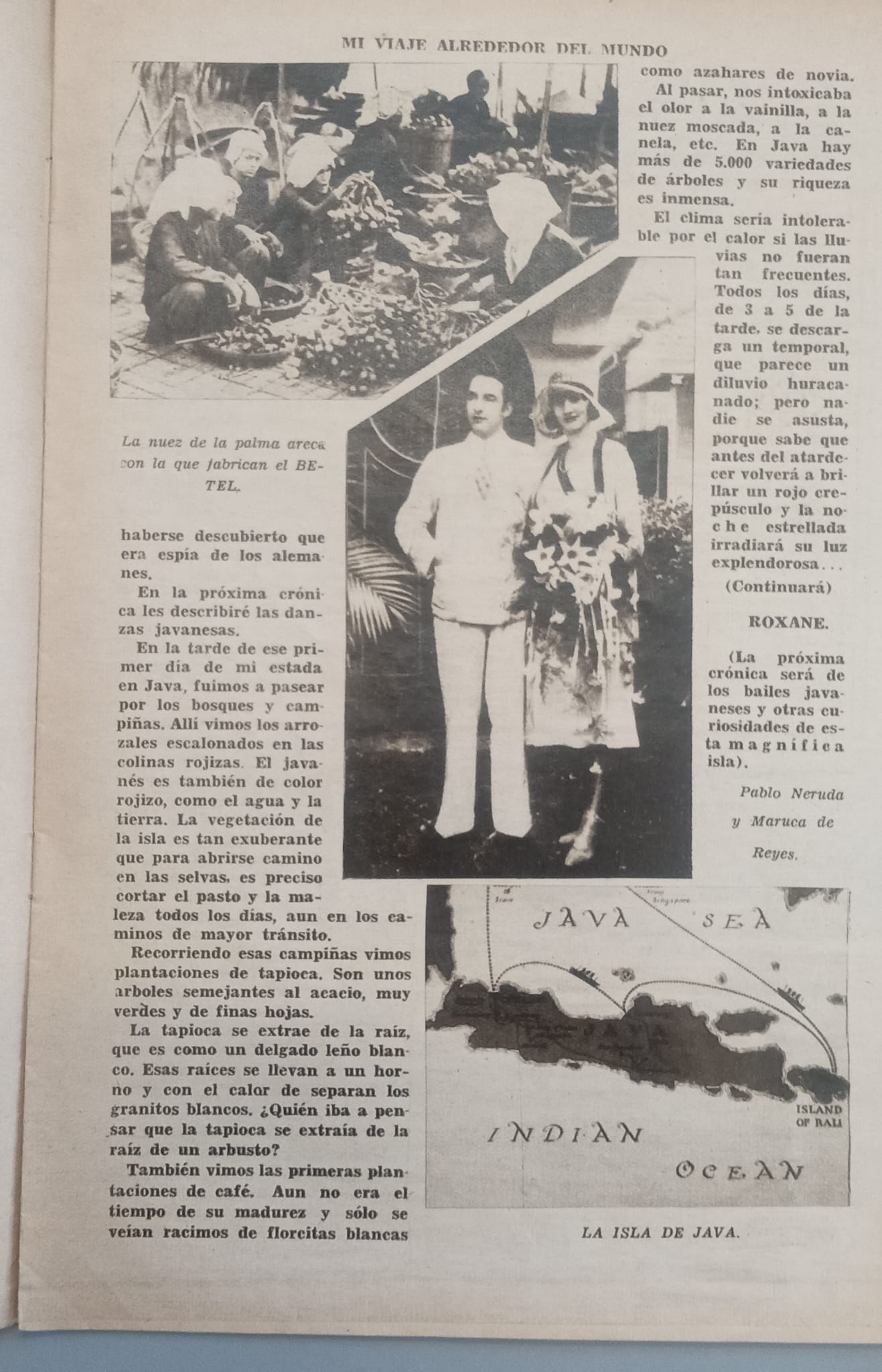
"Correspondence".
Alongside the "Collaborations" section, she edited "Correspondence", just as her former directors had done. El Peneca announced literary competitions and raffles, shared personal notices (birthdays, anniversaries) and promoted literary clubs in various cities across Chile. The most notable element was Santa Cruz's affectionate greeting, as she offered advice and signed most of the replies.
In issue number 1191 of 14 September 1931, a section entitled "To Our Readers" was included. Roxane thanked "Malvaloca" for her affection and encouraged her to continue collaborating. To Uturrieta she advised, "Perfect yourself further in drawing." The director saw potential in "Maubo"'s humour and suggested he open a section of his own: "Your cartoons are good. You could inaugurate a section of caricatures and joke-telling." To "Kari" she replied: "Why do you complain of my absence? Mamá Chayo attended to you all with all the affection of a good grandmother."
"Jorge Valenzuela. — If you wish to collaborate in the magazine, you must meet the requirements we demand. Drawings are executed on butter paper and with black Indian ink, in the sizes stipulated in each Competition.
Emilio Gómez. — We will be most pleased to accept you as a collaborator. Send us the production you indicate and we will judge it. Thank you for your kind words.
Carmen Guizado Barranco. — We are very pleased to receive letters such as yours, in which one appreciates the true affection that Peruvian children feel for El Peneca. We most gladly accept you as a collaborator, and Rosa Helena as well."
ROXANE.
El Peneca, no. 2008 or 2003, 7 July 1947 (only the page is available).
"Silvia Valenzuela. — Is the poem you are sending your own?
Blanca Poblete. — Your poems, scheduled for two fixed dates, were left over due to an excess of material. Consequently, your opportunity passed. Send us new works.
Nadia Ortega. — I am delighted that my work Flor Silvestre was so much to your liking and that you are an enthusiastic promoter of it. I deeply appreciate your effusive congratulations. I gladly accept you as a collaborator of El Peneca.
Carmen Saavedra Walker, Margarita D'Alencon, Fresia Sorucco, Carlos and Judith Pozo, Gilberto Núñez, Olga Chaparro. — We thank you for the congratulations you send us for Ben-Hur, Escuela de Vagabundos, Corazón Valiente, El Secreto de la isla Roja and Durga-Rani. As you yourselves opine, the interest of these series never wanes at any moment."
El Peneca, no. 2073, 4 September 1948.
Notices to readers were included at the foot of the page:
"NOTE. — Quintín, el Aventurero has not sent us its contribution this week, therefore we are replacing it with other series until the next issue.
The Editorial Team."
EL PENECA, no. 897, 25 January 1926.
"José Antonio Leiva. — For the publication of the photo you need only send it to the address of El Peneca. Its publication is free for our readers and collaborators."
EL PENECA, no. 1470, 15 February 1937.
At the bottom of the page, the following announcement appeared:
"COLLABORATION
EL CONDE CANIVAL is the hair-raising novel, full of the most surprising adventures, which befall a boy in a tribe of Black people and heir to a great fortune. Buy your magazine in good time."
EL PENECA, no. 1470, 15 February 1937.
To Manuel Riveros she replied:
". — The delay you notice in the publication of your poems is due to the excess of poems we have accepted and which we are publishing in turn."
ROXANE.
EL PENECA, no. 2050, 27 March 1948.
"Nelson Cortes, Margaret Darney, Lima, Peru. The drawings you send are very deficient. Practise intensively. Learn the laws of drawing: perspective, light and shadow, volume, artistic arrangement of objects, accuracy in details, etc."
ROXANE.
In the same issue, at the foot of the page, Roxane wrote an urgent notice:
"Roberto, your mother begs you to come home. She has suffered a great deal."
EL PENECA, no. 2088, 18 December 1948.
"CORRESPONDENCE
Senat and Nelly Blytte
Having the mission of forming the Peneca Committee in Antofagasta, they especially request all collaborators in that city to send them their postal addresses to: Senat, P.O. Box 294, or to Nelly Blytte, P.O. Box 542, Antofagasta. Especially the addresses of Wily Set, Hija del Cielo Boxing and Cruz del Sur."
EL PENECA, no. 894, 4 January 1926.
"XL Anniversary of El Peneca".
Upon completing four decades of trajectory, the editors commemorated the "XL Anniversary of El Peneca" in issue number 2032 (22 November 1947), printed a year earlier. Mario Silva Ossa surprised readers with an emblematic cover: the illustration of a peneca's face occupied the entire page, highlighting a pair of spectacles that, together with a calm gaze and a writing quill, radiated intellectuality. This cover constituted a visual homage to the work of José Foradori, published in the first issue of 23 November 1908.
The names of the collaborators of the period were highlighted: José Coamaño, Marcos Vegas Díaz "Indio Amado", Ernesto Baeza Palacios, Manuel Jordán "Jordán", César Sepúlveda, María Eliana Rojas "Nana", Julio Berríos "Juber", Reinaldo Pizarro, Demetrio Hurtubia Prado, Humberto Véliz, Mario Heyvar Cárcamo, Humberto Herrera and Margarita Reodi "Margarita del Desierto".
The Zig-Zag publishing house paid homage to the first two directors.
"EL PENECA TURNS FORTY
With a firm pedestal, like every work destined to endure, this children's magazine arose, already the idol of several generations.
Enrique Blanchard-Chessi, a man of science and study, gave it its first direction, followed and improved upon by the distinguished French writer Don Emilio Vaisse (Omer Emeth) until its twelfth year.
Both writers devoted part of their activities to El Peneca, but their many literary works prevented them from dedicating themselves entirely to it. The magazine needed, in order to progress, an absolute dedication, a total surrender of the spirit that was to animate it.
In 1920, Elvira Santa Cruz, known in the world of letters by the pseudonym Roxane, took charge of the direction of El Peneca, without calculating the transcendence of the mission entrusted to her; but her woman's intuition soon made her understand that she must give herself entirely to her work, and renounce all purely literary glory, all ambition to figure among the brilliant pleiad of national writers.
From then on El Peneca had a soul of its own, and this soul, which is warmth, renewal and drive, is what gives the magazine its immense success.
The pages of this children's weekly bring an essence of life…
The sheets are not filled routinely, but are constantly renewed.
This spirit, this intellectual dynamism, spreads to all the magazine's collaborators.
Mario Silva Ossa (Coré) came to the magazine because he was a child reader of it and began to draw, in love with its work. His sketches as a precocious artist gradually became magnificent creations, and now we can affirm with pride that he is one of the best illustrators in Latin America.
Elena Poirier joined our editorial team as a very young girl; here her artistic spirit has developed, lending ever greater relief to her undeniable talent as an illustrator.
Fidelicio Atria accompanies us with admirable dedication. A painter of renown, he does not disdain the illustration of children's tales, nor the artistic organization of the magazine.
Alberto Lungenstras, recently joined as an illustrator, will surely follow the path of success of his artistic colleagues.
Ketmis, Roxane's emulator in the literary sphere, was a fantastic little girl who timidly brought her contributions to the magazine, extraordinarily appreciated by readers. Today she can be compared with many Chilean pens for her creative spirit and fine style.
Olga Villalón, always in direct contact with the collaborators, directs the competitions, raffles and correspondence.
In addition to those named, there is a phalanx of collaborators who send poetry, drawings, jokes, etc.… and who aspire to follow in the footsteps of those who have already cemented their triumph. In all of them nest the same enthusiasm and the same fervour for the aggrandizement of the most popular magazine in South America.
All united solidly with their director, Roxane, they form that soul of its own that pours out light, joy and love into the world of children.
For El Peneca there are no economic crises, nor do price rises matter. The child needs the magazine as spiritual nourishment, and no one can deny it to him.
The little one hurries to learn to read in order to follow its serials; the schoolboy awaits it eagerly, caresses it and collects it like a treasure. In short, all children are proud of a magazine that is theirs and for them.
FORTY YEARS!... almost half a century of successes.
If there were a prize for tenacity and constancy, without hesitations and routines, it should be given to Roxane, who, after 28 years at the helm of El Peneca, aspires only to give it greater interest, greater animation, because this magazine is, so to speak, the prolongation of her spirit."
EL PENECA, no. 2032, 22 November 1947.
As a special part of the celebration, the publishing house rescued a poetic adaptation of "Sleeping Beauty" that Gabriela Mistral had created in 1947, barely two years after receiving the Nobel Prize in Literature. The edition, enriched with Atria's delicate illustrations, presented the classic tale in the format of serialized verses:
"Sleeping Beauty
A tale in verse by GABRIELA MISTRAL
(conclusion)
She sleeps white, like the frost
that congeals on the glass;
soul and body sleep in her;
peace is poured out
in the temples without heartbeat;
in the tress untouched,
and in the eyelid that falls,
pure dream and softness.
And he leans towards the face
(he can no longer breathe)
and his mouth kisses the other,
pale with eternity.
and the roses of life,
gently half-opening, go forth.
And the eyelids rise,
how heavy with dreaming!
and the lips unfasten,
and slowly saying go:
—Why did you take so long,
oh, my prince, to arrive!"
EL PENECA, no. 2032, 22 November 1947.
Synthesis.
Under Elvira Santa Cruz, the sections "Collaborations", "Correspondence" and the literary clubs functioned as a social network: children wrote, others replied, friendships were formed at a distance, ideas were debated and a collective identity was built.
This model anticipated by decades what we today call "engagement" or active user participation. The motivation was mutual recognition and the pleasure of seeing oneself published.
On the one hand, the use of pseudonyms was encouraged ("Incógnita", "Florisel", "Enano Azul", "Mapocho"), which allowed children to build literary identities free from the ties of everyday life. A shy child could be a daring adventurer in his writings; a girl from the provinces could become a recognized poet. On the other hand, the publication of the real name and photograph of the collaborator on the pages constituted an act of public consecration. The weekly magazine functioned as a machine for manufacturing small celebrities within the Chilean children's universe.
One of the findings was the deliberate construction of Roxane as a maternal figure. They dedicated poems to her, called her "spiritual little mother", "angel who guides us". She was a director and a symbolic mother for thousands of children.
Her letter recounting her first publication in El Mercurio showed that she had begun to write just like her readers.
Roxane's journey around the world (1930–1932) reinforced this image in a unique way. While most directors of children's magazines remained in their editorial offices, Elvira Santa Cruz boarded the Belgenland, the same ocean liner as Albert Einstein. The travel accounts fused the wonder of an exploration diary with the subtle morality of fables and the aesthetic sensitivity of Romanticism. For young readers, Roxane travelled the world and brought them, from every port, a lesson disguised as an adventure. Thus, the journey became a symbolic journey: that of a mother who set out to know the globe and then told it to her penecas.
The texts published by the collaborators revealed a consistent moral pedagogy: work dignified, poverty was an opportunity to demonstrate virtue. Obedience to parents was unquestionable and charity was a duty.
The story "El minerito" (1926) was exemplary: a hardworking child was disappointed by a "robust roto". The lesson was that one must distrust bad examples. The protagonist's suffering became an edifying moral, not a social denunciation.
The presence of collaborators from Peru, Argentina, France, and the distribution of the weekly magazine throughout Latin America fulfilled a crucial symbolic function: El Peneca was a Chilean weekly and also a Latin American one.
The call to Chilean collaborators to "set the example" because "Chilean children must be the first" revealed a nationalist pedagogy combined with patriotic pride.
Illustrations · original edition
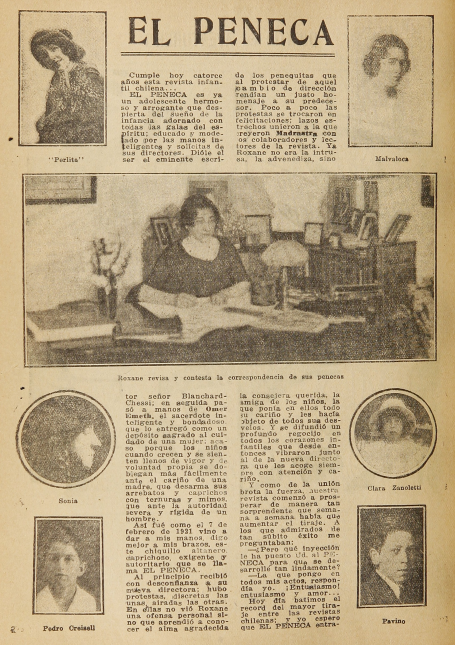
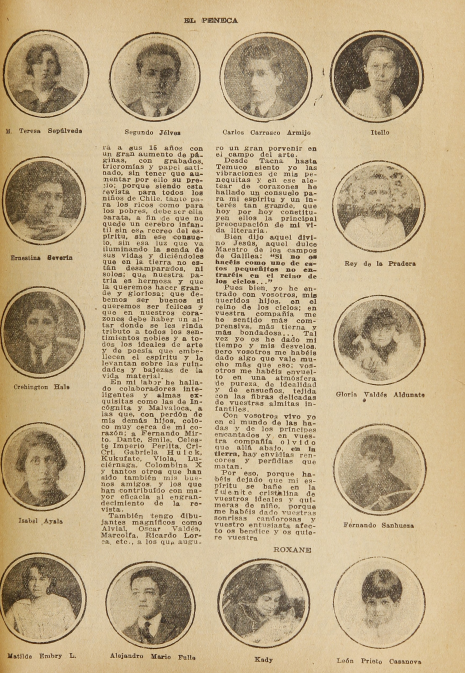
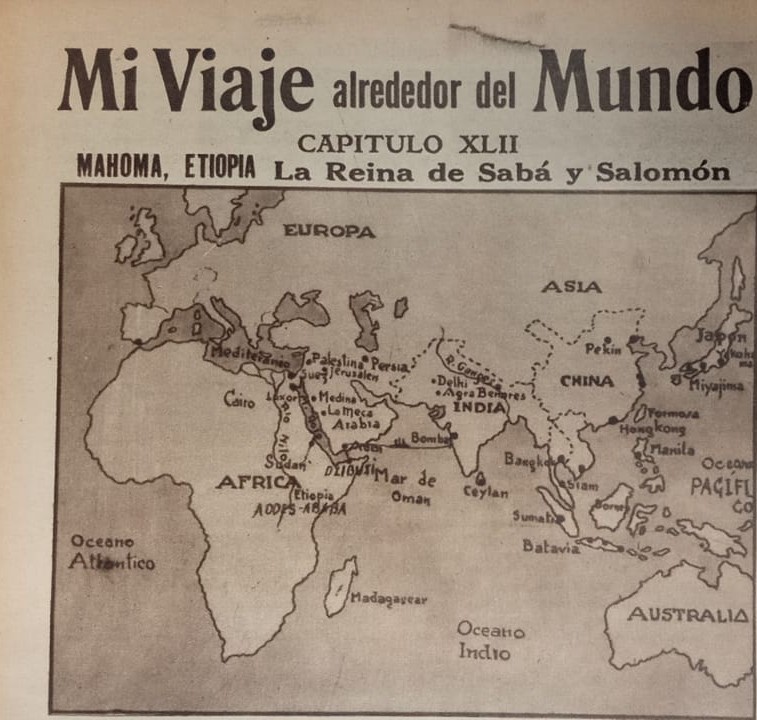
EL PENECA, n°1232, 27 de junio, 1932.
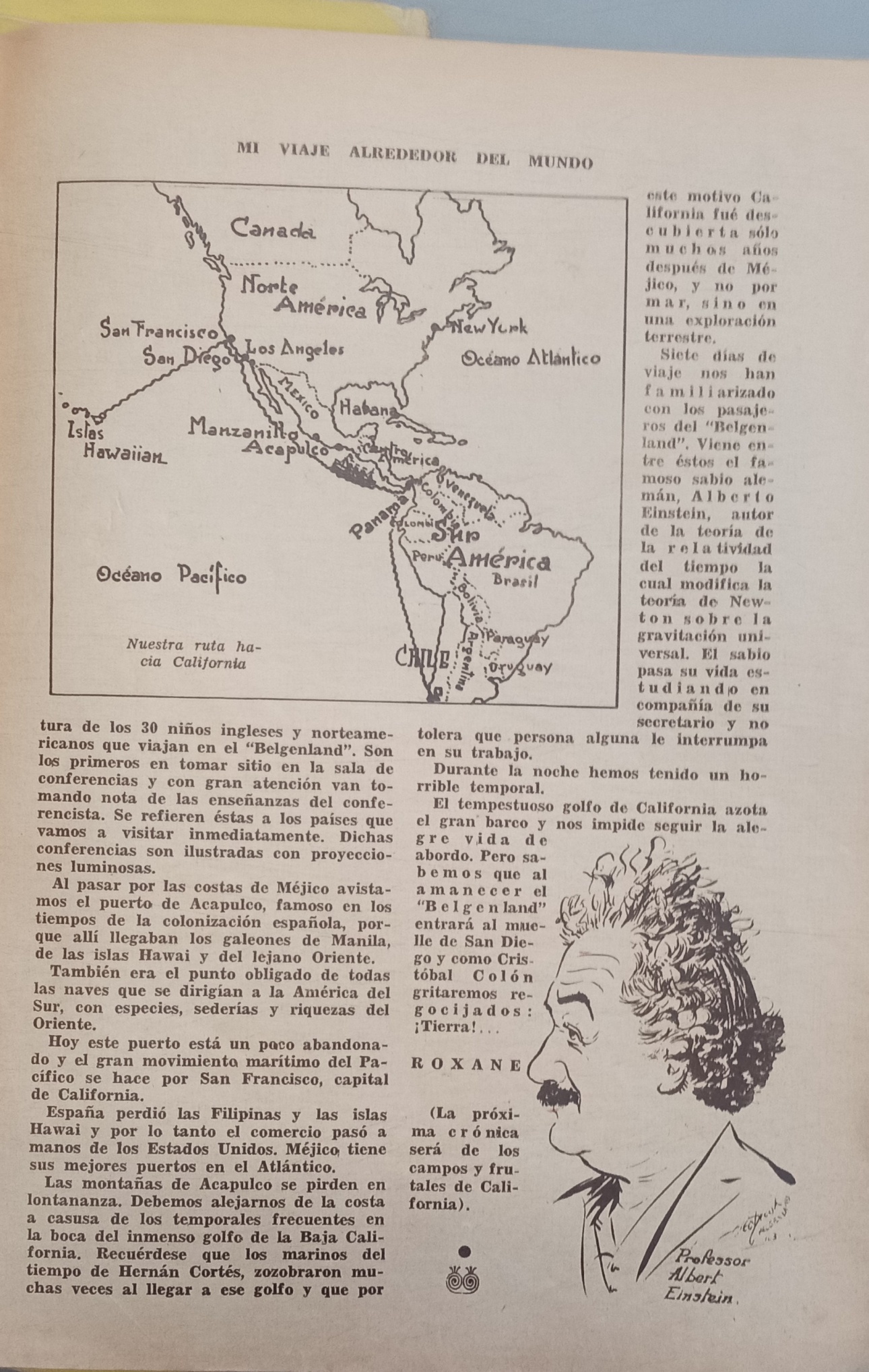
2.2.5. Children's Literature: A New Style.
Elvira Santa Cruz selected famous works from the Western literary tradition for young readers and adapted them in language accessible to the young reader. She continued to bring universal tales to light — both European and Oriental — without neglecting the writings of Chilean authors. However, the hallmark of her tenure was the serialization of these works, transforming each book into a series of weekly installments that extended over time. In this same context, she turned many literary works into illustrated strips. She likewise introduced the most famous comic or illustrated strip of El Peneca: Quintín, el aventurero (Quintín the Adventurer), a piece that served as a model for publishing a great many strips throughout her entire period.
Charles Perrault (1628–1703) was a pioneer of children's literature; his work marked a milestone by being devoted exclusively to a young audience. In 1697, under the pseudonym of his son Pierre Darmancour, he published the volume Histoires ou contes du temps passé (Tales of Times Past), which collected gems such as "Little Red Riding Hood," "Puss in Boots," "Cinderella," and "Bluebeard." The renowned author and member of the French Academy. He transformed peasant legends into masterful tales that transcended their time and remained relevant for centuries. The weekly magazine frequently turned to these narratives, adapting them for the national audience and including in each chapter a summary of the previous one.
In issue No. 654 (May 30, 1921), the contributor Perlita presented the version of "Cinderella" written by Jacinto Benavides. Perlita summarized it, interpreted it, and added the following moral:
"Moral: Cinderella was protected by the fairies because she was charitable and good. If she had ignored the voice of the little old woman asking for help in the forest, the fairies would not have protected her. In the world there are still benevolent fairies, and these are the seven virtues: by practicing them we will make others happy and at the same time we ourselves will be happy, because there is no greater happiness than that of a quiet conscience, nor greater joy than that which comes from duty fulfilled, from the alms that dries tears, and from the comfort of a compassionate word easing sorrows and pains.“
The Brothers Grimm, Jakob (1785–1863) and Wilhelm (1786–1859), published in 1812 the collections Kinder- und Hausmärchen (Children's and Household Tales). This collection compiled fables, myths, and legends that the linguists had gathered in the Kassel region, preserving the oral tradition with philological rigor. As attested by Jacob Grimm's letter to Franz Pfeiffer (February 19, 1860), "the brothers maintained a fierce opposition to literary narrative embellishments. They insisted on their desire to narrate the traditions in a pure and faithful manner. Jacob, in particular, firmly advocated fidelity and rejected exaggerations in conversations with Armin, but also with his brother Wilhelm." El Peneca published these narratives on many occasions. On February 14, 1921 (issue no. 639), it included “The Frog Prince,” which concluded in issue no. 641. On September 27, 1947 (issue no. 2024), it published “The Three Spinners,” illustrated by Fidelicio Atria Mardones. A princess who, after breaking her promise to an enchanted frog, was ordered by her father to honor her word, thereby setting in motion the amphibian's transformation into a prince.
"The Happy Prince," reproduced in issue No. 678 (November 14, 1921), was written by Oscar Wilde (1854–1900) in 1888 and became one of the Irish author's most emblematic works for a young audience. After the death of a prince who had enjoyed a pleasurable life, the citizens erected a golden statue of him at the top of the city. Covered in gold and jewels, the effigy was placed in a privileged position until, moved by the poverty he observed, it entered into a dialogue with a migratory swallow. Together they undertook a mission of charity: the prince ordered the bird to remove his gold leaf and pluck out the precious stones in order to distribute them among the needy. Justice was not in the gold one possessed, but in the good one shared; and mercy, like the swallow, always found a sky to nest in when it chose to stay by the side of the helpless.
Hans Christian Andersen (1805-1875) developed his literary career in the mid-nineteenth century. In 1839 he published his first children's book, Eventyr fortalte for Børn (Tales Told for Children). The work best known in Spanish received the title Aventuras para niños. An indefatigable traveler, Andersen became friends with Charles Dickens during his stay in London in 1847. Although he worked in many genres—from plays to novels—he became known above all for his fairy tales.
The story “Thumbelina” occupied a single issue. It recounted the adventures of a tiny girl born from a magical seed. After surviving dangers in the forest and escaping marriage to a toad, she flew to distant lands on the back of a swallow, where she found the prince of the flowers. The tale ended with their marriage and her coronation as queen of the flowers, a conclusion embodying the classic themes of belonging and miraculous transformation:
"Liluli, the King of the Flowers, chose as his wife the lovely Thumbelina.
'Goodbye! Goodbye!' exclaimed at that moment Sea Breeze (the swallow).
And she took flight towards a beautiful and distant country: Denmark, where the man who wrote this story lived. She told it to him, and he told it to us (to El Peneca).
THE END.”
EL PENECA, no. 2012, 5 June 1947.
The Czar's Courier, originally entitled Michel Strogoff. De Moscou à Irkoutsk, by Jules Verne (1828–1905), was serialized in the Magasin d'Éducation et de Récréation between 15 January and 13 November 1876. This historical adventure novel conveyed values such as patriotism, bravery and sacrifice through its protagonist, Michael Strogoff, personal courier to Tsar Alexander II, who fights for justice without ever giving up. His mission was to cross 19th-century Siberia, threatened by the Tatar rebellion, in order to deliver a message to the city of Irkutsk.
In the Chilean edition of El Peneca, Mario Silva Ossa illustrated the covers of the series, one of them corresponding to issue number 2082 (6 November 1948), while Elena Poirier produced the illustrations for the interior pages:
"THE CZAR'S COURIER
By Jules Verne
Chapter I. — Michael Strogoff
—The courier? —the Tsar asked quickly.
—Here he is, Majesty. I vouch for him. He has successfully carried out difficult and delicate missions. He possesses every quality needed to succeed. He has a body of iron and a heart of gold.
—How old is he?
—Thirty years old, Majesty.
—Let him come.
Moments later, Michael Strogoff entered the imperial study. Tall of stature, vigorous, broad of back and chest. His head displayed the fine, strong features of the Caucasian race. It was clear that this man, handsome and robust, would not easily be brought down against his will, for when he trod, it gave the impression that his feet had taken root in the earth. His face, generally pale, was altered only under the influence of a quickened heartbeat. His eyes, dark blue, had a frank, straight, unwavering gaze and shone beneath eyelids whose superciliary muscles, faintly contracted, expressed great courage — the courage without anger of heroes."
EL PENECA, no. 2078, 9 October 1947.
The novel The Scarlet Pimpernel (1905), by Emma Orczy (1865–1947), was adapted and serialized in El Peneca with illustrations by Mario Silva Ossa and Elena Poirier, becoming a resounding success. Its protagonist, Sir Percy Blakeney, an English aristocrat, had created a secret society to rescue French nobles during the Terror of the French Revolution. What was fascinating about the character was his double identity: in society, a frivolous and vain dandy; in the shadows, a daring hero who signed his feats with a small flower — the scarlet pimpernel:
"The Scarlet Pimpernel
By the Baroness Orczy
In the next issue we will begin this thrilling serial, which recounts the daring adventures of an Englishman who, in the very midst of the Reign of Terror in France, defied the leaders of the Revolution and snatched from them their victims, who had been sentenced to die on the guillotine."
EL PENECA, no. 2005, 17 May 1947.
Ben-Hur: A Tale of the Christ was written by Lew Wallace (1827-1905). This serialized work of fiction, one of the most influential novels in the United States, was adapted and serialized by El Peneca. Ben-Hur, a Hebrew prince who lived in the first century of the Christian era, witnessed the life of Jesus Christ and the birth of Christianity:
"BEN-HUR
By Lewis Wallace
Chapter XXIII. — Saint John the Baptist
SUMMARY: Ben-Hur is sentenced to the galleys through an intrigue of the procurator Valerius Gratus and of Messala, both Romans. Ben-Hur saves the life of the tribune Quintus Arrius and is adopted by him as a son. He inherits a great fortune and his name. The merchant Simonides and his daughter recognize themselves as his servants upon verifying that he is the son of Prince Ithamar of Hur, although he bears the name of Quintus Arrius. Messala is defeated by the Hebrew in a chariot race and is left crippled. Ben-Hur devotes himself to searching for his mother and sister, who, after a long captivity in the Antonia tower, are left leprous. The prince of Hur knows that they have contracted the terrible disease. Despite his efforts, he cannot find them. Then he returns to the desert, where he prepares Hebrew legions to receive the King announced by the Scriptures."
EL PENECA, no. 2068, 31 July 1948.
Within its editorial line, El Peneca adapted classic works such as David Copperfield, by Charles Dickens (1812–1870). The English author had begun his literary career in a peculiar way: while still unknown, he began publishing independent monthly stories at low cost, as most European writers did in the 18th and 19th centuries. After nineteen instalments (1836–1837), those fragments were compiled to form the complete novel The Posthumous Papers of the Pickwick Club. This system consolidated a model of serialization that El Peneca replicated: the stories were originally published in weekly format within the magazine and, once the series was finished, the sale of the complete work as a book was announced. Likewise in 1926, Zig-Zag transformed the serialized contents into collectible books. The announcement published in issue number 895 (11 January 1926), under the title "Gallery of Pictures for the Penecas", revealed this sales operation:
"GALLERY OF PICTURES FOR THE PENECAS
At the request of many penecas who wish to have the collections of the lovely trichromatic prints with the series of 'María Cenicienta' ('Cinderella'), 'Ali-Baba', 'La Bella y la Fiera' ('Beauty and the Beast') and the other series that will be issued shortly, the editorial team of El Peneca has decided to publish them on couché paper, with a margin, so that all children may place them in their playrooms and form with them a beautiful gallery of Perrault's tales. Each collection contains eleven pictures, costs $5.00, and may of course be ordered from the Editorial Office of El Peneca, Santiago, P.O. Box 84-D."
THE EDITORIAL TEAM.
EL PENECA, no. 895, 11 January 1926.
El Peneca included everything from the duels and intrigues of The Three Musketeers by Alexandre Dumas (1802–1870) to the sea adventures of Robert Louis Stevenson (1850–1894) in Treasure Island. Medieval legends such as El Cid and Herne the Hunter shared the pages with the Oriental tales of The Thousand and One Nights.
The selection also included Selma Lagerlöf (1858–1940) with the novel The Sacred Flame. The Swedish writer was the first woman awarded the Nobel Prize in Literature (1909). Another author published was Daniel Defoe (1660–1731), who established the canons of the adventure novel. In 1719 he published the emblematic work Robinson Crusoe, based on the experiences of the Scottish sailor Alexander Selkirk in the Juan Fernández archipelago.
Alongside these monumental works of universal renown, El Peneca included each week at least one original title by Spanish-speaking authors. This process generated a cultural syncretism in which traditions such as Eastern, European, and Chilean ones transformed one another upon coming into contact, as happened from the first period onward. Stories from other nations were adapted to the local context, while Chilean authors re-signified those stories from their own sensibilities, imprinting them with a distinctive mark.
An example of this phenomenon is the serialized story "Las zapatillas de baile" ("The Dancing Slippers"), adapted by Benjamín Oviedo. Published between 4 July 1921 (issue number 659) and issue number 661 of El Peneca, this narrative was based on the European folk tale "The Twelve Dancing Princesses". The plot recounted the nocturnal adventures of twelve princesses who, evading their father's vigilance, escaped from the palace to attend secret balls. After the failure of the suitors, a soldier discovered the mystery using a magic invisibility cloak. In the denouement, he married the eldest princess while the others were punished.
The artist and illustrator Aníbal Alvial adapted "El pez rojo" ("The Red Fish") in issue number 666 (22 August 1921). A red fish kidnapped a princess in the depths of the sea after she had lost a ring of stones in the water. A prince managed to defeat the fish, freed the princess and, as a reward, married her, giving the story a happy ending.
Within this same line, El Peneca published other tales such as: "Ancho, largo y ojos de brasa" ("Wide, Long and Ember-Eyed"), "Los tres deseos de Ahmed" ("Ahmed's Three Wishes"), "El mandarín y el pescador" ("The Mandarin and the Fisherman"), "Los señores del castillo blanco y del castillo gris" ("The Lords of the White Castle and the Grey Castle") and "Olavo, el de la granja" ("Olavo of the Farm").
"El príncipe gigante" ("The Giant Prince"), published on 9 August 1947 (issue number 2017), told the story of a prince who, at birth, began to grow disproportionately. Upon falling in love with a peasant woman, his majestic stature diminished owing to the feelings inspired in him by her simplicity.
On 1 March 1926, in issue number 902, "El oro de la piel roja" ("The Redskin's Gold") brought to the pages two children who fought to save the honour of their father, unjustly shot, facing the villain and those who coveted the inheritance. Years later, on 4 January 1932 (issue number 1207), "La mano de la venganza" ("The Hand of Vengeance") was the story of a noble orphan boy who, thanks to his integrity and ingenuity, resisted the abuses of criminals. Along the same lines, the serialized and extensive novels such as "La niña sin nombre" ("The Nameless Girl") and "Trono vacante" ("Vacant Throne") reflected values of strength and ethics in the face of adversity. Other titles — "La cueva del infiernillo" ("The Cave of the Little Hell"), "El país de las nubes" ("The Land of Clouds"), "La sombra del cóndor" ("The Shadow of the Condor"), "Sonia, la rebelde" ("Sonia the Rebel"), "Edna, la fugitiva" ("Edna the Fugitive"), "El mago y la princesa hechicera" ("The Wizard and the Sorceress Princess") and "Rumbo a Australia" ("Heading for Australia") — completed a diverse editorial offering. Special mention deserves "El último Faraón" ("The Last Pharaoh"), serialized and presented in a version by "Ketmis", whose ending unfolded on the full-colour back cover, with illustrations by Elena Poirier:
"THE LAST PHARAOH
CHAPTER XII AND FINAL — The End of a Dream
The prolonged silence that followed was interrupted by the cold voice of Lord Evendal:
—Now, what do you plan to do, Sahuri? I propose that you come with us. In my country or in Rumfius's you will find work. I…
—If my lord does not object, I would like to remain in Egypt —pronounced the timid voice of Nafra…
That was the last time Lord Arthur Evendal saw Princess Nafra, her beautiful face framed by the Bedouin cloak.
With a brusque gesture he indicated to Rumfius to follow him and made his way to his ship."
THE END.
EL PENECA, no. 2005, 17 May 1947.
In this regard, the voice of Mario Vargas Llosa, Nobel Prize in Literature 2010, takes on special significance. In an interview published on YouTube on 15 August 2019, the Peruvian writer recalled his childhood and his first steps as a reader thanks to El Peneca and Billiken. These words deserve to be heard even today: “I read mostly adventure books, made me participate in adventures life, I remember two monthly magazines, who arrived, probably circulate in all Latin America, one was Argentine Billiken, the other was Chilean Peneca. They were no comics there were for reading. They were kind of long novels that were divided in episodes, that may be gave me the idea that a very good novel it’s a very large novel, probably I had this prejudice in favor of great novels as novels that also were great in extensions.” “I read above all adventure books, which made me participate in life's adventures. I remember two monthly magazines that arrived, and probably circulated throughout Latin America: one was the Argentine Billiken, the other the Chilean El Peneca. They were not comics; they were for reading, like long novels divided into episodes. Perhaps that gave me the idea that a very good novel was a very long novel, and that is probably why I had this prejudice in favor of the best novels also being the longest.”
Comics and illustrated strips.
El Peneca also incorporated a new type of serialized narrative, whether in comic or illustrated strip format. Within this genre, detective plots enjoyed great popularity. These stories presented investigators of exceptional abilities, whose intellectual sharpness and technical expertise allowed them to solve complex cases, whether by complementing or supplanting the deficiencies of the judicial system. The protagonists, constructed as pragmatic figures, demonstrated a notable analytical capacity for interpreting legal codes and a resolute effectiveness in unravelling crimes, imparting justice and, ultimately, restoring social balance. The magazine published, among others, the following titles: "Browing y Co", "Iko Tertuk", "El Célebre detective japonés" ("The Famous Japanese Detective"), "Era un espía" ("He Was a Spy"), "Dan Doris", "El rastrero de Fu-Ghong" ("The Tracer of Fu-Ghong"), "Entre bandidos" ("Among Bandits"), "El detective David Lawson y su ayudante Eddie" ("Detective David Lawson and His Assistant Eddie"), "La herencia de Tomas Seyton" ("The Inheritance of Tomas Seyton"), "El trono vacante" ("The Vacant Throne"), "Las desventuras de Zitrina" ("The Misfortunes of Zitrina") and "El secreto de la isla roja" ("The Secret of the Red Island").
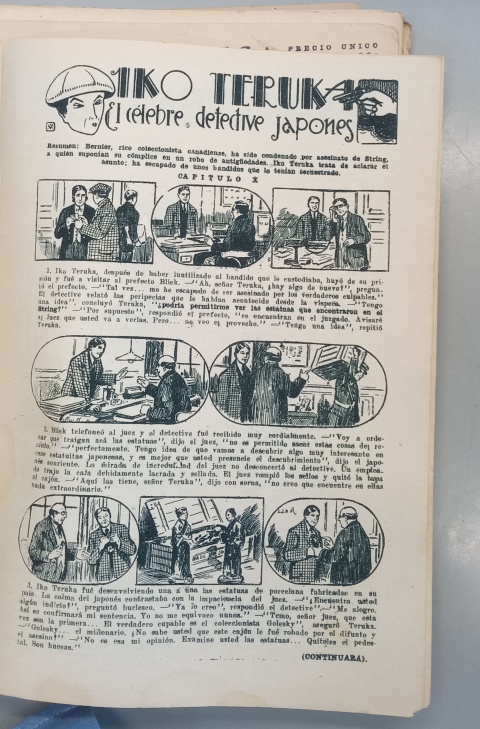
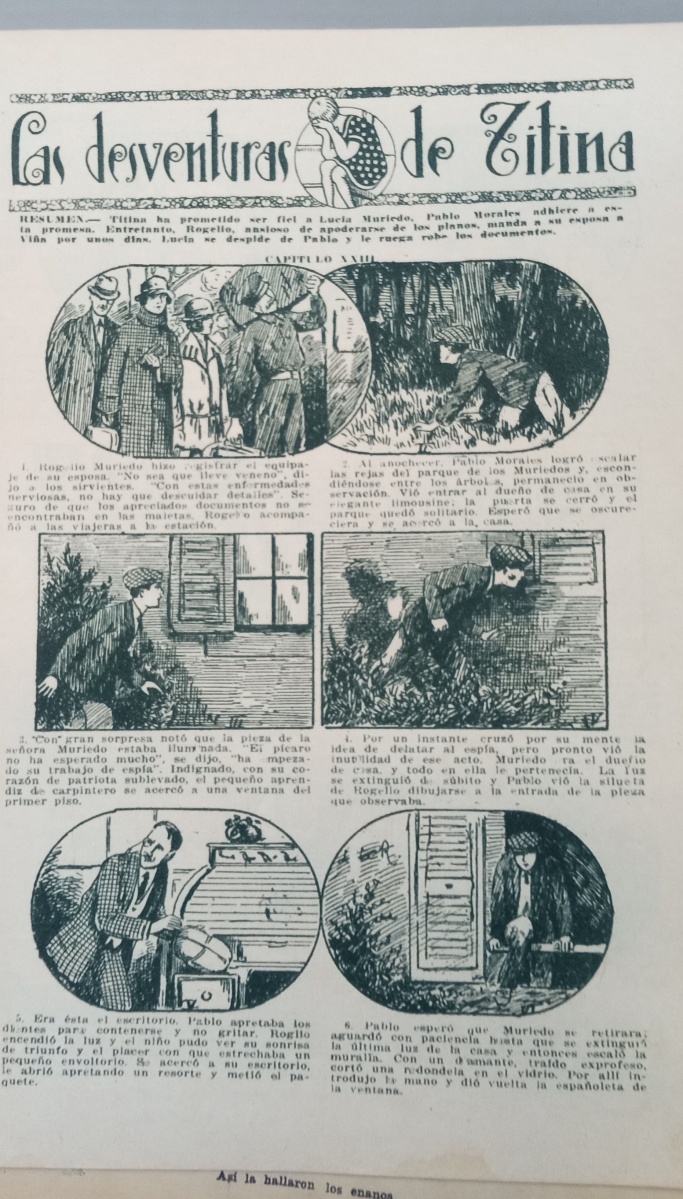
In parallel, the illustrated strips and serialized comics continued to be published along the lines of the previous editions, combining drawing and text to narrate everyday life, satirize daily existence or provoke laughter. Among the most representative titles were: "Olindo y Patelana", "Carmañola el valiente" ("Carmañola the Brave"), "Juanita, la lista" ("Juanita the Clever"), "Pussifucita no descuida a su hermanita Pussito" ("Pussifucita Does Not Neglect Her Little Sister Pussito"), "El hijo del superhombre" ("The Son of the Superman"), "Tío Cachiporra" ("Uncle Bludgeon"), "El caballo encantado" ("The Enchanted Horse"), "Pirulín", "Palema y Jaime" ("Palema and Jaime"), "El negrito Floridor" ("Little Black Floridor"), "La flecha de oro" ("The Golden Arrow"), "Papá Rucha y su hijo Mote" ("Papa Rucha and His Son Mote"), "El gato Fufulla" ("Fufulla the Cat"), "Los padecimientos de tía Cutufa" ("The Sufferings of Aunt Cutufa"), "El excursionista y sus ayudantes" ("The Excursionist and His Helpers"), "Farsa de los circos" ("Farce of the Circuses"), "Espíritu de imitación de dos macacos" ("Spirit of Imitation of Two Monkeys"), "Aventuras acrobáticas de Carlitos Chaplin" ("Acrobatic Adventures of Charlie Chaplin"), "El tío Fufulla y sus sobrinos" ("Uncle Fufulla and His Nephews"), "Sindicatos profesionales de mendigos" ("Professional Unions of Beggars"), "Aventuras de un perro vago" ("Adventures of a Stray Dog"), "Pin-Pin Safarín da la vuelta al mundo" ("Pin-Pin Safarín Goes Around the World"), "No más quebrazones" ("No More Broken Bones"), "Los dos chiflados" ("The Two Crazies"), "Crock, el cómico maravilloso" ("Crock, the Marvellous Comedian"), "Los duendes Chiche y Cheche" ("The Goblins Chiche and Cheche"), "Aventuras de un empresario de circo" ("Adventures of a Circus Impresario"), "Salambó" and "Carlitos Chaplin" ("Charlie Chaplin)
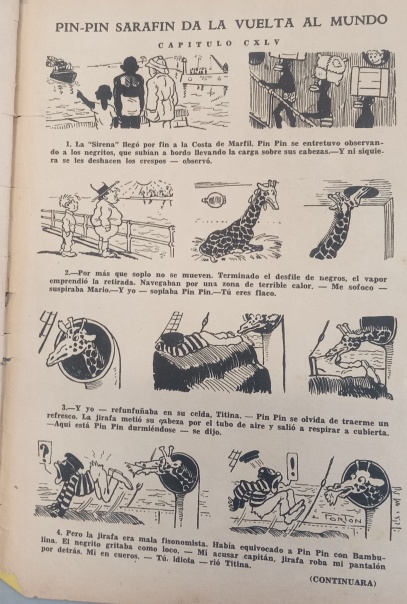
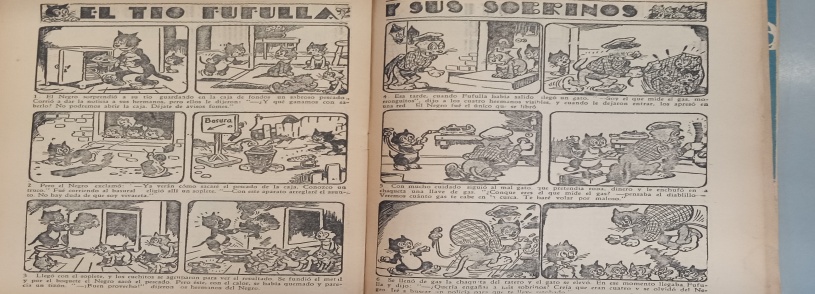
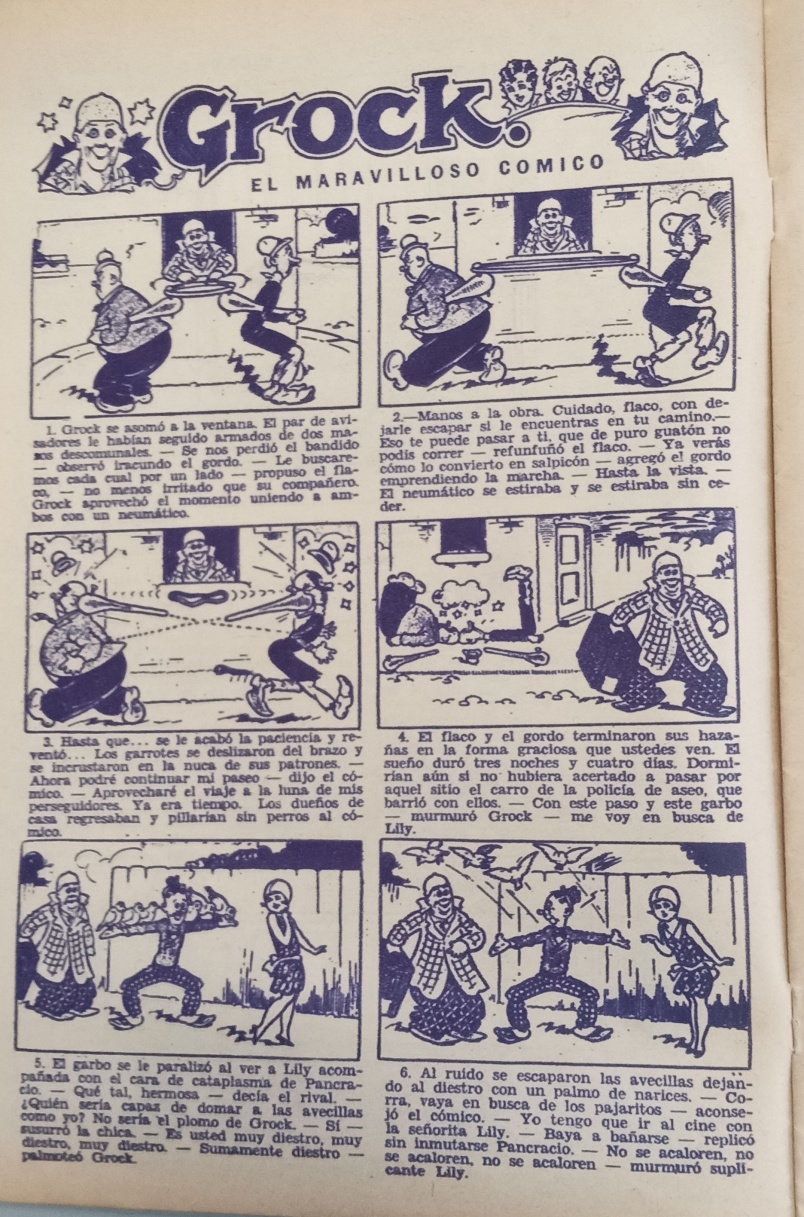
It is worth mentioning that in 1933, in issue number 1288 of El Peneca (21 August), a drawing of "Mickey Mouse" appeared, which demonstrated that the magazine not only cultivated the criollo genre and series illustrated by Chilean artists, but also incorporated some icons of North American popular culture.
"Rob, the Rover" was an English comic strip created by Walter Henry Booth and originally appeared in a satirical magazine called Puck. The comic strip arrived translated and adapted for the Chilean public, which gave rise to "Quintín, el aventurero" ("Quintín the Adventurer"). Quintín transcended geographical borders and appeared in settings such as jungles, deserts, islands, volcanoes, open seas, exotic countries and urban environments. For his feats, he used the famous "Submarplano" ("Submarplane"), a hybrid propeller-driven vehicle that functioned as a submarine, boat and aeroplane at the same time.
The first instalment appeared on 31 October 1921 (issue number 676), with four panels drawn in black and white, occupying a full page. The continuation was announced on the penultimate page of the same issue. This structure became a tradition over the years.
The beginning of the series featured a striking introduction. Quintín was a young orphan, humble, with no family support and, apparently, no preparation whatsoever for what destiny held in store for him. This premise served as an example that motivated young readers to imagine a future full of adventures, regardless of origin or social class. Quintín represented adventure and justice:
"Quintín the Adventurer
SERIES I
Quintín was an orphan boy, alone, who from a very young age wandered the world with no company other than his dog Alí. A great film impresario, having found in him a talent for a cinema actor, hired him for his company, and in that way Quintín was able to travel the world and satisfy his thirst for adventure. After visiting many countries, the company has reached the coasts of Ceylon. Within sight they have a canoe of Indians who dive for sponges from the bottom of the sea.
At once, the impresario decides to shoot an interesting film and to that end launches one of his boats into the water, placing the cinematographic camera there. And in truth it was very curious to see how the Indians plunged into the depths of the sea, naked and carrying a great knife clenched between their teeth to defend themselves from the sharks that infested those seas. The water was so crystal clear that the camera could take photographs through the ocean.
Quintín handled the oars in the company of the old sailor Daniel, father of Doris, the great friend of the adventurous boy. Suddenly, through the water, Quintín saw that one of the Indian sponge fishermen was trying in vain to free his foot, caught by a giant shell. —Look, Don Daniel —cried the compassionate boy— that poor Indian will drown if they don't save him soon. And in truth, if some of his companions did not come to his aid soon, the Indian would die."
While the Indians were considering how to save the unfortunate fisherman, Quintín, with extraordinary ingenuity and daring, decided to go to the Indian's aid. Taking a very thick grappling hook, he tied it to a cable. —An idea has occurred to me, if you will allow it, boss —said the boy to the impresario—. I am going to descend into the depths of the sea with this grappling hook. When I shake the cable, that will be the signal that you should pull the rope. —Go, generous boy —replied Mr. Gib— and may God protect you." (continues on page 18)
"Quintín" was the prototype of the comic strips that were gradually incorporated. It is important to note once again that, on numerous occasions, Alberto Lungenstras was the one in charge of illustrating and adapting "Quintín, el aventurero."This happened when shipments of comic strips from abroad did not arrive at the publishing house on the agreed date.
Within this line of adventures, figures such as the superman and superwomen emerged, represented in titles such as "El hijo del Superhombre" ("The Son of the Superman"), "Sandar", "El Archipiélago maldito" ("The Cursed Archipelago"), "Durga-Rani, reina de la selva" ("Durga-Rani, Queen of the Jungle"), "Lili, auxiliar del aire" ("Lili, Air Auxiliary") and "Náufragos del aire" ("Castaways of the Air"). "Robin Hood" arrived at the weekly magazine as an illustrated strip from issue number 2028 (25 October 1947). Published on the first two pages and on the penultimate page.
Serialized westerns constituted an indispensable genre in popular children's literature during Elvira Santa Cruz's period. These stories transported young boy and girl readers, through imagination, to arid landscapes populated by cowboys, Indians, duels with pistols and bows. Among the published titles, the following stood out: "Tex, el audaz patrullero" ("Tex the Daring Ranger"), "Venganza del lobo gris" ("Revenge of the Grey Wolf"), "El caballo salvaje" ("The Wild Horse"), "Halcones de Nevada" ("Hawks of Nevada"), "Los tres Halcones" ("the three Falcon"), “La flecha de oro” (The Golden Arrow) and "El rancho alegre" ("The Happy Ranch").
Synthesis.
El Peneca offered the classics of Perrault, Grimm, Andersen, Verne, Dumas, Dickens and Stevenson, to name but a few. Its novels achieved great fame, and their publication in instalments responded to an economic strategy: the reader who acquired El Peneca to follow the next chapter of The Thousand and One Nights, The Czar's Courier or Ben-Hur became a captive reader. Serialization generated a weekly purchasing habit, and each issue included a cliffhanger, a suspenseful ending, that encouraged the child, or their parents, to acquire the next edition.
In this way, the magazine offered its readers a cultural passport to an intellectual world, without their having to afford a private library. It was, in that sense, a democratization of culture: children learned to venerate the same authors as the teachers and intellectuals of the country.
The comic and the illustrated strip also formed part of the new literature for young people that Roxane successfully incorporated. Both genres were enriched with extraordinary illustrations, with Mario Silva Ossa standing out as the illustrator of the covers, which became the principal visual attraction for readers.
In this way, El Peneca not only entertained but also formed readers without distinction of birth, anticipating what we today call media education.
2.3. Third Period: 1951-1960 / 1971-1972.
Editors, Covers and Illustrators.
With the end of Elvira Santa Cruz's period as director on 26 September 1951, El Peneca began a slow decline. Directors and illustrators of national prestige followed one another who, despite their ability and excellence, could not save the weekly magazine.
Artists such as Themo Lobos, Elena Poirier, Renato Andrade ("Nato"), René Rodolfo Ríos Boettiger ("Pepo"), Mario Igor Vargas, José Herrera ("Toqui") and Víctor de la Fuente, along with others who remained anonymous or signed with pseudonyms, formed a group of artists who in this period tried to keep it afloat.
The effort they made between 1951 and 1960, until the closure of El Peneca, was embodied in teamwork; they were the creators of the most important magazines of the decade between 1960 and 1973. These publications, like El Peneca, have remained in the memory of readers who grew up after their disappearance.
Condorito, created in 1949 by "Pepo", is a world-renowned character and a symbol of Chilean identity that to this day has been part of reading culture. Mampato was a comic magazine whose creation is attributed to Eduardo Armstrong, with Óscar Vega as its first director and Themo Lobos as its principal illustrator. The magazine marked a milestone, achieving a fame comparable to that of El Peneca. Renato Andrade, known as "Nato", took part with his illustrations in this final stage; he later became art director of the well-known sports comic magazine Barrabases, created by Guido Vallejos, which has remained on the market to the present day. Elena Poirier accompanied the weekly magazine in its final years. In the same way, the journalist and illustrator Óscar Camino took part, and Mario Igor, who was one of the most active illustrators of the third period. Another Argentine illustrator was Adolfo Urtiaga (b. 1927), who worked for Zig-Zag and alongside Themo Lobos. Víctor de la Fuente not only gave the magazine a new look with the title "El Intrépido Peneca" ("The Intrepid Peneca"), but also attempted international distribution. After leaving Chile, he developed a world career in comics, full of recognition and awards. He received the Yellow Kid Award (1980, Lucca) — considered the "Oscar of comics". His drawings and illustrations have left an important legacy in this complex period.
All of them belonged to the last group of the generation of the "golden age of Chilean magazines".
The editors of this period were:
María Romero (October 3, 1951-January 11, 1955).
María Romero (1909–1990) studied English pedagogy. She began her career as secretary to educator Amanda Labarca and to the editor of Ecran magazine. A recognized film reporter and journalist, she worked for years as a columnist for El Mercurio. She was the first editor to succeed Elvira Santa Cruz. Illustrator L. Alvial produced the cover of issue no. 2239 (10 November 1951), titled "The Buccaneer's Treasure", depicting a pirate and a woman on the high seas. An innovative device appeared in issue no. 2240 (17 November 1951), where the front and back covers formed a single illustration of Alice in Wonderland. Under the pseudonym "Toqui", the cover of issue no. 2241 (24 November 1951) presented the face of "Roy Rogers, King of the Cowboys". Elena Poirier contributed to issue no. 2266 (17 May 1952) with "The Spotted Turtle Gang". "Toqui" returned to the star character on the cover of issue no. 2270 (14 June 1952), with a new illustration of Roy Rogers. "Pepo" left his mark on the covers: in issue no. 2331 (15 August 1953), he showed a student carrying his teacher on his shoulders because of a flood; and in issue no. 2333 (29 August 1953), he illustrated a young man in a helicopter offering his girlfriend a bouquet of flowers.
"Nato's" absurd humour appeared in issue no. 2347 (5 December 1953) with the cartoon "Pepe Conejín", in which a rabbit shot an arrow at a little lamb; and in issue no. 2479 (17 July 1954), a youngster equipped himself with diving gear to plunge into a bathtub that apparently was full of fish.
These covers illustrate the different strategies used to connect with the public. The repeated appearance of Roy Rogers, a Hollywood idol, showed how El Peneca incorporated pop figures in an effort to remain relevant. Covers such as Alice in Wonderland or The Spotted Turtle Gang represented the weekly's traditional pillar of classic tales and illustrated adventures. "Pepo" and "Nato", amid the rise of observational and absurd humour, were especially significant. "Pepo" had already refined his gaze on Chilean society. "Nato", by contrast, represented a more surreal humour that appealed directly to absurdity.
Edith Mützel (8 February 1955 – 3 January 1956).
Edith Mützel (b. 1922) worked for years at El Peneca, where she acquired her knowledge of editorial operations. After María Romero resigned, she assumed the editorship in 1955. Although her tenure lasted less than a year, she continued the educational and entertainment-oriented line. Examples from this period included: "Pepo", issue no. 2410 (19 February 1955); "Nato", issue no. 2411 (26 February 1955); "Pepo", issue no. 2414 (19 March 1955); "Pepo", issue no. 2418 (16 April 1955); issue no. 2419 (23 April 1955), by an anonymous artist; and "Nato" in issue no. 2435 (13 August 1955).
Graciela "Totó" Romero (9 January – 9 August 1956).
Graciela Romero (1925–2011) was the niece of the previous editor, María Romero. Although she trained as a social worker, she devoted herself principally to journalism, specializing in reportage. Known in journalistic circles as "Totó" Romero, she achieved popularity and charisma in Chile's cultural world.
Among the notable covers from this period were the following: Óscar Camino drew a man in space dressed as an astronaut for issue no. 2459 (28 January 1956). Issue no. 2463 (25 February 1956), titled "The Blue Triangle", featured the face of an aviator with warplanes speeding behind him. The cover of issue no. 2468 (31 March 1956) was designed by Elena Poirier. Themo Lobos illustrated issue no. 2469 (7 April 1956). Illustrator R. Noriega M. produced the covers of issues nos. 2476 (26 May 1956) and 2486 (4 August 1956).
Anonymous Editor (16 August 1956 – 28 February 1957).
The editorship during this brief period was not publicly identified. Editorial work was sustained by a Zig-Zag team that managed to retain star contributors "Nato", Themo Lobos, Elena Poirier and Adolfo Urtiaga.
Henriette Morván "Damita Duende" (7 March – 28 November 1957).
Henriette Morván (1900–1999) used the artistic name "Damita Duende" in her editorial work. She collaborated with Elvira Santa Cruz, Blanca Santa Cruz and Ester Cosani in collecting and adapting Chilean stories and legends.
She assumed the editorship in March 1957. This brief period was marked by a gradual decline in sales.
A parallel can be identified in the cover of issue no. 2491 (8 September 1956). For this cover, "Nato" drew a mischievous child playing a prank on an old man. The illustration directly evoked the cover of issue no. 39 (16 August 1909), which had shown an anonymous drawing of a child under the title "Kind Grandson", performing a similar action forty-seven years earlier.
Themo Lobos designed the cover of issue no. 2492 (15 September 1956). Elena Poirier illustrated the cover of issue no. 2494 (29 September 1956). Issue no. 2544 (14 September 1957) celebrated "Independence Day" with a portrait of Bernardo O'Higgins and Chile's Act of Independence.
Víctor de la Fuente (30 December 1957 – 11 October 1958).
Víctor de la Fuente (1927–2010) worked for Editorial Zig-Zag in the early 1950s before taking over as editor. He personally illustrated almost every issue during his brief ten-month tenure. He tried to revitalize the format with a more adventurous approach and made substantial efforts to keep the publication alive despite the continuing decline in readership. With issue no. 2555 of 30 November 1957, El Peneca underwent a dramatic shift and attempted a complete rebirth. The cover introduced a new word alongside an illustration of an American cowboy: "The Intrepid Peneca". The adjective cast the character as "brave, courageous, combative and daring". The concept departed entirely from the publication's original meaning. The cover announced: "11 continuing comic strips. One complete adventure."
The 21 December 1957 edition (issue no. 2558) showed a blond child on a tricycle inviting readers to celebrate the New Year of 1958. The same child crossed out the old number with lipstick and wrote: "Happy 1958."
"The Intrepid Peneca" might appear as a warrior in the wars of the Middle Ages, a defiant aviator, a boxer, a horseman, a fighter wearing a Peruvian Indigenous cap — with the muscular physique of a European figure — a cowboy, or an Indigenous boy of Western appearance carrying spears on his back.
Issue no. 2568 (1 March 1958) depicted two astronauts in space, creating the sensation that they were floating in the void. The same cover announced the beginning of an adventure series, "Monarch of the Sun".
"The Intrepid Peneca" appeared dressed as Tarzan in Africa and as an American soldier fighting in a distant country, in issue no. 2585 (28 June 1958). In issue no. 2596 (13 September 1958), he drew one of the heroes of Independence in combat, mounted on horseback and wearing the Chilean sash. His clothing suggested a figure from the independence struggle, perhaps one of the Carrera brothers, José de San Martín or Bernardo O'Higgins.
Carmen Alvayay de Zúñiga (October 1958 – 20 April 1960).
During this period, the covers returned to a more child-oriented audience, although the name "The Intrepid Peneca" was retained. An example of this shift is the simple, rustic illustration of 8 November 1958 (issue no. 2604), which showed Roy Rogers galloping on horseback.
In a final effort, the magazine returned to its older aesthetic tradition, integrating the words "The Intrepid" more discreetly. For these final issues, illustrators and artists such as "Nato", Themo Lobos, Elena Poirier, Mario Igor and artists signing under the pseudonyms "Ghion" and "Ashley" once again participated.
Odilia Navarro (April 2-October 20, 1960).
Odilia Navarro was El Peneca's final editor. She had joined the publication in its early years as part of Elvira Santa Cruz's team and worked closely with the magazine throughout its golden age, from the 1920s through the 1940s. She assumed the editorship in its twilight, when closure had become inevitable.
In issue no. 2680 (April 23, 1960), the word “el intrépido” was removed, and it was drawn by Igor Vargas. Issue no. 2705 (October 20, 1960) marked the definitive end of publication. In 1971, eleven years later, an attempt was made to revive the magazine.
Francisco Alomar (December 28, 1971-April 17, 1972).
In 1971, Francisco Alomar attempted to revive El Peneca after a decade of absence, but the relaunch had limited circulation and lasted barely four months. Together with contributors such as scriptwriter Juan Bley and illustrator Enrique Calvo, the team created a new version of the principal character: a studious, athletic boy named El Peneca, surrounded by a variety of entertainment stories. Despite these efforts, the publication could not survive and disappeared for good in April 1972, marking the end of every attempt to rescue the children's weekly.
Illustrations · original edition
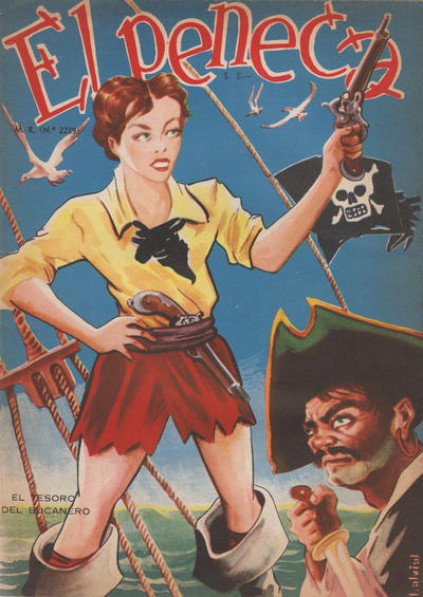
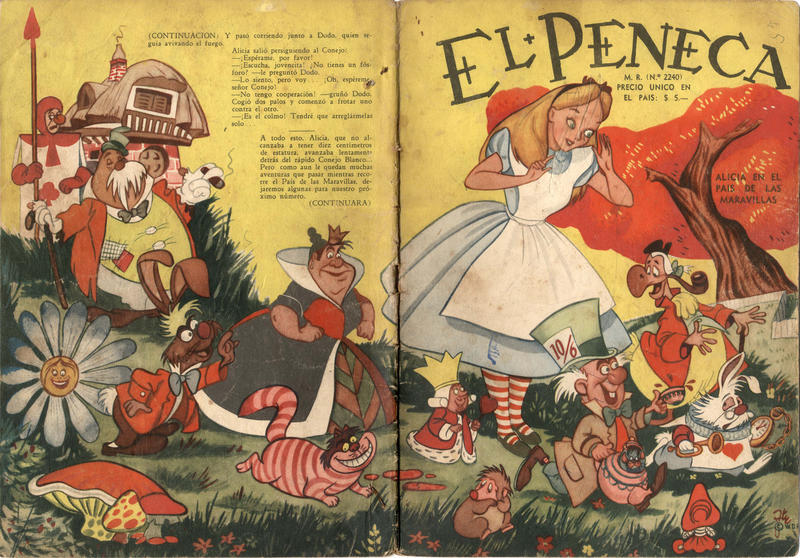
2.4. What Did El Peneca Teach Without Saying So?
The word PENECA, which gave the weekly its name, is an exclusively Chilean term that designated the student who was beginning the first tasks or preparatory classes at school. "Peneca: child, little boy.” As the definition indicated, the name itself revealed the purpose of: forming, preparing and initiating children. For this reason, one of the central goals was to consciously educate the penecas.
The editorial line was oriented towards forming and educating children, creating national unity in a young country such as Chile, which became independent in 1810. Being a recent republic, Chile needed to build its own national identity.
To this end, it turned to the historical rescue of the events of independence and to the integration of milestones such as the War of the Pacific (1879–1884) and other patriotic events. El Peneca presented these events as foundational pillars of Chilean identity.
The constitutive elements of the main message were: military valour, the homeland and social cohesion, rooted in events such as the struggle against Spanish colonialism (1810–1818) and the subsequent defence of national sovereignty.
El Peneca first appeared on 23 November 1908, 98 years after the First National Government Junta of 1810, during the mandate of President Pedro Montt (1906–1910). In issue number 44 (20 September 1909), the director Blanchard-Chessi published a historical account entitled "The Governments of Chile, 1810–1909", which covered from 18 September 1810, with the presidency of Mateo de Toro y Zambrano, to the government of Montt. This text reinforced institutional continuity as a fundamental axis of national identity.
The bravery of figures such as O'Higgins, the Carrera brothers, Rodríguez and San Martín were portrayed as noble souls whose sacrifice achieved independence. In addressing the penecas, a civic conscience aligned with the values of order, hierarchy and loyalty to the homeland was moulded. The selection of dates — 1810 (First National Government Junta), 1818 (Declaration of Chilean Independence) and 1879 (beginning of the War of the Pacific) — and their recurring appearance on covers and in articles created a civic calendar that linked the independence past with the present, projecting Chile as a young, triumphant and rising nation.
The images of the principal heroes offered examples of courage and daring. El Peneca presented heroes of the homeland and the combatant forces. The history of that period of struggle for emancipation celebrated the union of readers around that feat.
The Naval Battle of Iquique, during the War of the Pacific, occurred in 1879 and constituted the second legendary event that sealed the spirit of unity among Chileans.The love of the flag (the lone star, blue, white and red) and of the national anthem appeared as an unquestionable civic duty, linking identity with institutional loyalty. The warlike epic was blended with a moral tale: "to give one's life for the homeland" constituted the greatest honour.
The focus on military history and national heroes reflected the mentality of an era in which Chilean identity rested on myths of heroism and national unity.
2.4.1. Patriotic Values and National Heroes.
El Peneca presented to its readers numerous narratives about the lives of the principal national heroes, such as Manuel Rodríguez, a popular historical figure within the struggles for Independence. Literature for schoolchildren called him the first guerrilla fighter and spy in the history of Chile:
"The celebrated patriot MANUEL RODRÍGUEZ
Anecdotes about MANUEL RODRÍGUEZ
…It happened then that when in Chile Rodríguez was believed to be in Mendoza, he was beginning to unsettle the royalist authorities in Colchagua, preaching hatred against the Spaniards, magnifying their excesses and awakening everywhere the public spirit until then dormant. To this end he spared no sacrifice of any kind, nor was he daunted by any consideration.
Invisible only to those who could know him, he did not fear the Spanish soldiers; he passed among them shouting "Long live the King!" and eluded the strictest vigilance in order to communicate with his own and conspire in safety.
It is said that Rodríguez, taking fictitious names, visited the same houses frequented by Talavera's officers, and in order to discredit them even before the women, he maintained amorous rivalries with them."
José Bernardo SUÁREZ.
EL PENECA, no. 43, 13 September 1909.
In the short biography “The Carreras,” written by contributor Alejandro “2° Tinsly,” political controversies among patriots were attributed to external causes, avoiding deeper discussion of internal conflicts or ideological differences:
"THE CARRERA BROTHERS
Unfortunately, our country found itself given over to the most tremendous anarchy. Among the patriots themselves, they were divided into two camps, whose discords were fostered by the peninsular Spaniards, declared enemies of all political innovation…
…Nevertheless, he achieved small victories (General Don José Miguel Carrera, L.C.) over the enemy, his ephemeral command ending with the bloody and sublime epic of Rancagua.
In the company of the voluntary exiles he crossed to Argentina, execrated by the ignorant multitude and by the envious, who blamed him as the sole culprit of the latest disasters.
Alone, without a friend, without resources, he wandered through North America, without even knowing the language of those lands, in search of the means with which to reconquer his homeland.
And at last he succeeded! But envy and selfishness proved stronger than his will (that of José Miguel Carrera, L.C.). Upon arriving in Buenos Aires he was detained and arrested, on the pretext of conspiring against San Martín and O'Higgins, his most bitter enemies."
Alejandro 2° TINSLY.
EL PENECA, no. 43, 13 September 1909.
The story “One September Eighteenth of General O'Higgins,” published under the pseudonym “Cabo Moya,” dealt with the hero's exile. The narrative described how O'Higgins had to work to survive and maintain a life far from his homeland, exposing a tragic episode in his destiny: from abdication, through exile, to the final ingratitude of his compatriots. This humanizing perspective contrasted with the customary monumental representation of national heroes, revealing contradictions between patriotic ideals and historical reality: "General Don Bernardo O'Higgins
"A 'dieciocho' of General Bernardo O'Higgins
I
The most solid bulwark of Chile's independence, the illustrious and glorious General Don Bernardo O'Higgins, had to experience in his final years, after his abdication of the supreme power of his homeland in 1823, the deepest of sorrows: ingratitude."
III
"The words spoken by the victor of Chacabuco were sincere: he had reason to complain of the ingratitude of his compatriots…
The following case proves what we say: One day, as he was walking distracted, alone, stooped, pensive, along one of the streets of Lima, suddenly a group of Chilean boys, who recognized him, shouted enthusiastically:
—Long live Don Bernardo!
And they surrounded him and embraced him effusively and lifted him bodily, jubilant.
But the illustrious O'Higgins, confused by such a spontaneous ovation, yet with a secret within his breast, could not help but chide them affectionately, trying to free himself from the arms of his acclaimers:
—For God's sake! For God's sake! (those words are attributed to O'Higgins, L.C.) don't tear my frock coat, for I am poor, and it is the only good garment I have left!..."
CARAMOYA.
EL PENECA, no. 43, 13 September 1909.
In 1909 a historical essay signed by the director appeared, in which he recounted in eight episodes the Battle of Maipú of 5 April 1818. In this text, Enrique Blanchard-Chessi described real events with precise data: the location of the events, the number of combatants and maps of the period. Each episode unfolded in an atmosphere of patriotic drama, incorporating dialogues and confidences attributed to the heroes.The Battle of Maipú marked the beginning of Chile's definitive Independence, and the director wrote about its significance through a lyrical narrative, with the aim of inspiring in children the love of the homeland. In the third episode the reader read:
"THE BATTLE OF MAIPÚ
(5 April 1818)
III
Nevertheless, the brave invalid (Bernardo O'Higgins, L.C.), upon receiving news from the engineer Bacier D'Albe at 9 P.M. on the 4th that an enemy force, led by Primo de Rivera, was threatening to attack the city during the night, demonstrated how much his noble heart was capable of in serving his homeland: he personally visited the trenches that had been dug along the road, where today the Avenida del Brasil lies, and ordered his horse to be kept ready so that he might place himself at the head of the city's militia at the slightest event.
—Sir —said Baron D'Albe to him— abandon the city for tonight…
—No! —replied O'Higgins— I will die here, and if they come, they will find me at my post!."
ENRIQUE BLANCHARD-CHESSI.
EL PENECA, no. 51, 8 November 1909.
Issue number 43 (13 September 1909) commemorated the National Holidays. On the cover appeared the Chilean coat of arms. In the central pages one of the battles of Independence was illustrated. It included the Declaration of Independence of 12 February 1818, signed by Bernardo O'Higgins, Miguel Zañartu, Hipólito de Villegas and José Ignacio Zenteno. Blanchard-Chessi explained the patriotic significance of 18 September. Portraits of the precursors of independence appeared: José Antonio Rojas, Bernardo de Vera y Pintado, along with an apology for not having the image of the third precursor, Juan Antonio Ovalle. It included accounts of the "Events of 18 September 1810", patriotic odes, brief biographies of the heroes such as "The Dream of a Patriot", and of women who took part in the independence feat.
El Peneca had a civic dimension that expressed itself with all its force in 1910. One of the most important dates after Chile's Independence was the celebration of the centenary in 1910, marking one hundred years since that event. That year, the director devoted the pages of August and September to extolling this historical event. For 19 September, in issue number 96, the magazine increased its pages to thirty-nine, in order to include abundant graphic material. The pages were written almost exclusively by collaborating penecas, an unprecedented fact. El Peneca gave the floor to the children at a moment of patriotic solemnity. The publication printed photographs of secondary school pupils and primary schools. Texts, prose and verses were included that greeted the nation and the founding fathers. The director wrote only the introduction, allowing the children to express in their own words their feelings towards national Independence:
"The Centenary of Chile
With what rejoicing we celebrate today (18 September) the auspicious event of one hundred years of independent life!
Glory to Chile, glory to our homeland, which has advanced rapidly towards progress, always worthy, always honoured, always victorious!
It was born, one might say, into civilised life through the grand effort of the noble sons of Spain; but it possessed within itself a beautiful sky, a fertile land, powerful arms and generous hearts.
The Spaniards gave us civilisation; the Araucanians, its primitive sons, possessed that indomitable courage that leads to glory, even in defeat.
Both entities have made our beloved homeland glorious.
Once independence was constituted through the effort of politicians of truth and heart and of warriors of valour and heroic self-denial, it began its life as a nation, and organised itself with a solidity admired, with reason, by many other peoples."
ENRIQUE BLANCHARD-CHESSI.
EL PENECA, no. 96, 19 September 1910.
The cover featured an allegorical female figure resembling an angel, combining femininity with patriotic virtue. In her hair she bore a luminous star symbolizing the republican ideal. She held a torch of triumph that illuminated the path ahead, representing Chile's leadership toward a glorious future:
"Chile, the dense veil of ignorance
shrewdly tore, and sublime, with patience,
heroically conquered its independence,
and now towards progress continues its flight."
EL PENECA, no. 96, 19 September 1910.
In issue number 93 (29 August 1910), photographs of peasant children showed how they awaited the festivities with expectation. At the foot of the image it said: "The children are curious and truly await anxiously the Centenary of the great day, a date of just joy!".
In "Nuestra Historia Patria" ("Our National History"), written by Waldo A. Gallardo, warlike episodes and heroic figures were exalted as symbols of Chilean identity:
"OUR NATIONAL HISTORY
Historical Attempts
There will be no relic on our soil, beloved and venerated, more sacred than our sacrosanct 'national history', where in its annals are recorded for perpetual memory the names of its imperishable sons of sacrifice who eclipsed their fame in order to give their names to immortal memory and to crown with laurel leaves the illustrious ashes of those brave titans who, with their powerful arm, conquered the most unequal bloody struggles, warlike contests, amid the sound of bugles and the thunder of cannons.Glory to Chile! And may the undefeated glories that gave this soil Homeland and Liberty never pass unnoticed."
Waldo A. Gallardo C.
EL PENECA, no. 59, 3 January 1910.
"The Battle of Chacabuco" sealed a decisive confrontation between royalists and independence troops, whose victory precipitated Chilean independence (the Battle of Maipú). As a complement, it included a letter from O'Higgins to Egaña (1830) that elevated patriotic ideals above difficulties:
"THE BATTLE OF CHACABUCO
If my accusers had known these things, and experienced their torments, then and not otherwise would they have understood my feelings when I placed myself at the head of my brave infantry and used the cries of the days of Roble and Rancagua, when I exclaimed:
—Soldiers! To live with honour or to die with glory! Let the brave follow my march! Columns to the charge! — Then and not otherwise could my accusers understand the reason why seven hundred infantrymen, supported by 300 horses, defeated, destroyed and captured triple their number in less than an hour. Then and not otherwise could they know my feelings upon observing the fierce Talavera surrender his arms and the bloodthirsty San Bruno personally hand me his sword; and finally then and not otherwise could they have understood the reason why I exclaimed once more in that instant:
Now, even if death comes, it will find me content and happy, for I have lived long enough to have fulfilled the great object of all my vows and desires! I have a homeland once again, leaving its grievances avenged!"
(At the foot of the account, L.C.) (3) Letter from O'Higgins to Don Juan Egaña, written in Lima on 20 July 1830.
Enrique Blanchard-Chessi.
EL PENECA, no. 65, 14 February 1910.
In the “Chats” section, the contributor writing under the pseudonym “Lehrer” shared observations on the concept of the Homeland:
"TALKS
THE EIGHTEENTH
"Then the mother intervened and said:
—Look, children, if some foreign men came here, to our house, and took possession of everything and wanted to rule over us, what would we do?
What would Papa do?
—He would throw them out —shouted Juan…
—And if they didn't want to leave?
—He would beat them until he drove them off, and I would help him beat them.
—Well, children, that is what the Chileans did in 1810. That 'driving off' began on the 18th of that year, and since then, Chileans celebrate it by giving thanks to God in the Cathedral, and rejoicing everywhere…
—Did they really drive them off? asked Bobito, somewhat frightened… Won't they come back?
—No, Bobito, they won't come back, and you will always be able to say with pride: 'I am Chilean!"
EL PENECA, no. 252, 13 September 1913.
In 1915, the cover commemorated the national holidays with a white sculpture symbolizing “Homeland and Liberty.” In the “Chats” section, the weekly published a patriotic text under the pseudonym “Maricielo,” titled “To September 18 (For My Beloved Chile).”
"Sublime patriotism of the Chilean heart! Glory to the brave! Hosanna to your sons, my brothers! But it was still necessary to continue climbing the glorious path; you asked for more heroes and you had them; you wanted the blood of the brave and they gave it to you down to the last drop in their breast; and in giving you life, they gave you the liberty so long yearned for there in the immortal fields of Chacabuco and Maipo."
Valparaíso, 8 September 1915.
EL PENECA, no. 357, 20 September 1915.
Under the pseudonym “Lammenias,” in the section “A Little of Everything,” the text “Homeland” appeared as a lyrical manifesto on the bond between native land and identity. Written in the postwar climate following the First World War and amid the centennial era of Chilean Independence, the article went beyond ordinary patriotic prose to become a reflection on social cohesion, using images of the sacred. The author fashioned a definition of the national community in which the individual rose into the collective body.
"A LITTLE OF EVERYTHING
HOMELAND
It is the common mother, the unity in which isolated individuals merge; it is the sacred name that expresses the voluntary fusion of all interests into a single interest, of all lives into a single perpetually enduring life. And that fusion, a fertile source of inexhaustible goods, the beginning of continuous progress, impossible without it, that fusion whose effect consists in indefinitely increasing the strength of conservation and the power of development, the productive energy, security and prosperity…"
LAMMENAIS.
EL PENECA, no. 642, 7 March 1921.
Along the same lines, the magazine did not avoid the most tragic episodes of the struggle for Independence. It described the execution of José Miguel Carrera in 1821. He was exalted as a martyr of Independence, his tragic end contrasted with his legacy as a symbol of patriotic struggle:
"FATHERS OF THE HOMELAND
JOSÉ MIGUEL CARRERA
First President of the Republic of Chile
Fortune at last ceased to protect him, and, defeated by far superior forces, he was vilely betrayed by some of his own men and handed over to his enemies.
Taken prisoner to Mendoza, he was here judged as a bandit and led to the scaffold on 4 September 1821. He died with the fortitude and arrogance of a brave soldier. His enemies have tried in vain to cast upon the memory of that illustrious Chilean the mud of calumny. Posterity has done him justice; and now in Chile his name is venerated as that of the first revolutionary of the glorious era of independence."
EL PENECA, no. 669, 12 September 1921.
During the second government period of President Arturo Alessandri Palma, El Peneca published a text written in his own hand entitled "The Concept of the Homeland". He wrote it especially for the magazine. Aligned with a nationalist rhetoric, the speech reinforced the idea of the homeland as a civic union, exalting values such as institutional loyalty and social progress, characteristic of his government:
"His Excellency Mr. Arturo Alessandri P.
Portrait dedicated by the President to our magazine
THE CONCEPT OF THE HOMELAND
…In these difficult moments of new orientations, new demands, all of us who have a role, great or small, in the affairs of the Homeland, must be prepared, like him, for the sacrifice of life on behalf of collective ideals. It is essential that in these times of storms we know how to gather under the common aspiration of the sacrosanct love of the Homeland, of that supreme identity which some believe is going to disappear, and which I proclaim, on the contrary, as immortal. As long as there is a heart that beats, as long as there is a brain that vibrates, there will always be a citizen who loves his homeland; for the Homeland is nothing other than the supreme expression of the collectivity, the vibration of individual feelings gathered together by the impulses of traditions, beliefs, common interests, affections and ideals that form the best and most notable part of our being.
I am not defending a selfish Homeland; I defend the true Homeland, the one we have all felt in the lap of our mothers, the Homeland we have received from our elders, the one which I, gentlemen, have the imperative duty to preserve unharmed, and which unharmed I shall deliver to those who come after me."
EL PENECA, no. 670, 19 September 1921.
The murder of guerrilla fighter Manuel Rodríguez was attributed to betrayal and envy inherent in the human condition. This representation of Rodríguez as a victim of base human passions rather than political conflict reflected a moralizing view of history common in the patriotic narratives of the period:
"It is said that on a certain occasion (this occasion refers to Manuel Rodríguez's last stay in prison, L.C.), Rudimento Alvarado, apologizing before O'Higgins, is said to have remarked: I promise Your Excellency that if Rodríguez ever falls into my hands again, he will not trouble the government any more…
…posterity, doing recognized justice to his estimable services, has raised a monument to him on the very site where he was assassinated, which was inaugurated on 26 May 1863: it bears the following inscription:
The hero never dies!
The hand that wounds him,
On an immortal page writes his name,
and the martyr hero lives on in his glory."
Elvira Santa Cruz.
EL PENECA, no. 878, 14 September 1925.
“Roxane” wrote a fictional story based on historical events of the Independence period, illustrated by Atria, recounting the courage of a boy who joined the struggle against Spanish rule. The young man, named “Valentín,” fought alongside Manuel Rodríguez and lived in the home of Javiera Carrera, sister of José Miguel Carrera. This pedagogical fiction turned a child into a hero, bringing the national epic closer to young readers:
"THE STANDARD-BEARER OF THE HOMELAND
Manuel Rodríguez arrived shortly afterwards at the 'Posada del Loro' and, embracing señá Remedios, Valentín's happy grandmother, exclaimed:
—Señá Remedios, there may be heroic and patriotic men in Chile, but a boy more manly and more courageous than your Valentín cannot be found on this earth.
—There is another, and that one is you, my general —replied Valentín Moscoso, squaring himself militarily before the founder of the Hussars of Death."
ROXANE.
EL PENECA, no. 2022, 13 September 1947.
.
For the national holidays El Peneca narrated the adventures of Independence heroes in colonial times and their courage in fighting a better-equipped army. The historical tale “Long Live the Homeland!”, illustrated by Poirier, recounted how Manuel Rodríguez, although working behind the lines, joined his compatriots in preparing the final offensive to free Chile from monarchical rule. The text emphasized local ingenuity in the face of the royalist fighters' superiority and transformed resistance into a collective heroic act, in which tactical withdrawal was the step preceding liberation. The magazine turned national history into an epic adventure in which every child could imagine taking an active part in the struggle for freedom.
"LONG LIVE THE HOMELAND!
An adventure of Manuel Rodríguez, hero of Chilean Independence
—General Mariano Osorio, who re-established the royalist government in Chile after the disaster of Rancagua —said Don Pedro— had no intention of coming down too hard on the patriots. But Ferdinand VII and the viceroy Abascal of Peru harassed him with peremptory orders. To satisfy them, Osorio found himself obliged to persecute the supporters of liberty with extreme cruelty. Vicente San Bruno seconded him with murderous delight. In his rooms operated the Tribunal of Vigilance and Public Security, which was a kind of Inquisition.
—I am Manuel Rodríguez, I have come to liberate my homeland, and I wish to see Marcó del Pont.
The lame peasant had straightened up, leapt towards the shadow and was absorbed by it. When the soldier was able to react, the tip of his bayonet found only the air trembling with a mocking laugh.
And this was the first news the royalists had of Manuel Rodríguez's presence in Chile. Animated by him, the sacrosanct cry of Independence would rise again:
—Long live the homeland!"
EL PENECA, no. 2075, 18 September 1948.
The theme of Independence heroes and their national prominence intertwined with the presentation of historical events, which highlighted patriotic symbols such as the flag, the national anthem, the uniform and the national colors of white, blue and red:
"Heroes, men!, brave and battle-hardened,
of the homeland you are the pride;
men who always withstood upright
the cut of the sword and the cannonball.
Your serene breasts you offered,
from your blood a river was formed;
and all that you proudly gave,
for your Homeland forged liberty."
EL PENECA, no. 1764, 12 September 1942.
"YOUTHFUL POEMS
HEROIC
My flag, sacred tricolour,
holy banner of O'Higgins and Carrera,
unfurls to the wind on this day its splendour.
Amid the bullets it was the first
to exalt with honour
the sacrifice of the Glory of the entire Homeland."
Luis Reyes Elías.
The Chilean flag was exalted as a symbol and reminder of patriotic values:
"TO MY FLAG
If you knew how much I love you,
little tricolour flag;
you are like a ray of sun,
you are everything to me!
Since I first saw the light
in your fertile lap,
I have not let a single second
pass without thinking, Flag, of you.
Your beautiful silver star
lights our path
and points out the destiny
that through you we shall attain."
FRANCIA
EL PENECA, no. 2022, 13 September 1947.
"CHILE!
I love my flag,
that tricolour flag.
And I adore my lands
where my love is born.
My flag fills me
with pride and courage.
And when I say Chile!,
I say it with honour.
Chile, sacred land,
which God has idealised.
By all you are loved
with the purest love.
Chile, cradle of my years,
watchtower of liberty,
you are my noble shield.
Today, in your glorious feast
of 18 September,
with my verse and humility,
with my soul, I greet you!"
Mario Hayvar Cárcamo-
EL PENECA, no. 2075, 18 September 1948.
Among the central components of the patriotic message, the Naval Battle of Iquique, which occurred on 21 May 1879, became an annual commemorative date.
Issue number 26 (17 May 1909) of El Peneca focused exclusively on the War of the Pacific. Enrique Blanchard-Chessi wrote an essay in 15 sections (I–XVIII), combining historical prose, heroic verses, illustrations, artistic reproductions such as "Last Moments of the Esmeralda" by E. Martino, and photographs of combatants, of the families and of the people of Valparaíso.
The cover image showed a celestial figure illuminating the combatants, with the legend: "The Immortality of the Heroes of Iquique". In the hymn "To the Heroes of Iquique", Prat appeared as a symbol of bravery in facing the powerful Peruvian Huáscar with the weak vessel Esmeralda. A hymn was dedicated to Carmela Carvajal, Prat's widow:
"Hymn to the Heroes of Iquique"
Dedicated to the widow of Prat
Chorus
Eternal glory to the combat of Iquique,
a bloody, fierce, unequal strife,
which the centuries never witnessed,
that gave to Chile immortal renown!
A steel sea-monster falls
upon a gentle, slender wave:
the Esmeralda sees its star, and proudly
challenges the Huáscar and defies the fight.
Prat, raising the unconquered flag,
swears and orders never to lower it,
to go with it to martyrdom, to the abyss,
and in saving it, to save the Homeland.
He gives the electric cry of "Board!"
and leaps onto the Huáscar, resolute and daring;
after him leap Serrano and Aldea,
and to the Homeland they give their lives.
Prat, radiant, rushes to the helm,
wanting to dash the monster against the shore;
but a treacherous bolt deals him death…
he falls… and rises triumphant, immortal.
Uribe flies and seizes the ensign
that is Prat's bloody shroud:
he wraps himself in its folds, and impassive
awaits death.
And as he sinks with it into the abyss,
"Long live Chile!" flamed the tricolour:
from the bottom of the sea, "Long live Chile!"
Riquelme's cannon responds.
"APOTHEOSIS
Glory to Prat! In the heavens burst forth
Blanco, Cochrane, the geniuses of the sea;
Glory to Prat! The oceans resound;
GLORY! the world demanded GLORY to Prat!
GLORY! Chile responds and acclaims him
Saviour of the Homeland! IMMORTAL!"
JACINTO CHACÓN.
EL PENECA, no. 26, 17 May 1909.
That same month, a “Literary Competition” was announced for young people as a “Tribute on the Anniversary of the Epic of Iquique.” These pedagogical initiatives sought to reinforce historical memory through students' active participation, turning the patriotic narrative into a literary exercise:
"LITERARY COMPETITION DEDICATED TO THE STUDIOUS YOUTH IN
Homage to the Anniversary of the Epic of Iquique
"In offering an extraordinary, double issue on the anniversary of 21 May, we wished that the studious youth might cooperate with their tribute and their intelligence in so just a homage, for which reason we have resolved to open to that end a literary competition which, more than the incentives of a prize, may have the incentives of triumph and of the satisfaction, as Chileans, of commemorating, through their own effort, the anniversary of the conquest of the most beautiful glory of Chile."
EL PENECA, no. 25, 10 May 1909.
Hernán Díaz Arrieta won first prize in “Literary Compositions” with a text that justified the occupation of Bolivian territory and exalted popular patriotism. Here is the prize-winning passage:
“Literary Competition
LITERARY COMPOSITIONS
Causes of the War of the Pacific
(First Prize)
The outrage had reached its height and the crisis had to come: the most solemn commitments had been mocked, arbitration had been rejected, peaceful resources had already been exhausted… And the Chilean popular soul boiled with just indignation, demanding vengeance.
Only then did that government, of wise and most prudent memory, abandoning the policy of peace — now made impossible — order the occupation of the port of Antofagasta.
This happened on 14 February 1879, that is, on the very day on which the iniquitous auction of the great Chilean saltpetre company was to take place.
Two months later, Peru threw off the mask with which it had performed its hypocritical comedy of friendship and confessed its secret treaty with Bolivia.
Thus began the War of the Pacific."
HERNÁN DÍAZ URRIETA.
(Jacobo Téllez Ponce).
EL PENECA, no. 39, 16 August 1909.
Within this context the magazine published texts by survivors, such as “Luis Uribe's Letter on the Naval Battle of Iquique,” recounting how the sailors of the Esmeralda never considered abandoning the fight, even in the face of imminent defeat. These direct testimonies, rich in documentary value, reinforced the patriotic cult of naval heroism:
“LETTER FROM MR. URIBE ON THE COMBAT OF IQUIQUE
"For a moment the Huáscar ceased its fire, as if giving us time to reflect and surrender; it did nothing but increase our agony, since no one thought of lowering the flag that flew from the mizzen peak."
Luis Uribe.
EL PENECA, no. 78, 16 May 1910.
The same epic was transferred to the sea. Among the survivors of the Naval Battle of Iquique was Dr. Cornelio Guzmán, surgeon of the corvette Esmeralda on that key day and, years later, head of the army's medical service. In the text "The Between-Decks of the 'Esmeralda' in the Combat of 21 May (Account of a Survivor)", published on 16 May 1910 (issue number 78), he recounted the most dramatic moments of the confrontation between the ship La Esmeralda and the Peruvian Huáscar. With vivid and harrowing detail, he described the combatants fighting with inexhaustible ardour, falling into a sea tinged with blood, rescuing a conviction that transcended death: "To give one's life in defence of the homeland was the least of sacrifices." With this phrase, the account not only honoured the courage of the fallen but turned sacrifice into an act of pure self-giving. In 1915, Benjamín Oviedo associated, in the "Talks" section, the patriotism of the combatants of Iquique with virtues such as honour and loyalty. In his writings he extolled the dignity of the uniformed men, to whom he attributed a heroic sentiment towards life: “TALKS
21 MAY
And the hero of Iquique fulfilled that duty calmly, without shirking it, without evading it, without seeking a door through which to escape from its presence. And the duty he fulfilled — how terrible it was! The fulfilment of duty meant his death!"
MAGISTER.
EL PENECA, no. 340, 24 May 1915.
Alongside the survivors were the fallen. Among the articles on the Naval Battle of Iquique appeared a testimonial text: the story of Luis Cruz Martínez, a sixteen-year-old who became a second lieutenant. It noted that no details of his childhood were known, but that an adoptive mother, Martina Martínez de Franco, raised him. Cruz Martínez distinguished himself academically and, when the War of the Pacific broke out, joined the conflict to defend Chile. He died as a brave soldier who never abandoned the fight, and his example made him a symbol of youthful sacrifice, emphasizing his courage as a model for new generations:
“HEROES OF THE PACIFIC
LUIS CRUZ MARTÍNEZ
Second Lieutenant of the Chacabuco 6th Line Regiment
Some cholos, seeing him so gallant, shouted at him:
'Surrender, officer! We spare your life!'
But the Chilean officer answered by giving his men the order to fix bayonets, and with them they responded to the intimidations of their enemies. He went out into the square; behind him, the last four soldiers remaining of the 77 who made up the garrison. And there, one after another, they died killing, wrapped in a horrifying maelstrom of lances, rifles and clubs raised by the hundreds above their heads. The corpses, riddled with mortal wounds, lay in the middle of the square as a living example of what the spirit of Chile's heroic soldiers can achieve.
Second Lieutenant Cruz was found in the very middle of the square of La Concepción, his hands shattered by a persistent hand-to-hand combat with bladed weapons.
…Such was the passage through this earth of the boy Luis Cruz Martínez. Born in the shadows, he appeared in the sky like shooting stars: he shone for an instant and vanished over the horizon, leaving behind a luminous trail. But the memory of this star has remained indelible. The image of Luis Cruz has passed into bronze; that is why, on 8 October 1912, the city of Curicó, the hero's cradle, raised a statue to him."
EL PENECA, no. 660, 11 July 1921.
"COLLABORATION
(Dedicated to A.U.M.)
Forty years ago, a multitude inflamed with patriotism, amid columns of smoke and the thunder of cannons, ascended the Morro, triumphantly carrying the flag of Chile and with mad enthusiasm, at the resounding cry of "Long live Chile!", it was planted on the highest summit.
Hail! Oh sovereign of these lands!, replied the sea, caressing the Morro. Hail! Glorious tricolour!, repeated the wind, making the beloved flag of our Homeland flutter."
BLANCHETTE.
Arica, October 1925.
EL PENECA, no. 894, 4 January 1926.
The writings published in connection with May 21 focused exclusively on patriotic feeling and on a collective, glorious narrative of the nation:
"Oh Chile!, noble emblem of holy patriotism.
Your Homeric legend is a poem of epic glory.
At the victorious march of your centaurs who,
everywhere reaped laurels,
all of America acclaimed you in delirium!
The noble gallantry of your sons,
in all things always great,
is the faithful tradition of that indomitable and brave race
whose pride equalled the Andes.
This sacred soil,
for which noble men gave their soldier's blood,
shall never see its blazons depart;
for as long as there is a breast with breath,
it will know how to fight, haughty, against a hundred,
until falling at the foot of your banners.
If the enemy invades the frontier,
in their rapacious obsession of vandalism,
seeking to avenge old grudges,
bearing your flag as their emblem,
your sons will repeat with heroism
the feats of the Morro and Miraflores.
EL PENECA, no. 722, 18 September 1922.
The Chilean Navy appeared as one of the institutions most faithful to and entrusted with the nation's purest values, watching over the country's honor, sovereignty and higher destiny:
"YOUTHFUL POEMS
CHILE
When I look at your sky
and admire your mountains,
and wander through the rivers, the fields and the beaches,
I find no way to sing of you, and I admire you, my homeland.
This blessed land of my ancestors,
that infinite sea, that starry sky,
those men so strong that you yourself have formed,
those beautiful women and those brave soldiers.
And that is why I find no way to sing of you,
because you are so great, so immense and beloved,
because you are the narrow and long strip explained,
because now you extend from Arica to the Antarctic."
Mirella Castro.
EL PENECA, no. 2028, 25 October 1947.
During Elvira Santa Cruz's directorship, the magazine commemorated 21 May each year, the Day of Naval Glories, which constituted a milestone for Chilean identity. Schools encouraged students to write essays, poems and short accounts about the Naval Battle of Iquique.
The compositions — both those of El Peneca and those of the schools and the media — reproduced a traditional patriotic discourse with a homogeneous narrative. Chile dressed in its finest for that date. In Valparaíso, children awaited the naval parade anxiously, while the streets filled with flags bearing the three national colours.Floral offerings honoured the fallen soldiers, whose monument rose in the Plaza Sotomayor in Valparaíso, facing the sea.
Synthesis.
Throughout its pages, the magazine constructed a homogeneous and edifying account of Chilean history. The heroes of Independence — O'Higgins, the Carrera brothers, Manuel Rodríguez and Arturo Prat — were presented as almost immaculate figures, whose political controversies were attributed to external causes or to base human passions, avoiding any deeper examination of internal conflicts or ideological differences. Even in the most tragic episodes, such as the execution of José Miguel Carrera or the assassination of Manuel Rodríguez, the narrative leaned towards the exaltation of the martyr and the condemnation of ingratitude or betrayal, rather than towards critical historical analysis.
The recurring selection of key dates — 1810 (First National Government Junta), 1818 (Declaration of Independence) and 1879 (beginning of the War of the Pacific, together with Arturo Prat, frigate captain of the Chilean Navy) — created a civic calendar that linked the independence past with the present, projecting Chile as a young, triumphant and rising nation. This calendar ritualised patriotism among its readers, who learned to venerate the same dates, the same heroes and the same symbols as the teachers and authorities of the country.
The emphasis on military history and national heroes reflected the mentality of an era in which Chilean identity rested on myths of heroism and national unity. Military valour, love of the flag and sacrifice for the homeland were presented as unquestionable civic duties, where "to give one's life for the homeland" constituted the greatest honour. This implicit teaching was reinforced through the testimonies of survivors, such as those of the Naval Battle of Iquique, and through accounts of young heroes such as Luis Cruz Martínez, which offered readers a model of conduct with which to identify.
El Peneca taught that history was a tale of sacrifice and redemption, where the homeland was built upon the blood of its heroes and where every citizen, however young, had an inescapable duty to the nation. The phrase "To the boarding, boys!", with which Commander Prat met his death, immortalised his sacrifice and forged an imagined community of Chileans united by a common past and a shared destiny, thus contributing to the consolidation of national identity.
2.4.2. Images of Woman and Men.
During the directorship of Blanchard-Chessi and Emilio Vaisse, photographs reflected gender stereotypes and nationalist values: girls appeared in formal dress (emphasizing elegance and femininity), while boys were portrayed in uniform, associated with discipline, order and patriotism. This visual difference reinforced social roles and the idea of service to the homeland from childhood.
The mention of politicians, artists, military men and other public figures constituted an effort to make known the Chilean elites and the governing classes. The publication of events such as first communion reinforced the link between religion, tradition and homeland.
In El Peneca, the roles assigned by gender were clearly defined throughout its existence. Feminine and masculine stereotypes reinforced the family model as the basis of social order.
Woman was defined as a feminine, sweet and humble being, associated with the European physical ideal: pale skin, fine features and a slender complexion. In the first period, girls appeared represented as bearers of a social spirit, exclusively in charge of domestic tasks and cooking, skilled in sewing and embroidery, whose childhood was associated with playing with dolls.
In 1908, a photograph of Conchita Larraechea Herrera exemplified the prototype of the young Chilean upper-class girl, both in dress and in manners. The girl appeared obedient, modestly dressed and adapted to the conventions of her social class. These
characteristics made her a model of the feminine elite: refined, merciful and innocent. At the foot of the portrait one read:
"From the College of the Illustration
Lovely is Conchita Larraechea Herrera,
lovely and graceful, like a fresh flower.
In the classroom she is always first.
And a model in her games of candour.
Everyone loves her because she is always good,
because her attitude is always modest,
and they will always love her because her innocent
child's soul is filled with virtue."
EL PENECA, no. 6, 28 December 1908.
During the struggles for Independence, women were represented in connection with a supposed “natural vocation” of femininity. In the text “The Salon in 1810: Beauty and the Dominion of Women,” Vicente Grez's tribute to Ana María Cotapos and Javiera Carrera, their role as companions to the revolutionaries was exalted: they used their beauty as a political resource and provided emotional support to the heroes. They were idealized as sources of inspiration and comfort:
"THE SALON IN 1810
The salons of 1810 were revolutionary academies in whose bosom the great and fruitful ideas that accomplished all the prodigies of independence were stirred. In that era of sacrifices and dangers, men needed to communicate to one another all their hopes in order to keep alive the warmth of their enthusiasm and their faith.
Women were the soul of these dangerous gatherings, and it must be declared in their honour that never did the frailty and lightness of their sex lead them to commit an indiscretion. Back then they knew how to keep grave and important secrets. It seemed that from the very first moment they understood the role reserved for them in the revolution, for all their charm was needed, all the fascination they exercise over the spirit of man, to keep alive the heroism of the great struggle and the resolve to die or to conquer at any cost.
…Preserved as types of supreme beauty are the faces of many of the women who in that era figured by the influence given them by their social position, their talents and energy, their domestic virtues, or the love they inspired in the most celebrated leaders."
VICENTE GREZ.
EL PENECA, no. 43, 13 September 1909.
"Premio al Bien" ("Reward for Good"), written by M. Teresa Mogrovejo, was the story of an orphan girl, adopted by a woman without resources. The narrative showed how the girl married a wealthy young man. He became the "saviour and protector". The humble woman secured her future as a reward:
"REWARD FOR GOOD
Upon learning this story, little reader, pause for a moment to rest and think: he who does good, even if he does not expect payment, in the end God grants him his reward."
TERESA MOGROVEJO C.
Santiago, 1909.
EL PENECA, no. 114, 23 January 1911.
Elvira Santa Cruz initially presented Chilean girls through femininity and intellectual curiosity. These youthful protagonists partially broke with the stereotypes of the era, combining feminine grace with cultural curiosity, though always within the limits of bourgeois decorum:
"CHILDREN'S LIFE
Rebequita Varas thinks of nothing but
eating ice cream and reading EL PENECA.
Rosario Subercaseaux is happy because
the school year is about to end.
Teresita Stromilli is happy because she got
a 6 in religion.
Amelita Salas has decided to spend her
holidays travelling; she will visit San Sebastián,
Santander and other spots in the Mother Country.
María le Roy and Emilia Castro practise
boxing a great deal, for they do not wish to be
less than the American girls."
EL PENECA, no. 681, 5 December 1921.
Towards the end of the 1920s, women were granted a prominence derived from their growing insertion into the world of work. The magazine moved from the archetype of the woman who conquered man through innocence to figures who adopted active roles: heroines, stars or protagonists who explored public spheres.
This apparent advance contained contradictions, for the independent female characters ended up re-establishing the traditional family order. Hollywood divas such as Greta Garbo appeared presented with an artificially familiar everydayness for readers. In the 1920s, the magazine introduced female protagonists (heroines/stars) who, in the end, returned to traditional roles:
"…however, Greta Garbo is not proud and never disdains friendship with her work colleagues. But her exquisite soul as a Nordic and dreamy woman cannot reconcile itself with the frivolous life of the American stars."
EL PENECA, no. 935, 19 October 1926.
On 26 October 1931 (issue number 1197), the comic strip "La Venus de Jade" ("The Jade Venus") recounted the adventures of a heroine facing dangers. The denouement ended in marriage to a wealthy young American, and on 7 August 1948 (issue number 2069), it announced the beginning of the juvenile adventure series "Edna la fugitiva" ("Edna the Fugitive"). The synopsis described:
"EDNA Galaz, accused of theft, outlawed and homeless, flees to live in a cave in order to defend her little sister Ana against the hidden enemies who pursue her. With no protector other than a black mask and her great resources of cunning and intelligence, Edna Galaz will fight until she discovers the mystery that darkens her existence.
A dramatic and poignant story that we begin in the next issue and which, as the title indicates, recounts the adventures of EDNA THE FUGITIVE."
EL PENECA, no. 2069, 7 August 1948.
The main plot focused on clarifying the theft of which Edna had been accused. The protagonist used a mask to avoid being recognized, in order to investigate the unjust accusation and find the true culprits. In the end, it turned out that the stolen jewels had originally belonged to Edna, so she proved her innocence. Edna succeeded as an artist in the theatre and married the owner of the theatre.
The comic strip "Durga-Rani, reina de la selva" ("Durga-Rani, Queen of the Jungle") began publication on 3 July 1948 (issue number 2064) and had a long run. It presented the life of a European woman who adopted the Indian jungle as the setting for her struggle for justice. The protagonist possessed Western features and minimal attire, and established herself as leader and protector of the tribes. This character, a female Tarzan, stood out for her absolute mastery of the environment and for remaining undefeated against rival tribes.
It is worth mentioning that the magazine presented the woman of the era from an elegant and Western aesthetic. In issue number 1233, for example, of 4 July 1932, a "Women's Page" was included with illustrations of wardrobe models for the winter season: linen coats with fabric stitching and fur collars.
EL PENECA, no. 1233, 4 July 1932.
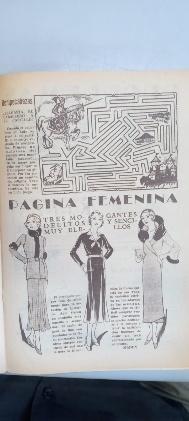
Closely linked to these feminine images, Elvira Santa Cruz appeared as a self-sacrificing mother who lived only for her little readers:
"Thanks to Roxane's wise direction, the care she takes to ensure that her magazine is beautiful and educational, and so that, upon reaching the tender little hands of those children who are so dear to her, it may leave in some the perfume of a healthy and holy joy; in others, the poor little ones, the consolation, the great consolation of having a mother and some brothers who write a magazine for them, and who only for them and because of them sacrifice their moments of rest — the one and the others — the moments they devote to their games.
And this mother is Roxane, who was known only in the enlightened social world."
In real life, she never married and never appeared in public with a companion; her dedication seems to have centered on her readers and charitable work. Her social life was culturally rich: she wrote books, directed other children's magazines, and had columns in El Mercurio and La Nación. She knew Chile's intellectual elite and associated with prominent artists and international cultural figures.
Although little was known about her private life, on one occasion she wrote to a friend, “Monito,” and confessed her feelings toward Arturo Alessandri Palma. The episode came in a postcard she sent while traveling in Paris, France, on June 9, 1927:
"The Lion (referring to Arturo Alessandri Palma, El León) has forgotten me. I have not received a single line from him. Does he forget that Roxane was the little lamp of the sanctuary that never extinguished the fire of his affection?
t was in the days of greatest joy of my travels; the memory of all of you accompanied me always. I swear to you that the constancy with which I think of Chile has even come to weigh on me.”
In contrast to the feminine figures, the masculine figure changed the destiny of life, governed, fought for what was right and administered justice. Photographs were printed of prominent figures from Chilean high society, belonging to the political, military, artistic and intellectual elites. The masculine images appeared portrayed with a stoic profile and a scientific education. The man projected an image of honour and respect: educated, prepared to be a professional and to protect his future family. This editorial construction reflected the masculine ideal of the Chilean elite of the early 20th century, where social leadership was associated with both military and intellectual virtues.
In issue number 18 (22 March 1909) appeared the portrait of Maximiliano Valenzuela, director of the School of Dentistry. On 14 March 1910 (issue number 69) appeared the writer Rómulo Mandiola. In issue number 314 (23 November 1914), photographs were published of José M. Molina Guzmán, Carlos A. Leyton and Francisco A. Lira, who belonged to the Chilean upper class (of Basque-Castilian or European origin).
In 1910, Enrique Blanchard-Chessi wrote a biographical review of the writer Alberto Blest Gana (1830–1920), considered the father of the Chilean novel. The origin, education and moral values of his forebears were highlighted as a model to follow for young readers. Blest Gana, of military training, married a lady of high society, thus sealing his belonging to the cultural and social elite of the era:
"NATIONAL GALLERY
Don Alberto Blest Gana
The illustrious and well-known Chilean Alberto Blest-Gana is the first Spanish American novelist.
Son of a very studious and intelligent English physician, Don Guillermo Blest, who served Chile with his science and charity, and of the most distinguished Chilean lady Doña María de la Luz Gana de Blest, whose parents were originally from France, he inherited talent and spirituality.
He was born in Santiago in 1831. His lively intelligence was not inclined, however, in his early years towards properly intellectual efforts but towards the practical ones of war in order to defend peace.
The military school was the cradle of his first studies.
After some years in that establishment he went to France to complete his knowledge and studied military engineering in Paris, which, in the middle of the century, when he returned to Chile, he used for the benefit of the students of the Military School, where he held the chair of topography.
He still resides in France, where he always remembers and honours his homeland with beautiful novels that vividly capture our customs and much of the colour of our land.
The first of the works with which he began in letters, and successfully so, was 'El pago de las Deudas' ('The Payment of Debts'), which he published in the 'Revista de Santiago' in 1855.
That charming little novel, simple, truly a reflection of our customs, was followed by a host of his productions that are always read with pleasure, for their pleasant and light quality.
'Martín Rivas', 'La Fascinación' ('The Fascination'), 'El Ideal de un Calavera' ('The Ideal of a Rake'), 'El Primer Amor' ('The First Love'), 'Juan de Arias', 'Engaños y Desengaños' ('Deceptions and Disillusionments'), 'Un Drama en el Campo' ('A Drama in the Countryside'), 'La Aritmética en el Amor' ('Arithmetic in Love') are owed to his pen."
E.B-CH.
EL PENECA, no. 108, 12 December 1910.
In the mid-1920s, the representation of masculinity in children's and young adult literature underwent a significant transformation, adapting to the expectations of a new reading public. These masculine characters were usually young men between 20 and 30 years old, slender, fair-skinned and youthful in appearance. Their mission was to defend the weak and those who had fallen into misfortune. The protagonists had an idealized omnipotence: they never lost a battle, overcame any obstacle and acted in the name of justice. They possessed athletic, white bodies as a standard and an almost non-existent past. This phenomenon coincided with the rise of comic strips such as "Quintín, el aventurero" ("Quintín the Adventurer"), "Aventura de dos gemelos" ("Adventure of Two Twins"), "Zani, el sin tierra" ("Zani the Landless"), "Tex, el audaz patrullero" ("Tex the Daring Ranger"), "Náufragos del aire" ("Castaways of the Air"), "Corazón de hijo" ("A Son's Heart"), "Corazón valiente" ("Brave Heart"), "El capitán luna" ("Captain Moon"), "Hijo del superhombre" ("Son of the Superman"), "Juan de Mendoza", "Sandar". The construction of these characters reinforced stereotypes of hegemonic masculinity, linking moral virtue with European physiognomies.
Synthesis.
Woman appeared defined as mistress of the home and matron of the family. Her value resided in chastity, innocence, self-denial and physical beauty, always in accordance with the European canon.
Towards the end of the 1920s, the magazine introduced active heroines, such as Edna the Fugitive or Durga-Rani. But the denouement always returned them to marriage and the traditional order. Elvira Santa Cruz herself reflected this paradox. She was a successful director and a recognized intellectual, but the magazine presented her as a "self-sacrificing mother" who lived only for her little readers. Woman could have prominence, yes, but always within the limits that did not threaten the patriarchal order.
In contrast, the masculine figure operated in the public sphere. He governed, fought, administered justice and changed the destiny of the country. The heroes of the youth comic strips — slender young men, fair-skinned, omnipotent — embodied an ideal of hegemonic masculinity where moral virtue was associated with physical strength, bravery and strategic intelligence. Unlike the heroines, these characters did not need to "return home" because their natural place was the outside world, adventure and struggle.
Both figures shared sacrifice for the homeland, but in different ways: the man died on the battlefield (Prat, Cruz Martínez, the soldiers of the Pacific), while the woman sacrificed her private life, her anonymity or her personal happiness in the silence of the home or in charitable works. The hero received statues and epics; the heroine, a mention at the foot of a photograph or a prize for "goodness".
This construction of gender in El Peneca fulfilled a social function: it gave Chilean girls and boys clear models of behaviour, contributed to national cohesion and transmitted values of order and hierarchy. However, it also imposed rigid limitations that the magazine's own contradictions — a powerful woman director, fugitive heroines, intellectual women — could not hide.
Illustrations · original edition
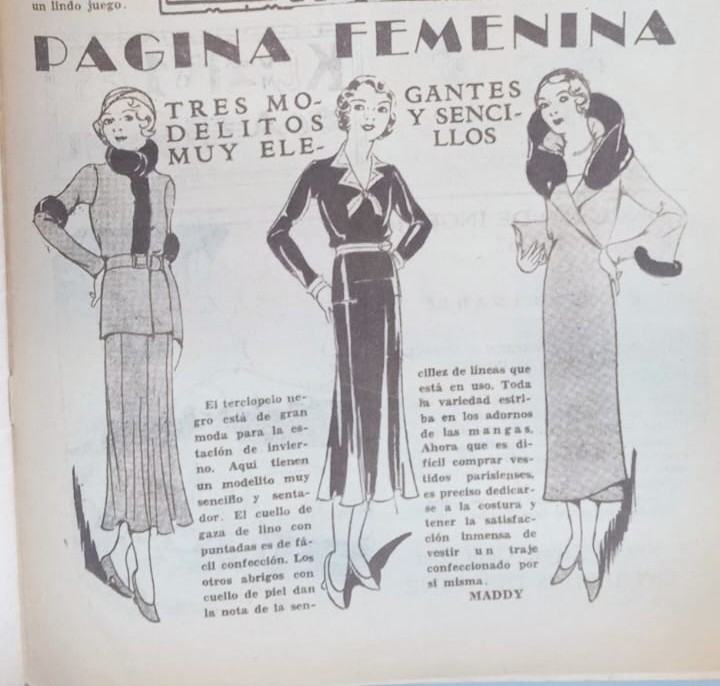
EL PENECA, n°1233, 4 de julio, 1932.

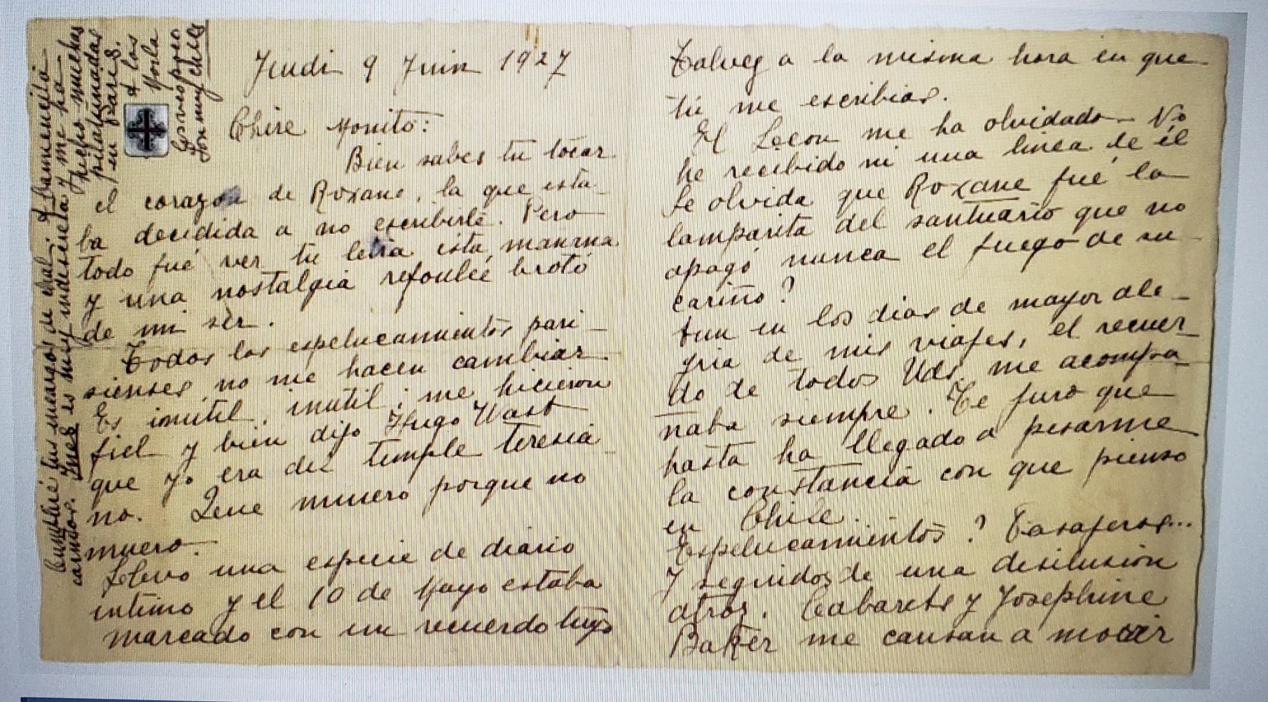
2.4.3. The “Roto”: A Chilean Figure That Later Disappeared.
The word "roto" first appeared around 1541 in the Viceroyalty of Peru as a derogatory nickname. In opulent Lima, people used this term to mock the appearance of those Spaniards who, after spending some time in the distant Captaincy of Chile, returned with ragged clothes and unraveled fabrics. Over time, the term crossed back over the Andes and reached Chile.
This term "roto" was reclaimed by Chilean society as an emblem of the strength and identity of the common man who forged the nation. These men were peasants, laborers, and soldiers who, often poorly equipped and with worn-out uniforms, made up for their shortcomings with ingenuity and daring. They were depicted with a garrison cap, a threadbare jacket, patched trousers, old shoes, and a rifle.
For educated Chilean society, highly stratified since colonial times, "el roto" represented the man of the lower class, simple and of ethnic origin. In this context, the text "El Gañán" by Humberto Pérez Montt, titled "Estudio de Costumbres" (Study of Customs), idealized the humble man of the Chilean people: hardworking, simple, a day laborer, and proud of his social condition. Pérez Montt described him as a day laborer who embraced his destiny with dignity:
"Study of Customs. The Gañán"
The symbol of the Chilean people is the roto; the peasant gañán is the true roto. For who plays the role of the roto better than the peasant gañán? He has his habits that are peculiar to him and to no one else. Of regular stature, he cannot be said to be tall or short; his build is solid, in which nerves predominate; his color is dark brown, if it can be called that; his head is protected by a thick foliage of black and bristly hair, which is not touched except every three months by the barber. His face, where beautiful and intelligent eyes can be seen shining, is friendly and full of kindness. His body is agile and free in its movements, marking in it a very pronounced martial seal.
More than anything, his clothing characterizes him. At work his attire is very simple: a shapeless hat of unknown color covers his head, a earth-colored undershirt hides his robust body — though not his chest, where a medal of a saint can be seen hanging from his neck by a filthy thread that encircles it; his trousers, rolled up to the knees, are held by a sash made from flour sacks, in whose folds the indispensable knife for cutting watermelons can be glimpsed; his feet display the appreciable chalalas, which are nothing but sandals under another name. We see him with his favorite weapons: the chuzo and the shovel.
His Sunday suit is characterized by the starch profusely applied to his clean shirt and his brand-new paltó, and above all by the brightly colored blanket that, carefully folded, is found very neat, matching the silk handkerchief he wears at his neck in the manner of a tie. Moreover, on that day he puts on his gala sash, which is now colored and with fringes that fall at the back of his body; for it is for no other purpose that he wears the short paltó, but to show off said sash. His hat has güaras and is worth twenty reales.
He shares his life among work, the house, and the cancha.
At work he is firm as an oak, and without flattery it can be said that there are none — and if there are, very few can work with the tenacity that he works to complete his task. It is worth seeing them: bent down without lifting their gaze, and chuchea and chuchea for hours and hours until they finish the work assigned to them. Then they breathe, then they look, then they live in this world; everything was alien to them except work, and it is for this reason that the peasant gañanes are not talkative; they acclimatize their life to work in such a way that their verbosity is not awakened unless they are called with a little bit of liquor.
His family is almost always numerous, and it is worth seeing the pile of fat and vigorous children who entertain themselves playing with dirt, while the mother washes beside a trough, watching over the little one who, seated on a crate, plays with a wet little shoe…"
EL PENECA, no. 43, September 13, 1909.
Benito Rebolledo Correa (1881-1964) was a central figure in the transition of Chilean painting from the 19th to the 20th century. The story recounted the talent that emerged from a rural and poor background, triumphing thanks to determination and natural gift. At the School of Fine Arts, the teaching of Pedro Lira and Juan Francisco González proved crucial. González pushed him to paint "outdoors," which would define his work. Contemporaries considered him the great painter of Chilean light. Rebolledo's works, often landscapes, costumbrist scenes, and portraits, were bathed in a vibrant light. The artist sought to capture the general impression of the scene, the warmth of the sun, and the richness of colors. This brought him close to the Impressionism that was developing in Paris since the mid-19th century, although he always maintained a realist base. In addition to the National Arts Prize (1959), he won numerous awards throughout his career. Rebolledo was one of the great artists and intellectuals of the first decade of the 20th century. A revealing example appeared in a 1910 essay written by Enrique Blanchard-Chessi. In it, the director presented him as a "son of the people," a "roto." This stereotype extolled a supposed innate simplicity and spontaneity, but denied the "intellectual stability" necessary to ascend in the rigid Chilean social ladder. Rebolledo had achieved indisputable national recognition with his paintings. The narrative of the "good-natured roto" was cracking before the reality of a consolidated plastic genius. Thus, the text itself became testimony to how talent and success could sometimes impose themselves and force the rewriting of rigid social scripts:
“GALERIA NACIONAL
Rebolledo
EL artista Benito Rebolledo es el más perfecto tipo de nuestra raza. Es hijo del pueblo i reúne todos los caractéres distintivo de nuestro ‘roto’, bonachon i valiente, todo corazón, noble e injenuamente receloso sencillo siempre, i grande siempre en su injénua sencillez, jeneroso i espontáneo.
Aunque es mas corazón que cerebro tiene agudezas instintivas, chispas intensas, semejantes a los relámpagos, que deslumbran…
Tosco, i aunque mas bien bajo, de rostro cobrizo, nariz abultada, patillas intensamente negras i tupidas, musculoso, realmente sólido, aparenta treinta i cinco años de edad,i semeja a un animal bravío; pero su mirada es suave, fijamente soñadora i sus l;abios gruesos i bien pronunciados, están siempre candorosamente sonrientes…
Incorpórese entónces, a una escuela nocturna de dibujo, i conoció las lecciones de don Lizandro Barrenechea, durante ocho meses, i pronto salió a interpretar el arte de los campos en compañía del pintor Juan Francisco González i se sintió artista i buscó inspiraciones.
Presentó al Salon de Bellas Artes un cuadrito ‘Sin Pan’ i fué aplaudido, i siguió presentando otras telas llenas de orijinalidad i sentimiento i mereció menciones honrosas i premios.
I compuso ‘Por sus frutos los conocereis’, ‘Principio social’, ‘Dejeneracion’, ‘Humanidad’, ‘Idilio’, ‘La risa del mar’ i tantos otros, hasta llegar ahora a su alabada tela, que se exhibe en el Salon i que se llama ‘Ante el mar’.
Rebolledo hoi vive en un ensueño de dichas i de glorias: vive para el arte, i el arte, que él siente i que el concibe de modo completamente orijinal, es su dicha i será su inmortalidad.”
EL PENECA, n°101, 24 octubre, 1910.
E. B-CH.
.
In 1923, a review was published about a sculpture by Virginio Arias that omitted both the artist's name and the original title of the work, "Héroe del Pacífico" (Hero of the Pacific). Virginio Arias was born in Ránquil, Chile, on December 8, 1855. The son of peasants, he showed artistic talent from childhood and received support to study art and restoration, revealing a prodigious condition: in 1873 he entered the Academy of Painting and Sculpture in Santiago. Arias arrived in Paris (1875), and in 1882 he won an honorable mention with the sculpture "Héroe del Pacífico" at the "Paris Salon," the most important institution of French arts and culture . Arias arrived in Paris (1875), and in 1882 he won an honorable mention with the sculpture "Héroe del Pacífico" at the "Paris Salon," the most important institution of French arts and culture. The work in France obtained one of the most important prizes ever received by a Chilean artist, but in Chile it was renamed "El Roto," without his consent. This monument was moved to the Plaza Yungay in Santiago, defying the content that honored the brave soldiers of the War of the Pacific and not "El Roto," as it is known to this day. The text described the physical image of the figure: a humble man of mestizo features and determined posture. The review exalted the willingness to die for the homeland "under superior orders," glorifying sacrifice as an act of national loyalty. Arias's original intention (1882) was to capture the duality of the soldier as an individual subject (anonymous face, yet unique) and to symbolize the collective national patriotic struggle. Chile reduced the work to a stereotype: "El Roto." Chilean society stripped the soldiers of their historical individuality. While Arias sought to honor the anonymous combatants (1879-1884), Chilean society transformed this work of art into a folkloric archetype, emptying it of its original historical context. Arias died on January 17, 1941, in Paris, without knowing the impact that this act of cultural appropriation would have on his legacy:
“Roto, descalzo, dócil a su suerte, cuerpo con ceño y ágil, tez morena, se levanta sereno en la Plaza de Yungay el certero fusil de mano fuerte.
No hay en su duro pie risco vedado; sueño no ha menester; quejas no quiere dónde lo llevan; jamás hastiado del símbolo de esta gran patria chilena.
Ni el bien le asombre ni el desdén lo hiere; sufrido, valeroso y resignado, obedece, pelea, triunfa y muere; ... “¡Viva Chile y el roto chileno!”
EL PENECA, n°766, 24 de Julio, 1923.
The figure of the uniformed “roto” was glorified, although it was nothing more than the image of humble soldiers placing their own lives at the service of the country in exchange for a modest wage:
"Who has his promised blood pledged to Chile
and has sworn to give his life for the homeland?
The soldier.
Who never lowers his chest and emerges with glory
from all combats?
The soldier.
When in the midst of pleasures, everyone
lives carelessly, who watches, fights, and dies?
The soldier.
Who defends with his hands the laws and the state
from anarchists and tyrants?
The soldier.
Oh, Sacred Mission, Sublime!
Who, silent, selfless, goes to combat and redeems us?
The soldier."
EL PENECA, no. 861, May 18, 1925.
In contrast with these official discourses, poet Bernardino Guajardo portrayed in Poesías Populares (Popular Poems, 1885) the tragic fate of veterans who returned disabled from the War of the Pacific. While society celebrated the hero on the battlefield, Guajardo denounced the hypocrisy of a system that abandoned those veterans in peacetime, reducing them to begging and state neglect:
"ALMS for the MUNICIPALITY'
Let us suppose a soldier
Disabled by war,
What does he do in this holy land
Finding himself rendered useless;
And instead of being rewarded
He receives no relief,
In such a way that he lives
As wretched as Adam,
And even when he begs for a piece of bread
The poor man is forbidden.
Sad it is to see a veteran
Who cannot work
And is incapable of earning
His sustenance by his own hand;
If he begs a sovereign
With a tender voice,
A morsel of food
Is given to him as an answer,
Today he is worthy of prison."
This tension reflected the ambiguous relationship Chile’s elite maintained with the poorer classes: although they were recognized as an essential part of national history and an emblem of popular culture, they were expected to accept with stoicism the place that “God” had assigned them. Even in 1944, the weekly was still publishing poems that linked factory work to a kind of divine mandate, in which workers, “smiling and content,” went to the factory convinced that each person must honorably “earn his daily bread.”
"A whistle tears through the air and wakes me up; it is the factory whistle, its call to work.
I hear hurried footsteps, I see the workers passing by, they go smiling and content and ready to struggle.
By the law that God imposed, that with honor each one must earn his bread."
EL PENECA, no. 1849, April 24, 1944.
The 1973 coup d'état and the civic-military dictatorship that followed abruptly replaced the system of values that had been in force for decades. The "roto" that El Peneca helped to disseminate — honored, hardworking, patriotic, and proud of his humble origins — was progressively degraded until he became a radically different figure. This transformation revealed the double face of the same elite. Editorial Zig-Zag, owner of El Peneca, was also the owner of El Mercurio, Chile's leading conservative newspaper. While the magazine had educated thousands of children in civic and patriotic values, the newspaper, under the direction of Agustín Edwards Eastman, deployed a systematic campaign to discredit the government of Salvador Allende and actively contributed to creating the conditions for the coup d'état. The directors of El Peneca — Blanchard-Chessi, Vaisse, and Santa Cruz — probably never imagined that the very publishing house would sponsor those who, years later, would burn the archives and destroy the cultural world they themselves had helped to build.
In post-coup Chile, the neoliberal model promoted the exaltation of individual merit, consumerism, and economic deregulation, generating new forms of inequality. Collective effort and the dignity of work gave way to ruthless competition and accumulation as the only values. In this context, a new denigrating figure emerged in the imagination of the upper and middle classes: the "flaite." Unlike the "roto," who could be both an object of contempt and of patriotic veneration, the "flaite" is an exclusively pejorative term, associated with vulgarity, the transgression of norms, and the abandonment of public education. Behind this term lies a relentless class judgment: the poor man is no longer the "roto" who fights for the homeland, but a dangerous or despicable subject.
This transformation reveals a fracture in Chilean society. The old hierarchical order, however unjust, at least recognized the humble people as an essential part of the nation. The dictatorship and the economic model that prolonged it dissolved that symbolic contract. The "roto" ceased to be the anonymous hero of the War of the Pacific to become, in the dominant discourse, a "flaite" to be feared or despised. The dictatorship swept away that old world and offered no worthy replacement. The transition to democracy consolidated, rather than corrected, this new symbolic order.
El Peneca and the magazines of the era were the last witnesses of a Chile where education, civic patriotism, and a certain idea of social harmony — hierarchical, unjust, but at least cohesive — still had a place. Nevertheless, despite the curfew, fear, and censorship, El Peneca did not disappear from the memory of its readers.
Illustrations · original edition
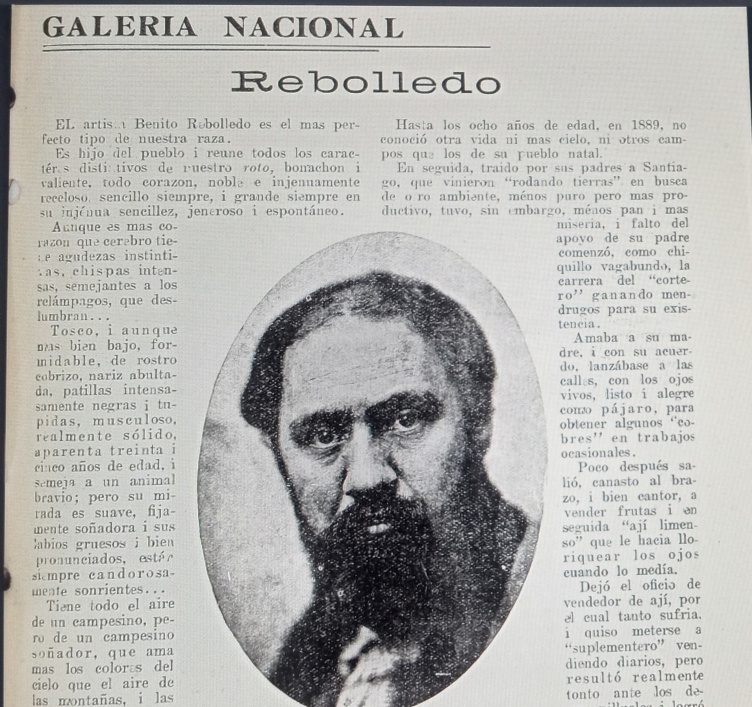
3. CHILEAN PUBLIC FIGURES REMEMBER EL PENECA.
This chapter sought to collect the memories of several prominent Chileans who had been devoted readers of El Peneca in childhood. Public figures from politics, the arts, and intellectual life were selected for these interviews, which were conducted between September and November 1990.
At the time of the interviews, the participants ranged in age from 48 to 76, indicating that their contact with the magazine had taken place between the 1920s and the 1940s.
José Donoso, born October 5, 1926, in Santiago, Chile. Journalist and distinguished writer. In 1990 he received the National Prize for Literature.
Armando Jaramillo, born November 8, 1923, in Santiago, Chile. Lawyer, academic, and conservative politician belonging to the National Party. During the dictatorship he was part of the Alliance for Democracy and later joined the PPD (Party for Democracy).
Enrique Lafourcade, born October 14, 1927, died July 29, 2019, journalist and writer. He wrote *Palomita Blanca*, one of the most widely read novels in Chile in its day. It was adapted for film and directed by the internationally renowned filmmaker Raúl Ruiz.
Juan Radrigán, born January 23, 1937, in Antofagasta, Chile. One of Chile’s finest playwrights. In 1980 he wrote *Hechos consumados*, which was adapted for film in 1986.
José Balmes, born January 20, 1927, in Catalonia, Spain. He arrived in Chile with his parents, who had fled Francisco Franco’s dictatorship. Painter, intellectual, and an important figure in Chile’s visual arts.
Patricio Phillips, born August 23, 1922, in Santiago, Chile. Politician belonging to the National Party. He supported the military coup carried out in 1973 and participated politically during the military dictatorship.
María Maluenda, born March 6, 1920. Actress married to the distinguished actor Roberto Parada. Their son, José Parada Maluenda, was murdered and had his throat slit by members of the military in 1985. In 1990, María Maluenda was a member of the Chamber of Deputies for the Party for Democracy (PPD).
Gustavo Leigh, born September 9, 1920. Commander-in-Chief of the Chilean Air Force (FACH). He was one of the four generals who carried out the military coup against elected president Salvador Allende in 1973.
Jorge Ovalle, born August 5, 1928. Chilean lawyer, politician, and academic. A member of the Radical Party. After the 1973 coup d’état, he served as an adviser to Commander Gustavo Leigh. He was removed for taking a more open position than the military leadership regarding a new constitution, and he became an opponent of the dictatorship’s governing junta.
Gabriel Valdés, born July 3, 1919. He served as president of the Senate during the government of Patricio Aylwin. A long-standing Christian Democratic politician and Minister of Foreign Affairs under Eduardo Frei Montalva. The Christian Democratic Party supported the military coup, an issue that remains controversial to this day.
Abraham Santibáñez, born June 11, 1938. Journalist and university professor. After working for Editorial Ercilla, in 1977 he and his friend Emilio Filippi founded the magazine *Hoy*, which became one of the first opposition publications during the dictatorship. In 1990 he was appointed editor of Chile’s state newspaper *La Nación*.
María Antonieta Saa, born January 8, 1943. Teacher and member of MAPU (Popular Unitary Action Movement). After the military coup she fought for human rights and women’s rights. She later joined the PPD (Party for Democracy) and served as a deputy for that party.
Anselmo Sule, born January 27, 1934, in Santiago, Chile. Radical Party politician. Before the 1973 military coup, he was senator for the O’Higgins and Colchagua regions, a seat he held again in 1990. He served as a vice-president of the Socialist International at the global level.
The conducting of the interviews was characterized by a great willingness on the part of the interviewees to talk about the subject. They, without any exception, remembered El Peneca as a natural part of childhood. The images remain vivid to this day, and a feeling of warmth envelops their faces. The smile, the emotion, and the enthusiasm of returning for a few moments to that period of their lives reveal the important place that El Peneca had in their childhood experiences. The ages of the interviewees ranged between 48 and 76 years.
Memories of El Peneca as a weekly magazine.
Anselmo Sule:
“I have extraordinary and beautiful memories of El Peneca. From the time I learned to read, around 1941, until 1950, my life was connected to this publication almost every day. Merely remembering it stirs me deeply.”
José Donoso:
“I read every issue. My mother bought it every week. I also bought second-hand copies myself. My three brothers read it; we fought over the magazine, and even my cousins would go out to buy it.”
María Antonieta Saa:
“I used to wait for the deliveryman to come by so I could read the magazine before my brothers did.”
María Maluenda:
“El Peneca was a magazine that fascinated my brothers and me. There were three of us; I was the only girl and the youngest. My father worked for a state-owned company. He was the editor of a very successful sports magazine at the time called *Sport*. Because he worked there, he would come home with two children’s magazines: El Peneca and *Don Fausto*. We received them the day before they went on sale. Having the magazines right there at home was a very special privilege. I remember we would fight over them—good-naturedly, I mean—because there were two magazines and three of us. We argued about who would read them first; I probably won because I was the only girl and the youngest.”
Patricio Phillips:
“We waited eagerly for the magazine.”
Gabriel Valdés:
“I had the complete collection.”
Abraham Santibáñez:
“Talking about memories of El Peneca is an adventure into the past, mixed with memories of leafing through very old bound volumes that my grandparents kept in Valparaíso.”
Gustavo Leigh:
“They didn’t buy it regularly at my house. Every now and then my mother would bring it home. There were four of us brothers, but the others managed to get second-hand copies one way or another. There weren’t so many forms of entertainment then—not even radio.”
Juan Radrigán:
“The fact that we read it as a family was important; my mother read it aloud to us, so there was a double sense of harmony.”
Jorge Ovalle:
“El Peneca aroused tremendous interest. My sister Eliana and I fought over it, and we would start waiting for it two or three days before it arrived.”
Memories of characters, drawings, and stories
María Maluenda:
“There are characters that have stayed with me ever since. ‘Quintín, the Adventurer’ is the one I remember most: he was such a good person, willing to do the most incredible things under pressure, always with a good purpose, always trying to help others. I remember that one of my brothers was nicknamed ‘Quintín’ by his friends.”
Armando Jaramillo:
“I remember the story ‘Herne the Hunter’; ‘The Man with the Horns’ was a sort of Batman with enormous horns. ‘Academy of Rogues’; among those stories I remember ‘Prim the Porter.’ And I remember Coré’s magnificent drawings.”
Juan Radrigán:
“I remember Coré’s fairy tales. There was a certain tenderness in the content: ‘Herne the Hunter,’ ‘Quintín, the Adventurer,’ ‘Ivan Joe.’”
Enrique Lafourcade:
“I remember ‘Quintín,’ ‘Juanita,’ some airplanes, some submarines. I remember the children’s poetry, the fairy tales, Coré’s covers.”
José Balmes:
“I have many memories of the magazine. It was formative; I remember Coré’s drawings, and Poirier’s. I remember the serialized stories, those dealing with strong passions. That was where I began reading the classical authors. Of course, those stories had been pirated and simplified.”
Patricio Phillips:
“‘Sinbad the Sailor’ brings back memories of princesses, wolves, and that whole world of fantasy and poetry that filled the magazine.”
Gustavo Leigh:
“The series I remember best is ‘Quintín, the Adventurer,’ because it was a whole life outside the home where the imagination could take flight. There wasn’t violence in those days; the heroes faced a specific danger. That was what the comic strips were like. I remember ‘Clever Juanita.’ There were good novels for adolescents. The comic strips with airplanes and their pilots are still engraved in my memory today. Those stories arrived week after week; I always liked them and followed them minute by minute.”
Jorge Ovalle:
“I remember my first readings very clearly: ‘The Mark of the Scorpion,’ ‘The Eye of the Cartufa’; perhaps El Peneca played a role in my reading about Valdivia, Ambrosio O’Higgins, Manuel Montt, Lastarria, Bilbao, Zañartu, Colocolo, Paula Jaraquemada, and the Carrera brothers.”
Gabriel Valdés:
“It was fantastic, original; it had stories that generated enormous interest in adventure, medieval legends, kings and princesses, stories from mythology. There were series about the Araucanians, stories of Caupolicán. The illustrator was fantastic. His name was Coré. The printing was very good for its time. It was an inexpensive magazine. It was morally clear-cut: the good people were good, the bad people were bad, nothing was murky. There were pretty girls, beautiful maidens who had to be rescued from dragons.”
Abraham Santibáñez:
“I read ‘Herne the Hunter,’ ‘Sexton Blake,’ ‘Quintín, the Adventurer,’ the story of ‘Paparrucha,’ and earlier ones as well. There were many orphans in dreadful reformatories, or couples living together in unusual circumstances. Alongside those stories was Coré’s fine, pleasing artwork. Looking at the different periods, however, I can clearly perceive the difference between a magazine with broader ambitions—the presence of Roxane was very strong in the bound volumes from the twenties and thirties—and a more conventional, almost purely adventure-oriented magazine that, toward the end of its existence in the sixties, settled into a certain French *Pilote*-like style.”
María Antonieta Saa:
“I remember Roxane as the director, a wise woman, a good person, full of affection for children. I remember one El Peneca cover showing Arturo Prat with a sword, in color.”
Unity in diversity: an emotional consensus.
Despite the ideological differences among the interviewees — from the coup supporter Gustavo Leigh to the left-wing playwright Juan Radrigán, passing through the Party for Democracy's María Maluenda — all remembered El Peneca with affection and emotion. Phrases such as "it causes me deep emotion" (Sule), "the magazine was awaited with longing" (Phillips), "I had the complete collection" (Valdés), "we fought over the magazine" (Donoso, Maluenda, Ovalle) built a common narrative: El Peneca was an object of shared desire in the childhood of these figures, regardless of their political future.
This affective consensus was significant because it demonstrated that El Peneca achieved something that few Chilean institutions have managed: to build a neutral symbolic territory where children from conservative, liberal, radical, and left-wing families could meet. The magazine was not perceived as "right-wing" or "left-wing"; it was perceived as the magazine of Chilean children.
The interviewees vividly remembered:
Characters such as “Quintín, the Adventurer” (mentioned by Maluenda, Radrigán, Lafourcade, Leigh, and Santibáñez).
Illustrators such as Coré (mentioned by Jaramillo, Radrigán, Balmes, Valdés, and Santibáñez).
Series such as “Herne the Hunter,” “Clever Juanita,” and “Sinbad the Sailor.”
And yet no one mentioned the explicitly patriotic sections—the editorials on Prat, the poems to the flag, the biographies of national heroes. This suggests a selective memory: what endured was adventure, fantasy, and entertainment; civic education, though present, had been absorbed unconsciously.
The patriotic message.
The former readers of El Peneca interviewed here belonged to different currents of thought, and their cultural and political prominence was framed even within absolutely antagonistic planes. Nevertheless, the identification with national symbols transmitted by the weekly magazine constitutes, to this day, a fundamental part of their definition as Chileans.
Readings on this subject did not manage to draw priority attention; however, the continuity in El Peneca contributed to reinforcing the universe of national symbols, such as the flag and its colors, the national anthem, the national heroes, and the war for Chile's Independence and the Naval Battle of Iquique.
María Maluenda:
“Whenever I see the Chilean flag, under any circumstances, I become emotional because I associate it with everything Chile is—with the good and the bad. I find it beautiful. The national anthem gives me a feeling of strength; I find it hard to hear the chorus without tears coming to my eyes, because the grave will belong to ‘the free.’ I cannot forget that many people dreamed of freedom, and that we once were—and I hope we will continue to be—‘an asylum against oppression.’
From my point of view, the figure of Bernardo O’Higgins is full of contradictions. On the one hand, he fought for independence, inspiring his people, the peasants of his own lands; on the other, after fighting, he went into exile. O’Higgins, as an illegitimate son, was despised by those who considered themselves more aristocratic. Yet the Military Academy bears his name while, hypocritically, refusing admission to illegitimate sons.
Arturo Prat is a symbol of someone capable of facing adverse circumstances with great courage. The contradiction is that May 21 commemorates a defeat. He gave his life defending what he believed his role to be. He does not carry the same force for me as other figures, such as the Carrera brothers, Manuel Rodríguez, and Bernardo O’Higgins.”
Armando Jaramillo:
“The flag is without question the most beautiful symbol. I’m a chauvinist, fiercely patriotic. When I see the flag abroad, I am moved to tears. Prat became a legendary figure. Let us put things in perspective: he was a lawyer, served as a naval officer, and had the worst frigate. He had a sense of honor and was brave. The figure of Prat emerged from the epic of Iquique; he united Chile against a common enemy.”
Juan Radrigán:
“Since 1973, I reject the flag. It lost all the sense of purity it had possessed until then. In the hands of the military, to me it represents a pirate flag. Arturo Prat and O’Higgins are not exactly friends of mine. Perhaps I remember Manuel Rodríguez more. It is not enough simply to be brave. Brave acts arise out of disasters. Honor, to me, is dignity. Honor is such an ancient idea. The homeland is something very maternal. It has to do with home.”
Enrique Lafourcade:
“Arturo Prat died for his convictions. He was the catalyst of the War of the Pacific. Without Arturo Prat’s death, the war would not have been won, because the country became filled with patriotic enthusiasm. O’Higgins, in his time and in the context in which he lived, understood his responsibility and gave his life to Independence.”
José Balmes:
“It is so difficult to speak about the flag, yet I cannot escape it. It has conventional elements, and I accept them. The image has multiple meanings. I take it up in order to use it, manipulate it, give it flesh—in the sense that the star becomes fire. I play with it. I step outside the rigid frame, confront reality through it, socialize it, and the farther away it becomes, the more ironic and unreal it grows; yet I always return to it.
Prat is distant; his gesture has great significance. Prat and O’Higgins have been removed from historical reality. They were men with histories, passions, anger, and hatred, as well as tremendous commitment. They were turned into stone, into marble. They should be subjects for reflection and affection on our part. We should not receive them aesthetically, as fixed and immovable figures. A homeland is inhabited by human beings; it is a particular space created through ways of relating and living.”
Patricio Phillips:
“The flag is the symbol of what the country is. A coat of arms for the soul; every good family has a face of its own. Chile does too. The flag represents the country and the country identifies with it. The flag represents honor and pride.
O’Higgins began the Republic. He is a symbol of selflessness because he abdicated and went into exile. He was the victim of a political defeat. Arturo Prat is the man of Chile’s Armed Forces. Chile has certain heroes who symbolize patriotism, who give up their lives for love of the homeland. It is a sign of courage; the homeland brings together all the country’s values in every sphere of life. It resembles everything associated with family, name, and coat of arms.”
Gustavo Leigh:
“The flag was very important. In the fifties, when we went to international events, we carried it. We were told it had been ranked second only to the ‘Marseillaise’ (France’s national anthem); one felt proud. It was a way of cultivating affection for the homeland and the flag.
O’Higgins is the founder of Chilean nationhood, a patriot who led by example. O’Higgins succeeded in forming the First Republic. He fought for the homeland and died in poverty in exile.
Prat is on a more secondary level; his was a heroic act. It had no far-reaching significance; he is celebrated as a hero. The media have elevated him.
The homeland is a concept in which nationalism, family, the flag, and the national coat of arms merge into a whole; it is identified with individual patriotism. I believe that Chileans in particular, within a Latin American context where race is the same from north to south, are able to look at the homeland serenely. I think countries without ethnic unity do not regard the homeland as we do, such as the Chinese or Koreans. Koreans, for example, have a small white population. Educational work through the schools is needed, in context, to create patriotic unity. The same is true in countries such as Colombia or Peru, which have great racial diversity.”
Jorge Ovalle:
“Even before I knew what it was, the Chilean flag always carried the meaning it has today: a symbol of national unity, something around which differences dissolve; before the flag, distinctions between poor and rich, socialist and conservative disappear. I identify the flag with peace, with the nation. I identify it with the presidents who passed through the Instituto Nacional, where I studied, with former members of parliament and my classmates.
Prat is the most distinguished hero the Republic has ever had, a great sailor. Those who inherited his legacy have distorted him. The memory of Arturo Prat is a hymn of praise and admiration for the democratic system. He accomplished something of great significance: he transformed a war into a national event. Prat possessed a consciousness of sacrifice. Before giving the order to board, he asked whether his men had eaten; he had a profound social conscience.
I have no opinion of O’Higgins. He did not understand what the homeland was. He was against us in the first stage of independence. In the end he became more Peruvian. The homeland is a binding feeling that unites a person with landscape, friends, memories, traditions, and food. Those of us who love life and are conservative feel it especially strongly. I am a patriot. I cannot conceive of life without my homeland. I am a conservative. I am a man who is at ease where his own people are. I cannot feel at home where I am a stranger; I was formed here, educated here. Everything is connected with the homeland.”
Gabriel Valdés:
“The flag is the Chilean landscape. It lies stretched across the sea. It is not an invented flag. Its colors are deeply Chilean; more than a warlike flag, it is a rodeo flag, a popular flag, a flag of country festivities.
Prat is the best Chile has to offer. Chile signifies a remarkable civic life. He was a lawyer; he believed in elections and democracy. The tradition that formed him was that of a great gentleman, a great sailor. He is the symbol of a personality who galvanized the country; his is the act of a Chilean who happens to be a sailor.
O’Higgins was an admirable man; he knew he had power, but did not seek to bend the country to his will. He possessed tremendous courage and bravery. His great gesture was his abdication. The homeland is strong. The country is fairly chauvinistic. Chileans harbor a certain sense of superiority. I am satisfied with Chile, with Chilean things. There is nothing better than Chile; of course, this is partly because our country is isolated, insular without enjoying any of the advantages of an island. It has an immense sea. That has made us rather like the English; the Chilean elite is more European than Latin American. The sun sets early in Chile. Folklore remains enclosed within itself; this is not a country of great migrations. Italians and Germans become more Chilean than Chileans themselves. Chileans have a strong character shaped by their homeland, their geography, their desert and mountains. Chile has a very rich history. It has the tradition of the colonial period; it is a country of war. From Puerto Montt to Arica, with no real accent differences, the sense of unity is remarkable. There is little variation in the way people live, and that makes the homeland one. The Armed Forces have contributed greatly to the historical respect accorded to it. They have been present in every town, everywhere in Chile. Historically, they have carried out a work of *chilenidad*—of building Chilean identity. They taught people to write, to cut hair. People asked for more police because they looked after them. This is a country of frontiers, with four centuries of strong military structures and great regiments.”
Abraham Santibáñez:
“The Chilean flag is associated with my childhood memories: September 18 in the countryside, the huasos, the fondas and cuecas, school celebrations. As an adult I have a certain moderate identification with the homeland. I say moderate because for sixteen years the military administered the homeland for me and appropriated the flag, and I did not identify with them; I felt increasingly distant from them. Even so, I still feel that the Chilean flag and other symbols, such as the national anthem, are mine—although they have been somewhat used and abused.
Arturo Prat and O’Higgins, much like the flag and the national anthem, are respectable figures, but they have been used too much, which makes it necessary to reassess them.”
The Flag as a Fractured Symbol.
The responses about the flag:
Leigh, the coup general, had a speech about the flag almost identical to that of Jaramillo and Phillips. For him, the flag remained an undisputed symbol of national unity. There was no awareness in his words that the dictatorship could have sullied it. This selective blindness is typical of perpetrators: their version of history did not include the horror they themselves executed.
The flag was stained by the use the military made of it, but even so the interviewees tried to "rescue" it (Balmes played with it, Santibáñez felt it "used and abused," Maluenda was moved despite everything).
For Radrigán, the flag "lost all meaning of purity." In the hands of the military it was "the flag of pirates." There was no possible rescue.
The heroes: Prat and O'Higgins as symbolic battlegrounds.
The opinions about Prat and O'Higgins revealed that these heroes functioned as projections of the interviewees' current political positions, rather than as stable historical figures.
For Maluenda, the figure of Prat commemorated defeat, and for Balmes, Prat had been distanced from historical reality. Phillips exalted him as "the man of the Armed Forces," and for Leigh the battle of Prat seemed "an act without transcendence."
O'Higgins, according to Maluenda, was full of contradictions. For Ovalle he "did not understand what the Homeland was," and Balmes maintained that "they turned him into stone."
Those who came closest to a demystified vision of the heroes were Radrigán, Balmes, and Maluenda, three people who suffered directly under the dictatorship (Radrigán as a persecuted playwright, Balmes as an exile, Maluenda as the mother of a political execution victim). Those who maintained a sacralized vision are those who supported the coup (Leigh, Phillips) or had a conservative upbringing (Jaramillo, Ovalle).
This suggests that political trauma could break the childhood idealization of national heroes. The dictatorship not only killed people: it also killed the innocence of certain symbols.
Leigh and the banality of patriotic evil.
Gustavo Leigh was the most extreme interviewee and, paradoxically, the one who most faithfully reproduced the patriotic discourse of El Peneca. He spoke of the flag as "the most beautiful," of O'Higgins as "founder of the nationality," of the need for "ethnic unity" and "educational work" to create patriotism. The discourse was indistinguishable from that of a good peneca of the thirties.
But this same man ordered the "death flights." He was the essence of authoritarian nationalism. Love of the homeland became so abstract and sacralized that it could coexist with the murder of real citizens, because those citizens were no longer "true Chileans" in the eyes of power.
Leigh was a product of his class and his military training, a man who learned to love the country in such an abstract and sacralized way that he could order the death of his compatriots without moral contradiction.
Radrigán: the exception that confirms the rule.
Radrigán was the only interviewee who explicitly broke with the patriotic narrative. He rejected the flag, minimized Prat and O'Higgins, and preferred Manuel Rodríguez (a more ambiguous hero). His position was that of someone who had critically thought through the symbols that El Peneca had given him.
Radrigán remembered El Peneca with tenderness: "mama read it to us." The break was not with the magazine, but with the political use of the symbols after the coup. He managed to distinguish between childhood affection and adult ideological adherence. In that, perhaps, he was the most lucid of all.
The testimony of María Maluenda.
María Maluenda was the most complex and moving interviewee. An actress of long career, wife of the well-known actor and theater director Roberto Parada, her life took a tragic turn in 1985 when her son, José Parada Maluenda, was murdered and beheaded by agents of the military dictatorship. In 1990, when I interviewed her, she was a deputy for the Party for Democracy, fighting for human rights from the very institutions that had been accomplices of the horror.
But what made the testimony so exceptional was not the story of pain, but the way that pain coexisted with an unconditional love for national symbols.
Her patriotism was a bond with the land, culture, history, and people, not a submission to the power of the day. When she said: "the tomb will be of 'the free,'" she was reclaiming the anthem for those who truly fought for freedom. When she spoke of O'Higgins as a "natural son despised by the aristocrats," she was establishing a parallel with her own story: she too was despised by those who believed themselves superior, the same ones who killed her son. By refusing to hand over the symbols to the executioners, Maluenda snatched from them the monopoly of the homeland. Maluenda's case was the most compelling proof of the central thesis of this book: El Peneca was a laboratory of citizenship and patriotic lessons. The weekly magazine taught a girl to love Chile who, decades later, would see her son murdered by those who appropriated the symbols of that homeland. The love that El Peneca sowed in childhood turned out to be stronger than the hatred that the dictatorship tried to impose. That was the power of a culture that educated from affection.
Synthesis.
The interviews revealed that El Peneca created a reading community that transcended adult political differences; in childhood, everyone was a 'peneca.' However, the readers' memory was selective: they remembered adventure and fantasy, not the explicit indoctrination, which suggests that patriotic education was more effective precisely because it was assimilated as a natural landscape. The dictatorship fractured those symbols: for perpetrators like Leigh, the flag and the heroes remained intact; for victims like Radrigán, Maluenda, and Balmes, the symbols had to be reconstructed, resignified, or abandoned. Maluenda and Radrigán represented two opposite responses to trauma (she resignified, he rejected), both legitimate. El Peneca provided a common symbolic repertoire that could be used both to build democracy and to justify a dictatorship. The difference lay in the uses that adults made of it.
4. EL PENECA AND OTHER CHILEAN CHILDREN’S MAGAZINES.
To understand El Peneca, one must look at it in the company of the other magazines of its time. There existed an entire network of journalists, illustrators, photographers, and scriptwriters who worked at publishing houses such as Zig-Zag and moved from one project to another. That constant exchange of ideas, styles, and talents created the "golden age of Chilean magazines."
There is no exact agreement on the dates, but most place its peak between the 1930s and 1960s. It was a period of creativity, professionalization, and commercial success. There was a shift from artisanal and anonymous work to stable teams of cartoonists and scriptwriters, many of whom achieved public recognition.
With the Compulsory Primary Education Law of 1920, literacy grew, and with it a mass of children, young people, and adults eager for recreational reading. Alongside the importation of foreign material, a powerful local industry emerged that created characters and magazines that became classics of popular culture.
The prestige of illustrators reached its peak in 1941 with the founding of the Alliance of Chilean Cartoonists, whose honorary president was Walt Disney, appointed during his visit to the country.
The Comic Department of Zig-Zag was created in 1962, bringing together professionals in design and graphics. It was an explosion of titles and characters in the media, with a quality and connection to the public that has not been repeated in Chile.
Among the artists who worked on El Peneca and other magazines of the time, we can name many: José Foradori, Emilio Dupré, Carlos Zorzi, Luis Fernando Rojas "Marius," Julio Bozo "Moustache," Raúl Figueroa Ruiz "Chao," Manuel Guerra Urquieta, Galvarino Lee, Juan Francisco González Ramírez, Paul Dufresne, Pedro Subercaseaux "Lustig," Emilio Álvarez, Jorge Délano "Coke," Walter Barbier, Germán Luco Cruchaga "Whisky," Enrique Alfonso "Osnofla," "Leonard," Jorge Arévalo, Benjamín Rabier, Alfredo Adduard, René Ríos "Pepo," Raúl Manteola, Enrique Cornejo Tapia "Penike," Fidelicio Atria Mardones, Alberto Bustos, Alcibíades Cuevas, Mario Silva Ossa "Coré," Miguel Ángel Suárez "MÁS," Jorge Christie Mouat, Luis Goyenechea "Lugoze"; recipient of the National Journalism Prize, 1964, drawing mention, Caro Jiménez, Elena Poirier, Alberto Lungenstrass, Abel Romero, Nicomedes Guzmán "Ovaguz," Alberto Vivanco, Oscar Camino, Mario Igor Vargas, Lautaro and Aníbal Alvial, Themo Lobos, Renato Andrade "Nato," Julio Berrios "Juber," who began his career at age 11 in El Peneca, Humberto Pastor Rabello, Víctor Orellana, José Herrera "Toqui," Avelino García, photographers such as "K. Nanyo," Jorge Valck, Odber Heffer, and Carlos Charlín Munizaga.
To this constellation were added hundreds of creators whose legacy was devoured by oblivion: photographers whose archives vanished amid institutional moves, writers who wrote under disappeared pseudonyms, illustrators whose originals ended up in the drawers of submerged publishing houses.
To illustrate this effervescent editorial atmosphere, it is worth mentioning some magazines that preceded El Peneca and others that emerged around this weekly, forming a graphic and narrative environment of which this publication was the principal exponent.
Letras i Monos (1906–1912).
It first appeared in 1906 and lasted until 1912. As its cover stated, it was intended for an audience ranging from six-year-old children to eighty-year-old adults. This reveals the educational and recreational ambition of Chile’s earliest magazines. It included practical sections on sports, hygiene, and school subjects, alongside romances, adventure novels, and detective stories. It also offered sections on women’s topics, news about political and business figures, and art chronicles. In its first issue, in 1906, it declared that its goal was to combine entertainment and education for all ages:
“Letras i Monos is intended for schoolchildren, for their needs of education and entertainment.”
Páginas del Hogar (1912).
Its director was Teresa Florenzano. It was dedicated to a young female audience. The topics were good manners, how to be feminine, being a good mother, and serving the homeland. It defined a specific area for girls and reinforced the patriarchal feminine model of the time. In September 1912 it declared: "In the center of the domestic home, surrounded by her children and helping her husband to bear the labors of life, is only how a woman is happy."
El Colegial (1912-1942).
Its director was Emiliano D'Alençon. It was published fortnightly, printed in trichromy (three colors), by a Catholic publishing house. It contained children's stories, short plays, graphic humor, jokes, educational pastimes, and chronicles. It was conceived as a vehicle for children's literature with a Catholic orientation. In September 1912 it said: "Many, almost the majority, say that writing for children is very easy. Error, profound error. Children's literature is perhaps the most difficult; it must be easy to understand and above all moral."
In 1941, under the direction of Eleodoro Caro, it adopted a patriotic approach, emphasizing nationalist school formation. It published poetry from readers and worked with illustrators such as Luis Fernando Rojas "Anka" and Miguel Ángel Suárez. It exalted heroic historical events. In May 1942 it expressed: "Our modest goal is to raise the moral level of the family through the children. To instill in tender hearts the sentiment of honor. And especially the sentiment of Homeland, so decayed in the difficult days that are upon us, is our greatest ambition."
El Pibe (1923–1924 and 1931).
It was first published on July 16, 1923. It ceased publication in December 1924, although it had a brief revival in 1931. Its first editor was José Masgrau, and H. Alzamora took over as director. Among the illustrators, Carlos Espejo stood out, and later Fidelicio Atria Mardones.
The central character was a humble boy inspired by the protagonist of the film "The Kid" (1921) by Charles Chaplin. The simple clothing represented the poor children of the time. In a final attempt to keep it alive, "El Pibe" merged with the magazine "Junior," which also had a short life. The word "pibe" is Argentine, not Chilean, which showed a certain foreign influence.
Don Fausto (1924-1964).
It appeared in August 1924 as a magazine dedicated exclusively to entertainment. It was published by Zig-Zag under the direction of Félix López Passi, who, according to what Olga Villalón (secretary of Elvira Santa Cruz) told me, "preferred to remain anonymous and work collectively." Its greatest attraction was the serialized novels and the dialogue with child readers. From March 1925 it adopted a larger format, similar to an evening newspaper. It was always up to date with the latest comics and highlighted characters such as Charles Chaplin, Harold Lloyd, Larry Semon, and Oliver Hardy.
At first it was printed in color, but after a year it reduced the palette to only three tones. Among the cartoonists were Alfredo Bustos, Humberto Pastor Rabello, Alcibíades Cuevas, Abel Romero, Mario Silva Ossa (under the pseudonym "Higopi"), and Mario Igor Vargas. It offered serialized novels of all kinds: political, romantic, adventure, and suspense. In 1958 it introduced Italian photonovels. Don Fausto was published until 1964, when it merged with the magazine Okey. Don Fausto opted for a cosmopolitan line, anticipating the globalization of children's entertainment.
Mamita (1931-1933).
It was directed by the educator Amanda Labarca (1886-1975), a fighter for women's rights, writer, politician, and ambassador. The magazine included traditional European tales such as "The Ugly Duckling," "The Nightingale," and "Sleeping Beauty," alongside Chilean stories and popular legends such as "Pedro Urdemales," "Flor Piliray," and narratives about heroes of Independence: José Miguel Carrera, Manuel Rodríguez, and Bernardo O'Higgins.
To encourage children's participation, it organized educational competitions, exercises with world maps, and story contests. Among the illustrators were Jorge Arévalo and Alfredo Adduard. Unlike publications such as Páginas del Hogar, which reinforced the domestic role of women, Mamita, under Amanda Labarca, represented a more modern and emancipatory vision of childhood and female education in Chile.
El Abuelito (1934–1935).
It was a small-format magazine, similar to a book-magazine. It was published between November 1934 and May 1935. The edition was linked to a radio program sponsored by the Hucke candy factory, hosted by the popular Doctor Luis López Rey, who played a beloved Grandfather. The magazine disseminated traditional European tales, commentary on the radio program, and a section with photographs of child readers. Being published by the Hucke industry, the company provided it with strong advertising and financial support. Like El Peneca, El Abuelito devoted several pages to commercial advertisements. The Imprenta y Litografía Universo, owned by Helfmann, took advantage of the popularity of these weeklies to include advertising. In this way, both El Abuelito and El Peneca used that "media convergence": they circulated through radio, printed paper, and commercial advertising. This was, in fact, the case with most children's publications of the time. It was an effective vehicle for reaching children, shaping not only their imagination but also their consumption habits.
Pulgarcito (1937-1955).
It was a children's weekly that, despite occasionally changing its name ("La revista de historias maravillosas," "Semanario cómico," or "Semanario infantil"), maintained its essence as a publication dedicated to comics and illustrated stories. The Zig-Zag publishing house released it in newspaper format, with 16 color pages. It was of North American origin and enjoyed great popularity in Chile. Among the most notable comics were "Popeye the Sailor," "The Phantom," "Mandrake the Magician," "Prince Valiant," "Mischief of Two Rascals," "Henry," "Mickey Mouse," and "Flash Gordon." One of its cartoonists was Lorenzo Villalón. All under King Features Syndicate rights. It ceased publication in 1955. Unlike El Peneca, which built its own narrative universe with Chilean characters and scriptwriters, "Pulgarcito" bet on international licenses.
El Cabrito (1941-1948).
A children's magazine published by Zig-Zag. Its first director was Elvira Santa Cruz, and later Henriette Morvan ("Damita Duende"). Among the creators and illustrators were the brothers Lautaro and Aníbal Alvial, Fidelicio Atria Mardones, Alfredo Adduard, Luis Arce, Julio Berríos, Armando Lira, Renato Andrade "Nato," Walterio Millar, and Hildegardo Igor Vargas (brother of Mario Igor Vargas).
From its beginnings it defined itself as a didactic publication, working with educators and schoolchildren. It gave special importance to historical themes and included in each issue a map of different regions of Chile. The themes were selected to familiarize children not only with the history of Chile and its heroes, but also with that of other Latin American countries. El Cabrito was a perfect example of Zig-Zag's Americanist and formative editorial line.
Condorito (August 1949 to the present day).
The Andean condor is a majestic bird, the largest of its kind in the world. In the national iconography it represents power, sovereignty, and freedom. It is an official and sublime symbol of the State and the nation. But René Ríos Boettiger, "Pepo," created a radically different condor. Condorito was not the heraldic bird of the coat of arms, but a character that belonged to all Chileans, molded by the idiosyncrasy of the ordinary Chilean. He personified the urban "roto": sly, ingenious, good-hearted, but often unfortunate. He reflected the joys, sorrows, humor, and daily struggle of everyday life.
Pepo created this anthropomorphic image for the first edition of the magazine Okey. But before he turned Condorito into an icon of Chilean popular culture, Mario Silva Ossa had already tried out that name in a bold and brief project: the magazine Condorito (1949-1950). It was an editorial experiment where "Coré" not only designed the covers but illustrated every interior page with the help of collaborators such as "LauFer" and Jorge Carvallo. The title itself played with typography: the last letter "o" curved like the bird's beak.
While "Coré's" version adapted classic European tales for a mixed audience (adults and children), "Pepo" opted for a purely popular humor, based on everyday situations. His anthropomorphic condor was expressive, genuine, rooted in the people. The magazine Condorito is a fundamental part of Chilean culture and an endearing window into Chilean idiosyncrasy. It is also read in Mexico, Peru, Colombia, and other countries. Condorito brought Chilean identity to the terrain of mass humor, demonstrating that the golden age not only educated and entertained, but also built popular mythologies.
Okey (1949–1965).
It was a magazine dedicated mainly to comics imported from abroad. Among the illustrators were René Ríos Boettiger, Óscar Camino, Gian Giacomo Delmasso, Mario Igor Vargas, Luis Goyenechea, and Mario Silva Ossa. It predominantly used the colors black and red. It was first published by Zig-Zag in August 1949.
Among the comics that appeared were adventures and superheroes such as: "Sexton Blake," "Superman," "Terror Negro," "Súper Chico," "Olas Justicieras," Western series: "Loe, the Terrible," "The Prairie Brothers," "Red Coleman," "The Stranger," and universal classics: "Tarzan," "Flash Gordon."
It also included melodramas for a female audience and serialized adventure novels such as "The Black Corsair" by Emilio Salgari.
Unlike other children's magazines, Okey reduced participation to contests. In 1964 it merged with Don Fausto and adopted a smaller format. That same year it incorporated Western series such as "Buffalo Bill," "Kansas Kid," "Buck Jones," and "Booty of Blood." Shortly before disappearing in 1965, it changed its name to "Justiciero" and specialized exclusively in Far West comics.
Aladino (1949-1951).
It was a weekly book published by Carlos de Vidts Ltda. under the direction of Clemente Andrade. Among the main cartoonists were Alfredo Adduard, Miguel Ángel Suárez "MAS," Jorge Christie Mouat "Melitón," Luis Goyenechea "Lugoze," E. Ditane "Tony," and Caro Jiménez. Some fragments were created by Clemente Andrade and Héctor Arroyo. The main peculiarity was that these stories were written and illustrated entirely in Chile. Clemente Andrade actively collaborated on stories such as "Pilucho, el pobre pollo" (drawn by Jorge Christie Mouat), with a humorous tone. Each issue included a section titled "When I Was a Boy," dedicated to biographies of great personalities.
Aladino represented a third editorial path in the golden age: it was not Zig-Zag (like El Peneca, Don Fausto, or Okey), nor Ercilla (like Pulgarcito), but an independent label that bet on local creation from beginning to end. It is a unique piece for understanding the effort of an independent Chilean publishing house in the mid-20th century.
Simbad (1949-1956).
In September 1949, the magazine Simbad appeared, directed by Elvira Santa Cruz and published by Zig-Zag. It carried the subtitle "The great friend of El Peneca," reflecting its link to the emblematic children's publication. Simbad was a book-magazine whose main illustrator was Elena Poirier. The decision to launch Simbad was made by Santa Cruz, inspired by the success of other low-cost magazines. It consolidated itself as a product derived from El Peneca, but with more limited participation from child readers. The publication was made possible mainly thanks to advertising.
It printed both classic children's literature and adventure, detective, and various comics. Some of the stories were: "Puss in Boots," "Gulliver's Travels," "The Steadfast Tin Soldier," "The Ingenious Gentleman Don Quixote of La Mancha," and "Alice in Wonderland." "Robinson Crusoe" was adapted, transforming it into "Rosita Crusoe." Among others: "The Gypsy's Secret," "The Secret of the Lantern," "The Friend of the Redskin," and "The Daughter of the White Shake." There also appeared Far West comics such as "Buffalo Bill" and national productions of a humorous nature. Odilia Navarro collaborated on some of the editions.
Barrabases (1953 - 2000).
It was an innovative sports comic magazine, created and directed by Guido Vallejos. It was unique in its genre in Chile. After its resounding success, Zig-Zag took over the edition and distribution. It portrayed the adventures of a group of children passionate about soccer who formed the team Barrabases F.C. (first division of Chilean soccer). They lived in "Villa Feliz," a fictional town created by Vallejos. Between 1970 and 1973, distribution was handled by Editorial Quimantú. The magazine was sold in Chile and abroad. Renato Andrade "Nato" created new characters such as "Pituto" and "Fanatincha," and was in charge of layout for about eight years.
Each edition included comics, sports news, contests, reports, stories inspired by sports feats, and photonovels starring prominent Chilean athletes. It was published in four colors, with a visual dynamism and a language accessible to children and young audiences.
Pandilla (1959).
It appeared in March 1959 in color and disappeared on June 24 of that same year. Its main collaborator, Ester Huneeus Salas, known as "Marcela Paz," was one of the great Chilean children's writers, author of "Papelucho," a milestone in our children's literature. She also collaborated with El Peneca. Mario Igor, René Poblete, and Abel Romero illustrated this publication. It was a humor series whose main character was "El Gordo Sotito," created by the renowned Chilean cartoonist Alberto Vivanco. Published by Zig-Zag, its main objective was to entertain. In its first issue it declared: "Pandilla wants no drama or tragedy; its intention is to entertain its readers and foster a sense of humor and make children and adults laugh."
Mampato (1968-1978).
Mampato was a Chilean comic magazine created by Eduardo Armstrong, with the main character of the same name (a boy who traveled through time) and his inseparable companion "Ogú," a caveman drawn by Themo Lobos. It was published by Editorial Lord Cochrane. It quickly became a reference of national comics due to the quality of its scripts, its bet on science fiction and historical adventure, and its innovative visual design. It appeared in 1968, toward the end of the so-called "golden age of Chilean magazines," and managed to survive until its closure in 1978.
The success of these and other comic magazines was cut short in 1973. The coup d'état not only meant their closure, but the interruption of a fertile cultural dialogue. The cartoonist Themo Lobos described it thus in an interview with Cristián Warnken, a few years before his death:
“It was a very beautiful, very active period that created opportunities for many characters and many themes to emerge. And it was very sad when they all ended—every single magazine ended. We all know why; there is no need to dwell on the matter, as Don Quixote used to say: ‘better not to stir it up.’ What were some of the most unusual magazines? El Peneca, for example, *El Pingüino*, *Barrabases*, where I worked, and a whole series of magazines published by Zig-Zag, which later became Quimantú—close to thirty magazines or more. At that time we Chileans were the second-largest writers and publishers of magazines in the Americas; only the Argentines surpassed us, and they still surpass us by far. An enormous number of characters were being created: cowboys, science fiction...”
5. WHY DID EL PENECA DISAPPEAR? (AND WHY DOES IT REMAIN IN MEMORY?).
The success was a formula that worked for five decades. El Peneca closed because the world that made it possible ceased to exist. For fifty-two years, it achieved something that no other Chilean publication has repeated:
• Forming readers in a country where primary education was just becoming compulsory.
• Creating community in a geography fragmented by the Andes and the desert.
• Building a national imaginary that survived its own creators.
This work has documented three keys to its permanence:
1.A consistent editorial strategy.
From Blanchard-Chessi and Emilio Vaisse to Elvira Santa Cruz, El Peneca maintained a perfect balance between entertainment and education, between tradition and modernity, between the local and the universal.
2.A network of exceptional creators.
Journalists, illustrators, photographers, and scriptwriters not only worked for the magazine: they were formed in it. El Peneca was a seedbed of talent that later dispersed throughout the entire Chilean cultural industry.
3.A community of active readers.
The penecas bought the magazine and inhabited it. It was a space of children's citizenship before that concept existed.
The causes of the closure: a multiple collapse.
The closure of El Peneca in 1960 (with a brief and failed resurrection attempt between 1971 and 1972) was a collapse where several factors converged.
1.The end of the life cycle.
Elvira Santa Cruz directed the magazine for thirty years. Her retirement in 1951 was the end of an era of charismatic leadership. No one could replace her in the dual condition of editor, symbolic mother, and talent manager.
In the fifties, radio, the development of other children's magazines, and the arrival of new national and foreign comics began to attract children. El Peneca, made of slow reading and weekly chapters, suddenly felt slow and old.
3.The loss of the editorial monopoly.
Zig-Zag had been the great Chilean publishing house for decades. But from the sixties onward, new independent labels emerged, founded by former collaborators of El Peneca, offering more specialized, more daring, or cheaper content. The market fragmented. El Peneca ceased to be the only option.
4.The saturation of the pedagogical model.
El Peneca had been conceived for a Chile where school was a privilege and books a luxury. In the sixties, the educational system expanded, illiteracy decreased, and children had access to more reading materials. The function of "school substitute" that the magazine had fulfilled became less necessary. Changes in reading habits, the arrival of television, transformations in the paper and printing industry, the development of new printing houses and, above all, the new initiatives of the very artists who had worked for El Peneca, who created children's publications more in keeping with the times of the 1960s, slowly eroded its readership.
5.The 1973 coup was also a symbolic death.
El Peneca had already closed in 1960, and its brief comeback attempt between 1971 and 1972 was barely a sigh. But it was the military dictatorship that buried forever any possibility of resurrection, and also the one that scattered its people. The creators dispersed like uprooted seeds: some were persecuted and imprisoned, others tried to survive in the shadow of the regime, and many more went into exile. The burning of the Quimantú archives, the old Zig-Zag, and the hunting of its collaborators was not an accident, but a calculated gesture: to erase the memory of an era in which Chilean culture was massive, critical, and diverse.
6.The paradox of Zig-Zag: educating for a world that was later destroyed.
One of the most disturbing contradictions revealed by this research is that the same publishing house that published El Peneca, Zig-Zag, also owned El Mercurio, the newspaper that actively supported the 1973 coup d'état.
Zig-Zag educated children in patriotic and civic values while, in parallel, the newspaper contributed to creating the conditions for a dictatorship that would destroy that very world. This paradox reveals that modern Chilean culture was, to a large extent, a product of the dominant class. That class had the vision to finance exemplary children's magazines, and did not hesitate to ally itself with the military that would crush everything, including the cultural heritage it had itself built.
This work has been an attempt to restore a minimal part of dignity to oblivion.
El Peneca is part of Chilean cultural history, and it is necessary to honor its artists and the thousands of people who, for 52 years, made it possible for children to dream, learn, and grow with its pages. El Peneca did not disappear altogether. Because there are magazines that die at the newsstand but survive in memory. And El Peneca lives on in every Chilean who leafed through its pages, in every illustrator who learned the craft in its panels, in every child who discovered that stories could have a Chilean accent. That is why we remember it: because it was not just a magazine; it was a part of Chile.
The path is open.
There are many pages left to read, many drawings to find, many names to rescue.
Today we are in the 21st century, giant steps away from a bygone era. New generations may not know what happened in Chile or of the existence of this weekly magazine. They were born with immediacy: what for us was waiting a week for the next issue, for them is a click. I don't know if that allows them to read as we read. But I know it is worth trying.
Will today's young people read a book like this? Will they take their time to leaf through a magazine that has no likes or algorithms? I don't know.
And now, thanks to www.elpeneca.com that path belongs to everyone.
Because memory is not kept: it is shared. This is heritage and it must be within everyone's reach.
Miami, 2026.
ACKNOWLEDGMENTS
I express my gratitude to the Friedrich-Ebert Stiftung foundation for having granted me a scholarship (1987 and 1990), which made it possible to finance my research on the weekly magazine El Peneca in Chile. Without this support, the development of this study would not have been possible.
To the National Library of Chile, I give thanks for having authorized my access to the invaluable historical archive, in particular to that underground space that became my workplace for more than a year (1987-1988). There, I found copies of century-old editions, consulted and manually transcribed many pages of El Peneca and other related magazines. I also thank Mr. Fernando Castro, in charge of the newspaper archive at that time, for his invaluable help.
I dedicate a special acknowledgment to my dear and always-remembered Prof. Dr. Klaus Doderer, founder and dean of the Institute for Youth Book Research at the Johann Wolfgang Goethe University in Frankfurt, who was my academic tutor and later a dear friend for many years. His wisdom and generosity left a mark on my formation.
Finally, I highlight the invaluable contribution of Prof. Dr. Karsten Garscha. Beyond his role as thesis advisor ("Doktorvater"), I admire his commitment to Spanish-speaking academics and students, especially his work as a bridge at the Johann Wolfgang Goethe University in Frankfurt and the Latin American professors hired in the 1970s. His collegial attitude and integrative vision inspire entire generations.
I was able to review and photograph some copies of El Peneca in June 2026 at the Ibero-American Institute in Berlin.
I thank my mother and my sister Sara for collecting and buying Penecas, and my sister Eda for her reading.
Miami, 2026.
Presentation of the Quotation.
The following testimony, published in El Peneca on November 24, 1913 —when the magazine was celebrating its first six years of life—, offers an exceptional glimpse into the inner workings of the publication. Signed by Roberto Meza Fuentes, the text does not merely list contributors or sections: it describes the daily pulse of a living editorial office, with its competitions and controversies, its plagiarisms and typographical errors, its literary academies and its young promises. It is, in a sense, an open door onto the editorial room in its everyday labor.
In reading it, one understands that El Peneca was far more than a children's magazine: it was a space of formation, debate, and community, where contributors learned to write, to argue, and to correct themselves, and where the director served at once as guide, critic, and teacher. The quotation preserves the spelling and style of its time, and is offered here as the closing of this study — not as an accessory document, but as a voice coming directly from the heart of the magazine.
“CONTRIBUTIONS TO ‘EL PENECA’
This magazine is already quite well known among young people, since it has devoted its pages to them from the very first issue, which appeared on November 23, 1908. Its director at the time, and until 1911, was the well-known writer Don Enrique Blanchard-Chessi, who that year handed the editorship over to the distinguished and eminent literary critic Don Emilio Vaisse (Omer Emeth). In both periods the magazine has had distinguished contributors who have brought it distinction through beautiful works in which they expressed their feelings, giving life to prose or poetry through laughter and tears, inviting those who read them either to weep sincerely, shedding pure tears, or to feel an inner joy just as intense and sincere….
The elegant prose of Raquel Olimpia Martínez, Bernardo A. Cruz, Araucana, M. Teresa Zunino Chacón, Pilar Hernández, Huérfana Valeriana, Nicanor Almeida, Manuel Vittini, and Chacato is worthy of the writers who appear today: Adami, Benjamín Oviedo Martínez, Blanca Poblete, Oscar Alfonso Godoy, José Molina Guzmán, Humberto Montecinos Garay, Adelfia Carvallo, Bruja, Friné, Jazmín, Luz, Bruma, Angel C. Hernández, Diamela, Hortensia Córdoba P., Tita M., Laura Muñoz Suazo, Escalena, Celia Díaz Palacios, María Stuardo, Magister, Lilita, Miguel A. Chamorro C., Carlos A. Leyton A., etc.
Poetry, too, has its genuine representatives in Benjamín Oviedo Martínez, Julio Fontecilla Riquelme, José M. Molina Guzmán, Abraham Castro, Antonio Morris Bisivinger, Hortensia Olivares, María Stuardo, Eugenio Roe, Zacarías Correa Pizarro, Alberto Spikin Howard, Francisco A. Lira D., Celia Díaz Palacios, Mario Moreno Flores, Friné, Jazmín, etc.
Recently, new contributors in prose and verse have also appeared, among them Luz, Diamela, Magister, Bruma, María del C. Jiménez Franklin, E. Seldom, Ernestina Torres, M. R. Meezs, Brisa, María Grez, Blanca Rabbi, Miguel A. Chamorro Clander and Eugenio Roe, Abraham Castro, and Fanni Marín Ríos, respectively.
There has been a controversy in our magazine during the year. Contributor Celia Díaz Palacios began it with her article “Our Magazine,” and several contributors took part. This is far too rare, because such discussions are very useful: they make us think and teach us that every clash of ideas is worthwhile provided personal attacks are left aside. If only such controversies arose more often!
Four enthusiastic young men, distinguished contributors in prose and verse, founded beneath the leafy branches of a tree, under the smile of the final winter twilight, a literary academy bearing names worthy of the vigor of their souls: “Youth,” and of the blessed goddess they adore, at whose altars they lay the beautiful thoughts drawn from their minds in the peace of night, when only the rays of the pale traveler enter through the windowpanes of their bedrooms: “Art.” Yes, that academy, founded by Benjamín Oviedo Martínez, the young and inspired poet who loves the institutions of his homeland; Mario Moreno Flores, worshipper of the Muses who sings of Nature in resonant verse; Oscar Alfonso Godoy, the young prose writer who elegantly joins the beauty of his thoughts to the beauty of his prose; and José M. Molina Guzmán, is destined to place upon the shining brows of Chile and Minerva more than one crown woven of green laurel and red copihue, the flower that grows there in Arauco...
There have been few cases of plagiarism, which speaks well of our director, who has fought them so effectively from his post with forceful articles. As he says, “a fraud and a dose of castor-oil purgative are one and the same thing to me.” Needless to say, “fraud” here is synonymous with plagiarist.
There have also been poetry competitions in which the contributing poets have displayed their fine gifts. The results of a major prose and verse competition are currently pending. Typographical errors have been plentiful. Proof: a beautiful article by the contributor Luz became unreadable; another by Hortensia Córdoba, entitled “How Glad We Are at Your Return!” appeared under the title “How Glad We Are at Our Return!” I wish to point out some of the most notable errors with which my article “Why?” was riddled. The word *critic* should have appeared in bold type because I was referring to pseudo-critics. The error is therefore corrected, and I believe I may consider myself forgiven by the genuine critics who might have thought themselves offended. There are two smaller errors: *alado* and *permanecer* should have read *hallado* and *permanece*. Shortly before the end it says: “I want to show them that it is more honorable for me to be pointed at because I write...” and the thought ends there. It is incomplete. After what was printed, it should have said: “than the worn-out indifference shown toward them when they are seen coming out of places where they ought not to be.”
Those enthusiastic young people who are beginning to appear in the pages of the magazine should be encouraged. Many of them represent our finest hopes, and they should not fear vulgar criticism. On the contrary, they should draw energetic phrases from their pens to condemn such critics, and words of rightful gratitude for those literary critics who, selflessly, show them the proper paths and correct their faults. To the latter they owe gratitude; to the former, nothing. If the latter are somewhat severe, it does not matter: they mean well. The former seek only to cut short the youthful aspirations of the beginner; the latter consider that secondary.
Enthusiastic contributors have also published beautiful books. Benjamín Oviedo Martínez has published three and has as many more in preparation; Evaristo Molina Herrera is preparing a volume of poetry, *Primaverales*; Oscar Alfonso Godoy M. is preparing a small book, *Amores Puros*; and Mario Moreno another volume of verse.
Adami, the intelligent and worthy contributor, has offered beautiful works that reveal her loving soul. Benjamín Oviedo Martínez has presented poems worthy of his lyre and two elegant pieces of prose, “In the Editorial Office” and “My First Verses,” which place him among the foremost prose contributors. He has suspended his criticism, which is regrettable, since it enjoyed so much sympathy among contributors and he possessed gifts for the art practiced by Unamuno, Cejador, and Omer Emeth.
Francisco A. Lira D. has won the affection of the contributors through his “Profiles” and simple poems.
Oscar Alfonso Godoy M. has opened a “Gallery of Young Writers.” He has also written prose infused with love for his native soil, such as “Airs of Doñihue” and “The Sprig of Doña Petita.” I confess that this last article is one of the best I have read in a genre in which Galo Pando, Juan del Campo, Rafael Maluenda, and others have distinguished themselves so greatly.
Luz and Magister show promise.... Forward!
Mario Moreno Flores has given El Peneca beautiful poems.
Young José M. Molina Guzmán is unquestionably a fine hope for the future. His prose and verse promise brilliant days for national literature. His perseverance deserves applause: he contributes both prose and poetry; he is also a puzzle solver and contributor to the Pastimes section. In some of his works we know him under the pseudonym Julio M. Sáenz Góman. María Teresa Zunino Chacón, an enthusiastic contributor during the first period, has reappeared with works worthy of her.
Bruja, María Stuardo, Friné, Jazmín, Bianca Poblete, and Adelfia Carvallo continue to offer their beautiful work, especially the author of “Far from the Homeland,” while the pens that produced “The Poets,” “September 29,” “Memory”—nothing more than memory—“Ideal...,” and “Dawn and Twilight” appear only rarely.
Manuel Vittini, who was an enthusiastic contributor during the first period, has brought distinction to his name with “Immortal Greece” and “Broken Lyre,” both published in this magazine.
Zacarías Correa Pizarro has published beautiful poems. His brother Homero, who had been an enthusiastic contributor during the first and second periods, has written very little this year. It is regrettable.
The young Humberto Montesinos Garay and Julio Fontecilla Riquelme are intelligent contributors in prose and verse respectively. The first caught my attention with his beautiful article “Twilight Sadness,” and later again with “The Tiger Hunt” and “Moonlight.”
Today, as El Peneca completes six years of prosperous life, today as our delighted souls celebrate the magazine’s success, let us all unite so that, from the peneca reader to the young contributor and onward to the director, our sincere gratitude may rise, together with our wish that the magazine triumph over professional envy and competition, since what matters most is the noble purpose it pursues: encouraging a taste for literature among children and young people. Let us flee from mutual flattery and anything resembling it, and let us be fair in our judgments. In this way we shall worthily follow our director’s example.
May all of us in the future think of making lighter the work of that industrious and enthusiastic spirit who perhaps with sorrow throws our first compositions into the wastebasket; that being for whom there is no rest; that being who teaches us to take our first steps in literary life: the director!
May the activity of Benjamín Oviedo Martínez, Adami, Julio Fontecilla Riquelme, Oscar Alfonso Godoy, Francisco A. Lira D., and Bruja find, on El Peneca’s sixth anniversary, an admirer and imitator in every reader!”
ROBERTO MEZA FUENTES.
EL PENECA, no. 262, November 24, 1913.
The citations have respected the original spelling of the period. (Extraordinary, estraordinario).
Peneca: child, youngster. Used in Chile. Real Academia Española, 1970. Diccionario de la lengua española. Nineteenth edition, p. 1002.
The Universo Printing and Lithography Works was founded in Valparaíso in 1859 by Guillermo Helfmann. In 1905, Gustavo Helfmann, together with Gustavo Ross, bought the printing works from his father and formed a corporation. In 1919, Edwards reached an agreement with Gustavo Helfmann to sell him his company, Editora Zig-Zag, in exchange for shares in Imprenta Universo, merging the two companies; these two businessmen became partners in the most important publishing and printing enterprise in Chile at the time.
El Mercurio, Chile’s most influential national conservative newspaper, was founded in Santiago on June 1, 1900, by Agustín Edwards Mac-Clure. Agustín Edwards Ossandón (1815–1878) acquired in 1875 the building that housed the newspaper, El Mercurio de Valparaíso.
Editorial Zig-Zag was founded by Agustín Edwards Mac-Clure in 1905 and printed the magazine “Zig-Zag,” which bore the same name. It was a general-interest magazine that reported on the social life of the period.
There was now the need to find a name for the new publication... No one had thought about such a difficulty, and for a moment there was a moment of suspense at the meeting. Suddenly, Mr. Edwards broke the silence. "We need," he said, "a name that can be shouted out quickly, that conveys agility, dynamism, and stays in the mind of whoever hears it..." And, as he said these words, Mr. Edwards's hand traced a rapid movement in the air. "Zigzag," exclaimed Don Agustín Edwards. Special issue 1905–1955. Half a Century of ZIG-ZAG.
The UNIVERSO company, owned by Gustavo Helfmann, printed the publications of Editorial Zig-Zag.
https://www.tebeosfera.com/documentos/zigzag_y_la_historieta_chilena_a_comienzos_del_siglo_xx.html
See: Salas, Darío:El problema nacional. Santiago, 1967, p. 108
See: Escobar, Enrique: La educación primaria en Chile. Santiago, 1945, p. 75.
This figure has appeared in various “studies.” In El Peneca no. 2188, dated November 18, 1950, Elvira Santa Cruz stated that circulation stood at 200,000 copies per week.
https://www.memoriachilena.gob.cl/602/w3-article-3351.html#cronologia
1907. Chile has a total population of 3,231,022 inhabitants.
1920. Chile has a total population of 3,720,235 inhabitants.
1930. Chile has a total population of 4,287,445 inhabitants.
1940. Chile has a total population of 5,023,539 inhabitants.
1952. Chile has a total population of 5,932,995 inhabitants.
1960. Chile has a total population of 7,374,115 inhabitants.
1970. Chile has a total population of 8,884,768 inhabitants
Caption box: a narrative text box that complements the image without belonging to the characters’ dialogue. Didascalia: a graphic space within the panel, connected to the character by a balloon, reproducing the character’s words or thoughts.
https://www.memoriachilena.gob.cl/602/w3-article-600743.html
Chrarades refers to a type of riddle in which clues are given for different parts, usually syllables.
Logogriphs (from Greek lógos = word, gríphos = riddle) is a word puzzle in which a word is guessed from clues referring to its syllables or letters.
Dentística, an old, archaic term used to refer to Dentistry. Dr. Don Maximiliano (Germán) Valenzuela Basterrica (1859–1922) was the first director of the School of Dentistry at the University of Chile.
The German Wilhelm Mann (1874–1948), educated and awarded his doctorate in his native country, developed his career in Chile. He was rector of the boys’ Liceo de Aplicación and, on his own initiative, founded the girls’ Liceo de Aplicación. He also created the Experimental Psychology Laboratory. His work continued in 1928, when the Chilean government appointed him director of the Pedagogical Institute; he later became dean of the Faculty of Philosophy at the University of Chile.
https://archivoluisdavidcruzocampo.udec.cl/index.php/Mann,-Wilhelm,-1874
In some Penecas there were spelling mistakes or errors.
The movement supported the restoration of the monarchy and the restoration of Catholicism as the state religion.
Vaisse, Emilio, seudónimo, “Omer Emeth” y la Cultura Chilena. Santiago, abril de 1930.
(it was a blueprint for building a model airplane. L.C.)
Benjamín Oviedo Martínez (1894–1974) joined as a contributor and assumed the position of editorial secretary of the weekly at the age of sixteen. He had a long career as a poet and historian.
Numerical logogriphs are a specific type of riddle or word game that combines elements of traditional logogriphs with numbers and mathematical operations.
An anagram consists of rearranging the letters of a word or phrase to form a different word or phrase.
At the foot of the drawing: “Many gifts, a doll and other figures of good size our Peneca has received, because today the youngster turns one year old.”
Luis Fernando Rojas. Obra gráfica. 1875–1942. Carola Ureta Marín and Pedro Álvarez Caselli. Santiago, 2014.
“Cabo Moya” is a paradigmatic example of how El Peneca used writers as conscious builders of Chilean identity through children’s and young adult literature. His pseudonym was itself part of the message. “Cabo Moya” wrote historical and patriotic stories, often in adventure form, for young readers, working in collaboration with illustrator Luis Fernando Rojas.
Número especial 1905-1955. Medio Siglo de ZIG-ZAG.
C. L. :"Pacos" is Chilean slang for police officers, and "maritornes" refers to rough, coarse women of the lower classes, often used in a humorous or satirical sense.
The newspaper La Nación, founded in 1917, was seized by the military government after the 1973 coup d’état. On October 2 of that year, it was renamed, La Patria, by decree and became one of the regime’s principal propaganda organs. It circulated under that name until 1975. Finally, in 1980, the newspaper was able to reopen under its original name. Journalist Délano was one of the figures who publicly endorsed the dictatorship. In the first issue of La Patria, he greeted the Government Junta with a self-portrait celebrating the military period, accompanied by the caption: “For ‘La Patria,’ on its first issue, with hopes that it may have the same success ‘La Nación’ enjoyed when it first appeared.”
According to “Coke” (Jorge Délano), Juan Francisco González Ramírez was the worthy son of a great painter. He signed his work Huelén to distinguish himself from his famous father, one of the towering figures of Chilean painting, and he never abandoned that name. https://www.geni.com/people/Juan-Francisco-Simon-Gonz%C3%A1lez-Ram%C3%ADrez/6000000010082004599
https://www.tebeosfera.com/documentos/zig-zag_y_la_historieta_chilena_a_comienzos_del_siglo_xx.html
“Federico Von Pilsener” is considered one of the first comics in Chilean history.
“H. Paper” was a young contributor to El Peneca whose real name was Abel Guevara.
https://catalogue.bnf.fr/ark:/12148/cb40411517q
https://www.tebeosfera.com/documentos/zig
https://www.tebeosfera.com/documentos/zig
zag_y_la_historieta_chilena_a_comienzos_del_siglo_xx.html
Alfredo Lobos was born in Rancagua, Chile, in 1890 and passed away at the age of 27 in Madrid, Spain. He was the brother of Enrique and Alberto Lobos, and the three of them were part of the so-called Generación del Trece, a group of Chilean artists who brought new life to the country's art in the early 20th century.
Spelled “Marter” this way in the weekly.
The cartoonist and comic creator remained anonymous under the pseudonym Leonard; to this day, no details about his person have been found.
During Elvira Santa Cruz’s period, four photographers were named.
See quotation at the end of the study.
Plutarch (c. 46–c. 120 CE) was a Greek historian, biographer, and philosopher, known chiefly for his Parallel Lives, one of the most important sources on Classical Antiquity.
In this section, 'El Peneca Mail,' reference was made to the only photographer , Mr. Rebolledo, whom El Peneca named by surname during this period.
https://www.casamuseoeduardofrei.cl/destacado-del-mes-piececitos-de-nino-infancia-en-chile-a-principios-del-s-xx/
Max und Moritz: A Story of Seven Boyish Pranks is an early work by the well-known German poet and illustrator Wilhelm Busch, first published in late October 1865.
“The Yellow Kid” was the lead character in Richard F. Outcault’s 1895s comic strip „Hogan’s Alley“, one of the first Sunday-supplement comic strips in an American newspaper. The Yellow Kid was a bald, snaggle-toothed child with a goofy grin, dressed in a yellow nightshirt, who wandered through a ghetto alley filled with equally odd characters, mostly other children. Instead of speaking, the child wore his words on his shirt in a satire of advertising billboards. His bald head suggested that it had recently been shaved to get rid of lice, as was common in poor urban neighborhoods at the time.
This Chilean comic strip is reminiscent, in its format, of Max and Moritz by Wilhelm Busch.
The cartoonist and comic creator remained anonymous under the pseudonym Leonard; to this day, no details about his person have been found.
In 1658, the Czech philosopher and educator Jan Amos Komenský (1592–1670), known in Latin as Comenius, published in Latin and German what is regarded as the first illustrated book for children. *Der Mensch und seine Welt* nach Comenius mit Bildern von Václav Sokol nach der Ausgabe von 1883 (“Man and His World” according to Comenius, with illustrations by Václav Sokol based on the 1883 edition).
Between 1885 and 1888, the British Arabist Sir Richard Francis Burton published his famous translation of The Thousand and One Nights, titled The Book of the Thousand Nights and a Night. It is characterized by its rigorous fidelity to the original Arabic, by defying the censorship of the Victorian era, and by incorporating abundant ethnological and anthropological notes that enrich the reading.
Alberto Mauret Caamaño (1880–1934) was a Chilean writer, poet, and intellectual whose work, including titles such as La Lira chilena and Héroes y patricios, made a significant contribution to national literature at the end of the nineteenth and beginning of the twentieth centuries.
The word “Alsatian” refers to something originating in Alsace, a historical and cultural region of eastern France renowned for its rich heritage of traditional tales and legends.
The word mañero an adjective used in Chile. It refers to someone who rises early and has energy, willingness, or performs well during the first hours of the day.
Under Elvira Santa Cruz’s direction, El Peneca increased from 16 to 24 pages and later to 36 pages.
Blanca Santa Cruz Ossa was the author of a collection of children’s books characterized by educational value and accessible storytelling. She was a pioneer in the study of myths and legends, both Chilean and foreign, helping to preserve and disseminate world cultural heritage.
19th Amendment to the U.S. Constitution: Women’s Right to Vote. 1920.
The victory of women’s suffrage in Chile was the result of a long and sustained struggle by various women’s organizations throughout the country. The process unfolded in stages: the first major milestone came in 1934, when women exercised the right to vote for the first time in municipal elections. That right was expanded and legally consolidated with the enactment of Law No. 9,292 in 1949, which established universal suffrage for women. The process culminated in 1952, when nearly all Chilean women voted for the first time in a presidential election.
https://www.bibliotecanacionaldigital.gob.cl/visor/BND:99055
Mackenna S., Manuel: Problemática social. Diario La Nación, Santiago, diciembre 1917.
Under the marital-property system, the husband exercised control over the assets.
Revista chilena. Hacia el optimismo, mayo, junio, 1923.
During the governments of Arturo Alessandri Palma, democratic policies were promoted and the Constitution of 1925 was established, remaining in force until 1979. His administration showed contradictions in its treatment of mass political movements organized by workers, peasants, and miners. On the one hand, he presented himself as sympathetic to these groups; on the other, his authoritarianism led him to order violent repression of demonstrators in the name of restoring “order.” Chilean history records two of the gravest massacres during his governments: on June 4, 1925, more than 2,000 miners were killed at the La Coruña nitrate works. On September 5, 1938, sixty-two young pro-Nazi militants were shot after illegally occupying the Seguro Obrero building.
The exact origin of the word ,once, is uncertain. According to popular belief, it came from a custom among nitrate miners in the late nineteenth century. During their break they drank ,aguardiente, a word with eleven letters; hence, tomar once, (“to take eleven”). Chilean families, meanwhile, traditionally gather in the late afternoon for tea with bread rolls and sweets. This custom is called, tomar once.
The interviewees’ exact words.
The letter is held at the National Library of Chile, 1951. Today it is digitized. Joaquín Edwards Bello belonged to the branch of the influential Edwards family. He was a journalist and writer of the book "El Roto," a classic of Chilean literature. Son of Joaquín Edwards Garriga, who was co-founder of the Banco Edwards. Descendants of Joaquín Edwards Ossandón.
Any equivalence would be speculative. What is evident, as the text points out, is that for a director with 38 years of experience, it was a notably low remuneration.
Apuntes, El Mercurio, Santiago de Chile, 1960. En una entrevista concedida por Elvira Santa Cruz al diario El Mercurio, según las notas de investigación tomada directamente de los archivos de la Biblioteca Nacional en 1988, la directora declaró que nunca escribió historias violentas o de venganza, sino cuentos románticos, y que bajo su dirección la revista creció de 6 mil a 240 mil ejemplares.
In 1942 it was in its thirty-fifth publication year; in 1943 it would complete exactly thirty-five years.
Some sources state that Aníbal Alvial Bensen and his brother Arturo Alvial Bensen (born in 1901) may have been twins, which would also place Aníbal’s birth in 1901, but this has not been officially confirmed. As for his date of death, I have not found reliable records establishing it.
Despite searches in period archives and catalogs of Chilean illustrators, it has not been possible to identify the artist behind the pseudonym “Dicky Spark.” He may have been a foreign artist or an occasional contributor.
Alberto Lungenstras o Alberto Lungenstrass,
Author’s note: It has not been possible to find birth or death dates for Alberto Lungenstrass, nor biographical records in the archives consulted. We know only that he worked for El Peneca from a young age, that he drew “Quintín, the Adventurer,” and that his colleagues called him by the name of his character. His case is representative of so many working illustrators erased by official graphic-art history.
Themo Lobos: Un encuentro con Mampato "Encountering Mampato" . https://www.youtube.com/watch?v=G4IqpOx6EYA
Numero especial 1905-1955. Medio Siglo de ZIG-ZAG.
Chile’s National Journalism Prize has been awarded since 1954 and does not include comic-script writers.
Second Prize (Outside Competition) went to Fidelicio Atria, who was also a prominent illustrator of the period, although his name is less remembered today than Coré’s.
Editorial Quimantú was founded in 1971 when Salvador Allende’s government acquired the Zig-Zag company. During its brief existence, Quimantú retained much of the magazine and publication catalog inherited from Zig-Zag and produced low-cost books to broaden access to reading among working-class sectors. After the 1973 military coup, the publishing house was placed under intervention, its facilities were destroyed, and a large part of its book stock was burned, abruptly ending one of the most innovative publishing projects in Chilean history.
Rapa Nui was the first Chilean publishing house devoted exclusively to children’s literature, founded in 1946 by Chilean writer Hernán Solar and Catalan writer Francesc Trabal.
More than a simple primer, the Silabario hispanoamericano, became a cultural symbol in which aesthetics and education merged, leaving an indelible mark on childhood.
A traditional Chilean festive shelter, typically made of branches and wood, erected during the national holidays (especially 18 September) for eating, drinking, dancing cueca, and celebrating with family and community.
Lihn, Enrique, “La Castaña”; poetry, graphic art, humor, no. 6, winter 1986. Santiago, Chile.
Mundo, no. 421, Year IV, May 1986. Santiago, Chile.
By then I had walked the block her sister had indicated to me, and it had disappeared.
https://www.bibliotecanacionaldigital.gob.cl/colecciones/BND/00/RC/RC0218271.pdf
Montealegre, Jorge. Coré, el tesoro que creíamos perdido. Santiago, Chile. 2012.
The Académie Française (the French language academy) was established in France in 1635.
Luethi, Max. Maerchen. Siebte Auflage. Sammlung Metzler Band 16. Stuttgart, 1979.
Mario Vargas Llosa interview: “Literature Makes Citizens Critical.”
https://youtu.be/me_fiUW3Boo?si=iRNWNWiYUAoW5Qlj
A recent quotation, included because of its relevance to the context of this research.
Puck was an American political-satire and humor magazine created in 1876 by Austrian-born Joseph Keppler and published in English- and German-language editions during the nineteenth and early twentieth centuries.
National Journalism Prize, drawing category, 1971.
Former director of El Peneca, Edith Muetzel, recalls her life in Victoria. Diario Austral. Temuco. February 28, 2010.
Report: Out of feminine curiosity or simply to gossip, she stopped by one day to say hello and met Roxanne, director of El Peneca. "She immediately proposed that I stay and write, and I became editorial secretary, translating serials from French and German." She then became the youngest director of El Peneca, with a circulation that any magazine today would envy. She was one of the last directors of the publication before it began to undergo transformations that led to its demise.
See the interview with Odilia Navarro, “Ketmis,” in this study.
Diccionario enciclopédico Océano*, Barcelona, 1983, vol. III.
Diccionario de la Lengua Española*. Nineteenth edition, p. 1002. Madrid, 1970.
According to the dictionary of the Royal Spanish Academy. Madrid, 1970, p. 603. Héroe (hero) means: Illustrious and famous man for his feats or virtues. He who carries out a heroic action. Principal character of any poem in which an action is represented, and especially epic. Any of the elevated characters in the epic.
Vicente Grez (1847–1909) was a Chilean politician, journalist, and writer.
Archive: postcard sent by Elvira Santa Cruz to “Monito.” National Library of Chile.
The Academy of Painting was founded in Santiago, Chile, on March 17, 1849.
The Paris Salon was the most important art exhibition in the Western world. By the late nineteenth century, it was the arena in which academic tradition collided with modernity.
espíritu de sacrificio.
Bernardino Guajardo, Poesías Populares, vol. 8, p. 24. Santiago, 1885.
I did not manage to transcribe the interviews with René Ríos and Cardinal Monsignor Raúl Silva Enríquez. My house in Macul, Santiago, was burglarized; among other things, my camera and tape recorder were stolen.
Peña Muñoz, Manuel. *Historia de la Literatura Infantil Chilena*. Santiago. September 1982, p. 15.
A cookie and chocolate factory inaugurated in Valparaíso in 1892; it was purchased by the Nestlé consortium in the 1980s.
Interview conducted by Cristián Warnken with Themo Lobos: https://www.youtube.com/watch?v=G4IqpOx6EYA